Las Vegas Window Coverings Center · Product Comparison
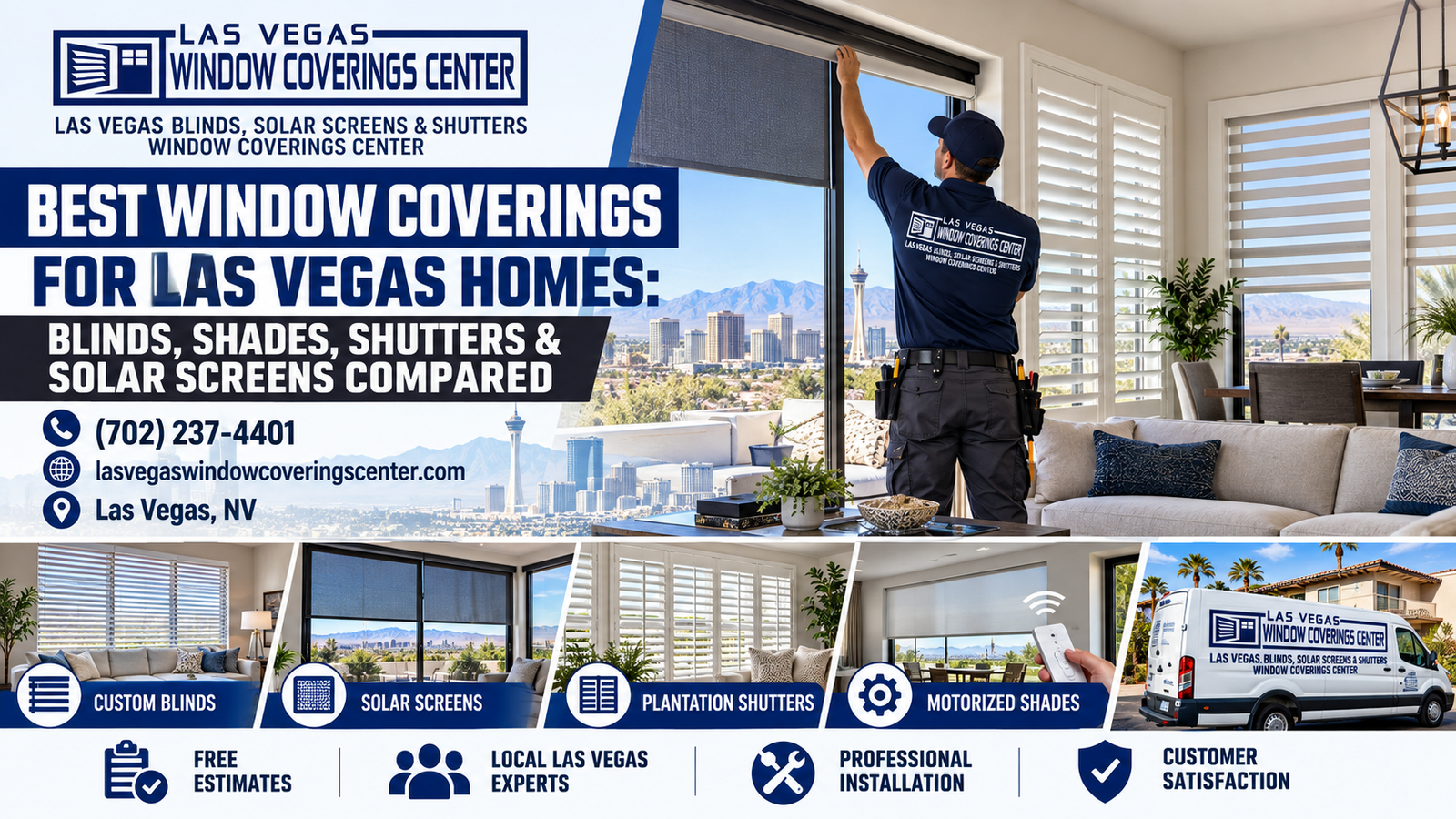
The best window coverings for Las Vegas homes are the ones that match each window’s job: stopping desert heat, cutting glare, protecting privacy, darkening bedrooms, and looking consistent from the street. Exterior solar screens often lead on the hottest elevations because they block sun before it hits the glass, while blinds, shades, and plantation shutters handle interior light, privacy, and finish. This comparison walks through a four-family matrix, room and elevation decisions, layering strategies, cordless safety, motorization for tall glass, and HOA factors for exterior products—so you can choose with intent instead of guessing from a national product list written for milder climates.
There is no single best product for every Las Vegas window. The right choice depends on what that opening needs most: stopping heat before it hits the glass, cutting glare while keeping a view, darkening a bedroom, matching HOA curb appeal, or surviving dust and daily use. In the Valley, the strongest heat-control answer is often an exterior solar screen on west- and south-facing glass, paired with interior blinds, shades, or shutters chosen for privacy, light control, and look.
This page is a decision comparison across four product families—blinds, shades, plantation shutters, and solar screens—so you can match each room and elevation to the right type. For the full product encyclopedia, start with our Las Vegas window coverings guide.
Local context: The National Weather Service Las Vegas office describes abundant sunshine, triple-digit summers, an urban heat island near downtown and the Strip, and strong winds with blowing dust that are most common in spring and fall. Those conditions reshape which coverings perform well and which wear out fastest.
Want energy performance numbers for a specific product? Look for an Attachments Energy Rating Council (AERC) label and compare Warm Climate Ratings; the Efficient Window Coverings tool helps pick attachment types by orientation and goal.
Most national “best blinds” lists ignore desert heat, west-facing afternoon sun, and fine dust. In the Las Vegas Valley, start with the problem at each window, then pick the product family that solves it.
Heat, glare on screens, privacy from neighbors, blackout for sleep, UV fading of floors, street-facing curb look, or hard-to-reach tall glass. One window can have two priorities.
West and south openings take the hardest sun. East rooms get morning glare. North rooms are milder but still need privacy and dust-friendly materials.
Exterior solar screens block heat before it reaches the glass. Interior products manage light, privacy, and finish. Many Valley homes use both on the hottest walls.
Cordless for kids and pets, motorization for tall or wide glass, manual for simple everyday windows. Safety and use matter as much as fabric.
The PNNL Building America Solution Center explains why goals differ by window: summer heat gain, glare, privacy, views, and winter heat loss are separate jobs. In a hot climate, Warm Climate performance and operable shading on east and west glass matter most.
Use this matrix as a starting point. Within each family there are big differences (solar versus blackout shades, faux wood versus aluminum blinds, mesh openness on screens), so treat the cells as typical strengths, not absolute rankings.
| Factor | Blinds | Shades | Plantation shutters | Exterior solar screens |
|---|---|---|---|---|
| Heat control | Good when closed; heat still enters the glass first | Very good with solar or cellular fabrics | Excellent insulation when louvers are closed | Excellent: blocks sun before it hits the glass |
| Glare control | Excellent (tilt slats) | Excellent (openness and fabric choice) | Excellent (adjustable louvers) | Very good while keeping outdoor view |
| Privacy | Strong when closed; night privacy depends on light inside | From sheer/solar to full blackout | Strong when closed; classic “daytime tilt” look | Daytime privacy; less nighttime privacy alone |
| Light control | Precise tilt; raise for full view | Wide range: sheer to blackout | Precise louver tilt; panels fold open | Filters daylight; does not black out a room |
| Insulation | Moderate | Cellular shades lead among soft treatments | Strong sealed-frame effect | Reduces solar gain; not a winter insulating panel |
| Outdoor view | Open for full view; closed blocks it | Solar/sheer preserve view; blackout does not | Partial through open louvers | Designed to keep view while shading |
| Maintenance / dust | Horizontal slats collect dust; wipeable surfaces help | Fewer ledges; fabric needs gentle care | Louvers need dusting; durable finishes | Exterior mesh collects dust; hose or brush care |
| HOA exterior look | Interior only (unless exterior blinds) | Interior only (unless exterior roller shades) | Interior; strong curb consistency when matched | Exterior product—color and style often need HOA approval |
| Kids / pets (cordless) | Choose cordless or motorized | Choose cordless or motorized | No lift cords; louvers are the control | No interior cords; interior product still needed for night privacy |
| Best overall for… | Everyday rooms, budget-conscious upgrades, rentals | Modern glass, glare + view, blackout bedrooms | Street-facing rooms, long-term built-in look | West/south heat walls and sun-baked living areas |
For deeper one-to-one comparisons, see shutters vs. blinds, exterior screens vs. interior solar shades, and cellular vs. solar shades.
Custom blinds remain a practical choice for many Las Vegas rooms because tilting slats give fine glare control and raising them opens a full view. Faux wood is popular in bathrooms and humid spots; real wood suits dry rooms with a traditional look; vertical blinds still appear on wide sliding doors, though many homeowners now prefer roller or sliding-panel shades there.
Compare materials in our faux wood vs. real wood blinds guide, and see cordless blinds when kids or pets are in the picture.
Custom shades cover the widest performance range of any interior family. Solar roller shades cut glare and UV while preserving the Strip, mountain, or backyard view. Cellular (honeycomb) shades add insulating air pockets. Blackout roller or cellular fabrics darken bedrooms. Sheer, zebra, Roman, and woven wood options cover style needs that hard blinds cannot.
Openness factor and fabric color change both heat and privacy. Our guides to solar shade openness, light vs. dark solar fabric, and blackout vs. room-darkening explain those tradeoffs.
Plantation shutters mount into the window opening and read as part of the architecture. Closed louvers create a solid barrier against light and a useful insulating air space next to the glass. Open louvers give a classic, adjustable daylight pattern that many street-facing Las Vegas homes prefer for curb consistency.
Exterior solar screens sit outside the window and intercept sunlight before it becomes heat inside the room. That is a different physics problem from closing an interior blind after the sun has already entered the glass. For many west-facing Las Vegas walls, screens are the highest-leverage heat move, especially when paired with interior coverings for night privacy.
Also compare exterior solar shades when you want a retractable exterior option instead of fixed screens.
Desert sun is the main reason “best window coverings Las Vegas” is a different question than in milder climates. Building America guidance notes that exterior attachments typically reduce solar heat gain more effectively because they block sunlight before it passes through the glass, while interior attachments remain excellent for privacy, daylight tuning, and winter insulation.
| Goal | Stronger starting choice | Why |
|---|---|---|
| Cut afternoon room temperature on west glass | Exterior solar screens (often + interior shade) | Stops heat outside; interior product handles privacy after dark |
| Kill TV or monitor glare | Solar shades or tiltable blinds/shutters | Precise light steering without necessarily blacking out the room |
| Dark bedroom for shift sleep | Blackout shades or shutters | Screens alone will not create darkness |
| Reduce cooling load across the home | Operable high-performance attachments, used consistently | DOE field studies cited by PNNL report roughly 15%–25% whole-home summer cooling savings from optimized use of high-efficiency window attachments—results vary; not a promise for any one house |
| Compare specific products | AERC Warm Climate Rating | Independent energy ratings; see how to read the residential label |
If heat is your top problem, start with the hottest elevation, not with a whole-house style decision. You can always unify colors later.
| Room | Common Las Vegas need | Often-strong options |
|---|---|---|
| West living / great room | Heat + glare + view | Exterior solar screens + interior solar or roller shades; shutters if you prefer a hard treatment |
| Primary bedroom | Privacy + darkness | Blackout shades, shutters, or layered solar + blackout |
| Kids’ rooms / nursery | Safety + blackout | Cordless or motorized shades/blinds; shutters |
| Home office | Screen glare | Solar shades or blinds with precise tilt |
| Front rooms (street) | Curb consistency + privacy | Matching shutters or faux wood blinds |
| Sliding glass / patio | Wide opening control | Vertical blinds, sliding panels, wide roller shades, often motorized |
| Bathrooms | Moisture + privacy | Faux wood blinds, moisture-tolerant shades, shutters |
| Kitchen | Easy clean + daylight | Faux wood blinds, simple roller shades |
Large and tall openings need their own plan—see coverings for large windows. Arches and specialty shapes are covered in our specialty shapes guide.
Hardest afternoon load. Prioritize exterior screens or high-performance solar fabrics; add blackout only where sleep matters.
Long daily sun exposure. Screens and solar shades perform well; shutters help when you want a sealed look.
Morning glare into bedrooms and kitchens. Light-filtering or solar shades, or tiltable blinds, often beat heavy blackout unless you sleep late.
Milder heat. Privacy, style, and insulation can lead; still choose dust-friendly, UV-stable materials.
Skylights, clerestories, and two-story glass usually favor motorized shades because manual reach is impractical. High-rise glass has building rules of its own—see automated roller shades for high-rises.
Layering is common in Las Vegas because one product rarely solves heat, night privacy, and style at once.
Layering costs more than a single product per opening, so apply it where the problem is severe rather than on every window.
Performance is not the only decision. The U.S. Consumer Product Safety Commission states that cordless window coverings are the only option that eliminates the cord strangulation hazard, and advises replacing blinds sold before November 2000, which often have inner cords a child can pull into a loop. The Window Covering Safety Council offers education and retrofit resources, and the Window Covering Manufacturers Association publishes ANSI/WCMA A100.1-2022, which took effect June 1, 2024 for products manufactured on or after that date.
For nurseries, kids’ rooms, and any window near climbable furniture, prioritize cordless or motorized interior products. Shutters avoid lift cords by design. Exterior screens do not create interior cord hazards, but they do not replace a safe interior covering for privacy.
More detail: window covering safety in Las Vegas.
Motorized shades and blinds turn “best covering” into “covering you will actually use.” On tall great-room glass or a wall of west windows, a covering that stays open because it is a hassle to operate wastes whatever heat performance it has on paper.
See motorized shades for options. Building America guidance also recommends pre-wiring during construction for future automation.
Interior products are usually your choice. Exterior solar screens and some exterior shades often need HOA color approval, and street-facing interiors still affect curb photos. Matching neutrals across the front elevation usually looks better than mixing random stock blinds.
Before you order exterior products, read our HOA-friendly window coverings study and confirm your community’s rules.
If you are also timing a replacement around summer heat, see when to replace blinds, shades, or shutters. For how long custom work takes, see the installation timeline. Bring photos to the showroom at 3871 S Valley View Blvd #6—get directions to Las Vegas Window Coverings Center on Google Maps.
Bring photos of your west walls, bedroom windows, and patio glass, or book a consultation to map products to problems. Call (702) 237-4401, visit the showroom at 3871 S Valley View Blvd #6, or get directions to the showroom. You can also use the contact page.
Las Vegas Blinds, Solar Screens & Shutters Window Coverings Center is a window treatment store at 3871 S Valley View Blvd #6, Las Vegas, NV 89103, offering custom measuring and professional installation of blinds, shades, plantation shutters, exterior solar screens, and motorized and smart-home window coverings. The team serves Las Vegas, Summerlin, Henderson, North Las Vegas, Spring Valley, Enterprise, Southern Highlands, Mountain’s Edge, Green Valley, Anthem, Paradise, Centennial Hills, Skye Canyon, Inspirada, Lake Las Vegas, and other Las Vegas Valley communities. Call (702) 237-4401 or open the Google Maps listing.
For the strongest heat control, start with exterior solar screens on west- and south-facing glass, because they block sun before it reaches the window. Pair them with interior solar shades, cellular shades, or shutters for privacy and light control. The PNNL Building America Solution Center explains why exterior attachments often outperform interior ones for solar heat gain.
They solve different jobs. Shutters offer a built-in look and strong closed-louver control; blinds are often more budget-flexible and familiar to operate. Compare them in our shutters vs. blinds guide and choose by room goals, not a single winner.
Often yes on the hottest elevations. Blinds manage light after sun enters the glass; screens reduce the heat load before it enters. Many homes keep interior blinds or shades for night privacy and add screens on west walls.
Exterior solar screens plus an interior solar or roller shade is a common high-performance pair. Shutters also work when you want a hard treatment. See screens vs. solar shades for the tradeoffs.
Prioritize privacy and darkness: blackout or room-darkening shades, or shutters. Use cordless or motorized controls if children are present. Compare blackout vs. room-darkening fabrics.
Wide openings often use vertical blinds, sliding panels, or wide roller shades, frequently motorized so they get used. Our large windows guide covers tall and wide glass.
The CPSC says cordless window coverings are the only option that eliminates the cord strangulation hazard. ANSI/WCMA A100.1-2022 took effect June 1, 2024 for newly manufactured products. Replace older corded blinds in homes with young children without waiting.
Yes. Many Las Vegas homes use screens on hot exteriors, shutters on street-facing rooms, blackout shades in bedrooms, and solar shades on view glass. Keep street-facing colors consistent.
Use the AERC Warm Climate Rating on rated products and the Efficient Window Coverings tool to compare attachment types. Ratings help you compare models; they are not a utility-bill guarantee.
List each room’s top problem (heat, glare, privacy, blackout), note west and south elevations first, then book a measure. Call (702) 237-4401 or find the showroom on Google Maps.
The showroom is at 3871 S Valley View Blvd #6, Las Vegas, NV 89103, just west of the Strip. Open the listing on Google Maps for directions, hours, photos, and reviews, or call (702) 237-4401 before you visit.
Get products matched to each elevation and a measured quote. Call (702) 237-4401 or view the showroom on Google Maps.
Las Vegas Blinds, Solar Screens & Shutters Window Coverings Center · 3871 S Valley View Blvd #6, Las Vegas, NV 89103 · (702) 237-4401 · lasvegaswindowcoveringscenter.com