
Arched, half-circle, eyebrow, angle-top, trapezoid, triangle, round and other specialty-shaped windows add architectural character, but ordinary rectangular blinds and shades do not always fit them correctly. The right treatment depends on the exact shape, whether the window opens, how much privacy and light control you need, and whether preserving the original architecture is more important than making every portion fully operable.
Short answer: custom shutters are often one of the most versatile window treatments for arched and specialty-shaped windows because they can be fabricated to follow curves, angles and unusual geometry while providing adjustable louvers for privacy and daylight control.
Specialty cellular or pleated shades are another strong option for arches, half-circle windows and selected geometric shapes. However, some specialty-shape shade configurations are stationary rather than fully operable, so function should be confirmed before ordering.
For combination windows, such as an arch above a rectangular lower window, the best answer may be two coordinated treatments: a fixed or specialty-shaped upper covering and a fully operable shade, blind or shutter below. Drapery mounted above the entire architectural opening is another practical option when complete privacy is more important than matching every curve.
For Las Vegas homes, also consider the direction of the window, intense afternoon sunlight, high-window access, privacy requirements and whether the specialty shape itself is an architectural feature you want to keep visible.
A rectangular window gives a manufacturer four straight sides to work with. Arched and specialty-shaped windows introduce curves, changing angles, asymmetrical sides and unusual transitions between frame sections.
That geometry affects far more than appearance. It determines whether a covering can raise, lower, rotate, fold, stack or remain stationary.
Hunter Douglas describes angled, arched and other specialty shapes as windows that can still benefit from privacy and natural-light control, while its arched-window guidance identifies cellular shades, shutters and drapery among the solutions available for arches.
Graber likewise identifies cellular shades, pleated shades and shutters as common approaches for curved arched windows.
That does not mean every product can fit every arch or triangle. Specialty-shape capability is product-specific.
“Arched window” can describe several very different openings. A perfect half-circle above a rectangular window is not the same as an elongated Palladian-style arch. An eyebrow curve is not the same as a Gothic point. A trapezoid with one angled side behaves differently from a triangle.
The first task is therefore to identify the geometry accurately.
Some homeowners simply want to reduce afternoon light through a decorative arch that never opens. Others need the lower portion of a window to open for ventilation. A bedroom may need stronger privacy, while a foyer arch may be treated primarily for glare.
The best specialty-window treatment is the one that addresses both the geometry and the actual reason the window needs to be covered.
Las Vegas homeowners can compare specialty-window options through Las Vegas Blinds, Solar Screens & Shutters Window Coverings Center before deciding whether the opening is better suited to shutters, cellular shades, pleated shades, drapery or a coordinated combination.
Many non-rectangular windows can be treated, but the available options depend on their exact geometry and the manufacturer's specialty-shape capabilities.
A symmetrical semicircle commonly positioned above a rectangular window, door or grouped window assembly.
A shallow curved top that requires a different template from a full half-circle.
A taller arched top in which the curved portion extends beyond a perfect half-circle proportion.
A specialty opening with curved sides that rise toward a pointed center rather than a rounded semicircle.
A four-sided opening where one or more sides are angled rather than square to the floor.
Often used below rooflines, on high walls or as part of a larger architectural window group.
A mostly rectangular opening whose top edge follows a roofline or other architectural angle.
Decorative circular and oval windows require a covering capable of following curved perimeter geometry.
One of the most practical specialty-window situations because the upper and lower portions can often be treated independently.
Hunter Douglas also documents specialty treatments for trapezoidal, hexagonal and octagonal windows, reinforcing why the phrase “specialty shape” covers much more than arches.
Exact product availability should always be verified for the specific dimensions and geometry being measured.
This comparison focuses on how each treatment deals with unusual geometry rather than assuming a standard rectangular installation.
| Treatment | Strong Applications | Operability | Privacy / Light Control | Architectural Shape | Main Tradeoff |
|---|---|---|---|---|---|
| Custom Shutters | Arches, circles, ovals, triangles, angles and many custom geometric openings. | Louvers may remain adjustable; panel operation depends on design. | Strong adjustable control through louver position. | Can closely follow the perimeter of many specialty shapes. | Frames and louvers remain visually present as part of the architecture. |
| Specialty Cellular Shades | Arches, half-circles and selected angled or specialty shapes. | Some specialty versions are fixed; others offer limited or specialized operation. | Fabric selection can provide different light-control levels. | Fan-style and custom-shaped designs can highlight curved geometry. | Not every shape or size can be fully operable. |
| Pleated Shades | Arches and selected custom shapes. | May be stationary depending on shape and product. | Fabric provides varying levels of daylight control. | Can complement the curve without adding a heavy frame. | Less adjustable than operable louvers when fixed. |
| Full-Height Drapery | Tall arches, arch-over-rectangle windows and difficult irregular openings. | Fully operable across the entire opening when track or rod layout allows. | Can range from sheer to room-darkening depending on fabric and lining. | Covers the opening rather than following every curve. | The distinctive window shape is hidden when the drapery is closed. |
| Rectangular Shade Below Arch | Combination windows where only the lower section requires routine control. | Lower shade can remain fully operable. | Strong privacy in the lower sightline while leaving the arch exposed. | Preserves the decorative upper arch. | Upper portion remains uncovered unless a second treatment is added. |
| Two-Part Coordinated System | Arch over rectangle, angle above standard window or multi-part assemblies. | Lower section can operate independently from specialty upper section. | Allows different privacy and daylight control by zone. | Can respect existing window divisions. | More components and additional custom measuring are required. |
| Specialty Sheer / Shading | Selected arches, angles and other shapes when supported by the product system. | Shape-dependent. | Useful where filtered light and softer privacy are desired. | Provides a softer appearance than shutters. | Availability varies substantially by exact specialty shape. |
Custom shutters are one of the strongest products to compare when the homeowner wants the window treatment to follow the architecture rather than hide it.
Unlike a standard rectangular roller shade that would have to stop below an arch or cover the entire opening from above, custom shutter frames can be manufactured around curved or angled geometry.
Norman's current arched-shutter guidance describes custom shutters that can follow arches, ovals, circles, triangles and other specialty shapes. Hunter Douglas also lists shutters as an option for specialty-shaped openings, including arches.
The biggest design advantage is that the perimeter of the treatment can echo the perimeter of the glass.
A semicircular window can remain visually semicircular. A triangle can remain a triangle. An angled roofline does not necessarily need to be disguised behind a rectangular curtain.
Another important advantage is that louvered specialty shutters can provide adjustable daylight and privacy even when the surrounding frame is fixed.
This matters on a sun-exposed arch. The homeowner may not need the entire covering to retract if rotating the louvers provides enough control.
In an arched shutter, louver design can influence whether the treatment follows a sunburst appearance or maintains stronger horizontal visual lines.
The appropriate configuration depends on the window geometry, manufacturer capability and desired appearance.
This is both the advantage and the tradeoff.
Shutters do not disappear when open. Their frame, stiles, rails and louvers remain visible, which can enhance a traditional or structured interior but may not suit a homeowner who wants an uninterrupted view through the specialty glass.

Custom shutters can follow curved architectural openings while providing adjustable louvers for privacy and daylight control.
Yes. Specialty cellular shades are one of the best fabric-based products to compare for arched windows, especially when the homeowner wants a lighter visual treatment than shutters.
Both Hunter Douglas and Graber identify cellular shades as a solution for arched windows.
A common approach to a half-circle or lunette-style arch is to arrange cellular material in a fan pattern that radiates outward from the base of the curved section.
This uses the geometry of the fabric to complement the architecture instead of forcing a rectangular shade into a curved opening.
This is one of the most important details to understand before ordering. A specialty shade may fit the arch beautifully but remain fixed in position.
If the homeowner expects to expose the glass completely each morning, a fixed treatment could become disappointing even though the fit is technically correct.
Hunter Douglas specifically notes that many cellular options for arches are stationary, while adjustable options can also exist depending on the selected product.
Graber identifies pleated shades alongside cellular shades for arched windows. Pleated materials can introduce additional color or texture while following a specialty shape.
As with cellular shades, confirm whether the exact proposed treatment is fixed or operable.
Yes. Drapery is often one of the simplest ways to make a difficult specialty window fully coverable because the fabric does not have to reproduce every curve or angle in the glass.
Hunter Douglas specifically identifies drapery as a practical treatment for arched windows, particularly in rooms with tall ceilings.
Instead of following the arch, the rod or track can be installed above the complete window. When closed, the drapery covers the entire opening. When open, it stacks to the sides.
This can be useful when strong privacy is more important than displaying the curve at all times.
Specialty windows often occur in foyers, formal living rooms and double-height spaces. Full-length drapery can visually connect the tall architectural opening to the floor and create a deliberate finished look.
If the goal is to reveal the complete arch when the fabric is open, sufficient wall space should exist beside the window for the drapery stack.
If the fabric must remain over part of the glass, some of the specialty shape or view may remain hidden.

Full-height drapery can cover an entire tall or unusual opening without requiring the fabric itself to match every curve.
Treating the upper and lower sections independently is often one of the most practical solutions.
A half-circle or eyebrow arch may sit above a standard rectangular window. The lower portion typically handles most of the direct sightline into the room, while the arch contributes architectural daylight higher on the wall.
If glare and privacy are not serious problems at the upper window, leaving the arch exposed preserves its architectural character.
The rectangular lower portion can then use a conventional shade, blind or shutter that remains fully operable.
This approach provides more complete coverage while accepting that the upper arch may not need to open every day.
A fan-shaped cellular shade or specialty shutter can occupy the curved section, while a matching or complementary lower treatment provides daily operation.
If the window geometry and selected shutter system allow it, custom shutters can visually coordinate the arch and the rectangular lower portion.
When full privacy or room darkening is more important than keeping the arch visible, drapery can cover the complete opening.
It depends on how often the light, view or ventilation needs to change.
Specialty windows frequently involve a tradeoff between matching the exact shape and providing conventional movement.
A specialty shutter may be physically fixed around the perimeter yet still provide significant adjustment through movable louvers.
That can be sufficient for many arches where the main objective is controlling light rather than completely removing the treatment from the glass.
For adjustable privacy and daylight control, custom louvered shutters are one of the strongest specialty-shape options because the louvers can change position without requiring the frame itself to move.
Cellular and pleated specialty shades provide coverage through fabric opacity rather than adjustable louvers. Drapery provides broader open-or-closed control over the entire opening.
Decorative arches on the front elevation can become visible from the street after dark. If the opening is low enough to create a direct sightline into the room, privacy deserves more attention than it might on a high clerestory window.
A high arch may not create a major direct privacy problem, yet it can allow bright sunlight into the room during specific hours.
In this case, glare or solar exposure may be more important than nighttime privacy.
If the specialty window is in a bedroom where darkness matters, remember that unusual geometry can create perimeter gaps.
A fabric described as room-darkening or blackout does not automatically remove every sliver of light around an arch, angle or custom frame.
If stronger darkness is essential, discuss how the complete opening will be covered rather than focusing only on the opacity of the material.
Specialty windows are often installed specifically to bring additional daylight into a dramatic architectural space. In Southern Nevada, that same feature can create a concentrated glare problem when the opening faces strong afternoon sun.
A high arch on a west or southwest elevation can allow low-angle afternoon sunlight into a foyer or living room even when the rectangular windows below are already covered.
Leaving the upper arch untreated may therefore undermine the glare control provided by the lower shades.
Before ordering, observe where the light enters during the most uncomfortable time of day.
If the sun enters primarily through the curved upper section, covering only the lower rectangle will not solve the problem.
The goal does not always need to be complete light elimination. A light-filtering cellular arch, partially adjusted shutter or other specialty covering may soften sunlight while preserving the reason the specialty window was designed into the room.
For larger specialty assemblies that combine unusual shapes with broad areas of glass, the related guide to window coverings for large Las Vegas windows explains additional factors such as treatment weight, multiple shades and motorized operation.
Sometimes, but motorization depends heavily on the product and shape. It should never be assumed simply because motorized rectangular shades are available.
An arched cellular treatment may be stationary while the conventional rectangular shade below is motorized.
This can be an efficient solution because the part of the assembly that needs regular movement receives motorization while the decorative upper section remains covered.
Specialty windows are frequently installed high on walls, above staircases or in double-height rooms. If an operable compatible shade is available, motorization can make routine control more practical.
Motorized capability, motor size, power method, remote control, scheduling and smart-home compatibility depend on the specific product.
Those features should be verified from current manufacturer documentation for the exact treatment being ordered.
Hardwired electrical work should be performed according to applicable installation and electrical requirements.
Specialty-window measurement is more demanding than measuring a rectangular opening because the installer must document the geometry, not merely the overall width and height.
Two arches can share the same maximum width and height yet have different curvature. A triangle can share the same overall dimensions as an angle-top window while requiring completely different fabrication.
The widest and tallest points establish the overall envelope of the opening, but those measurements alone are rarely enough for a true specialty treatment.
On many arched windows, it is important to identify where the straight vertical sides transition into the curved upper section.
That point affects the proportions of the specialty shape and can help distinguish a true half-circle from another arch geometry.
The height of the curved section from its base to its highest point is another important dimension.
Trapezoids, triangles and angle-top windows require accurate dimensions for the sloping sides and relevant corners.
Inside-mounted shutters or shades require sufficient usable depth for the selected frame, brackets or headrail.
Complex or imperfect shapes may require a physical or digital template according to the manufacturer's fabrication process.
This is important because existing homes are not always perfectly symmetrical. What appears to be a perfect arch from across the room may vary slightly from one side to the other.
Handles, locks, cranks, hinges and opening mechanisms can interfere with specialty shutters or shades if they are not accounted for.
An inside treatment may follow the glass opening closely. An outside mount may cover trim or extend beyond the specialty frame.
Those two approaches produce very different visual results.
Mounting changes both fit and architecture.
An inside-mounted specialty treatment sits within the window opening. This can keep trim visible and create a more integrated appearance when sufficient depth exists.
The opening needs a suitable surface for the selected mounting system, and irregularities in the frame can become more important because the treatment must fit inside the available space.
An outside-mounted treatment attaches beyond the immediate window opening. This can provide more flexibility when depth is limited or when the objective is to cover the entire architectural opening.
Full-height drapery is the clearest example: the track can be mounted above the highest point rather than reproducing the curve itself.
The homeowner may prefer an inside mount aesthetically, but available depth, window hardware or product-specific requirements can make an outside mount more practical.
Specialty glazing is not limited to residential arches. Restaurants, hotels, offices, retail spaces and other commercial buildings can combine standard rectangular glass with angled, curved or elevated architectural windows.
Commercial projects introduce additional planning issues such as repeated appearance across multiple openings, glare on screens, difficult access, durable controls and the need to coordinate specialty glass with conventional window coverings in the same room.
An unusual upper window may require a fixed specialty treatment while the rectangular storefront or office glass below uses operable solar roller shades.
The products do not necessarily need identical mechanics to look coordinated. Fabric tone, frame color and alignment can help the full elevation read as one design.
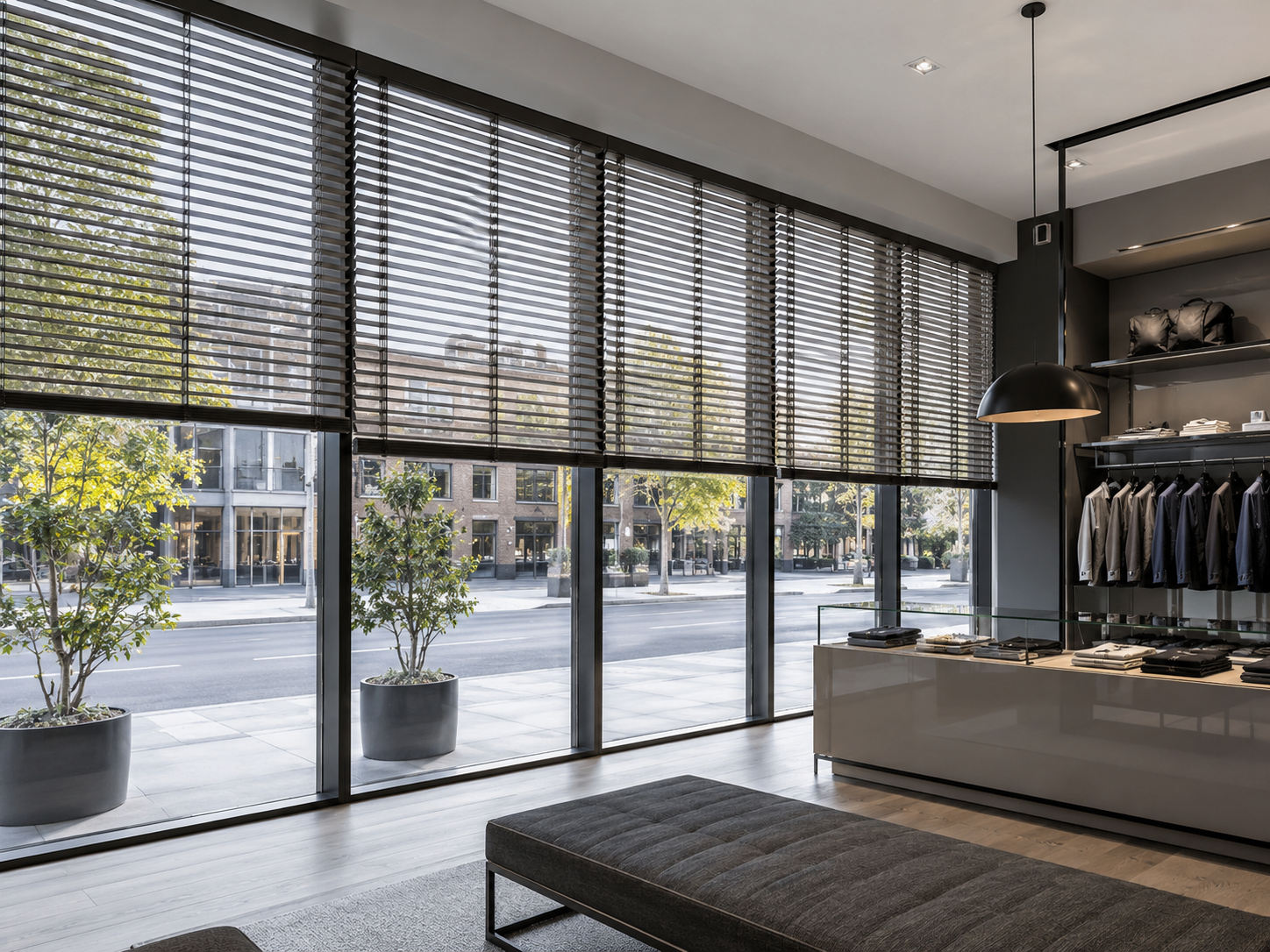
Commercial projects may combine standard glass with architectural specialty windows, making coordinated measurement and product selection important across the entire elevation.
Specialty-window cost is influenced by more than the square footage of the glass. Custom geometry, fabrication complexity and measurement can make a smaller specialty treatment more involved than a larger standard rectangular shade.
A simple symmetrical half-circle can be easier to document than an irregular arch in an older opening. A triangle with known dimensions can be more straightforward than a compound angle connected to several adjoining windows.
Two quotes may describe very different solutions. One may cover only the rectangular lower portion. Another may include a custom upper arch. A third may cover the entire opening with drapery.
The written estimate should make clear which parts of the specialty window are being covered, what remains operable and what materials or controls are included.
Strong choice when the treatment should follow the curve or angle rather than hide it.
Worth comparing for arches and selected specialty shapes when fabric is preferred over a framed shutter.
A fixed specialty upper treatment can be paired with a fully operable lower blind or shade.
Useful when privacy matters more than matching the precise curve or angle.
Can simplify operation where only part of a tall architectural window needs daily adjustment.
If glare and privacy are not problems, preserving the architectural glass may be preferable to adding an unnecessary treatment.
Specialty windows should not be quoted as though they were ordinary rectangles.
Specialty windows may use unusual control configurations, particularly when a fixed upper treatment is paired with an operable lower blind or shade.
The U.S. Consumer Product Safety Commission recommends cordless window coverings where young children are present because accessible window-covering cords can create a strangulation hazard.
Ask how the lower operable treatment is controlled and whether a suitable cordless, wand-operated or motorized configuration is available for the exact product being considered.
Arched and specialty-shaped windows are often architectural statement pieces. In the Las Vegas Valley, those windows also interact with intense desert sunlight, tall ceilings, large residential glass and views that homeowners may not want to sacrifice.
A homeowner may install conventional shades on the lower rectangular windows and still experience afternoon glare because direct sunlight is entering through an uncovered arch above them.
This is especially relevant on western exposures where low afternoon sun can reach deep into a room.
Homes in Summerlin, The Ridges, Red Rock Country Club, Queensridge and other west-valley communities can include tall foyers, angled rooflines and large window groups designed around mountain views.
The best treatment may need to reduce direct sun without unnecessarily hiding the architectural glass.
Properties in Seven Hills, Anthem and MacDonald Highlands may combine unusual window shapes with elevated valley views.
In view-focused rooms, a custom shutter or fixed specialty shade should be evaluated for how much of the view remains visible—not simply whether the treatment technically fits.
Double-height entries can feature arches, half-circles, triangles or angle-top windows several feet above normal reach.
If the specialty portion is only intended to soften light, a fixed treatment may be more practical than creating an operating mechanism that is rarely used.
Specialty windows often contribute to the exterior architecture of a home. The interior treatment may be visible from outside, especially after dark.
Color, symmetry and how the treatment fills the shape should therefore be evaluated from both sides when exterior appearance matters.
Interior window coverings generally create fewer exterior-change issues than products mounted outside the building, but visible appearance rules can vary by community.
Homeowners should confirm current community requirements before ordering exterior-facing changes or treatments that materially alter the visible exterior appearance.
A specialty shutter positioned high in a foyer can collect dust just like any other horizontal surface, while fabric treatments have their own manufacturer-specific cleaning instructions.
Maintenance should be considered before installing a treatment that will be difficult to reach after installation.
A decorative north-facing arch that does not create glare or privacy problems may be better left visible.
The purpose of a professional consultation should be to identify which windows actually need treatment and what problem each treatment is supposed to solve.
Las Vegas Blinds, Solar Screens & Shutters Window Coverings Center is a local Las Vegas window covering business where homeowners and property owners can compare different approaches for unusual window shapes instead of assuming every opening should use the same product.
A specialty-window consultation can consider the exact geometry, window depth, trim, hardware, privacy requirements, sun direction, whether the window opens, whether the treatment needs to move and how important it is to preserve the architectural outline.
Depending on the opening, relevant categories may include custom plantation shutters, specialty cellular or pleated shades, coordinated upper-and-lower treatments, drapery and motorized treatments for compatible rectangular or operable portions.
Custom measurement is particularly important because arches, triangles and angled windows cannot be accurately described by width and height alone.
Las Vegas Blinds, Solar Screens & Shutters Window Coverings Center serves customers throughout the Las Vegas Valley. These communities describe service coverage and do not imply a separate showroom or physical business location in each area.
Visit Las Vegas Blinds, Solar Screens & Shutters Window Coverings Center at 3871 S Valley View Blvd #6, Las Vegas, NV 89103 to discuss arched-window shutters, specialty shades, custom measurement and other treatments for unusual window shapes.
Custom shutters and specialty cellular shades are two of the strongest treatments to compare for arched windows in Las Vegas. Shutters can follow many curved shapes while providing adjustable louvers. Cellular or pleated arch shades create a softer fabric look, although some specialty configurations are stationary. Drapery mounted above the entire opening is another option when full privacy matters more than following the exact curve.
Yes, custom shutter manufacturers offer specialty configurations for arches and other unusual shapes. Depending on the system, shutters may be fabricated for half-circles, elongated arches, circles, ovals, triangles and angled windows. The exact dimensions and geometry must be measured accurately, and product capability should be confirmed for the specific opening before ordering.
Yes. Specialty cellular shades can cover many arched windows, including fan-style treatments for half-circle openings. The important question is whether the proposed shade is fixed or operable. Some specialty cellular designs remain permanently positioned in the arch, while others may provide additional adjustment depending on the specific product and dimensions.
Often the most practical solution is to treat the two sections separately. The half-circle can use a fixed specialty cellular shade or custom shutter while the rectangular lower window uses a fully operable blind, shade or shutter. If the upper arch does not create glare or privacy problems, it can also be left uncovered while the lower section receives the functional treatment.
Yes, selected custom shutters, shades and specialty treatment systems can be fabricated for trapezoids, triangles, angle-top windows and related geometric shapes. Product availability varies, so exact measurements and angles need to be evaluated before the treatment is selected. Some specialty configurations may be fixed rather than retractable because the geometry limits conventional up-and-down movement.
Cover the arch when it creates unwanted glare, direct sun, privacy problems or excessive brightness. Leaving it uncovered can be a good choice when the window is high, does not compromise privacy and its architectural shape is an important design feature. Observe the window during the time of day when sunlight is strongest before deciding that the upper arch does or does not need treatment.
Some compatible specialty-window systems or adjoining rectangular treatments may be motorized, but motorization is not available for every unusual shape. A common solution is a fixed specialty treatment in the arch with a motorized shade below. Motor, power and smart-home compatibility should be verified for the exact product rather than assumed from another shade in the same product family.
Contact Las Vegas Blinds, Solar Screens & Shutters Window Coverings Center at (702) 237-4401 or visit 3871 S Valley View Blvd #6, Las Vegas, NV 89103 to compare treatments for arches, half-circle windows, angles, trapezoids, triangles and other custom window shapes based on fit, privacy, light control and architectural appearance.
Specialty-shape capability varies by product and manufacturer. These current manufacturer and government resources support the major shape, fit, operability and safety principles discussed in this guide.
Hunter Douglas identifies arches, angles and other specialty-shaped windows as openings that can use custom window treatments for privacy and natural-light control.
Hunter Douglas discusses traditional, elongated, quarter-round, half-moon, half-circle, eyebrow and Gothic arches and identifies cellular shades, shutters, drapery and selected shadings as treatment approaches.
Graber identifies cellular shades, pleated shades and shutters as solutions for arched windows and explains that combination windows may use a fixed treatment in the specialty upper section with a fully functional treatment below.
Norman documents custom shutters designed around arches and other specialty geometries, including ovals, circles and triangles, and discusses inside- and outside-mount considerations.
Hunter Douglas documents specialty treatment options for trapezoidal and tapered-side windows, demonstrating why angled openings require product-specific custom solutions.
Hunter Douglas also documents custom treatments for geometric hexagonal and octagonal windows, including operable shutter solutions for selected shapes.
CPSC recommends cordless window coverings where young children are present because accessible window-covering cords can create a strangulation hazard.
An unusual window does not automatically need to be hidden behind a rectangular treatment. Custom shutters can follow many curved and angled shapes, specialty cellular and pleated shades can provide softer fabric solutions, and a coordinated upper-and-lower approach can preserve architecture while keeping the portion you use every day fully functional.
The right choice begins with the exact shape, dimensions, window operation, sun exposure, privacy requirements and desired appearance. Specialty windows should therefore be measured and planned before the product is ordered.
Call Las Vegas Blinds, Solar Screens & Shutters Window Coverings Center at (702) 237-4401 to compare window treatments for arched and specialty-shaped windows in Las Vegas and nearby areas.