
Large picture windows, floor-to-ceiling glass, wide patio openings and high windows can transform a Las Vegas home—but they also create challenges involving desert sun, glare, privacy, view preservation, operating weight and access. The best window covering depends on the dimensions of the opening, room use, exposure and whether you need solar shades, roller shades, cellular shades, vertical treatments, shutters, drapery or motorized operation.
Short answer: the best window coverings for large windows in Las Vegas are usually solar or roller shades for broad picture windows, panel-track or vertical treatments for very wide glass and sliding openings, cellular shades when insulation and comfort are priorities, and custom shutters when an architectural framed appearance is preferred. Motorization is especially useful for tall, heavy or hard-to-reach treatments.
For large windows with desert sun and a valuable view: solar shades are often one of the first products worth comparing. They can reduce glare while preserving some outward visibility, depending on fabric openness and color.
For exceptionally wide openings: do not assume one enormous shade is automatically better. Product width limits, roller-tube strength, fabric behavior, control weight and structural mounting conditions can make two or more coordinated shades a more practical solution. Aligning shade divisions with window mullions can reduce the visual effect of those divisions.
The best choice depends on six things: window width and height, exposure to direct sun, desired privacy, importance of the view, operating method and the manufacturer's size limitations for the exact product.
Large windows are one of the strongest architectural features in many Las Vegas Valley homes. They bring daylight into open living spaces, frame mountain or city views and connect indoor rooms with pools, patios and desert landscapes.
But a treatment that works perfectly on a standard bedroom window cannot automatically be scaled up to a wall of glass.
As width and height increase, the window covering becomes heavier, the operating hardware carries more load, fabric has farther to span, roller tubes may need greater rigidity and mounting brackets require suitable structural support.
There is also more glass receiving sunlight. A large west-facing opening can introduce substantial afternoon glare, while a broad street-facing window can create a significant privacy issue after dark.
Hunter Douglas specifically identifies large windows as openings where light, privacy and motorized operation deserve additional consideration, while Graber's wide-window and door guidance identifies roller and solar shades, sliding panels, vertical blinds, cellular treatments and shutters among the product categories designed for larger openings.
There is no single width at which every window suddenly becomes a “large window.” A dimension that is routine for one shade system may exceed the limits of another.
Maximum size depends on the exact manufacturer, product line, fabric, operating system, mounting method and sometimes the relationship between width and height.
That is why professional measurement should happen before the final product decision rather than after a fabric has already been chosen.
Homeowners can compare suitable large-window options through Las Vegas Blinds, Solar Screens & Shutters Window Coverings Center .
The best product depends on the job the window covering needs to perform. This comparison focuses on the practical differences that matter most for large Las Vegas windows.
| Window Covering | Best For | View | Glare / Light Control | Large-Window Advantage | Main Tradeoff |
|---|---|---|---|---|---|
| Solar Shades | Large view windows, west-facing glass, offices and high-rise windows. | Can preserve outward view depending on fabric openness and color. | Strong glare-management potential with correctly selected fabric. | Clean flat appearance across broad glass. | Open fabrics do not automatically provide strong nighttime privacy. |
| Roller Shades | Large picture windows where simple operation and broad fabric choices matter. | Depends on fabric opacity. | Available from light-filtering through more opaque options. | Compact roll and visually simple design. | Very wide shades can require larger hardware or division into multiple shades. |
| Cellular Shades | Large windows where insulation, privacy and comfort are important. | View is normally blocked when the shade covers the glass. | Available in different light-control levels. | Honeycomb construction adds an insulating air layer. | Maximum widths vary; extremely large openings may need multiple units. |
| Panel Track Shades | Very wide windows, patio doors and broad glass openings. | Depends on fabric and how far panels are stacked. | Controlled through fabric selection and panel position. | Designed to move horizontally across broad openings. | Wide panels require stack-back space. |
| Vertical Blinds / Vertical Sheers | Tall windows, wide glass and sliding doors. | Adjustable through vane rotation. | Strong directional control from rotating vanes. | Horizontal traverse matches wide-opening geometry. | Visual style is more segmented than a flat shade. |
| Plantation Shutters | Architectural windows where privacy, louver control and a built-in appearance matter. | Adjustable through louvers and panel configuration. | Strong adjustable light control. | Can divide large openings into structured sections. | Panels and frames remain visually present even when open. |
| Custom Drapery | Large feature windows where decorative scale and side stacking are desired. | Full view when fabric stacks sufficiently beyond the glass. | Depends on fabric and lining. | Can span broad openings without one giant roller mechanism. | Requires wall or side space for the fabric stack. |
| Motorized Shades | Tall, heavy, numerous or hard-to-reach large windows. | Depends on the underlying shade type. | Makes frequent adjustment easier. | Convenient operation without manually handling a large treatment. | Motor, power and shade-size compatibility must be confirmed. |
Yes. Solar and roller shades are among the first products worth comparing for large picture windows because their flat construction can cover broad expanses of glass without introducing many visual components.
Graber specifically includes solar and roller shades among its solutions for wide windows and doors, while Hunter Douglas offers roller and screen-shade systems designed for broad residential glass.
Large windows often exist because the homeowner wants daylight and a view. A completely opaque treatment can solve glare but also eliminate the architectural benefit of having the window.
Solar shades use screen-style fabric that can reduce harsh visual brightness while retaining different degrees of view-through. Openness factor determines how tightly the material is woven.
Lower-openness fabrics typically provide stronger glare control but restrict more of the view. More open fabrics preserve a clearer outdoor connection while allowing more daylight through.
A dark solar fabric can improve perceived view-through and glare control, while lighter or reflective fabrics may be preferred where solar reflectance is a stronger priority.
Large glass makes this difference more visible because the fabric may cover dozens of square feet rather than a small bedroom window.
For more detail, see the guide to light vs dark solar shade fabric for Las Vegas sun .
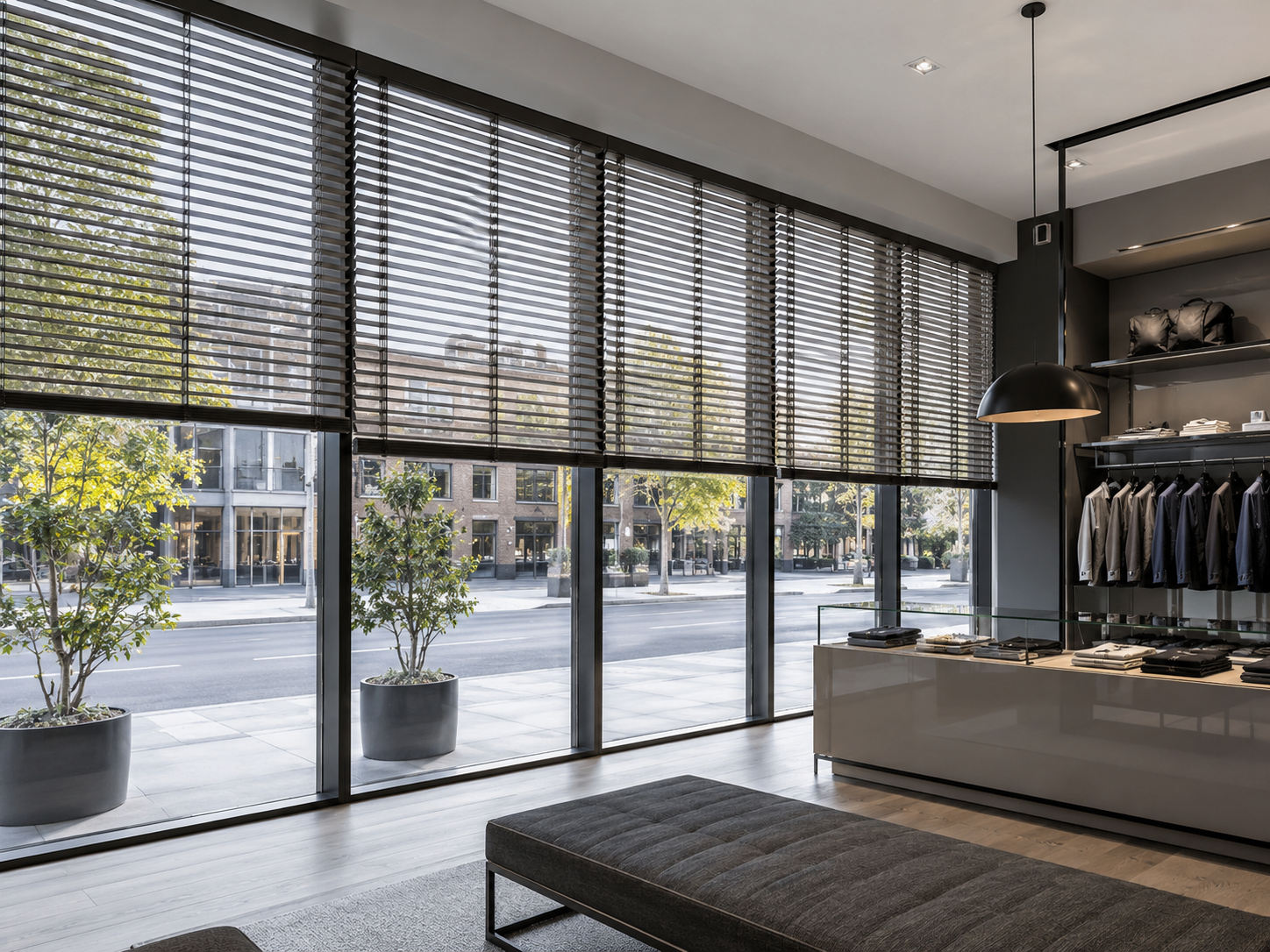
Large areas of glass often benefit from a treatment that manages daylight and glare without unnecessarily eliminating the view.
Every roller system has size limits. As a shade becomes wider, fabric weight increases and the roller tube has farther to span between its supports.
The appropriate tube, brackets, motor or manual operating system must be selected according to manufacturer specifications.
Very wide windows may therefore work better with multiple shades positioned side by side rather than forcing one roller across the entire opening.
Cellular shades are particularly useful when the large window creates a comfort or insulation concern in addition to privacy and light-control needs.
Their pleated honeycomb construction creates pockets of trapped air. The U.S. Department of Energy's cellular shade guidance describes how well-fitted cellular shades can add an insulating layer at the window.
The larger the window area, the more significant the glass becomes within the room's interior surface. A large sun-exposed or poorly insulated window can therefore have a noticeable effect on comfort around the seating area.
Cellular shades are worth comparing when homeowners want stronger privacy and insulation rather than preserving a view through the lowered treatment.
Do not assume an unlimited-size honeycomb shade can be manufactured. Maximum width and height vary with fabric, cell construction, operating system and manufacturer.
A broad wall of windows may be better treated with multiple cellular shades aligned to the window divisions.
Vertical cellular systems are available from some manufacturers for wide windows and patio doors. Instead of lifting upward, these treatments traverse laterally.
That horizontal operation may be more practical when the opening also functions as a doorway.
Very wide windows and glass doors often benefit from treatments that move sideways rather than lifting an entire covering vertically.
Panel track shades, vertical blinds and vertical sheer treatments are specifically designed around broad horizontal spans.
Panel-track systems use several wide fabric panels suspended from a multi-channel headrail. The panels overlap when closed and stack laterally as the treatment opens.
Graber describes its sliding panels as treatments for wide windows and patio doors.
They are especially useful when a large contemporary opening would look visually busy with dozens of small slats or individual components.
Vertical blinds use narrow vanes that both rotate and move horizontally. Rotation provides directional light control while the lateral traverse allows the treatment to clear a broad opening.
They remain a practical option for large glass when adjustable privacy and straightforward operation matter more than having a single flat fabric surface.
Vertical sheer products combine softer fabric with vertical light-control elements. Hunter Douglas specifically identifies several vertical treatment styles for large windows and wide expanses of glass.
Every side-traversing treatment must go somewhere when open. Measure the stack-back area and decide whether the covering can move beyond the clear glass or whether part of the window will remain covered.
This is especially important when the large opening frames a view.
Custom plantation shutters can work very well on large windows when homeowners prefer an architectural treatment with adjustable louvers instead of a fabric shade.
The main difference is structural. A roller shade presents a continuous fabric surface, while shutters divide the opening into framed panels.
Louvers can be tilted to change privacy and daylight without raising or lowering the entire treatment. Separate panels can also allow different portions of a large window to be controlled independently.
Wider louvers may provide more open sight lines when appropriate for the specific shutter system and opening.
An oversized shutter panel is not automatically desirable. The opening may need to be divided into multiple panels according to manufacturer engineering, frame design and how the window needs to operate.
Aligning panel divisions with existing window mullions can create a more integrated appearance.
Homeowners with an uninterrupted valley or mountain view should understand that shutter frames and panels remain visually present. Even with louvers fully open, the structure does not disappear like a roller shade retracted into a compact roll.

Plantation shutters can divide a large opening into adjustable architectural sections while providing strong privacy and daylight control.
Drapery can be one of the most flexible treatments for a broad window because fabric can travel horizontally across a long track instead of requiring one large roller tube.
It also creates visual scale. A tall wall of glass can make a small standard-width treatment appear undersized, while full-height drapery can complement the architecture.
If sufficient wall space exists beside the window, drapery can stack beyond the glass and expose most of the opening.
If there is little side space, however, the fabric stack may cover a meaningful portion of the view even when the treatment is open.
Sheer drapery, unlined decorative fabric, privacy lining and room-darkening lining do not perform the same way.
Select the construction according to whether the priority is soft daylight, privacy, room darkening or decorative framing.

Layered drapery can give large windows decorative scale while separate sheer or opaque layers address different privacy and light-control needs.
Not necessarily. On a large window wall, multiple coordinated shades can sometimes provide better operation, easier serviceability and more flexible daylight control than one extremely wide treatment.
A single fabric panel creates a clean uninterrupted appearance. There are fewer visible gaps and only one treatment to operate.
If the opening falls comfortably within the manufacturer's size limits and the hardware can support it correctly, this can be an excellent solution.
As a roller shade becomes wider and taller, the fabric becomes heavier. The tube has more distance to span and the operating system must manage greater load.
Manufacturers therefore specify maximum widths, heights and total areas for particular fabrics, tubes and controls.
A window beyond those limits may need a larger commercial-style system, a different product or several coordinated shades.
When a large window already contains vertical structural divisions, those mullions provide natural locations for separate shade edges.
Instead of placing a gap over clear glass, positioning the division over an existing frame member can make multiple shades look intentional.
A homeowner may want to lower the shade over the west-facing portion of a window wall while leaving the less exposed section open.
Separate shades make that possible. One giant shade creates an all-or-nothing decision.
Motorization becomes increasingly useful as a window covering becomes taller, heavier, more numerous or harder to reach.
Hunter Douglas specifically identifies motorized operation as a useful way to control treatments on large windows without manually handling them each time.
Motorization is not simply an accessory added after the shade is built. The motor must be compatible with the treatment's dimensions, fabric weight, tube, control system and manufacturer requirements.
This is another reason the full window dimensions matter before the product is ordered.
Depending on the manufacturer and exact product, motorized shades may use different power approaches. Availability changes by shade system.
For new construction or major renovation, electrical planning may be easier before walls and finishes are complete.
Hardwired electrical work should be performed according to applicable product installation and electrical requirements.
Remote controls, wall controls, apps, schedules and smart-home integrations vary. Do not assume every motorized large-window shade automatically works with every smart-home platform.
Verify compatibility for the exact motor and control ecosystem before the shade is ordered.
Heat and glare are related, but they are not identical.
Glare is a visual problem. A television, computer monitor or seating area may become uncomfortable because the window is dramatically brighter than the rest of the room.
Solar heat gain is a thermal problem involving solar energy entering through the window system.
Solar screen shades are particularly useful when the owner wants to reduce visual intensity while preserving some outward view.
Fabric openness and color should be selected according to the exposure.
Cellular shades are worth comparing where insulating the glass is a stronger priority than maintaining the view while the treatment is down.
DOE research recognizes the insulating function of cellular window attachments.
Interior solar shades manage light after sunlight has passed through the glass. Exterior solar screens or exterior shades interact with sunlight before it reaches the interior glazing surface.
Those are different strategies. A homeowner whose main complaint is severe west-facing solar exposure may benefit from comparing both interior and exterior approaches rather than assuming one interior fabric solves every problem.
Because exterior-facing changes may be regulated in some communities, homeowners should confirm current HOA or community requirements before ordering an exterior product.
This is one of the most common large-window design conflicts: homeowners paid for a room with a large view, but direct sunlight and privacy concerns make leaving the glass uncovered uncomfortable.
If daytime view-through matters, solar shades are one of the strongest products to compare because the fabric remains partially open.
A darker room-facing screen can often provide a clearer outward view, while openness factor determines how much of the exterior remains visible.
Vertical sheer products can diffuse incoming daylight while adjustable vanes change privacy and view.
Plantation shutters can provide excellent control, but frames and louvers remain part of the window composition.
Roller shades retract upward, while panel tracks and drapery stack to the side. Determine which direction offers more unused space around the particular opening.
Open solar and sheer fabrics can appear relatively private during a bright day because the exterior is more strongly illuminated. After dark, indoor lighting can reverse that relationship.
If nighttime privacy is critical, compare an opaque secondary layer, room-darkening treatment, drapery or shutter rather than relying on open screen fabric alone.
Large windows frequently occur in double-height living rooms, stairwells, entry spaces and high-ceiling architectural designs where ordinary manual operation becomes inconvenient.
In those situations, accessibility may determine the product before appearance does.
These can be particularly practical on tall windows where a manual control would be difficult to reach.
Where insulation and stronger privacy are priorities, compatible motorized cellular systems may be worth comparing.
Some high architectural windows do not require frequent adjustment. Others receive changing sun throughout the day and benefit from regular operation.
Determine whether the treatment truly needs to move daily before paying for an operating system that may rarely be used.
A high window may require specialized access for measurement, installation or future service. That access can influence installation planning and overall project cost.
Once an opening functions as a doorway, traffic flow becomes as important as light control.
A conventional horizontal shade may fit the width but become inconvenient if it must be raised every time someone uses the door.
Side-traversing products such as panel-track shades, vertical blinds, vertical cellular shades or drapery often fit the movement pattern of the door more naturally.
Determine which panel moves and where the window treatment should stack so it does not block the normal traffic path.
Handles and locks can project into the room and interfere with panels, vanes or shades if the system is mounted too close.
A covering can technically fit the opening but still make the doorway inconvenient if the stack occupies too much of the active side.
Large-window projects should be measured around both fit and function. Width and height alone are not enough.
A large treatment places more load on brackets or a headrail than a small shade. The mounting surface should therefore be appropriate for the product and installation requirements.
This is especially important for large motorized shades, broad panel tracks and other systems with substantial hardware.
Large windows are commonly divided by frames or mullions. If multiple shades are necessary, aligning the shade edges with those existing divisions can create a cleaner visual result.
Large window coverings can require substantial operating mechanisms, but safety should still be part of product selection in homes where young children are present.
The U.S. Consumer Product Safety Commission recommends cordless window coverings where young children are present because accessible window-covering cords can create a strangulation hazard.
Ask which cordless, wand-operated or motorized configurations are available for the specific large-window product being considered.
Do not assume a treatment is child-appropriate simply because the product photograph does not visibly show a cord.
Large-window pricing should not be estimated from square footage alone. The complete system becomes more important as dimensions increase.
Larger dimensions may move a treatment into a different hardware, roller, track or motor category.
This means doubling a window's width does not necessarily produce a simple doubling of price.
A meaningful estimate should identify the product, material, number of treatments, control method, mounting approach and installation scope.
When comparing one-shade and multiple-shade layouts, ask whether the price difference also changes independent operation, light gaps or future serviceability.
A strong starting point when you want a clean surface across broad glass with flexible fabric choices.
Compare openness and fabric color when glare must be controlled without unnecessarily eliminating the view.
Honeycomb construction is worth comparing when the large area of glass creates a comfort concern.
Side-to-side travel can work naturally across wide windows and glass doors.
Framed panels and adjustable louvers create a substantial built-in look.
Motorization can make routine control practical when manual access would be inconvenient.
Prioritize privacy and the desired darkness level rather than preserving daytime view.
Full-height fabric can complement architectural scale while stacking laterally when the view is desired.
Separating the opening at mullions can improve independent control and keep each treatment within suitable size limits.
Large windows require more technical planning than simply selecting an attractive fabric sample.
Large windows amplify both the benefits and the challenges of living with glass in Southern Nevada.
A standard window may create a manageable patch of afternoon glare. A floor-to-ceiling wall of west-facing glass can change the character of the entire room.
West- and southwest-facing windows often deserve the greatest attention because direct afternoon sunlight can remain intense for hours.
Solar shades, reflective fabric choices, cellular shades and exterior solar-control options may all deserve comparison depending on whether glare, view, privacy or thermal comfort leads the decision.
Homes in Summerlin, The Ridges, Red Rock Country Club, Queensridge and surrounding west-valley communities may use large windows specifically to frame mountain or valley views.
In these homes, the covering should not be selected only for sun control. View preservation can be equally important.
Solar shades with an appropriate openness factor, retractable roller shades or treatments with minimal stack over the glass can help balance these priorities.
Seven Hills, Anthem, MacDonald Highlands and other Henderson-area communities may also have broad windows oriented toward valley or mountain views.
Motorization can become useful where large windows are tall or where furniture placement makes manual control inconvenient.
Condos in Las Vegas and Paradise can have floor-to-ceiling windows with extensive city views and limited wall space.
In these properties, compact shade hardware and preserving the view when treatments are open may be priorities.
Building rules may also affect installation methods. Condo owners should confirm current property requirements where relevant.
Enterprise, Southern Highlands, Spring Valley and other parts of the valley include homes with broad glass doors connecting interiors to patios, pools and outdoor entertaining areas.
In these rooms, the treatment has to control sunlight without becoming an obstacle every time someone walks outside.
Large shades and shutters have more surface area to collect dust. Material selection should therefore include realistic cleaning requirements.
A tall fabric treatment that is difficult to reach may benefit from a material that can be maintained according to manufacturer instructions without frequent complicated cleaning.
Las Vegas glare can come from more than direct sunlight. Light-colored stucco, stone, concrete, pool decks and neighboring structures can reflect brightness toward large windows.
Evaluate the window during the actual time of day when the problem is strongest before finalizing fabric opacity or openness.
A north-facing picture window may need little more than adjustable privacy. A west-facing home-office window may require substantial glare control. A bedroom may prioritize darkness, while a living room may prioritize the view.
Matching the treatment to each exposure generally produces a more useful result than selecting one product for the entire home solely for visual uniformity.
Las Vegas Blinds, Solar Screens & Shutters Window Coverings Center is a local Las Vegas window covering business where homeowners, property owners and businesses can compare different approaches for large windows rather than assuming one product works for every opening.
A large-window consultation can evaluate window width and height, mullions, glare, view, privacy, orientation, mounting conditions, control preferences and whether one treatment or several coordinated treatments make more sense.
Relevant categories can include solar and roller shades, cellular shades, vertical treatments, panel-track options, plantation shutters and motorized shades depending on the actual window and project goals.
Professional measurement is particularly important when size, structural mounting, roller selection, motor capacity or side-stack space can affect whether the selected design will operate correctly.
Las Vegas Blinds, Solar Screens & Shutters Window Coverings Center serves customers throughout the Las Vegas Valley. These communities describe service coverage and do not imply a separate showroom or physical location in each area.
Visit Las Vegas Blinds, Solar Screens & Shutters Window Coverings Center at 3871 S Valley View Blvd #6, Las Vegas, NV 89103 to discuss large-window shades, blinds, shutters, solar-control options and motorized window coverings.
The best window coverings for large windows in Las Vegas depend on the opening and the room. Solar or roller shades are strong choices for large picture windows and views. Panel-track shades and vertical treatments work well for very wide openings. Cellular shades are useful when insulation and privacy matter, while custom shutters provide adjustable louvers and a more architectural appearance. Motorization is especially useful for tall or hard-to-reach windows.
Not always. One large shade provides a clean uninterrupted appearance, but extremely wide shades can exceed manufacturer size limits or require larger hardware. Multiple coordinated shades can reduce individual treatment size and provide independent light control. When possible, shade divisions can be aligned with existing window mullions so gaps fall over the frame instead of clear glass.
For a west-facing large window, solar shades are often worth comparing when glare reduction and preserving an outdoor view are priorities. Cellular or more opaque shades may be preferable when privacy or insulation matters more than view-through. Fabric color, openness, window glazing and the intensity of afternoon exposure should all be considered before the treatment is chosen.
Motorization can be particularly useful for large windows when shades are tall, heavy, numerous or difficult to reach. It can make frequent adjustments easier without manually operating a large treatment. The exact motor must be compatible with the shade's dimensions, fabric, tube and manufacturer requirements. Power and smart-home options should be verified for the specific system before ordering.
Solar shades can be a strong choice for floor-to-ceiling windows when glare control and preserving the daytime view are important. Openness factor affects how much light and view pass through, while fabric color influences glare and perceived view clarity. Very large floor-to-ceiling shades must also stay within the manufacturer's dimensional limits and may require motorization or multiple coordinated shades.
Cellular shades are particularly worth comparing when insulation is a major objective because their honeycomb construction traps air within the shade. The U.S. Department of Energy recognizes well-fitted cellular shades as insulating window attachments. Actual performance depends on the exact product, window, fit and installation, so avoid assuming every cellular shade performs identically.
Panel-track shades, vertical blinds, vertical cellular shades and drapery are common products to compare for very wide sliding glass doors because they move laterally. The best option depends on privacy, view, glare, cleaning, stack-back space and how the active door panel operates. Door-handle clearance and usable walking width should be measured before the treatment is ordered.
Contact Las Vegas Blinds, Solar Screens & Shutters Window Coverings Center at (702) 237-4401 or visit 3871 S Valley View Blvd #6, Las Vegas, NV 89103 to compare window coverings for large windows based on size, sun exposure, privacy, view, mounting, motorization and room requirements.
Product size limits, hardware requirements and available operating systems differ by manufacturer. These current manufacturer and government references support the major large-window principles discussed in this guide.
Hunter Douglas discusses window treatments for large glass, including the importance of natural light, privacy, temperature considerations and motorized operation for larger treatments.
Graber's current wide-window guidance identifies shutters, sliding panels, solar and roller shades, vertical blinds and vertical cellular shades as solutions for broad windows and doors and publishes product-specific dimensional guidance.
Graber describes sliding panels as a side-traversing treatment designed for wide windows and patio doors, with broad overlapping panels instead of conventional narrow vertical vanes.
Hunter Douglas identifies vertical sheer panels and panel-track treatments for large, tall and wide areas of glass.
DOE explains how cellular shades trap air within honeycomb-shaped cells and can provide an insulating window attachment in addition to daylight, glare and privacy control.
Read the U.S. Department of Energy cellular shade fact sheet →
DOE guidance explains the relationship between window glazing, visible light and solar heat gain and notes that interior blinds, shades and exterior solar-control approaches can be used to reduce unwanted solar heat.
CPSC recommends cordless window coverings where young children are present because accessible window-covering cords can create a strangulation hazard.
Large windows need more than an attractive fabric. The treatment has to fit the opening, stay within product limits, control the right amount of sunlight, provide the privacy you expect and remain practical to operate.
Solar and roller shades, cellular shades, panel-track systems, vertical treatments, shutters, drapery and motorized shades each solve different large-window problems. The correct starting point is the actual size, orientation and use of your window.
Call Las Vegas Blinds, Solar Screens & Shutters Window Coverings Center at (702) 237-4401 to compare window treatments for large windows in Las Vegas and nearby areas.