
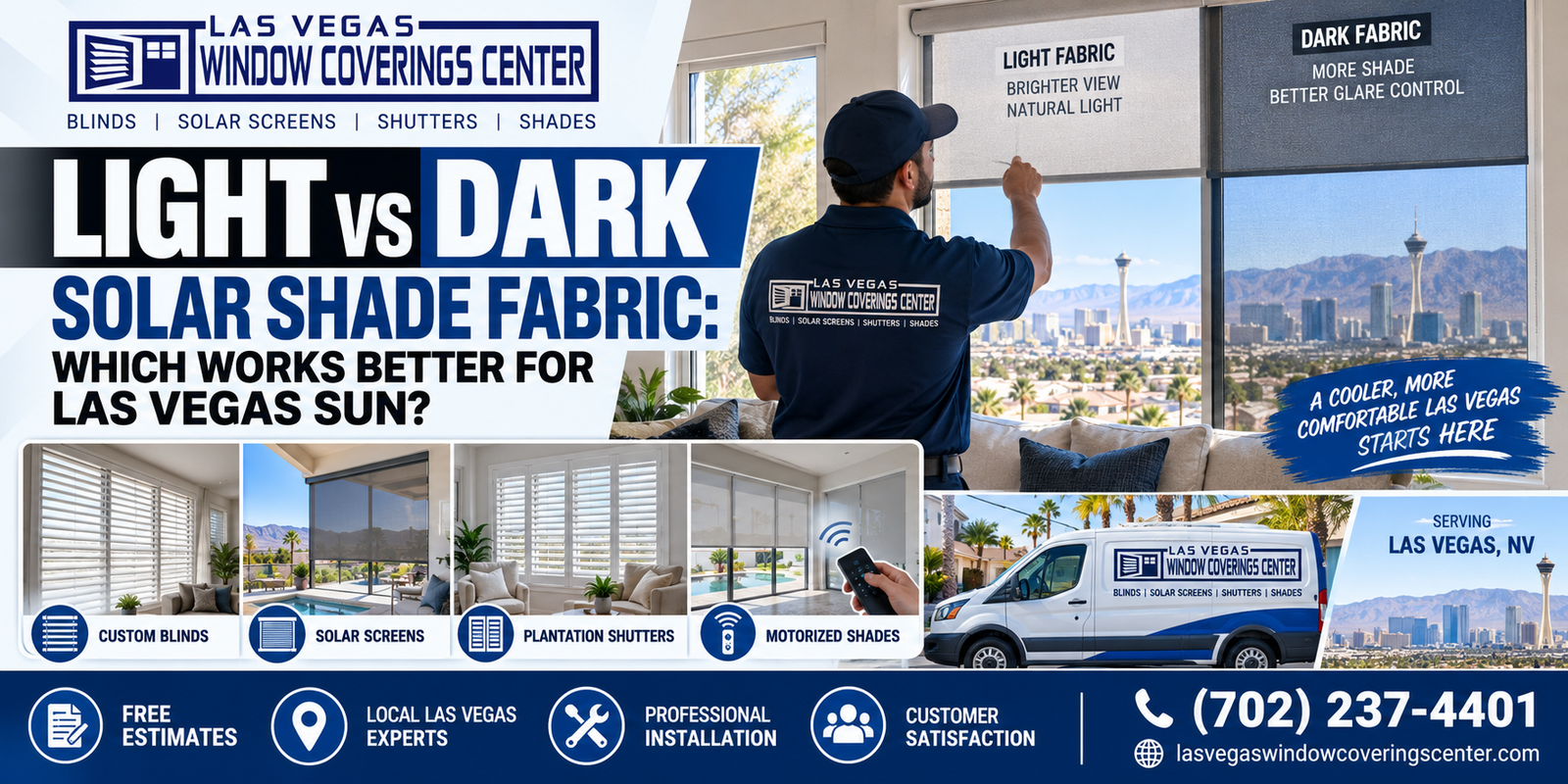
Solar shade color changes more than the appearance of a window. At the same openness factor, a light fabric and a dark fabric can produce noticeably different results for glare, outward view, reflected daylight and solar heat at the window. This guide explains how those tradeoffs apply to Las Vegas homes, condos, offices and west-facing glass so you can select fabric by performance rather than color alone.
Short answer: neither color is universally better. For interior solar shades, lighter fabrics generally reflect more solar radiation and keep the room visually brighter, making them a strong comparison when reducing interior heat buildup is a priority. Darker fabrics generally control glare more effectively and provide a clearer outward view through the weave.
Choose a lighter solar fabric when: reflecting solar energy, maintaining a bright interior and reducing the visual intensity of a sun-exposed window matter more than having the sharpest possible view through the shade.
Choose a darker solar fabric when: glare reduction, television or monitor comfort and a clearer view through the lowered shade matter more. Dark fabric can absorb more solar energy, so it should not automatically be chosen when heat rejection is the primary objective.
For Las Vegas windows that need both: a dual-sided fabric with a lighter exterior-facing side and a darker interior-facing side can combine stronger solar reflectance toward the glass with better glare control and view-through inside. Always compare color together with openness factor, because weave density can change the result substantially.
Solar shades look simple: a flat woven screen rolls down over the window. Yet two fabrics with similar texture and the same openness percentage can feel very different once intense Southern Nevada sunlight hits the glass.
One room may become brighter and more softly illuminated behind a light-colored fabric. Another may feel visually calmer behind charcoal fabric because reflections and glare are reduced and the exterior view becomes more distinct.
This becomes important in Las Vegas because homeowners often want several goals from the same window. They may want to reduce afternoon glare without losing a mountain view. They may want a west-facing living room to feel cooler while still receiving daylight. A home office may need better monitor visibility but cannot feel dark all day.
Manufacturer guidance confirms that fabric color is a genuine performance variable rather than a purely decorative choice.
Hunter Douglas explains in its solar shade color and openness guide that lighter colors reflect more heat and brighten a space, while darker colors provide better glare reduction and clearer view-through.
Lutron similarly explains that darker solar-shade fabrics typically provide lower visible light transmission, helping with glare and outdoor views, while lighter fabrics reflect more solar radiation. Lutron also documents dual-sided fabrics designed to combine a light exterior side with a darker room-facing side.
Las Vegas homeowners can compare solar-shade materials through Las Vegas Blinds, Solar Screens & Shutters Window Coverings Center rather than choosing fabric from a small swatch without seeing how it behaves against daylight.
Solar shade color changes the way light interacts with the fabric. Some incoming solar radiation is transmitted through the openings, some is reflected and some is absorbed by the material.
The exact balance depends on the specific fabric, weave, coating, color, openness factor and window glass. This is why a generic statement such as “dark shades block more sun” or “white shades are always cooler” can be misleading.
A light-colored solar fabric generally reflects more incoming radiation than a comparable dark fabric. It can therefore help keep more solar energy from being absorbed by the interior shade.
The reflected visible light also makes the shade itself appear brighter. This can illuminate the room but can create a more diffused or hazy view through the weave.
Dark material tends to absorb more of the light striking the fabric. From the room side, that darker surface produces less reflected light around the eye.
That lower visual reflectance is a major reason the outdoor scene can look clearer through dark screen fabric and why dark colors are often effective in rooms where glare is a major complaint.
A homeowner choosing a light fabric may gain stronger reflectance and a brighter interior but sacrifice some view clarity. A homeowner choosing dark fabric may gain clearer view-through and stronger glare control while accepting greater absorption at the shade.
Once the desired priority is clear, openness factor and fabric construction can be chosen around it.
This comparison assumes fabrics of similar construction and openness so the practical influence of color is easier to understand. Actual manufacturer specifications should always be reviewed for the exact fabric.
| Decision Factor | Light Solar Fabric | Dark Solar Fabric | Typical Advantage |
|---|---|---|---|
| Solar Reflectance | Generally reflects more incoming solar radiation. | Generally absorbs more solar radiation. | Light fabric |
| Glare Control | Can reduce glare, but reflected light from the fabric itself may remain visually brighter. | Generally provides stronger perceived glare control. | Dark fabric |
| Outdoor View | View may appear softer or hazier through a bright weave. | Typically provides clearer view-through from the room side. | Dark fabric |
| Room Brightness | Reflects more daylight and can keep the room visually brighter. | Creates a darker visual field at the window. | Depends on preference |
| Interior Heat Buildup | Often stronger when solar reflection is the priority. | Darker fabric can absorb more solar energy and become warmer. | Light or reflective fabric |
| Television & Monitor Glare | Can work with a sufficiently tight weave, but the fabric surface remains brighter. | Usually stronger where glare reduction is the main objective. | Dark fabric |
| Mountain / City View | Exterior scene can appear more veiled. | Dark room-facing fabric typically sharpens perceived view. | Dark fabric |
| Bright Minimalist Interior | Often integrates naturally with white or light neutral interiors. | Creates stronger contrast at the window. | Design preference |
| West-Facing Exposure | Useful when solar reflectance and brightness management are priorities. | Useful when direct glare and preserving the view are priorities. | Depends on main problem |
| Dual-Sided Option | A lighter exterior-facing side combined with a darker room-facing side can balance solar reflectance with glare control and view. | Strong option for competing goals | |
| Privacy | Influenced heavily by openness and lighting conditions. | Also influenced heavily by openness and lighting conditions. | Neither color guarantees privacy |
Light-colored solar fabric deserves strong consideration when the primary concern is solar reflectance and maintaining a bright interior.
White, off-white, light gray and similar tones can reflect a larger portion of incoming solar radiation than comparable dark fabrics. That reflected energy is one reason light colors are commonly evaluated for windows receiving strong solar exposure.
Daylight striking a light shade is reflected and diffused across the room. In spaces where the homeowner wants to maintain an airy appearance, that can be attractive.
This may work particularly well in smaller rooms, kitchens or spaces with lighter décor where a large dark shade would visually dominate the window.
The same reflectance that keeps the fabric visually bright can make it more noticeable when you look toward the outside.
Rather than visually disappearing against the outdoor scene, a light weave can appear more like a sheer screen between you and the view. Hunter Douglas describes the effect as somewhat hazier compared with darker solar-shade colors.
Dark solar fabric is often the stronger choice when the homeowner's priorities are glare control and preserving the exterior view.
Dark charcoal, graphite, deep gray and black screen fabrics absorb more visible light and reflect less of that light back toward the eye. The outdoor scene therefore competes less with the bright appearance of the screen itself.
This is similar to looking through a dark insect screen. The darker strands can recede visually, allowing your eye to concentrate more easily on the brighter outdoor environment beyond them.
Lutron specifically recommends darker screen fabrics when view clarity is a high priority and also identifies dark room-facing fabric as advantageous for glare control.
In a home office or television room, bright reflected light at the window can contribute to uncomfortable visual contrast.
Darker solar fabric generally reduces that reflected luminance and can make screens easier to view while still permitting an exterior connection through the shade.
This is where many homeowners make the wrong assumption.
A dark shade may look as though it “blocks” more sun because it visually reduces glare. Yet dark fabric commonly absorbs more solar energy than a lighter version of similar construction.
Lutron notes that darker solar fabrics can become hotter and may provide less thermal mitigation than a more reflective light-colored fabric. When heat is the main concern, review the actual fabric's solar properties rather than judging by how dark it looks.
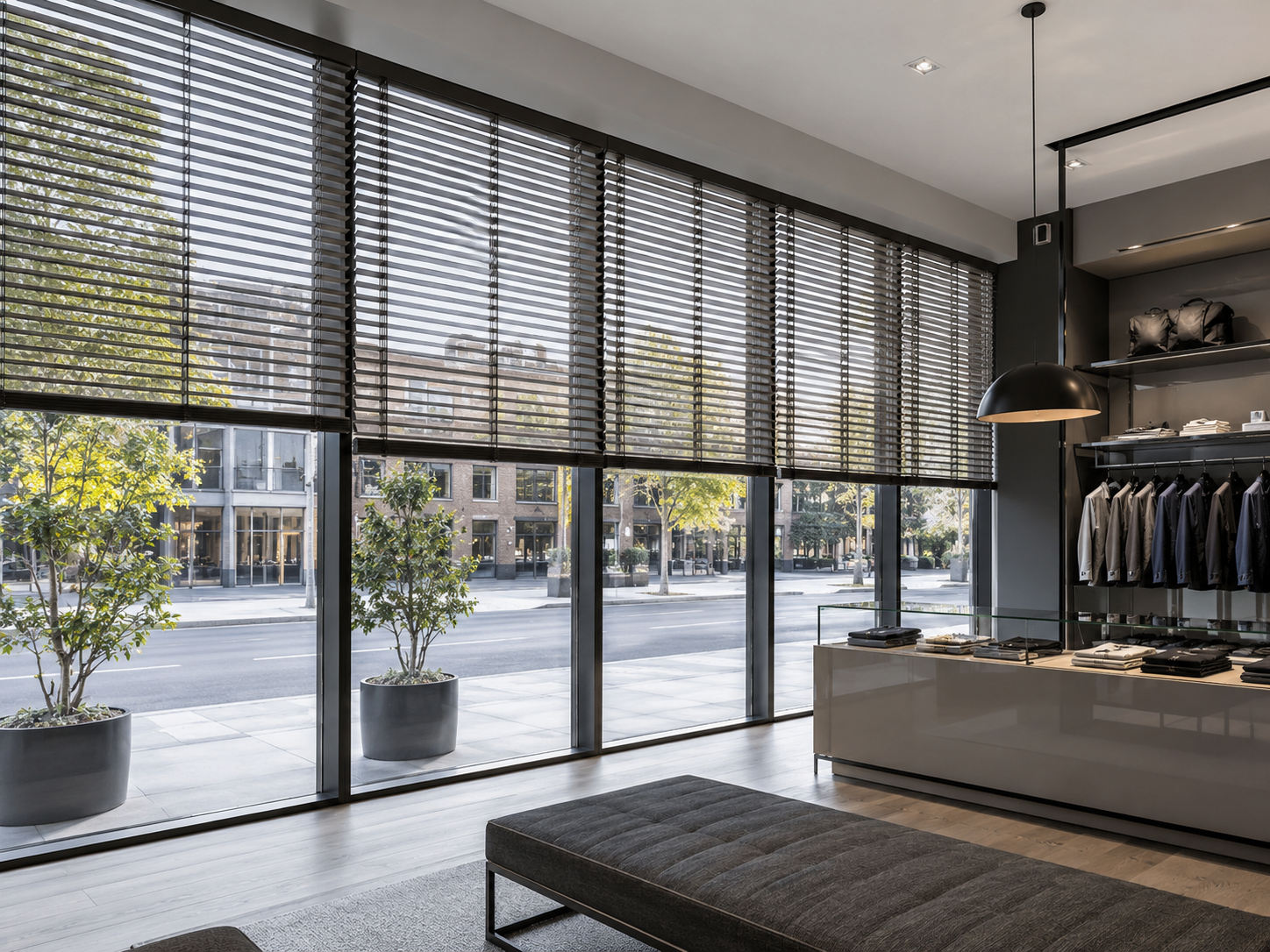
Large areas of Las Vegas glass often require a balance between glare control, outdoor view, interior brightness and solar exposure rather than simply choosing the darkest-looking fabric.
Both matter, but they control different parts of solar-shade performance.
Color strongly influences reflectance, glare and the perceived clarity of the view.
Openness factor describes how open or tightly woven the screen fabric is. A lower openness percentage means a tighter weave. A higher openness percentage means more open space within the weave.
A tighter weave generally admits less visible light, provides stronger sun control and reduces view-through more than a more open version of the same fabric family.
Common solar-shade collections may include choices such as 1%, 3% or 5% openness for homeowners who prioritize glare reduction over maximum view.
A more open weave generally allows more daylight and a clearer view through the fabric, but it also admits more direct solar exposure and usually provides less daytime privacy.
A 10% openness screen, for example, is visually much more open than a 1% screen in the same general category.
A dark 10% fabric may provide an excellent view but still admit more sunlight than a homeowner with severe west-facing glare wants.
A light 1% fabric may reflect solar radiation effectively but limit the mountain view far more than expected.
Dark solar-shade fabric is generally the stronger choice when reducing perceived glare is the main objective.
Lutron identifies darker solar fabrics as having lower visible transmittance and stronger glare performance, while Hunter Douglas also describes dark solar colors as particularly effective for glare reduction.
A monitor positioned near a large bright window can be difficult to read because the eye continually adapts between the screen and the much brighter surrounding glass.
Dark screen fabric can lower the visual intensity of that window while preserving some connection to the outdoors.
A dark solar fabric can also be useful when a sun-exposed window causes reflections on a television.
Openness remains important. A very open dark fabric may still allow enough direct sunlight to remain distracting. If the room needs substantially greater darkness for daytime viewing, a solar shade may need to be paired with a room-darkening treatment.
Office spaces with multiple computer monitors can place even greater importance on glare. Dark room-facing solar fabric is commonly considered where maintaining outdoor views and reducing visual brightness must happen at the same time.
Dark solar-shade fabric generally provides the clearer outward view.
This can initially feel counterintuitive. Many homeowners expect a white or light shade to be easier to see through because the material looks lighter.
In practice, the opposite often occurs. A light weave reflects more brightness toward the viewer, so the screen itself remains visually prominent.
A dark screen reflects less room-side light and can visually recede, allowing your eye to focus on the brighter scene outdoors.
Homes in areas such as Summerlin, The Ridges, Red Rock Country Club, Seven Hills and MacDonald Highlands may have windows positioned specifically to capture mountain, valley or city views.
A homeowner may not want to choose between managing afternoon sun and enjoying that view. In those rooms, a dark interior-facing solar fabric is worth comparing.
A dark 1% fabric will usually restrict view more than a dark 5% or 10% version of similar construction.
Color improves perceived view-through, but it does not erase the physical difference between a tight and open weave.
For an interior solar shade, lighter or specially reflective fabrics generally deserve the stronger comparison when the primary objective is reducing solar energy absorbed at the interior shade.
The U.S. Department of Energy recognizes interior blinds and shades as tools that can help reduce unwanted solar heat gain. However, the exact result depends on the window, glazing, material, fit and how the covering is used.
Fabric color is one piece of that system.
Light-colored material generally reflects more incoming solar radiation. Instead of absorbing as much of that energy, more is reflected back toward the glass.
Dark solar fabric generally absorbs a larger share of incoming radiation. That helps reduce visible glare but can cause the shade itself to become warmer.
Some absorbed heat can then move into the surrounding room by radiation and convection, which is why dark color alone should not be interpreted as stronger heat rejection.
Color is not the entire specification. Some solar fabrics use reflective backing, specialized coatings or dual-sided constructions specifically to improve solar performance.
The correct way to compare those fabrics is to review current manufacturer performance data for the exact material rather than assume all dark or light screens behave identically.
In many high-sun applications, dual-sided solar fabric can be one of the most useful options to compare.
A dual-sided screen uses different colors on the two faces. The side facing the glass may be light or reflective while the side facing the room is darker.
The lighter exterior-facing surface can reflect more incoming solar radiation rather than absorbing as much of it into the shade.
The darker interior side can reduce perceived glare and improve the clarity of the outdoor view from inside.
Lutron's fabric-selection guidance specifically identifies this combination for applications where customers want both stronger light reflectivity and a clearer outdoor connection.
Not every manufacturer or solar-shade collection offers the same dual-sided colors or specifications. Confirm the exact fabric options available for the proposed shade system.
Color alone should not be used to decide privacy.
Openness factor, fabric construction and relative lighting conditions are more important. An open solar screen remains an open solar screen whether it is white, charcoal or gray.
During a bright Las Vegas day, the outside of the home may be much brighter than the interior. That difference in illumination can make it harder for someone outside to see through the solar shade while occupants retain some outward view.
At night, the lighting relationship reverses. Interior lamps make the home brighter than the exterior, so people outside may be able to see through an open solar weave.
Hunter Douglas specifically warns that the daytime privacy effect of open solar fabrics changes when interior lights are on after dark.
A darker solar shade should therefore not be sold as an automatic nighttime privacy solution.
Compare a dual-shade system, separate room-darkening shade, drapery, shutter or another opaque treatment that can cover the window after sunset.
Solar shades are strongest when the homeowner understands what they are designed to do: manage daylight, glare and view while preserving a degree of visual connection through the fabric.
If the same room also needs strong nighttime privacy, layering can prevent one fabric from being forced to solve conflicting jobs.

A solar shade can manage daytime glare and view while an additional opaque layer provides stronger nighttime privacy when required.
West-facing windows are where this color decision becomes especially important.
Late-afternoon Las Vegas sun can be intense, low in the sky and visually uncomfortable. The window may need to manage several problems simultaneously: direct glare, solar heat, television reflections and loss of view.
If the homeowner's primary complaint is that the window becomes a major source of afternoon heat and the view is secondary, a lighter or reflective exterior-facing solar fabric deserves strong consideration.
If the goal is to keep mountain or landscape views visible while reducing harsh visual brightness, darker room-facing fabric can be more satisfying.
If the room needs stronger reflectance toward the window but a darker visual field inside, a dual-sided material can resolve part of the compromise.
A fabric that is too open can allow direct low-angle sun to remain uncomfortable even if its color is well chosen.
That is why the west-facing recommendation should include both color and openness instead of treating them as separate purchases.
A darker screen often provides the clearer outdoor view and stronger glare control while the shade remains lowered.
Light facing the glass and dark facing the room can help balance solar reflectance with view and glare control.
Dark interior-facing material can reduce visual glare around computer screens while maintaining an outside connection.
Light solar fabric can preserve a bright, airy appearance when maximum view clarity is not the main objective.
Dark screen material can visually recede and improve the perceived clarity of skyline and valley views.
Solar shades are useful for daytime sun, but an additional opaque treatment may be more appropriate when strong nighttime privacy or room darkening is required.
The larger the window, the more visually significant fabric color becomes.
A 3-inch sample may look subtle in a showroom, but the same material covering a large multi-panel window can dominate the entire room.
A broad light shade can blend into light walls and keep the room feeling open. It can also become a luminous surface when direct sun strikes the fabric.
A large charcoal or black solar screen can create a strong architectural frame around the view. In modern rooms, that can be attractive.
In a smaller room, however, the same dark area may feel visually heavy.
Homeowners choosing a solar fabric for a large view window should evaluate more than a tabletop swatch. Hold the sample against actual daylight and look through it from normal seating distance.
The difference between light and dark view-through becomes much more obvious when the sample is positioned directly against the window.
Commercial spaces often need solar-shade fabric to solve a specific visual problem rather than simply coordinate with décor.
Dark room-facing solar fabric can be useful where computer glare, presentation screens and exterior views need to coexist.
A light or reflective exterior-facing surface may be useful where the glazing receives substantial direct solar exposure.
A restaurant may want guests to enjoy an outdoor view while reducing uncomfortable low-angle sun at tables. Dark solar fabric can improve visual connection to the exterior, while openness should be selected according to how intense the exposure is.
Retail applications may prioritize controlling glare on displays while maintaining an open feel. The desired level of outside visibility should be established before selecting color.
Hotel, condo and high-rise environments often place a premium on view. Dark room-facing solar fabric or dual-sided material can be worth comparing where afternoon exposure competes with city or mountain sight lines.
Motorization does not change the optical characteristics of light or dark fabric, but it can change how consistently the shade is used.
A solar shade only controls direct sun when it is actually lowered into the path of that sun.
Motorized shades can be practical on tall glass, high-rise windows or areas where manually operating multiple large shades would be inconvenient.
Certain motorized systems may support schedules or automated control. Compatibility depends on the exact motor and control platform and should be verified from current manufacturer documentation.
Motor selection must be appropriate for the exact shade dimensions, fabric, roller system and manufacturer specifications.
Hardwired electrical work should be performed according to applicable product installation and electrical requirements.
Very wide sliding glass doors add another issue: operation.
A solar shade may work on certain large openings, but width, roller requirements, door traffic and how the treatment clears the opening should be considered before assuming a conventional vertical roller treatment is the best solution.
If your primary problem is choosing a side-to-side window covering for a patio door rather than choosing solar fabric color, review the guide to vertical blinds vs panel track shades for Las Vegas sliding glass doors .
The correct product category should be established before fabric color is finalized.
Solar-shade selection should begin with the actual window rather than the fabric book.
Custom roller shades require accurate dimensions for the selected inside- or outside-mount configuration.
Inside-mounted shades need enough depth for the brackets, roller, cassette or fascia specified by the product system.
A north-facing window and a west-facing window may need different openness and color strategies even when they are the same size.
Is the complaint heat, glare, washed-out computer screens, faded décor, privacy, loss of view or too much daylight?
Different problems lead to different fabric recommendations.
A dark solar fabric may look excellent when viewed straight through the window but appear visually heavy from elsewhere in the room.
A light shade may complement the décor but create more visual haze over a valued view.
This is particularly important. A fabric sample under showroom lighting does not reveal how it will behave against a bright Las Vegas sky.
Color alone does not create a universal pricing rule.
The complete solar-shade cost can be influenced by fabric collection, openness, specialized backing, dual-sided construction, window size, roller hardware, controls and installation.
Compare written quotes by exact fabric and system rather than assuming that one color category is automatically the premium option.
Solar shades are designed around sun control and maintaining some degree of view. That makes them excellent for many living rooms, offices and large windows—but not every requirement.
If occupants need complete visual privacy after dark, an open solar screen may require another layer or a more opaque product.
A solar shade should not be described as a blackout product merely because the fabric is dark or has low openness.
Bedrooms used by day sleepers or media rooms requiring much stronger darkness should compare dedicated room-darkening or blackout constructions.
If the homeowner wants to redirect daylight rather than lower a flat screen across the window, blinds or plantation shutters may be more appropriate.

Plantation shutters solve a different problem from solar shades: adjustable louvers and stronger visual privacy rather than preserving view through an open solar screen.
Start with a lighter or reflective window-facing fabric when managing solar energy is the primary goal.
Darker room-facing fabric generally creates better visual glare control.
Dark solar screen fabric tends to visually recede and provide clearer view-through.
Light material reflects more daylight and can make the window feel brighter and less visually heavy.
Compare a light exterior-facing side with a darker room-facing side when competing priorities must be balanced.
Color alone cannot make an open solar fabric a complete nighttime privacy treatment.
Be cautious when fabric color is presented as a universal answer without considering openness, exposure and the actual window.
Las Vegas solar-shade selection is strongly influenced by intense sunlight, long periods of clear sky, large residential glass and bright outdoor surfaces.
The correct fabric color may therefore change from one side of a house to another.
West-facing glass can receive intense late-afternoon light. In these rooms, darker room-facing fabric can improve glare control and preserve the view, while a lighter or reflective exterior-facing surface can help address solar absorption.
Dual-sided fabric can be especially relevant when both goals matter.
Homes in Summerlin, The Ridges, Red Rock Country Club, Queensridge and other west-valley communities may combine strong afternoon exposure with valuable mountain views.
Choosing only for heat can unnecessarily compromise the view. Choosing only for view can overlook solar reflectance. Compare both goals.
Homes in Seven Hills, Anthem, MacDonald Highlands and other elevated areas may have expansive valley or mountain sight lines.
A darker room-facing solar screen can be particularly attractive where maintaining a clear daytime view is central to the room.
Las Vegas home offices with sun-exposed windows often need a stronger focus on visual comfort. Darker solar fabric can reduce perceived glare, while openness should be selected so direct sunlight does not continue to interfere with screens.
High-rise residences in Las Vegas and Paradise may have large areas of glass with city, Strip or valley views. A dark interior-facing fabric can visually recede, while dual-sided constructions may help address strong solar exposure.
Glare does not always come directly from the sun. Pale exterior walls, pool decks, concrete, stone and neighboring structures can reflect significant brightness toward the window.
A room may therefore benefit from dark solar fabric even when the sun itself is not directly centered in the glass.
A north-facing room may work well with a more open, visually light material. A west-facing home office may require tighter openness and a darker room-facing color. A primary living room may benefit from dual-sided fabric to preserve a view.
Using one solar-shade fabric across every elevation may simplify the order, but it is not always the best performance strategy.
Las Vegas Blinds, Solar Screens & Shutters Window Coverings Center is a local Las Vegas window covering company where homeowners and businesses can compare solar-shade options based on the actual window, exposure and room use.
A useful solar-shade consultation can consider window orientation, glare, desired outdoor view, fabric openness, room brightness, nighttime privacy, mounting conditions, large-window requirements and whether light, dark or dual-sided solar fabric better matches the customer's priorities.
Professional measurement also helps determine whether the planned shade can fit the opening correctly and what side gaps, hardware or mounting conditions should be expected.
Las Vegas Blinds, Solar Screens & Shutters Window Coverings Center serves customers throughout the Las Vegas Valley. These communities describe service coverage and do not imply a separate showroom or physical business location in each area.
Visit Las Vegas Blinds, Solar Screens & Shutters Window Coverings Center at 3871 S Valley View Blvd #6, Las Vegas, NV 89103 to compare solar-shade colors, openness factors and other custom window covering options.
It depends on the main goal. Light solar fabric generally reflects more solar radiation and keeps the room visually brighter. Dark solar fabric generally provides stronger glare control and a clearer outward view. For Las Vegas windows where heat, glare and view are all important, a dual-sided fabric with a light exterior-facing side and darker room-facing side can be worth comparing.
Not necessarily. Dark fabric often looks more effective because it reduces visual glare, but darker materials generally absorb more solar energy. Lighter or reflective fabrics can reflect more incoming radiation. Actual heat performance depends on the exact fabric, openness, glazing, backing and installation, so review manufacturer performance data instead of choosing solely by color.
Dark fabric reflects less light back toward your eyes, so the strands of the weave tend to visually recede. Your eye can then focus more easily on the brighter outdoor scene beyond the shade. Light-colored screen fabric reflects more visible light and can create a softer or hazier view. Openness factor also affects how much of the outdoor scene remains visible.
For a west-facing window, choose according to the primary problem. A lighter or reflective fabric may be preferable when solar reflectance is the priority. A darker room-facing fabric may work better when afternoon glare and preserving the view are the main concerns. If both matter, compare a dual-sided fabric along with an appropriate openness factor.
They affect different things. Openness determines how open or tightly woven the screen is and strongly influences incoming daylight, view-through and sun control. Color affects reflection, glare and perceived view clarity. A well-selected solar shade should consider both. Choosing the correct color with the wrong openness can still produce too much glare or too little view.
Dark color alone does not guarantee nighttime privacy. Open solar fabrics can appear relatively private during the day because the exterior is brighter than the room. After dark, interior lighting can reverse that effect and make the interior visible from outside. If nighttime privacy is essential, consider an additional opaque shade, drapery or another privacy treatment.
Dual-sided solar fabric uses different colors on its two faces. A common performance-oriented configuration uses a lighter side facing the glass to reflect more solar radiation and a darker side facing the room to improve glare control and outward view. Availability and performance vary by manufacturer, so compare the specifications for the exact fabric being considered.
Contact Las Vegas Blinds, Solar Screens & Shutters Window Coverings Center at (702) 237-4401 or visit 3871 S Valley View Blvd #6, Las Vegas, NV 89103 to compare solar-shade colors and openness factors based on window orientation, glare, desired view, privacy and solar exposure.
Solar-shade performance depends on the exact material, color, openness and window system. These manufacturer and government references support the major fabric-selection principles discussed in this guide.
Hunter Douglas explains that lighter solar-shade colors reflect more heat and brighten a room, while darker colors reduce glare and provide better view-through. The guide also explains the relationship between openness factor and view.
Lutron explains how dark fabrics can improve glare reduction and outward visibility while lighter colors reflect more solar radiation. It also discusses dual-sided fabrics combining a lighter exterior side and darker interior side.
Lutron's technical fabric reference identifies dark fabrics for clearer view-through, light-reflective fabrics for high-heat applications and dual-sided fabrics where both view and reflectance are priorities.
Graber documents multiple solar-shade openness levels and explains how tighter and more open fabrics change sunlight, glare and outdoor view.
Graber explains solar-shade weave and openness and how those variables influence the amount of sunlight entering the room, outward view and screen glare.
Department of Energy guidance recognizes interior blinds and shades as tools that can help reduce unwanted solar heat gain and explains why daylight and solar heat are separate window-performance considerations.
Light solar-shade fabric generally makes the stronger case when reflecting solar radiation and keeping the room visually bright are priorities. Dark solar fabric generally makes the stronger case when glare reduction and preserving a clear exterior view matter most.
For difficult Las Vegas exposures, particularly west-facing windows, dual-sided solar fabric can help combine a lighter exterior-facing surface with a darker room-facing surface. The final decision should also account for openness factor, window orientation, glazing, privacy and room use.
Call Las Vegas Blinds, Solar Screens & Shutters Window Coverings Center at (702) 237-4401 to compare solar shade fabrics in Las Vegas and nearby areas.