
★ ★ ★ ★ ★
Proudly backed by over 500+ 5-Star Reviews
Trusted by Las Vegas homeowners.
Plantation shutters vs blinds comparison for privacy, light control and style in a Las Vegas home
Shutters vs Blinds • Las Vegas Home Guide

Plantation Shutters vs Blinds in Las Vegas: Which Is Better for Your Home?

Plantation shutters and blinds both use adjustable slats or louvers to control privacy and daylight, but they create very different finished windows. This Las Vegas comparison looks at appearance, privacy, light control, desert sun, maintenance, large windows, specialty shapes, bedrooms, cost factors and installation so you can choose the option that fits your home rather than simply buying the product that looks best in a sample photo.

Las Vegas Blinds, Solar Screens & Shutters Window Coverings Center 3871 S Valley View Blvd #6, Las Vegas, NV 89103
Plantation Shutters Custom Blinds Professional Measurement Professional Installation

Are Plantation Shutters or Blinds Better for a Las Vegas Home?

Short answer: plantation shutters are generally the better fit when you want a built-in architectural appearance, wide adjustable louvers, strong privacy control, a treatment that remains integrated with the window and custom solutions for shaped or front-facing windows. Blinds are generally the better fit when you want a lighter visual profile, easier replacement, broad material choices and more flexibility in how much of the window covering is raised or lowered.

For privacy and architectural style: plantation shutters often have the advantage. Their framed panels and adjustable louvers can become a visible part of the window design, and some configurations allow upper and lower louver sections to be controlled independently.

For flexibility and product variety: blinds often have the advantage. Horizontal blinds can be raised, lowered and tilted, while materials can include real wood, faux wood, metal and other options. Vertical blinds can also serve wide openings and sliding doors differently from plantation shutters.

Neither product automatically wins for every Las Vegas window. Window depth, frame shape, direct sun, material, room use, view, cleaning preferences, door clearance and budget should all be considered before choosing.

Why Plantation Shutters vs Blinds Is More Than a Style Decision

Plantation shutters and blinds can look similar in one important way: both use rigid horizontal elements that can be tilted to change privacy and light. That visual similarity causes many homeowners to think the products work essentially the same way.

They do not.

A blind normally hangs from a headrail. Horizontal slats can be tilted and the blind can generally be raised to expose more of the window. Plantation shutters use hinged panels installed within or around the window opening. The louvers tilt, while the shutter panels themselves can usually swing open when full access to the window is needed.

Hunter Douglas describes blinds as rigid horizontal slats that tilt for privacy and light control. Its shutter guidance describes adjustable louvers, different louver sizes and custom configurations for specialty windows. Those structural differences are the foundation of the buying decision.

The U.S. Department of Energy also recognizes both blinds and interior shutters as categories of interior window attachments. Window coverings can help manage direct sunlight, but actual performance depends on the window, product, fit, material and how the covering is used.

Think of the decision this way: plantation shutters become part of the window's architecture. Blinds behave more like an adjustable covering suspended in front of the glass.

Homeowners can compare both categories through Las Vegas Blinds, Solar Screens & Shutters Window Coverings Center and evaluate the product against the actual opening rather than choosing from appearance alone.

What Is the Main Difference Between Plantation Shutters and Blinds?

Plantation shutters are framed, hinged window treatments with adjustable louvers. The frame and panels remain attached to the window opening, giving the treatment a more permanent, built-in appearance.

Blinds are headrail-mounted window coverings with individual slats. On a typical horizontal blind, you can tilt the slats for light and privacy and raise the blind when you want more of the window completely exposed.

Plantation Shutters

Framed & Architectural

Hinged shutter panels remain part of the window treatment. Adjustable louvers provide privacy and directional daylight, while the panels can open when greater window access is needed.

Blinds

Flexible & Familiar

Slats tilt for privacy and daylight, and horizontal blinds can normally be raised to uncover the window. Material, slat size and operating systems vary widely.

Why the construction changes the finished room

A shutter frame visually outlines the window. Even when the louvers are open, the shutter panel and frame remain visible. This can create a strong finished architectural look.

A blind typically occupies less visual space around the perimeter. When fully raised, much more of the opening can be exposed, although the headrail and stacked slats remain at the top.

Plantation Shutters vs Blinds in Las Vegas: Side-by-Side Comparison

Use this table as a decision guide. Exact results depend on the material, manufacturer, window geometry and installation.

Factor Plantation Shutters Blinds Typical Advantage
Appearance Framed, built-in, architectural look. Lighter visual profile with many material and color choices. Depends on design preference
Privacy Adjustable louvers can provide strong privacy; split-louver configurations may separate upper and lower control. Slats tilt for strong privacy but overlap, route holes and fit can affect closure. Shutters for flexible panel privacy; both can work well
Daylight Wide louvers can direct light while maintaining a clean opening. Slats can be finely tilted; raising the blind exposes the glass. Blinds for fully raising; shutters for louver control
Full Window Access Shutter panels generally swing open. Horizontal blinds generally raise toward the headrail. Depends on window and furniture clearance
Specialty Shapes Custom shutters can be designed for many arches, angles and shaped openings. Some blind systems accommodate specialty shapes, but options can be more product-specific. Plantation shutters
Large Windows May require multiple panels and sufficient room for panel operation. Wide horizontal blinds can become heavy; vertical blinds may work better on broad openings. Depends on opening geometry
Sliding Doors Requires a shutter system designed specifically for the opening. Vertical blinds are a common sliding-door configuration. Blinds for straightforward sliding-door applications
Cleaning Louvers and frames need dusting, but the rigid panels are easy to access. Horizontal blinds may contain many narrow slats; maintenance varies by material. Depends on louver/slat size and material
Replacement Flexibility Custom framed treatment is more integrated with the opening. Blind can generally be replaced without changing a surrounding shutter frame. Blinds
Cost Structure Custom frames, panels, louvers and installation can create a higher initial project scope. Wide range from simpler materials to premium custom real-wood blinds. Blinds usually offer a broader range of entry points
Best Overall Fit Architectural appearance, specialty shapes, privacy-oriented front windows. Flexible window coverage, broad material choice, simpler replacement. Depends on homeowner priorities

Which Looks Better: Plantation Shutters or Blinds?

There is no objective winner because the two products create different design effects.

Plantation shutters frame the window and can look similar to custom millwork. Their panels, rails and louvers stay visible as part of the opening. This can work especially well in rooms where the homeowner wants the window itself to look finished without adding drapery.

Blinds create a lighter treatment. Wood or faux-wood blinds can still look substantial, but the blind is visually separate from the trim. Aluminum or other narrow-slat blinds can create an even simpler profile.

Plantation shutters often suit:

  • Traditional and transitional interiors
  • Rooms with prominent window trim
  • Front-facing windows
  • Arches and specialty shapes
  • Rooms where a built-in appearance is desired
  • Windows that do not need to disappear visually when open

Blinds often suit:

  • Modern or simple interiors
  • Rooms where the covering should visually recede
  • Windows the homeowner wants to uncover by raising the treatment
  • Properties where future replacement flexibility matters
  • Projects needing different materials across different rooms
Design test: ask whether you want the window treatment to look like part of the architecture or like an adjustable covering in front of the glass. That question often makes the choice much easier.

Are Plantation Shutters or Blinds Better for Privacy?

Both can provide excellent adjustable privacy, but plantation shutters can offer an especially useful advantage when the shutter is configured so different louver zones operate independently.

Graber documents split-tilt shutter configurations that let upper and lower sections be adjusted separately. This can allow the lower portion of the window to remain closed for privacy while the upper portion admits daylight.

That can be useful on street-facing windows, bathrooms and bedrooms where occupants want natural light without exposing the entire interior.

How blinds provide privacy

Horizontal blinds use overlapping slats. Tilting those slats closed can substantially limit the direct view through the window.

Privacy depends on the fit, slat overlap, route-hole design, blind width and the angle of the slats. A blind that does not close evenly or is significantly narrower than the opening may leave more visible gaps.

Which should you choose for a front window?

If adjustable lower-level privacy is important and you like the framed appearance, plantation shutters deserve strong consideration.

If you would rather raise the entire covering and fully expose the window at certain times, blinds may offer more operational flexibility.

Which Provides Better Light Control?

Both shutters and blinds provide directional light control because the louvers or slats can be tilted rather than simply opened or closed.

This is one of the most important ways they differ from a typical roller shade. With a blind or shutter, the homeowner can redirect incoming light while keeping much of the window covered.

Plantation shutter louvers

Plantation shutters commonly use wider louvers than standard horizontal blinds. Larger louvers create fewer horizontal lines across the window and can provide a broader opening for view and daylight when tilted open.

Hunter Douglas and Graber both document multiple louver-size options for custom shutters, with larger louvers providing greater visibility through the open shutter.

Blind slats

Blinds are also available with different slat widths. Larger slats can create a more substantial look and reduce the number of horizontal lines across a large opening. Smaller slats can create finer directional control but also produce a busier appearance on broad windows.

The Hunter Douglas blind guide notes that horizontal-blind slats can be tilted to change both incoming light and privacy without raising the entire treatment.

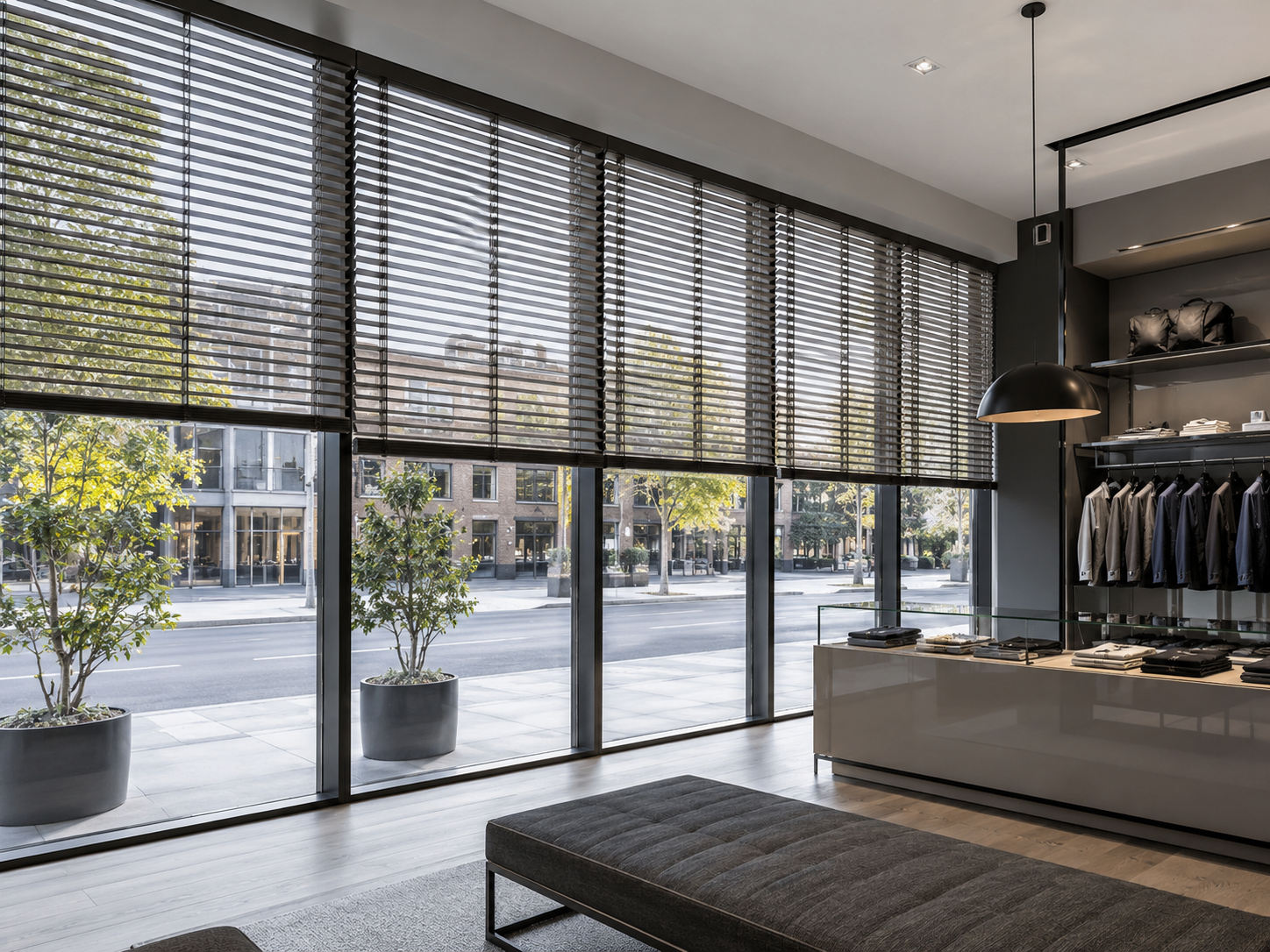
Custom blinds on large Las Vegas windows for adjustable daylight and privacy

Adjustable blind slats let occupants redirect daylight while keeping part or all of the window covered.

Are Plantation Shutters or Blinds Better for Las Vegas Heat?

Neither category should automatically be called the best heat-control product without considering the exact window and material.

Both plantation shutters and blinds can reduce direct sunlight entering a room when their louvers or slats are closed or angled appropriately. The U.S. Department of Energy recognizes interior shutters and blinds as types of interior window attachments and notes that interior window coverings can help reduce unwanted solar heat gain.

However, the amount of solar control depends on the actual fit, material, color, window glass and how consistently the treatment is used.

Why fit matters

Plantation shutters are typically framed to the opening. When the panels are closed, the shutter covers the window with rigid louvers within that frame.

Blinds hang from a headrail, and their slats overlap when tilted closed. Light and heat can still enter around perimeter gaps or through small openings between components.

Why material matters

Shutters can be made from real wood, composite materials or other engineered compounds depending on the manufacturer. Blinds can be real wood, faux wood, aluminum and other materials.

A product that performs well in one room may not be the correct material for another. Strong afternoon exposure, moisture, window size and weight all influence the decision.

What if heat is the main problem?

If a west-facing Las Vegas room is significantly overheating, compare shutters and blinds but also consider products designed specifically around solar control.

The previous guide on exterior solar screens vs interior solar shades for Las Vegas heat explains why exterior and solar-fabric solutions may be more relevant when direct solar exposure is the dominant problem.

Which Is Better When You Want to Preserve the View?

The answer depends on whether you want to look through the treatment or make the treatment disappear from the window.

With plantation shutters, larger louvers can create broad openings between the horizontal elements when tilted fully open. That can provide a good view while keeping the shutter panels closed.

If the homeowner wants the treatment almost completely out of the sight line, the shutter panels need to swing open. That requires clearance beside the window and may not be practical when furniture, walls or other objects interfere.

Horizontal blinds can usually be raised toward the headrail so most of the glass becomes uncovered. This may be preferable for a homeowner who wants an unobstructed window at certain times of day.

View-through vs clear glass: wide shutter louvers can provide a clean view through an otherwise closed treatment. Blinds may provide the stronger option if you want to raise the entire covering and expose nearly all of the glass.

Wood, Composite, Faux Wood and Metal: Why Material Changes the Comparison

Comparing “shutters vs blinds” without discussing material can lead to an oversimplified recommendation.

A genuine wood shutter and a composite shutter do not necessarily behave the same way in intense sun or moisture. A real wood blind, faux wood blind and aluminum blind also have different weight, appearance and maintenance characteristics.

Real wood shutters

Genuine wood can provide natural grain and a furniture-like appearance. Because wood responds to moisture and environmental conditions, product selection and finish should match the room.

Composite shutters

Composite shutters use engineered materials rather than relying solely on natural wood. Manufacturer formulations differ, so the actual product documentation should be reviewed before making heat, moisture or durability assumptions.

Real wood blinds

Real wood blinds provide natural grain and are generally lighter than many faux-wood products, which can be useful on larger horizontal openings.

Faux wood blinds

Faux wood can be useful where easier maintenance or resistance to demanding room conditions is important. Quality varies between products, so “faux wood” should not be treated as one universal construction.

Aluminum blinds

Metal blinds create a thinner, lighter visual profile than wood-style blinds or shutters. They can be practical in high-use spaces but create a very different design effect from plantation shutters.

Are Plantation Shutters or Blinds Easier to Clean?

Both have horizontal surfaces that collect dust, which is relevant in the Las Vegas Valley.

Plantation shutters often use fewer, wider louvers than a narrow-slat blind. Their panels can also swing open, giving access to both sides of the louvers and the window glass.

Blinds can contain a larger number of individual slats. Cleaning each slat may take more time, although the exact difference depends on slat width and blind size.

Material matters more than product category alone

A composite shutter may have different cleaning instructions than a stained wood shutter. Faux wood blinds can have different care requirements from genuine hardwood blinds.

Use the manufacturer's care instructions for the exact material. Avoid saturating genuine wood unless the product documentation specifically permits that cleaning method.

Desert dust can influence color choice

Dust visibility can vary by finish and color. Very dark louvers or slats may show light-colored desert dust sooner than some lighter finishes.

Homeowners who prefer low-maintenance interiors should evaluate not only the product style but how easy the actual chosen finish will be to dust and clean.

Which Is Better for Large Las Vegas Windows?

Very large windows require more than a style decision. Width, height, mounting surface, panel weight, blind weight and how the opening will operate all matter.

Plantation shutters on large windows

A wide shutter installation may be divided into multiple panels rather than one oversized panel. Panel divisions should align logically with the window architecture when possible.

Large louvers can help preserve view-through, but the panels also need room to swing if the homeowner wants to open them fully.

Horizontal blinds on large windows

As horizontal blinds become wider, total slat weight and headrail load become more important. A configuration that works easily on a small bedroom window may be less practical on a broad living-room opening.

Some wide windows may work better with multiple blinds aligned with window mullions rather than one large unit.

What about very wide sliding openings?

A vertical product may be more appropriate than either conventional plantation shutters or horizontal blinds. Vertical blinds and other sliding-panel treatments move laterally and can coordinate more naturally with sliding glass doors.

For large windows: professional measurement should include width, height, mounting depth, structural mounting surface, window divisions, hardware, adjacent furniture and the intended opening direction.

Are Plantation Shutters Better for Arched and Specialty-Shaped Windows?

Specialty shapes are one of the strongest reasons to compare custom plantation shutters.

A custom shutter can follow the shape of many arches, angles, octagons and other unusual openings while keeping adjustable louvers within the architectural shape.

Hunter Douglas specifically identifies shutters as an option for custom geometric windows and notes that shutters can remain operable on certain shaped openings.

Some blind products can also be configured for specialty windows, but the options depend more heavily on the exact product and shape.

Why custom measurement becomes critical

Specialty windows should not be ordered from a simple width-and-height measurement. Radius, angle, symmetry, frame depth and surrounding trim may all affect the finished treatment.

For a prominent arched window, it can also be important to decide whether the homeowner wants the covering to emphasize the architecture or visually simplify the shape.

Custom plantation shutters with adjustable louvers in a Las Vegas interior

Plantation shutters create a framed architectural appearance while adjustable louvers manage daylight, view and privacy.

Which Is Better for Las Vegas Bedrooms?

Plantation shutters can work well in bedrooms where privacy and a finished appearance matter. Louvers can be closed when privacy is needed and tilted open to admit daylight.

Blinds can provide similar adjustable privacy while offering the additional option to raise the treatment toward the headrail.

Neither should automatically be called blackout

This is an important buying distinction. Plantation shutters have spaces between louvers, around panels and around frames. Blinds also allow some light through slat overlaps, route holes and perimeter gaps.

If a bedroom needs strong room darkening, particularly for shift workers or light-sensitive sleepers, compare shutters or blinds against an opaque shade or layered treatment instead of assuming either rigid-louver product will create complete darkness.

The best bedroom choice depends on whether the goal is privacy, attractive daylight control, strong room darkening or all three.

Which Is Better for a Las Vegas Living Room?

Living rooms often make the plantation-shutter-versus-blinds choice primarily about architecture and view.

Plantation shutters can give a front living room a highly finished appearance without requiring additional drapery. Wide louvers can maintain a relatively open view when tilted.

Blinds may be preferable when the homeowner wants the ability to raise the entire treatment and expose more glass.

Think about furniture before selecting shutters

Shutter panels need space if they will be swung open. A sofa, table or built-in cabinet directly beside the window can change how practical full panel opening will be.

If the shutters will usually stay closed with the louvers tilted, that may not be a problem. But the expected operation should be discussed before the panel layout is finalized.

Can Shutters or Blinds Be Layered With Drapery?

Yes. A rigid window covering and a soft treatment can solve different design and light-control goals.

Plantation shutters may provide privacy and adjustable daylight while drapery adds softness, color and an additional room-darkening layer.

Blinds can be layered in a similar way. The blind handles daily slat control while drapery changes the visual character of the window.

Layering is not necessary on every opening. It is most useful when the second treatment has a specific function rather than simply duplicating the first.

Layered interior window treatments in a Las Vegas home with soft filtered light

Layered treatments can combine adjustable rigid-window privacy with softer decorative or room-darkening control.

Plantation Shutters vs Blinds for Doors and Sliding Glass Doors

Door applications should be evaluated separately from ordinary windows. The treatment must allow the door to open, close and lock without interfering with handles or traffic flow.

French doors

Shutters can be built for certain French-door configurations, and horizontal blinds can also be mounted to many doors. Handle clearance and how firmly the treatment remains in position when the door moves should be reviewed.

Sliding glass doors

A standard horizontal blind is often not the most natural solution for a wide sliding glass door because the blind raises vertically while the door operates horizontally.

Plantation shutters can be engineered in specialized bypass or other configurations, depending on the product system, but they create a more substantial framed installation.

Vertical blinds are another product category worth comparing because their operating direction can coordinate naturally with a sliding door.

For any door: measure the handle, lock, frame depth, opening direction and traffic path—not just the visible glass.

What About Cordless Window Coverings in Homes With Children?

Cord accessibility should be part of the buying decision in any home where young children live or visit.

The U.S. Consumer Product Safety Commission advises consumers to use cordless window coverings where young children are present because accessible window-covering cords can create a strangulation hazard.

Plantation shutters generally use louvers and panels rather than a hanging lift cord to raise or lower the product.

Blinds are available with different control systems. When selecting blinds for a child's room or another child-accessible area, ask for a cordless or otherwise compliant control configuration appropriate to the actual product.

Do not assume that simply tying an older cord higher makes the hazard disappear. CPSC guidance should be followed for existing corded window coverings.

Do Plantation Shutters Cost More Than Blinds?

Plantation shutters often involve a larger custom project scope because the installation includes frames, hinged panels, louvers and precise fitting to the window opening.

Blinds span a very broad range. A simple aluminum blind and a custom hardwood blind are not comparable products, so there is no useful single “blinds price” to compare with shutters.

Rather than asking only which product costs less, compare quotes that identify exactly what is being provided.

Plantation-shutter cost factors can include:

  • Window width and height
  • Number of shutter panels
  • Frame style
  • Louver size
  • Wood, composite or other material
  • Specialty shapes
  • Custom color or finish
  • Door or bypass configurations
  • Installation complexity

Blind cost factors can include:

  • Real wood, faux wood, aluminum or other material
  • Slat width
  • Blind dimensions
  • Decorative tapes or valances
  • Control system
  • Special mounting requirements
  • Number of windows
  • Professional installation

A written estimate should identify material, size, controls, installation and any specialty hardware so the homeowner is comparing equivalent scopes.

Why Professional Measurement Matters More With Shutters

Measurement matters for any custom window covering, but plantation shutters are especially dependent on the relationship between the opening, frame and panels.

The installer needs to know more than nominal window width and height. Window squareness, sill shape, trim, mounting depth, handles and panel clearance can all affect the finished shutter.

For plantation shutters, measure and evaluate:

  • Width at multiple points
  • Height at multiple points
  • Window-frame depth
  • Existing trim and sill projections
  • Cranks and locks
  • Panel swing clearance
  • Mullions and window divisions
  • Specialty shapes or arches
  • Furniture near the window

For blinds, also evaluate:

  • Inside-mount depth
  • Headrail clearance
  • Slat stack when raised
  • Window hardware
  • Blind weight on wide openings
  • Whether multiple blinds align better with window divisions
Do not order from rough dimensions alone. A custom product should be measured for the exact mounting method and the actual window condition.

Quick Room-by-Room Guide

Front Living Room

Plantation Shutters

Strong first comparison when architectural appearance, privacy and adjustable daylight matter.

Bedroom

Either Can Work

Choose based on privacy, design and whether the blind needs to raise fully. Compare blackout treatments separately if darkness is the main requirement.

Bathroom

Material Matters

Compare moisture-appropriate shutter materials with faux-wood blinds rather than choosing based on style alone.

Arched Window

Plantation Shutters

Custom shutters deserve strong consideration when the goal is to follow the architectural shape with an integrated treatment.

Large View Window

Depends on Operation

Wide shutter louvers preserve view-through; blinds can be raised to expose more glass. Compare panel swing and blind weight.

Sliding Glass Door

Compare Vertical Options

Standard shutters or horizontal blinds may not be the simplest choice. Vertical blinds or purpose-built sliding systems may fit the door movement better.

Questions to Ask Before Choosing Plantation Shutters or Blinds

Do I want the treatment to look built into the window or visually disappear when open?
Do I want to raise the entire treatment or only tilt louvers for most daily use?
How much privacy do I need during the day and at night?
Would independent upper and lower louver control be useful?
How important is a completely unobstructed view when the treatment is open?
Is this a west-facing window with strong afternoon sun?
What shutter material is recommended for this room and why?
If choosing blinds, should I compare real wood, faux wood or aluminum?
What louver or slat size works best with this window?
Will shutter panels have enough room to swing open?
Will blinds interfere with window handles or cranks?
Is the window large enough that blind weight becomes an issue?
Does the opening require multiple shutter panels or multiple blinds?
How will the treatment fit an arch or unusual window shape?
How should the exact material be cleaned?
If children live or visit here, what cordless control option is appropriate?
Does the written quote include custom measurement?
Does the written quote include professional installation?
What manufacturer warranty documentation applies to the exact product?
Are there other window treatments I should compare before ordering?

Red Flags When Comparing Plantation Shutters and Blinds

Be cautious when the recommendation is based on a generic sales pitch instead of the actual window and room.

  • Someone claims plantation shutters are always better than blinds for every room.
  • Someone claims blinds are always the cheaper choice without identifying material and specifications.
  • The recommendation is made without measuring the window.
  • Shutter-panel swing clearance is never discussed.
  • Large-window blind weight is ignored.
  • A seller does not identify whether the shutter is wood, composite or another material.
  • A blind is described only as “wood look” without identifying its actual construction.
  • A bedroom treatment is described as blackout without discussing light around louvers, slats or perimeter gaps.
  • The product is recommended for a bathroom without discussing moisture suitability.
  • Specialty-shaped windows are quoted without detailed measurements.
  • Door handles, cranks or locks are ignored.
  • A corded product is recommended for a child-accessible room without discussing safer cordless alternatives.
  • Unsupported energy-savings or heat-reduction percentages are promised.
  • The written quote does not identify installation scope.
  • The seller pressures you to order before you understand the material, controls and fit.

How Las Vegas Conditions Affect the Shutters vs Blinds Decision

The Las Vegas Valley combines intense sunlight, a long cooling season, dry desert conditions, large residential glass and a wide range of home styles. That makes room-by-room product selection more useful than simply installing one treatment throughout the entire property.

West-facing windows

A window receiving strong afternoon sun may need greater attention to material, slat or louver closure and solar-control strategy than a shaded north-facing opening.

Shutters and blinds can both manage direct sunlight, but if solar heat is the dominant problem, the homeowner should also compare dedicated solar-control options instead of asking a shutter or blind to solve every issue.

Summerlin and west-valley homes

Homes in Summerlin, The Ridges, Red Rock Country Club, Queensridge and nearby communities may combine strong western exposure with large, design-focused windows. Wide plantation-shutter louvers can create an architectural look, while blinds may offer greater flexibility when the owner wants the covering fully raised.

Henderson and hillside properties

Homes in Henderson, Seven Hills, Anthem and MacDonald Highlands may prioritize outward views. The choice should consider whether the owner wants to look through open louvers or remove most of the covering from the glass by raising a blind.

Street-facing homes

In Spring Valley, Enterprise, Green Valley, Centennial Hills and other neighborhoods, lower-level privacy may be particularly important. Split-louver shutter configurations can be useful when the lower part of a window should remain private while the upper section admits light.

Desert dust

Both horizontal blind slats and shutter louvers collect dust. Material, louver size, slat size and finish should therefore be considered alongside appearance.

Las Vegas architecture varies

Some homes benefit from the substantial framed character of plantation shutters. Others have contemporary glass where a lighter blind or shade is visually more appropriate.

A well-designed project does not require the same product in every room. Plantation shutters may be appropriate for front-facing and specialty windows while blinds or shades work better elsewhere.

Compare Plantation Shutters and Blinds in Las Vegas

Las Vegas Blinds, Solar Screens & Shutters Window Coverings Center is a local Las Vegas window covering company where homeowners can compare shutters, blinds and other window treatment categories against the actual room and window.

A useful shutter-versus-blind consultation can consider window dimensions, depth, trim, direct sun, privacy, desired view, panel clearance, slat or louver size, room use, material and maintenance preferences before a product is selected.

This is particularly valuable when the window is unusually large, arched, street-facing, exposed to strong afternoon sun or located where furniture and door hardware can affect operation.

Las Vegas Blinds, Solar Screens & Shutters Window Coverings Center
3871 S Valley View Blvd #6
Las Vegas, NV 89103

Phone: (702) 237-4401
Website: lasvegaswindowcoveringscenter.com
Google: Las Vegas Blinds, Solar Screens & Shutters Window Coverings Center on Google Maps

Plantation Shutter & Blind Service Areas Across the Las Vegas Valley

Las Vegas Blinds, Solar Screens & Shutters Window Coverings Center serves customers throughout the Las Vegas Valley. These communities describe service coverage and do not imply a separate showroom or physical business location in each area.

Las Vegas
Summerlin
Henderson
North Las Vegas
Spring Valley
Enterprise
Southern Highlands
Mountain's Edge
Green Valley
Anthem
Seven Hills
Paradise
Centennial Hills
Skye Canyon
Spanish Trail
The Ridges
Red Rock Country Club
MacDonald Highlands
Sun City Summerlin
Queensridge

Visit Our Las Vegas Window Covering Showroom

Visit Las Vegas Blinds, Solar Screens & Shutters Window Coverings Center at 3871 S Valley View Blvd #6, Las Vegas, NV 89103 to compare plantation shutters, blinds and other window covering options.

Plantation Shutters vs Blinds FAQs

Are plantation shutters better than blinds for Las Vegas homes?

Plantation shutters can be the better choice when you want a built-in architectural appearance, wide adjustable louvers, strong privacy control or a custom treatment for specialty-shaped windows. Blinds may be better when you want to raise the entire treatment, prefer a lighter visual profile or want a wider range of materials and project scopes. The actual window and room should determine the choice.

Are plantation shutters better than blinds for privacy?

Both provide adjustable privacy. Plantation shutters can be especially useful when the louver configuration allows the upper and lower portions to be controlled separately, allowing lower privacy while keeping daylight above. Blinds also provide strong privacy when slats close properly, but slat overlap, route holes, side gaps and fit can affect the final result.

Do plantation shutters help with Las Vegas heat?

Plantation shutters can help control direct sunlight entering through a window when their louvers are closed or angled. However, the amount of solar control depends on the exact shutter material, fit, window glass and exposure. If intense west-facing solar heat is the main problem, homeowners should also compare dedicated solar-control treatments rather than assuming shutters alone are the strongest option.

Are plantation shutters good for arched windows?

Custom plantation shutters can be a strong option for many arches, angles and geometric windows because the frame and louver layout can be built to follow the opening. The exact shape needs precise professional measurement. Operability can differ by shape and shutter system, so homeowners should review the proposed panel and louver configuration before ordering.

Are blinds easier to replace than plantation shutters?

Generally, yes. A conventional blind is mounted from a headrail and can typically be replaced without changing a custom shutter frame around the opening. Plantation shutters are more integrated with the window because the panels and frame are custom fitted. That integrated appearance is an advantage for some homeowners, while easier future replacement favors blinds.

Are plantation shutters blackout?

Plantation shutters should not automatically be considered blackout. Even with the louvers closed, some light can enter between louvers, panels and the surrounding frame. Blinds have similar limitations around slats and perimeter gaps. If very strong room darkening is required, compare an opaque shade or layered treatment designed specifically for that purpose.

Are shutters or blinds better for homes with young children?

The key issue is accessible operating cords. The U.S. Consumer Product Safety Commission recommends cordless window coverings where young children are present. Plantation shutters generally operate through louvers and hinged panels rather than hanging lift cords. Blinds are available with cordless control systems, so ask which configuration is appropriate for the specific blind.

Where can I compare plantation shutters vs blinds in Las Vegas?

Contact Las Vegas Blinds, Solar Screens & Shutters Window Coverings Center at (702) 237-4401 or visit 3871 S Valley View Blvd #6, Las Vegas, NV 89103 to compare plantation shutters and blinds based on privacy, daylight, window shape, materials, room design and Las Vegas sun exposure.

Technical & Authority References

Plantation Shutter, Blind & Window Covering Authority Sources

Window-covering construction and specifications vary between products. These government and manufacturer sources support the practical distinctions discussed in this guide.

U.S. Department of Energy — Interior Window Attachments

Department of Energy materials recognize blinds and interior shutters as types of interior window attachments and discuss the role window coverings can play in solar control and building comfort.

Review Department of Energy window-covering information →

U.S. Department of Energy — Solar Heat Gain & Window Coverings

DOE guidance explains that interior blinds and shades can be used to reduce unwanted solar heat gain and emphasizes that window performance depends on climate, glazing and other building factors.

Read DOE guidance on windows and solar heat gain →

U.S. Consumer Product Safety Commission — Go Cordless

CPSC advises consumers to choose cordless window coverings in spaces where young children are present because accessible window covering cords can create a strangulation hazard.

Read CPSC window-covering cord safety guidance →

Hunter Douglas — Interior Shutter Guide

Hunter Douglas documents adjustable shutter louvers, different louver sizes, privacy configurations and applications for specialty-shaped windows.

Review Hunter Douglas interior shutter guidance →

Hunter Douglas — Custom Blind Construction & Light Control

Hunter Douglas explains how horizontal blind slats tilt to control daylight and privacy and describes real-wood and alternative-wood blind options.

Review Hunter Douglas wood and faux-wood blind information →

Graber — Composite Shutters & Louver Options

Graber documents multiple shutter louver sizes and split-tilt configurations that can change view-through, daylight and privacy.

Review Graber composite shutter information →

Important: manufacturer claims apply to the specific product documented by that manufacturer. Do not assume every plantation shutter, composite shutter, wood blind or faux-wood blind has identical material, performance, warranty or operating characteristics.

Related Las Vegas Shutter & Blind Topics

Compare Plantation Shutters and Blinds on Your Actual Windows

Plantation shutters generally make the strongest case when you want an integrated architectural appearance, wide adjustable louvers, specialty-window capability and flexible privacy. Blinds generally make the strongest case when you want a lighter treatment, broad material choices and the ability to raise most of the covering away from the glass.

The right answer changes with window depth, size, orientation, room use, material, furniture placement and the amount of privacy and daylight you want.

Call Las Vegas Blinds, Solar Screens & Shutters Window Coverings Center at (702) 237-4401 to compare plantation shutters and custom blinds in Las Vegas and nearby areas.