Choosing the right solar shade openness affects glare, daylight, outdoor view and daytime privacy. This Las Vegas guide compares 1%, 3%, 5% and 10% solar shade fabrics so homeowners and businesses can understand which openness level may work best for different windows, exposures and rooms.
Short answer: there is no single solar shade openness percentage that is best for every Las Vegas window. Lower openness means a tighter weave. In general, that provides stronger glare control, reduces visible light and increases daytime privacy, but it also reduces the outdoor view.
Higher openness preserves more daylight and outward visibility, but it also allows more visible light through the shade and generally provides less daytime privacy.
For strong Las Vegas sun, 1% or 3% is often worth comparing where glare control is the priority. 5% can provide a useful middle ground between glare control and outdoor view, while 10% is more view-oriented and may work better where maintaining daylight and outward visibility is more important.
Openness is only one factor. Fabric color, window orientation, glass type, room use, mounting method and the exact fabric construction can all change the result.
Solar shades are designed to filter sunlight while preserving some degree of outward visibility. That makes them especially useful in rooms where homeowners or businesses want to reduce glare without completely covering the window with an opaque treatment.
In Las Vegas, that decision can become especially important because a window may receive strong desert sunlight for several hours during the day. West-facing windows can be particularly challenging in the afternoon, while large windows in condos, offices, restaurants and modern homes may need a balance between glare control and preserving the outdoor view.
The main number customers see when comparing solar-shade fabrics is the openness factor.
Solar-control fabric manufacturers such as Phifer publish solar shade fabrics in multiple openness factors. In general, a lower openness percentage represents a tighter weave with less view-through, while a higher openness factor preserves more daylight and outward visibility.
Homeowners can also compare solar shades , exterior solar shades , and other window coverings in Las Vegas when deciding how to control sun, glare and privacy.
Openness factor describes how tightly woven a solar shade fabric is. It can be thought of as the relationship between the solid woven material and the small open spaces within the mesh.
A lower number means the weave is more closed. A higher number means the fabric has more open space.
That difference directly influences how much the user can see through the shade, how much visible brightness reaches the room, and how much daytime privacy the fabric can provide.
Strong choice to compare when glare control and daytime privacy matter more than preserving a wide-open exterior view.
Offers more outward visibility than 1% while still providing substantial filtering for bright windows.
Often compared when homeowners want meaningful glare filtering while keeping more of the outdoor view.
Provides the greatest outward visibility among these four openness levels but less glare and privacy control.
The table below shows the general relationship between openness, view-through, brightness, privacy and glare. Exact performance varies by the specific fabric.
| Openness | Outdoor View | Daylight | Daytime Privacy | Glare Control | Common Las Vegas Use |
|---|---|---|---|---|---|
| 1% | Most restricted | Lowest of these four | Generally strongest | Generally strongest | Bright west-facing rooms, offices, privacy-focused spaces |
| 3% | Moderate | Low to moderate | Strong daytime privacy potential | Strong | West-facing living areas, offices and commercial glass |
| 5% | Good | Moderate | Moderate | Moderate to strong | Living rooms and offices where view still matters |
| 10% | Best of these four | Highest of these four | Lowest of these four | Lowest of these four | View-oriented spaces and lower-glare applications |
A 1% solar shade uses a very tight weave. Among the four openness levels discussed in this article, it generally provides the least outward visibility and the strongest filtering of visible brightness.
That can make 1% worth considering for Las Vegas rooms that receive intense afternoon sun or where glare is the main problem.
A homeowner with a valuable mountain, city or backyard view may decide that a 1% fabric hides too much of what they want to see outside.
This is why comparing a real sample against the window is valuable. A small fabric swatch viewed indoors can look different when stretched across a large glass opening.
A 3% solar shade remains relatively tight but preserves more outward visibility than a typical 1% fabric.
For many Las Vegas applications, that creates an attractive balance. Customers can achieve meaningful glare control while keeping a stronger visual connection to the exterior.
Three-percent openness can be useful for west-facing living rooms, home offices, conference rooms, restaurants and commercial windows where sunlight is strong but the view still matters.
Fabric color remains important. A dark 3% shade may provide a clearer outward view, while a light 3% shade can behave differently because light colors generally reflect more solar energy.
A 5% solar shade is often considered when homeowners want stronger outward visibility than 1% or 3%, but still want meaningful filtering of bright sunlight.
For large living-room windows, dining areas, offices and commercial spaces, 5% can provide a useful balance between maintaining a view and reducing glare.
More openness means the shade filters less visible light than tighter fabrics. A room that receives very aggressive afternoon sunlight may require a tighter option.
For less intense orientations—or rooms where view is more important— 5% may feel more comfortable visually.
Ten-percent openness is the most open option in this comparison. It provides the greatest outward visibility and generally allows the most daylight through the shade.
This can be valuable in Las Vegas homes, condos or commercial spaces where preserving the view is one of the main reasons the property has large windows.
Ten-percent openness may work well in living areas with desirable views, lower-intensity exposures, restaurants or commercial spaces where maintaining a visual connection to the exterior is important.
Because the weave is more open, more visible brightness can pass into the room. For harsh west-facing afternoon glare, a tighter fabric may be a better starting point.
Openness factor is only part of solar-shade selection. Fabric color also affects how the shade manages light, glare, outward visibility and solar energy.
Light fabrics generally reflect more solar energy and can keep the interior appearance visually bright. They can also create a softer, more diffused view through the shade.
Darker solar fabrics are often selected when glare reduction and clearer outward visibility are higher priorities.
A dark solar shade may absorb more solar energy than a light fabric, but it can provide stronger visual contrast when looking outside.
This is why choosing “3% openness” does not finish the selection process. The actual fabric and color should also be compared.
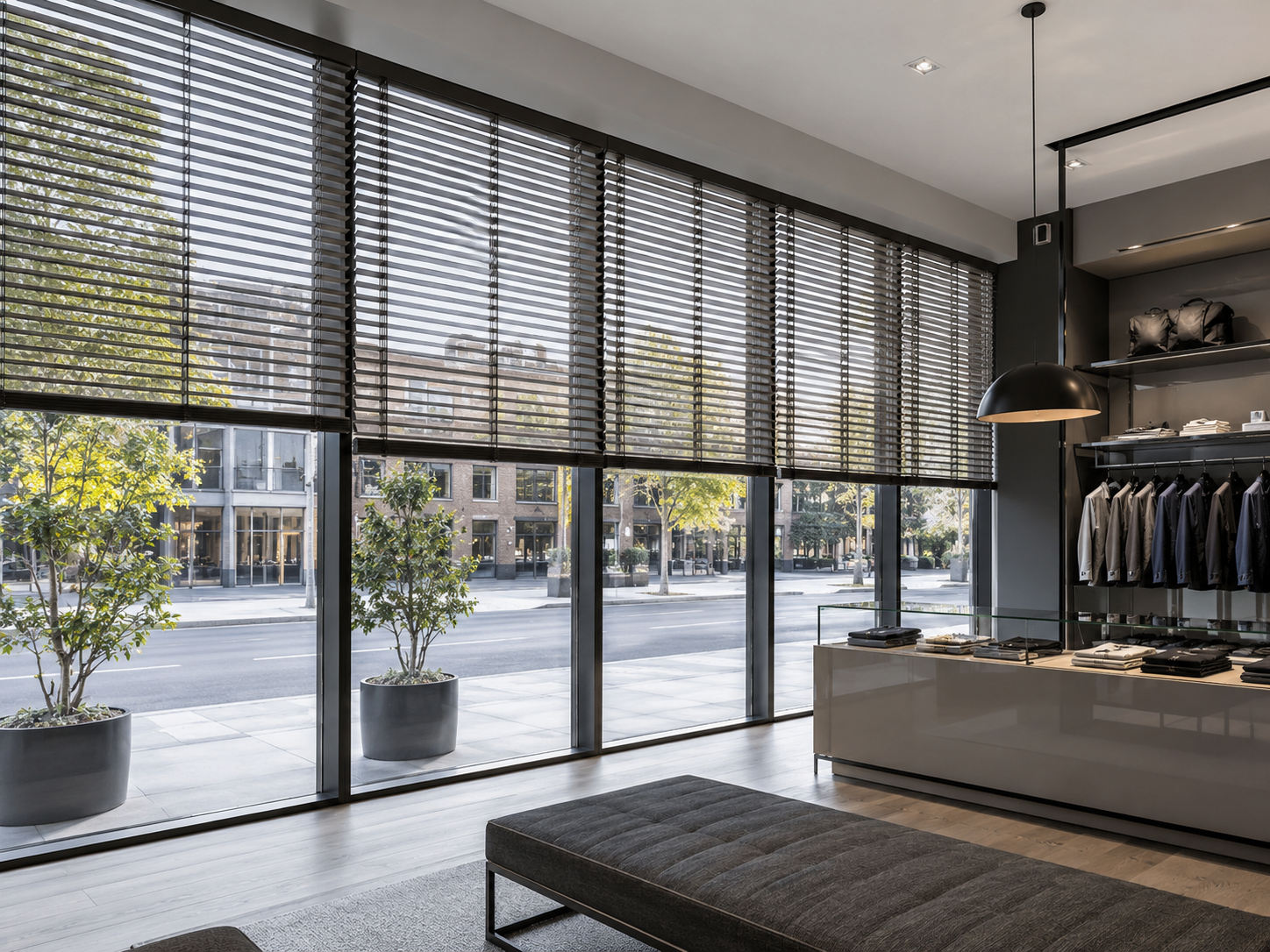
Commercial glass often requires a different balance of glare control, daylight and view-through than residential bedrooms or privacy-focused rooms.
Generally, tighter solar fabrics provide more daytime privacy because the weave is more closed.
However, solar shades should not be described as guaranteed privacy treatments.
Privacy depends strongly on the difference in lighting between the inside and outside of the building.
During a bright day, people inside may see outside while people outside have more difficulty seeing into the darker interior.
At night, that relationship can reverse when interior lights are on.
Bedrooms, bathrooms and other privacy-sensitive rooms may require blackout shades , shutters, drapery or a dual-shade configuration.
West-facing windows can receive strong low-angle sunlight during the afternoon. For those windows, homeowners often begin by comparing tighter solar fabrics such as 1% and 3%.
The tighter weave can help reduce visible brightness and glare, particularly in home offices or living areas where direct afternoon sun makes the room uncomfortable.
Window orientation matters because solar exposure changes throughout the day. The U.S. Department of Energy guidance on energy-efficient window coverings discusses the role window attachments can play in managing unwanted solar heat gain.
A west-facing bedroom, living room, restaurant and office may all need different solutions.
A living room owner may accept more glare in exchange for preserving a mountain view, while an office user may prioritize computer-screen visibility and choose a tighter shade.
Customers with severe solar exposure can also compare interior solar shades with exterior solar shades or solar screens.
Homeowners commonly balance glare, outdoor views, daytime privacy, interior appearance and room-specific needs.
Businesses may prioritize computer-screen glare, large glass, repeatable appearance, daylight control, durability and motorized operation.
In offices, glare may be the dominant concern because employees need to see computer monitors comfortably.
In restaurants, preserving the view can be part of the customer experience.
Retail storefronts may need daylight control without making the business look closed from outside.
Commercial property owners can also review commercial window shades for larger glass and business applications.
No. Openness describes the solar fabric itself. It does not describe the space between the fabric and the window frame.
Roller-shade fabric is usually narrower than the overall hardware, which means some side light can be visible depending on the mounting method and window.
An inside-mounted shade may show more edge light than an outside-mounted shade with additional overlap.
This becomes especially important when a homeowner is comparing solar shades with blackout products.
A 1% solar shade is still a solar shade. It is not equivalent to an opaque blackout treatment.
Motorization can make sense for tall, large or difficult-to-reach windows.
A motorized shade can also make it easier to adjust window coverings throughout the day as sunlight changes.
In commercial buildings, multiple motorized shades may be easier to operate than individual manual shades.
Motor choice should depend on the actual shade size, hardware, power source and product system.
Customers interested in automated operation can compare motorized window coverings in Las Vegas .

Layering window treatments can separate daytime glare control from nighttime privacy requirements.
Be cautious when product claims sound precise but are not connected to an actual manufacturer specification or the real window.
Las Vegas window coverings often need to manage strong sunlight, bright exterior surfaces and large amounts of glass.
In Summerlin, Henderson, Southern Highlands, The Ridges, MacDonald Highlands and other communities, many homes use large windows to capture views and natural light.
Choosing an overly tight solar shade can reduce that view more than the homeowner expected.
At the same time, selecting a very open shade on a severe west-facing window can leave more glare than desired.
High-rise properties and commercial buildings may have different priorities again. View preservation, screen glare and motorized operation may be more important than the priorities of a conventional residential bedroom.
Solar shade openness should therefore be selected around the actual room and exposure rather than assuming every window should use the same percentage.
Bedrooms, media rooms and other spaces that require substantial darkness may need an opaque blackout treatment rather than solar fabric.
Plantation shutters offer adjustable louvers and a more architectural built-in appearance. They can be useful when privacy and directional light control matter more than maintaining full outward view-through.
Cellular shades can provide privacy and a different insulation strategy, but they do not preserve an outdoor view in the same way a solar shade can.
Exterior solar-control products address sunlight before it reaches the interior side of the glass. That makes them a different strategy from interior solar shades.

Plantation shutters solve privacy and light-control needs differently from solar shades and may be worth comparing when view-through is not the primary goal.
Las Vegas Blinds, Solar Screens & Shutters Window Coverings Center helps homeowners, condo owners, businesses and property managers compare window coverings based on the actual room, window exposure and desired result.
Solar shade consultations can include comparisons of openness factors, fabric colors, outward view, daytime privacy, glare control, inside versus outside mounting, large-window requirements and motorized options.
Customers can also compare solar shades with custom blinds, exterior solar shades, blackout shades, cellular shades, plantation shutters and other window covering options.
Window covering consultations are available throughout the Las Vegas Valley. These locations describe service areas and do not imply a separate showroom in each community.
Visit Las Vegas Blinds, Solar Screens & Shutters Window Coverings Center at 3871 S Valley View Blvd #6, Las Vegas, NV 89103 to compare solar shades and other window covering options.
A 1% openness solar shade uses a very tight woven fabric. Compared with 3%, 5% and 10%, it generally allows less visible light and less outward view while providing stronger glare control and daytime privacy. Exact performance depends on the specific fabric and color.
It depends on the room. A 3% fabric generally provides stronger glare filtering and more daytime privacy, while a 5% fabric preserves more outdoor view and daylight. A bright west-facing office may favor 3%, while a living room with a desirable view may favor 5%.
Ten-percent openness may be too open for some severe west-facing glare problems because more visible light can pass through the looser weave. It can still be appropriate where preserving the exterior view is a higher priority.
Among 1%, 3%, 5% and 10%, lower openness fabrics generally provide more daytime privacy because the weave is tighter. Privacy still depends on fabric color and the difference between indoor and outdoor lighting.
Yes. When it is dark outside and interior lights are on, nighttime visibility can reverse the normal daytime privacy effect. Privacy-sensitive rooms may need blackout shades, shutters, drapery or a second shade.
They work differently rather than one color always being better. Darker fabrics often provide clearer outward views and strong glare control, while lighter fabrics generally reflect more solar energy. The right choice depends on the room's priorities.
No. Solar shades use woven material designed to filter sunlight while retaining some outward view. Blackout fabrics are opaque. Even a 1% solar fabric is not the same thing as blackout material.
Contact Las Vegas Blinds, Solar Screens & Shutters Window Coverings Center at (702) 237-4401 or visit 3871 S Valley View Blvd #6, Las Vegas, NV 89103 to discuss solar shade fabrics, openness levels, glare, privacy and window orientation.
Solar shade performance can vary by fabric construction, color, openness factor, glazing, window orientation and installation. The following educational and technical resources provide additional information about solar-control fabrics, openness and window performance.
Phifer publishes solar-control fabric specifications that include multiple openness factors. These technical resources are useful when comparing how different woven solar fabrics are constructed.
Review Phifer SheerWeave solar shade fabric specifications →
Hunter Douglas explains how solar-shade openness affects outward view, incoming light and privacy and why fabric color should also be considered during product selection.
The U.S. Department of Energy provides educational guidance about energy-efficient window coverings and the role window attachments can play in managing unwanted solar heat gain.
Read U.S. Department of Energy guidance on energy-efficient window coverings →
The difference between 1%, 3%, 5% and 10% openness can change the amount of glare, daylight, daytime privacy and outdoor view you experience after installation.
Compare the actual window orientation, room use, fabric color and desired view before deciding which openness factor is right for your Las Vegas property.
Call Las Vegas Blinds, Solar Screens & Shutters Window Coverings Center at (702) 237-4401 to compare solar shades in Las Vegas and nearby areas.