
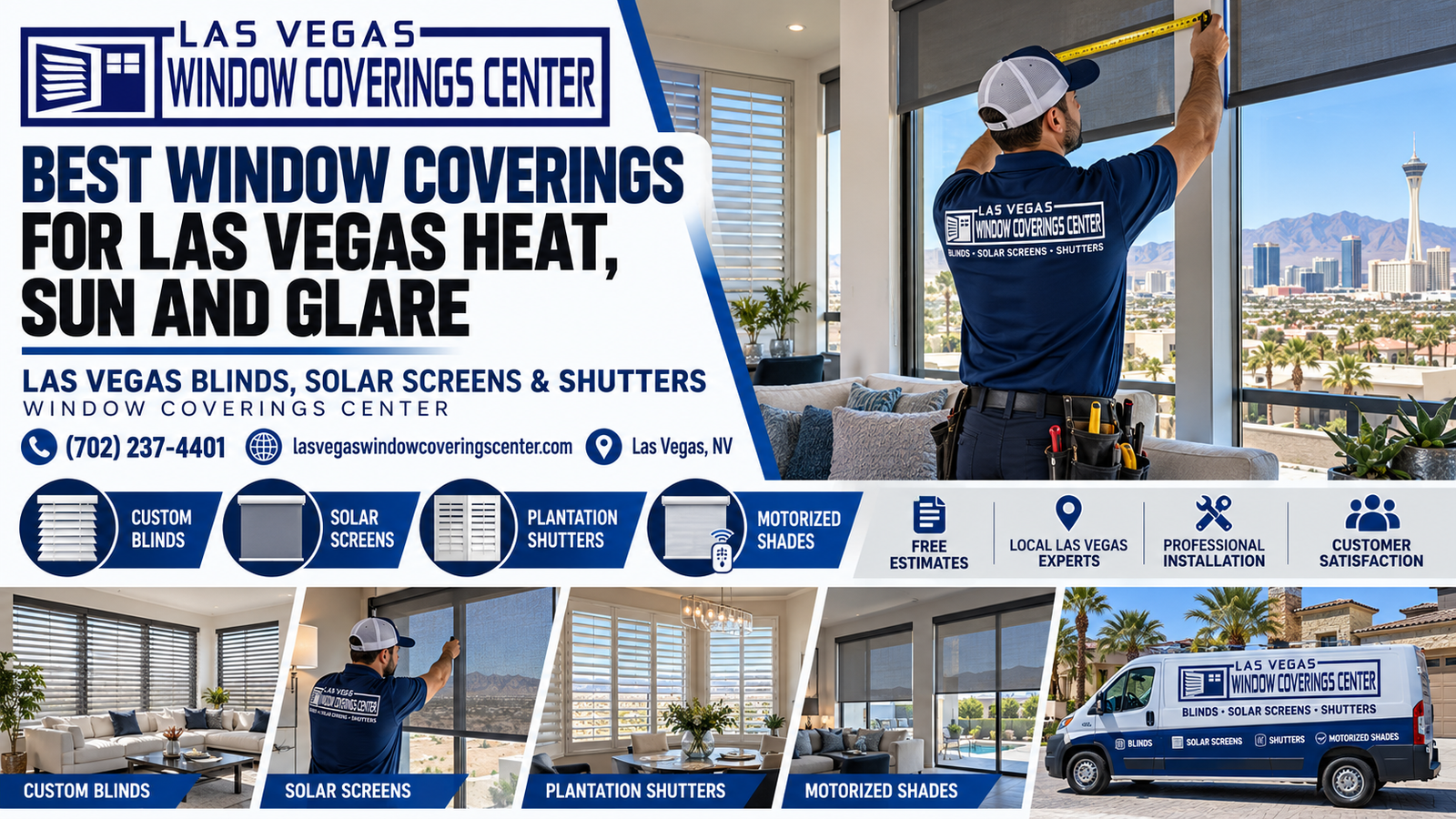
Las Vegas Window Coverings Center · Heat, Sun & Glare
The best window coverings for Las Vegas heat, sun, and glare start with the physics of desert light: stop sun before it hits the glass on the hottest elevations, then finish inside for glare control, privacy, and blackout. Exterior solar screens and exterior shades lead on west and south walls, while interior solar fabrics, cellular shades, blinds, and shutters handle the light jobs screens cannot. This guide covers elevation strategy, exterior vs. interior performance, openness and fabric color, AERC and PNNL science, blackout vs. solar mismatches, layered stacks, and why operation (including motorization) decides whether paper performance shows up in a real afternoon living room.
Start outside on the hottest glass, then finish inside for privacy and light control. Exterior solar screens (or exterior roller shades) block desert sun before it enters the pane—usually the highest-leverage move on west- and south-facing walls. Interior solar shades, cellular shades, blinds, or shutters then manage glare, views, night privacy, and blackout. No single product does every job: openness factor, fabric color, and whether you need sleep darkness change the answer room by room.
This page is the heat/sun/glare problem guide: elevations, exterior vs. interior physics, openness and color, AERC and PNNL science, blackout vs. solar fabrics, and layered stacks. For a three-way interior decision among blinds, shades, and shutters, see blinds vs shades vs shutters. For a four-family overview that includes screens in the matrix, see the best window coverings comparison.
Local context: The National Weather Service Las Vegas climate summary highlights abundant sunshine, triple-digit summers, an urban heat island near downtown and the Strip, monsoon thunderstorms in July–August, and strong winds with blowing dust that are most common in spring and fall. Those conditions define which elevations fail first and how exterior products weather.
Mild-climate advice often starts with style and ends with a light-filtering shade. In the Las Vegas Valley, afternoon west glass can make a living room uncomfortable even with the air conditioner running, and morning east sun can wash out monitors before anyone thinks about “decor.” Dust and UV also punish materials that look fine in a catalog photo.
Separate three complaints that people often merge into one word—“hot”:
A covering that kills glare may still leave heat high if it sits inside the glass. A screen that cuts heat may still leave a bedroom too bright for day sleep. Name the complaint before you shop.
The PNNL Building America Solution Center explains the difference clearly: exterior attachments typically reduce solar heat gain more effectively because they block sunlight before it passes through the window, while interior attachments remain versatile for privacy, daylight tuning, winter insulation, and finish. Reflecting heat back out after it has already entered the glass is harder than stopping it outside.
| Goal | Stronger starting choice | Why |
|---|---|---|
| Lower afternoon room temperature on west/south glass | Exterior solar screens or exterior roller shades | Sun is intercepted outside; absorbed heat stays outdoors |
| Kill TV / monitor glare while keeping a view | Interior solar shades (tuned openness/color) or tiltable blinds/shutters | Precise light steering without necessarily blacking out the room |
| Dark bedroom for shift sleep | Blackout shades or closed shutters | Screens and solar mesh are not designed for darkness |
| Night privacy on street-facing rooms | Interior blinds, shades, or shutters | Exterior screens alone are weaker for nighttime privacy |
| Compare specific rated products | AERC Warm Climate Rating | Independent energy ratings—see how to read the residential label |
DOE field studies cited by PNNL report roughly 15%–25% whole-home summer cooling savings from optimized use of high-efficiency window attachments. Treat that range as study context, not a utility-bill guarantee for your address. Results depend on how consistently coverings are closed when sun hits the glass.
Hardest afternoon load in most Valley homes. Prioritize exterior screens or high-performance exterior shades on living areas and patio walls. Add interior solar for glare/view or blackout where sleep matters.
Long daily sun exposure. Screens and solar fabrics perform well; shutters help when you want a sealed hard look. Still watch glare on polished floors and screens.
Morning glare into bedrooms, kitchens, and offices. Light-filtering or solar shades, or tiltable blinds, often beat heavy blackout unless you sleep late or work nights.
Milder heat. Privacy, style, and insulation can lead. Still choose UV-stable, dust-friendly materials; north is not “no sun forever.”
Skylights, clerestories, and two-story glass usually favor motorized interior shades because manual reach fails in daily life. Building America guidance also notes that operable shading on east and west glass is especially valuable because horizontal overhangs alone struggle with low-angle sun.
Exterior solar screens sit outside the window and filter sunlight while preserving outdoor view. They are often the first recommendation when a homeowner says “the west wall cooks every afternoon.” Mesh openness and color affect how much light and heat pass through; darker meshes typically absorb more light (better glare cut) while lighter meshes may look brighter from inside—ask to see samples on a sunny elevation, not only under indoor LEDs.
Retractable exterior solar shades are an alternative when you want to open the exterior layer fully for evening breezes or winter sun. Compare tradeoffs in screens vs. solar shades.
Interior solar roller shades are the workhorse for glare-plus-view rooms. Two specs matter more than the marketing name:
How much of the weave is open (commonly discussed in percentages). Lower openness generally means more privacy and more light/heat blocking; higher openness preserves more view and daylight. Match openness to the room—see solar shade openness.
Light vs. dark faces change how the room feels and how glare behaves. Darker faces often cut glare more aggressively; lighter faces can keep interiors brighter. Details in light vs. dark solar fabric.
Solar shades manage light after it enters the glass. On the hottest west walls, they pair well with exterior screens rather than replacing them. Use AERC Warm Climate Ratings when comparing specific rated models.
Homeowners often ask for “something that blocks the sun” and get offered a blackout shade for a living room that needed glare control and a view. Separate the jobs:
Compare blackout vs. room-darkening. Layering a solar shade for day with a blackout roller for night is common in west-facing primary bedrooms.
Not every heat/glare room needs a solar roller.
For which interior family fits which room overall, use the blinds vs shades vs shutters decision page and the fuller window coverings guide.
When two products look similar, use independent tools instead of brochure adjectives:
Ratings help you compare products. They are not a promise of a specific monthly bill change.
Layering costs more per opening, so use it where the problem is severe.
Apply layers to west living walls and primary bedrooms first. North secondary rooms rarely need a two-product stack.
DOE research summarized by Building America notes that many windows already have operable shading, yet relatively few are operated consistently for energy and comfort. A closed exterior screen or scheduled west shade outperforms an “efficient” product left open all afternoon.
Large openings: coverings for large windows. High-rises: automated roller shades for high-rises.
Safety still matters while you chase comfort: the CPSC says cordless is the only option that eliminates cord strangulation hazard; see also WCSC, WCMA standards (ANSI/WCMA A100.1-2022 effective June 1, 2024), and our safety guide.
Timing and install stages: best time to replace and how long installation takes. Cost drivers without invented stickers: custom cost in Las Vegas 2026. Visit 3871 S Valley View Blvd #6 or open the showroom on Google Maps.
Bring photos of the hottest elevations and problem rooms, or book a consultation to plan exterior and interior layers. Call (702) 237-4401, visit 3871 S Valley View Blvd #6, or find us on Google Maps. You can also reach the team on the contact page.
Las Vegas Blinds, Solar Screens & Shutters Window Coverings Center is a window treatment store at 3871 S Valley View Blvd #6, Las Vegas, NV 89103, offering custom measuring and professional installation of blinds, shades, plantation shutters, exterior solar screens, and motorized and smart-home window coverings. The team serves Las Vegas, Summerlin, Henderson, North Las Vegas, Spring Valley, Enterprise, Southern Highlands, Mountain’s Edge, Green Valley, Anthem, Paradise, Centennial Hills, Skye Canyon, Inspirada, Lake Las Vegas, and other Las Vegas Valley communities. Call (702) 237-4401 or see the business on Google Maps.
For the strongest heat control, start with exterior solar screens (or exterior shades) on west- and south-facing glass, then add interior solar shades, cellular shades, blinds, or shutters for privacy and light. PNNL Building America explains why exterior attachments often outperform interior ones for solar heat gain.
Exterior screens plus an interior solar or roller shade is a common high-performance pair. Shutters also work when you want a hard treatment. See screens vs. solar shades.
No. Solar mesh cuts glare and UV while keeping a view; it is not designed for sleep darkness. Use blackout or room-darkening fabrics—or shutters—for bedrooms. Compare blackout vs. room-darkening.
Yes. Openness and light vs. dark faces change glare, privacy, and how bright the room feels. Guides: openness and light vs. dark fabric.
Both can work. Blinds give precise tilt; solar shades preserve view while cutting glare. For the fuller interior three-way, see blinds vs shades vs shutters.
Use the AERC Warm Climate Rating and residential label, plus the Efficient Window Coverings tool. Ratings compare products; they are not a bill guarantee.
They excel at daytime heat and glare reduction but do not replace night privacy or blackout. Most homes still need an interior product on bedrooms and street-facing rooms.
Often for exterior products. Confirm mesh and frame colors before ordering—see the HOA-friendly study.
On tall or wide glass, yes—because performance requires use. Schedules that close west treatments before afternoon sun help. See motorized shades; hardwired electrical work should use a licensed electrician (Nevada State Contractors Board).
Map west and south problem windows first, decide exterior vs. interior (or both), then pick openness/blackout by room. Call (702) 237-4401 or get directions to the showroom.
The showroom is at 3871 S Valley View Blvd #6, Las Vegas, NV 89103, just west of the Strip. Open the listing on Google Maps for directions, hours, photos, and reviews, or call (702) 237-4401 before you visit.
Plan exterior and interior layers for your elevations and get a measured quote. Call (702) 237-4401 or open directions in Google Maps.
Las Vegas Blinds, Solar Screens & Shutters Window Coverings Center · 3871 S Valley View Blvd #6, Las Vegas, NV 89103 · (702) 237-4401 · lasvegaswindowcoveringscenter.com