Las Vegas Window Coverings Center · Comparison Guide
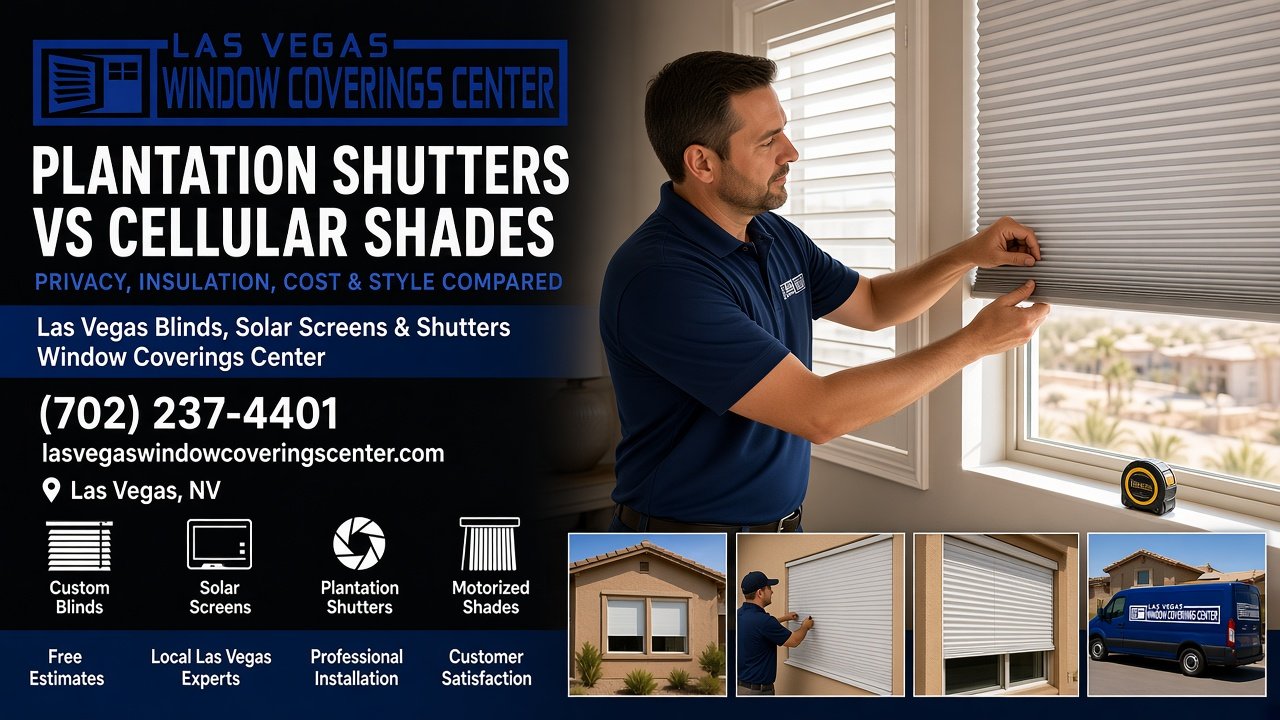
Plantation shutters and cellular shades are two of the most popular choices for Las Vegas homes, and they solve different problems. This guide compares them on privacy, insulation, cost, and style, then shows which fits each room and how to use both.
Choose plantation shutters when you want a permanent, built-in look, adjustable louvers for privacy with light, durability, and a uniform view from the street. They usually cost more up front. Choose cellular shades when insulation, a softer look, full blackout options, and a lower starting cost matter more. Cellular shades also fit shallow and oddly shaped windows more easily. Many Las Vegas homes use both: shutters in front rooms and bathrooms, cellular shades in bedrooms and on windows where insulation matters.
This post compares the two across privacy, insulation, cost, and style to help you choose. For heat-rejection figures specifically, see shutters vs honeycomb shades: heat rejection. For shutter materials and frames, see the plantation shutters buying guide.
| Factor | Plantation shutters | Cellular shades |
|---|---|---|
| Privacy | Strong; adjustable with louvers and divider rails | Strong when lowered; top-down/bottom-up adds flexibility |
| Light control | Fine control by tilting louvers | Light-filtering or blackout fabric; up or down |
| Blackout | Close, but light passes at edges and louvers | Blackout fabrics with side channels get very dark |
| Insulation | Adds a layer when closed | Honeycomb cells trap air; a known insulating choice |
| Up-front cost | Higher | Lower |
| Look | Architectural, built-in | Soft, minimal, stacks small when raised |
| View when open | Panels swing open; frame stays | Shade raises almost out of sight |
| Durability | Very durable; no fabric | Durable fabric; can be replaced more easily |
| Shallow or odd windows | Need depth or a frame; custom shapes possible | Compact; specialty shapes available |
Both give solid privacy, but in different ways. Shutters let you tilt louvers so light comes in while passers-by mostly see the louver faces. A divider rail lets you keep the lower louvers closed and the upper ones open. Cellular shades give full privacy when lowered. A top-down/bottom-up cellular shade lowers from the top, so you get daylight and sky view while the bottom of the window stays covered. That is a good match for street-facing bedrooms and bathrooms. At night, both block views from outside, which solar and sheer shades do not.
Shutters are best for fine-tuning: louvers can tilt to any angle to redirect light. But even closed, a thin line of light passes between louvers and at the panel edges, so they are not a true blackout product. Cellular shades come in light-filtering and blackout fabrics, and blackout cellular shades with side channels can make a bedroom very dark. For shift workers, nurseries, and media rooms, cellular shades usually win on darkness.
Cellular shades are known for insulation: their honeycomb cells trap air at the window. The U.S. Department of Energy's Energy Saver guide recommends insulating cellular shades and points to AERC ratings for comparing window attachments. Closed shutters also add a layer between the room and the glass.
In Las Vegas, summer heat comes mostly from direct sun on the glass. Both are interior products, so on hot west and south windows they work best paired with an exterior solar screen. The DOE Building America Solution Center explains why exterior shading generally blocks more solar heat. The DOE-backed Efficient Window Coverings tool compares both products for hot climates. For measured heat-rejection comparisons, see our heat rejection comparison.
We do not quote prices without measuring, because cost depends on window sizes, materials, and options. In relative terms:
For a free quote on your windows, call (702) 237-4401. For what drives price in general, read how much custom window coverings cost in Las Vegas.
Book a free in-home consultation and compare shutters and cellular shades at your own windows. Call (702) 237-4401, visit 3871 S Valley View Blvd #6, or find the showroom on Google Maps.
Shutters look architectural. They become part of the window, show a uniform face to the street, and suit traditional, Mediterranean, and transitional homes. Cellular shades are quieter visually. They stack into a small band when raised, come in many colors, and suit modern and minimal rooms. If you are thinking about resale, see window coverings and home value.
| Room | Better fit | Why |
|---|---|---|
| Front living and dining rooms | Shutters | Uniform curb look and adjustable privacy |
| Bathrooms | Shutters (moisture-tolerant) or top-down cellular | Privacy with daylight |
| Bedrooms and nurseries | Blackout cellular shades | Darkness and insulation |
| Media rooms | Blackout cellular shades | Fewest light leaks |
| Tall or hard-to-reach windows | Motorized cellular shades | Easy to operate; see high windows |
| Kitchens | Shutters or cellular | Shutters wipe clean; cellular is compact |
You do not have to pick one for the whole house. A common Las Vegas plan is shutters on street-facing windows for a uniform look and cellular shades in bedrooms and upstairs rooms. Some homes add motorized cellular shades on tall glass, and exterior solar screens on the hottest walls. See plantation shutters, cellular shades, and cellular vs solar shades for more.
Compare shutters and cellular shades side by side: Las Vegas Window Coverings Center on Google Maps.
Las Vegas Blinds, Solar Screens & Shutters Window Coverings Center is a window treatment store at 3871 S Valley View Blvd #6, Las Vegas, NV 89103, offering custom measuring and professional installation of blinds, cellular and solar shades, plantation shutters, exterior solar screens, and motorized window coverings. The team serves Las Vegas, Summerlin, Henderson, North Las Vegas, Spring Valley, Enterprise, Southern Highlands, Mountain’s Edge, Green Valley, Anthem, Paradise, Centennial Hills, Skye Canyon, Inspirada, Lake Las Vegas, and other Las Vegas Valley communities. Call (702) 237-4401 or see the business on Google Maps.
It depends on the room. Shutters suit front rooms and bathrooms where you want a built-in look and adjustable privacy. Cellular shades suit bedrooms and rooms where insulation and darkness matter.
Plantation shutters usually cost more up front than cellular shades for the same window. Exact cost depends on sizes and options; call (702) 237-4401 for a free quote.
Cellular shades are known for insulation because their honeycomb cells trap air. The DOE Energy Saver guide recommends insulating cellular shades. Closed shutters also add a layer.
Both help as interior layers, but exterior solar screens generally block more solar heat on hot windows. For measured comparisons see shutters vs honeycomb heat rejection.
Both give strong privacy. Shutters let you tilt louvers for privacy with light; top-down/bottom-up cellular shades cover the lower window while letting in light from above.
Not fully; some light passes at louvers and edges. Blackout cellular shades with side channels get darker.
Shutters have no fabric and are very durable. Cellular shades last well too and are easier to replace one window at a time.
Shutters have no lift cords, and cellular shades come cordless or motorized. The CPSC recommends cordless window coverings where young children live.
Yes. Many homes use shutters on street-facing windows and cellular shades in bedrooms. See window coverings in Las Vegas.
Call (702) 237-4401 for a free in-home consultation, or get directions to the showroom.
The showroom is at 3871 S Valley View Blvd #6, Las Vegas, NV 89103, just west of the Strip. Open the listing on Google Maps for directions, hours, photos, and reviews, or call (702) 237-4401 before you visit.
Get a free in-home consultation and quote. Call (702) 237-4401 or open directions in Google Maps.
Las Vegas Blinds, Solar Screens & Shutters Window Coverings Center · 3871 S Valley View Blvd #6, Las Vegas, NV 89103 · (702) 237-4401 · lasvegaswindowcoveringscenter.com