
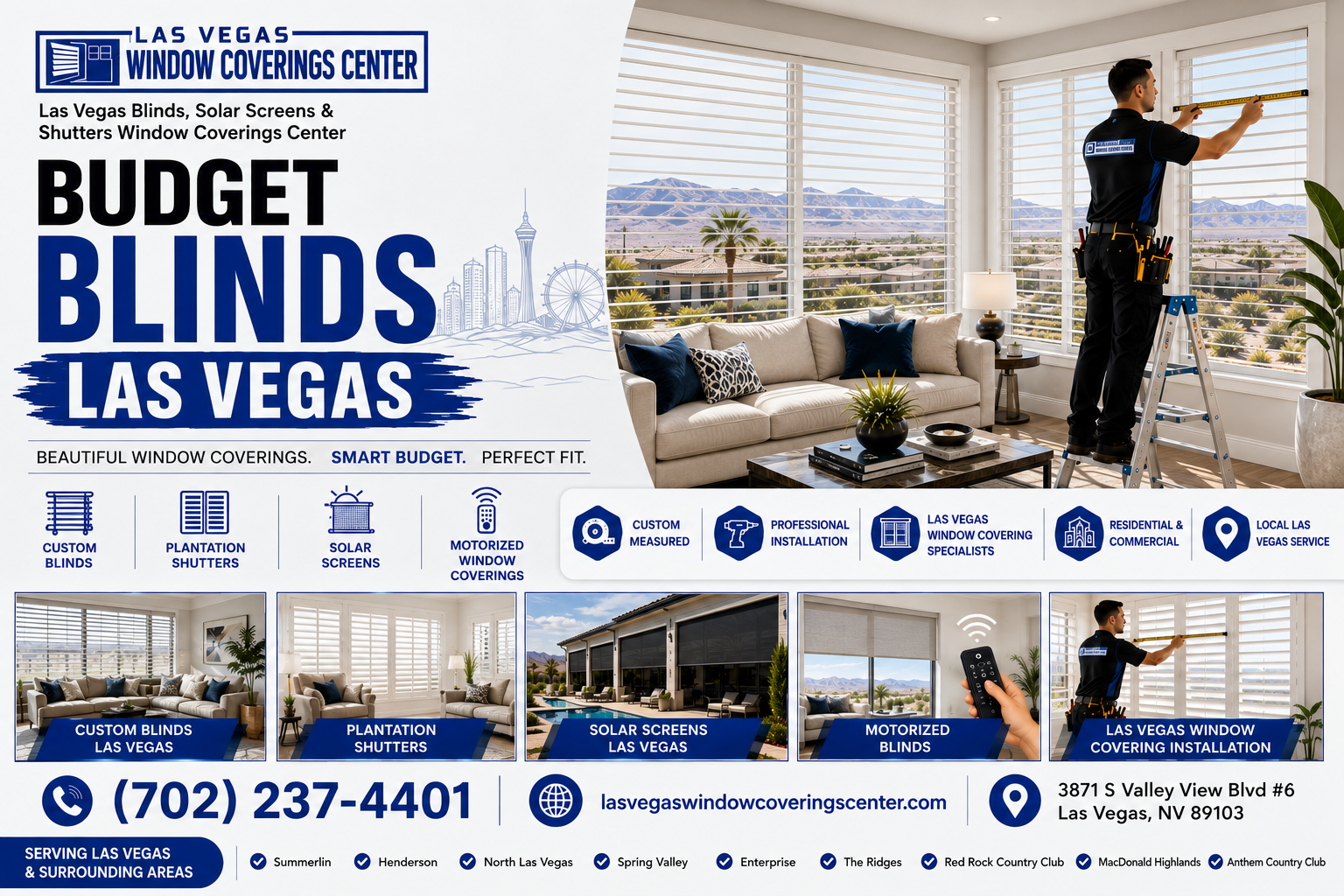
Budget Blinds Las Vegas
Searching for Budget Blinds Las Vegas often means you are trying to find attractive, functional window coverings without overspending. The smartest budget strategy is not simply choosing the lowest advertised price. It is matching the product to the room, window size, privacy needs, sunlight, operating style, and installation requirements so you do not pay for features you do not need—or replace a poorly fitted product later.
This guide from Las Vegas Blinds, Solar Screens & Shutters Window Coverings Center explains how Las Vegas and Summerlin homeowners can compare affordable blinds, shades, shutters, solar screens, and custom-measured options while keeping total project cost, fit, function, and long-term usefulness in perspective.
Quick Answer: How Do You Find Budget Blinds in Las Vegas Without Buying the Wrong Product?
A good budget window-covering strategy starts by controlling the factors that add cost without adding value for your specific room. Standard window sizes, simpler materials, manual operation, fewer decorative upgrades, and prioritizing the most-used rooms can help keep a project practical. Vinyl blinds, mini blinds, selected faux wood blinds, and some basic shades may fit budget-conscious projects, but the right option depends on window dimensions, privacy, sun exposure, durability needs, and appearance.
The lowest upfront price is not always the lowest total cost. A poorly measured blind can leave awkward gaps, interfere with handles, fit crookedly, or need replacement. A very inexpensive product on a heavily used or strongly sun-exposed window may also be less satisfactory than a modestly higher-cost option that better matches the opening and room.
Las Vegas homeowners should compare complete project scope rather than headline price alone. Ask whether the quote includes measuring, the exact product and material, hardware, installation, removal of old coverings, large-window or sliding-door considerations, and any motorization or specialty options. For current project-specific pricing, call (702) 237-4401.
What “Budget Blinds Las Vegas” Should Mean for a Smart Buyer
“Budget” does not need to mean flimsy, temporary, or poorly fitted. A better definition is a window covering that meets the room’s real requirements without adding unnecessary cost. The goal is to buy enough function, fit, privacy, and durability for the application while avoiding features that do not improve the way the room is used.
For example, a guest bedroom may not need motorized operation, premium decorative finishes, or a highly specialized mounting system. A rental property may benefit from a simple, easy-to-clean blind rather than a more decorative material. A large west-facing living-room window, however, may justify spending more because sunlight, glare, size, daily use, and appearance all make product selection more important.
A budget decision is therefore room-specific. The cheapest product in a catalog is not automatically the most economical choice for every window. The most economical choice is the product that performs acceptably for the expected use, fits correctly, and avoids unnecessary reordering or replacement.
Budget Is About Total Scope, Not Just Unit Price
A blind may have a low unit price but still become more expensive after oversized dimensions, custom fabrication, installation, specialty brackets, or multiple operating upgrades are added. Conversely, a custom-measured option may cost more initially but reduce the chance of ordering errors on a difficult opening.
When comparing window coverings in Las Vegas, ask for enough detail to understand what you are actually comparing. One quote may include professional measuring and installation while another may cover product only. Those quotes should not be treated as equivalent.
Avoid Paying for Features You Will Not Use
Motorization, upgraded fabrics, specialty finishes, decorative valances, smart-home controls, custom colors, premium woods, and unusual hardware can all add complexity or cost. They may be worthwhile where they solve a problem, but they should not be added automatically.
If the blind will be raised only occasionally, manual operation may be practical. If the room already has strong artificial lighting and you mainly need privacy, you may not need an elaborate daylight-control system. If the window is small and standard, a simple treatment may be enough.
Prioritize the Windows That Matter Most
Whole-home projects can become expensive because small differences multiplied across many windows add up quickly. One budget strategy is to prioritize high-impact rooms first. Living rooms, primary bedrooms, street-facing windows, offices, and strongly sun-exposed spaces may deserve the most attention. Secondary rooms can sometimes use simpler products.
What Actually Drives the Cost of Window Blinds in Las Vegas?
Pricing depends on more than material. A complete window covering project can be influenced by window size, number of openings, custom sizing, mounting style, product category, operating system, installation difficulty, and whether existing coverings need to be removed.
| Cost Factor | How It Affects Price | Lower-Cost Scenario | Higher-Cost Scenario | Question to Ask |
|---|---|---|---|---|
| Window size | Larger openings typically require more material and may need stronger components. | Standard bedroom window | Oversized living-room window | Is pricing based on final measured width and height? |
| Material | Vinyl, aluminum, faux wood, real wood, fabrics, and shutter materials differ in cost and construction. | Basic vinyl or mini blind | Premium wood or custom shutter | What material is included in this quote? |
| Operation | Manual systems are generally simpler than motorized systems. | Manual tilt and lift | Motorized or smart-home control | Which controls and power components are included? |
| Custom sizing | Made-to-measure products are built for specific dimensions. | Ready-made standard size | Custom opening or specialty shape | Is custom fabrication required? |
| Installation | Height, access, wall conditions, and mounting complexity affect installation labor. | Accessible standard opening | High or unusually wide window | Is installation included? |
| Removal | Existing products may need to be taken down and handled before new installation. | Empty opening | Existing shutters or multiple layers | Is removal part of the quote? |
| Sliding doors | Wide openings may require specialized track or vertical systems. | Standard window | Large patio slider | How is this wide opening priced? |
Window Dimensions
Width and height are basic cost variables because they determine how much product is required and whether the manufacturer can use a standard configuration. Very wide blinds may need different engineering or may not be available in every material. Large shades can become heavier. Wide shutters may require multiple panels.
Number of Windows
A whole-home project may offer design consistency, but multiplying even modest per-window upgrades across 10, 15, or 20 openings can significantly affect total cost. Homeowners working within a budget should decide whether every room needs the same specification.
Product Category
Blinds, shades, shutters, and solar screens are not interchangeable products. Their construction, mounting, hardware, manufacturing, and installation can differ. A “window covering” price without the product type is too vague to compare accurately.
Material
Material affects appearance, weight, maintenance, and general cost position. Vinyl and aluminum are often considered for simpler or budget-conscious applications. Faux wood can provide a more substantial wood-like appearance while remaining practical for many rooms. Real wood and custom shutters may occupy a different price category depending on specifications.
Motorization
Motorization can be useful on high windows, large windows, or coverings that are adjusted frequently. But if the main goal is keeping the project economical, manual operation is often worth considering where access is easy and convenience is not a priority.

Budget-Friendly Window Blind Types Las Vegas Homeowners Can Compare
There is no single “budget” material that works best everywhere. The most economical product depends on how much privacy, light control, appearance, maintenance, and daily use matter in the room.
Vinyl Blinds
Often considered for cost-conscious residential, rental, office, and utility applications where straightforward function and easy cleaning matter.
Mini Blinds
A compact horizontal-blind format that may work well for standard windows when basic privacy and tilt control are the priorities.
Aluminum Blinds
Lightweight horizontal blinds that can suit offices, rentals, utility rooms, and simple modern spaces depending on desired appearance.
Selected Faux Wood Blinds
May cost more than the simplest vinyl option but can provide a fuller appearance where budget and interior style need to be balanced.
Basic Roller Shades
Simple shade construction can be practical when a clean visual surface is preferred over adjustable slats.
Vertical Blinds
Often considered for sliding glass doors and broad openings where horizontal products may be less practical.
Vinyl Blinds
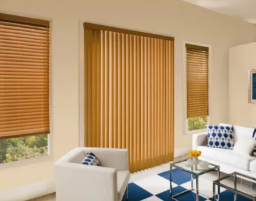
Vinyl blinds are commonly considered by shoppers focused on price because the material can support simple horizontal-blind designs and is relatively easy to wipe clean. They may be appropriate for rentals, guest rooms, utility spaces, offices, and other areas where straightforward privacy and light control matter more than a premium wood appearance.
However, homeowners should still compare slat quality, color, dimensions, headrail construction, tilt mechanism, lift system, and custom fit. A budget material does not eliminate the need for correct sizing.
Mini Blinds
Mini blinds use narrow horizontal slats and are familiar in apartments, offices, rentals, and many residential spaces. Their simple format can make them attractive for budget-focused projects, but they should be evaluated for the actual window size and the level of visual finish desired.
Aluminum Blinds
Aluminum is lightweight and can produce a clean, thin-slat appearance. It may suit contemporary offices, utility rooms, rentals, or homeowners who like a more minimal look. As with any blind, slats can bend if handled roughly, so the expected use matters.
Faux Wood Blinds
Faux wood blinds may be a middle-ground option for shoppers who want a more substantial horizontal-blind appearance while still managing cost. They can work in bedrooms, living areas, kitchens, rentals, and other spaces depending on exact material and product construction.
Homeowners can compare custom blinds in Las Vegas when deciding whether the cleaner fit and material selection of a made-to-measure blind justify the additional cost over a ready-made product.
Roller and Cellular Shades
Budget shoppers should not assume that blinds are always the lowest-cost answer. In some rooms, a simple shade may provide the required privacy and light control with a clean appearance. Cellular shades, roller shades, and light-filtering shades have different constructions and should be compared based on the room rather than category name alone.
How to Budget Window Coverings Room by Room
Treating every window exactly the same can make a project more expensive than necessary. A room-by-room plan lets you direct more of the budget toward the windows that have the greatest effect on comfort, privacy, design, or daily operation.
Living Room
Living rooms often have larger windows and greater visual impact. If this is the main entertaining area, spending slightly more on a product that fits cleanly and coordinates with the interior may be worthwhile. In a west-facing living room, light and glare considerations can also become more important.
Primary Bedroom
Privacy and light control may justify prioritizing the primary bedroom. Instead of automatically choosing the cheapest blind, consider whether a more effective shade, layered treatment, or better-fitting blind would improve sleeping conditions and privacy.
Guest Bedroom
Guest rooms are often good candidates for straightforward manual blinds or shades. They may not need motorization, upgraded decorative features, or the same level of daily-use durability as the primary bedroom.
Kitchen
Kitchens benefit from materials and finishes that are practical to maintain. The least expensive product is not a good value if the material is poorly suited to regular cleaning or the window is positioned near food preparation areas.
Bathroom
Privacy is usually the first priority. Depending on the room, moisture and cleaning considerations may influence material choice. A simple blind can work, but confirm that the material and mounting method make sense for the specific environment.
Home Office
Glare on screens can make light control more important than decorative upgrades. A budget-friendly product that provides effective tilt or shade positioning may deliver more value than a visually premium treatment that does not control the light where the desk is positioned.
Sliding Glass Doors
Large patio doors need a product designed around access. A low-priced product that constantly blocks the active door or is awkward to move may not be good value. Vertical blinds or other wide-opening treatments can be worth comparing.
Custom Blinds vs. Ready-Made Blinds: Which Is Better for a Budget?
Ready-made blinds can be attractive when the opening is close to a common size and the homeowner is comfortable with the available materials and dimensions. Custom blinds can make sense when fit, color, slat size, mounting method, unusual dimensions, or professional measuring matter more.
When Ready-Made Can Save Money
- The window is a standard size.
- The opening is easy to measure.
- A basic color and material are acceptable.
- The homeowner is comfortable with available mounting options.
- Exact edge coverage is not a critical design goal.
- The room is lower priority.
When Custom Can Prevent False Economy
- The opening is unusual or not perfectly square.
- Inside-mount depth is limited.
- Window handles or trim create obstructions.
- The homeowner wants a more exact visual fit.
- Multiple windows need coordinated sizing.
- The window is very large.
- The product is expensive enough that a measuring mistake would be costly.
The tradeoff is not “custom equals expensive” and “stock equals cheap.” It is better understood as flexibility versus simplicity. For some windows, ready-made products are entirely adequate. For others, custom measurement can reduce compromise and ordering risk.
If you are comparing budget options after reading about vinyl window blinds in Summerlin, consider whether the material alone solves the problem or whether fit, mounting, and privacy should receive equal attention.
Manual vs. Motorized Window Coverings on a Budget
Manual operation is usually the more straightforward choice when minimizing project complexity. For standard windows that are easy to reach, it can provide all the function a homeowner needs.
Motorization becomes more compelling when a window is high, large, difficult to reach, frequently adjusted, or part of a coordinated smart-home plan. In those situations, the added cost may solve a real accessibility or convenience issue.
| Feature | Manual | Motorized | Best Use | Budget Consideration |
|---|---|---|---|---|
| Operation | Hand-operated tilt/lift or shade movement | Remote, wall, app, or other supported control | Depends on accessibility | Manual is simpler where windows are easy to reach |
| High windows | May be inconvenient | Can improve access | Clerestory or tall openings | Motorization may justify extra cost |
| Power | No motor power required | Battery or wired depending on system | Smart-home or automation projects | Ask what power components are included |
| Maintenance | Simpler mechanical operation | Includes motor/control components | Convenience-focused projects | Consider future service needs |
Inside Mount vs. Outside Mount: A Budget Detail That Affects Fit
Mounting method can change how a blind looks and how forgiving the measurement needs to be. It can also affect light gaps, trim visibility, and whether the product fits within the window opening.
Inside Mount
An inside mount places the product within the opening. This can create a clean appearance, but sufficient depth is required. Narrow or irregular openings may limit what can be installed inside the frame.
Outside Mount
Outside mounting places the blind or shade beyond the opening. It can be useful when depth is limited or when wider coverage is desirable. It may also be more forgiving in some installations, but it still requires careful placement for a balanced appearance.
Why Mounting Matters to Budget
Ordering a blind that cannot be mounted as expected can turn a low-cost purchase into a waste. Before buying, confirm whether the opening has enough depth, whether handles interfere, whether trim affects bracket placement, and how much edge coverage you expect.

Budget Blinds and the Las Vegas Sun: Where It May Be Worth Spending More
Las Vegas homeowners deal with intense sunlight, bright interiors, long hot summers, and windows that can receive powerful west- or south-facing exposure. These conditions can influence whether the least expensive product is the most practical choice.
The U.S. Department of Energy notes that exterior sunscreens and interior blinds or shades can be used to reduce undesirable solar heat gain. That does not mean every blind produces the same energy result, and homeowners should be cautious about unsupported percentage-savings claims. Product type, window orientation, glazing, installation, and how the covering is used all matter.
West-Facing Windows
West-facing windows can receive strong late-afternoon sun. If glare is the main concern, adjustable slats may be useful because they can redirect light. If reducing direct solar exposure is more important, homeowners may also compare shades or solar screens in Las Vegas.
South-Facing Windows
South-facing exposure can create different patterns of sun throughout the year. Budget planning should consider how often the covering needs to be adjusted and whether the room benefits from preserving daylight while limiting glare.
Large Windows
Large glass can make both product quality and operation more noticeable. Very wide blinds can be heavy and may not be offered in every material. In some cases, multiple smaller products or a different shade system may be more practical than forcing the lowest-cost blind style onto a wide opening.
Mountain and Golf-Course Views
In communities such as Summerlin, The Ridges, and Red Rock Country Club, some homeowners want to preserve views while controlling glare and privacy. A budget plan should not automatically block an important view if a different product configuration would better support how the room is used.
How to Compare Budget Window Blind Quotes Apples-to-Apples
Price comparison is useful only when the scope is comparable. A lower quote may exclude measurement, installation, removal, motorization components, or hardware that another proposal includes.
Ask for a Written Scope
A written quote should identify enough product information for you to understand what you are buying. “Ten blinds” is not enough detail if one proposal includes vinyl, another faux wood, and another a different headrail or operating system.
Do Not Compare an Online Product Price With a Full-Service Installed Quote
Online-only prices may exclude measuring, installation, removal, local consultation, or problem solving. That does not make online ordering bad; it simply means the comparison must account for what each option includes.
Watch for Large-Window and Specialty Additions
Oversized windows, specialty shapes, difficult access, high windows, or sliding doors can change project cost. Ask about these conditions early so the final quote does not surprise you.
Safe Homeowner Checks Before Shopping for Budget Blinds
You can gather useful information before contacting a window covering company without taking unnecessary risks or attempting final custom measurement.
What Homeowners Should Not Do
Do not climb unstable ladders, attempt high-window installation without appropriate equipment, drill into unknown surfaces without understanding what is behind them, alter electrical wiring for motorized products without proper knowledge, or force a blind into an opening that is too narrow.
If exact custom fit matters, do not guess. A small measuring error can make a custom product unusable. Professional measuring can be especially useful for inside mounts, shutters, high windows, large openings, and multi-window projects.
If young children are present, operating-cord safety should be part of product selection. The U.S. Consumer Product Safety Commission advises that cordless window coverings are the safest option where young children are present.
Should You Adjust, Upgrade, or Replace Existing Blinds?
Budget-conscious homeowners do not always need to replace every window covering. Sometimes a small adjustment, cleaning, or hardware check is enough. In other cases, replacement becomes more practical because the product no longer fits the window or the room’s function.
Minor Adjustment May Make Sense When
- The blind is slightly misaligned.
- Slats simply need cleaning.
- A remote battery needs replacement.
- The mounting hardware needs inspection.
- The treatment is otherwise functional.
An Upgrade May Make Sense When
- You want cordless operation.
- You want motorization on a hard-to-reach window.
- Privacy needs have changed.
- The room now receives stronger afternoon sun because furniture or room use changed.
- A remodel changed the interior style.
- A sliding door needs a more practical treatment.
Replacement May Be More Practical When
- Slats are heavily damaged.
- The headrail no longer functions properly.
- The product no longer fits after a window replacement.
- The mounting system is failing.
- The covering no longer provides needed privacy or light control.
- The product repeatedly fails and repair is no longer practical.
Questions to Ask Before Buying Budget Blinds in Las Vegas
- What exact material is included? Vinyl, aluminum, faux wood, wood, and shade fabrics have different characteristics.
- Will my windows be professionally measured? Ask whether measurement is part of the service or your responsibility.
- Is this inside mount or outside mount? Mounting changes fit and appearance.
- How much window depth is required? This matters for inside mounting.
- What privacy should I expect? Daytime and nighttime privacy can differ.
- How does this product handle strong Las Vegas sunlight? Ask for a product-specific explanation rather than a vague energy claim.
- Does the quote include hardware?
- Does the quote include installation?
- Is removal of my existing blinds included?
- Are large windows priced differently?
- How are sliding glass doors handled?
- Can I keep manual operation to control cost?
- Can this product be motorized later? Not every system supports the same upgrade path.
- What maintenance does the material require?
- What light gaps should I expect?
- Can I see samples before ordering?
- Can I receive a written quote?
- What warranty applies? Ask for actual applicable terms rather than assuming.
Red Flags When Shopping for Low-Cost Window Blinds
A low price can be legitimate, but price alone does not prove value. Several warning signs together should encourage additional questions.
- The quote does not identify the product material.
- No one asks about window dimensions.
- Inside versus outside mount is never discussed.
- Window depth is ignored.
- Every room is given the same recommendation automatically.
- The company promotes “lowest price guaranteed” without clear written terms.
- A very low price excludes installation but that is not obvious.
- Oversized windows are not discussed until after ordering.
- Motorization is promoted without explaining controls or power.
- Privacy and light-control expectations are not discussed.
- Strong Las Vegas sun exposure is ignored on exposed windows.
- Custom measurements are guessed rather than confirmed.
- The business has no clear local contact information.
- Unverified awards or ratings are used to pressure the sale.
- You are pushed to order before understanding the specification.
Why Consider Las Vegas Blinds, Solar Screens & Shutters Window Coverings Center?
Las Vegas Blinds, Solar Screens & Shutters Window Coverings Center is a local Las Vegas window covering company serving homeowners, property managers, landlords, interior designers, small businesses, and commercial properties throughout Las Vegas, Summerlin, and nearby Las Vegas Valley communities.
For budget-focused shoppers, the advantage of comparing multiple product categories is that you do not have to assume the cheapest blind is automatically the right solution. You can compare custom blinds, faux wood blinds, vinyl blinds, mini blinds, Venetian blinds, shades, shutters, solar screens, motorized options, and sliding-door treatments according to the actual window and room.
Custom Blinds
Compare made-to-measure options where precise fit, privacy, or coordinated design matters.
Window Treatments
Compare blinds, shades, shutters, and related products when you are still choosing the right category.
Solar Screens
Consider exterior screen options for windows where direct sun and glare are major priorities.
Venetian Blinds
Compare horizontal slat systems for adjustable privacy and light control.
Professional Measuring
Useful when exact fit matters, particularly on inside mounts, large windows, shutters, and multi-window projects.
Local Las Vegas Service
Visit or contact the business from its Las Vegas location when comparing options for your project.
Business: Las Vegas Blinds, Solar Screens & Shutters Window Coverings Center
Address: 3871 S Valley View Blvd #6, Las Vegas, NV 89103
Phone: (702) 237-4401
Website: lasvegaswindowcoveringscenter.com
Budget Window Covering Service Areas Around Las Vegas
The business serves customers throughout the Las Vegas Valley from its physical Las Vegas location at 3871 S Valley View Blvd #6, Las Vegas, NV 89103. The communities below are service areas and do not represent separate business locations.
Budget-conscious blinds, shades, shutters, solar screens, and custom options.
Window coverings for privacy, strong sun, large windows, and modern interiors.
Custom and practical window treatments for contemporary homes.
Options for newer homes, west-facing windows, and large glass.
Easy-operation blinds, shades, and practical privacy options.
Window treatments for custom homes and large architectural windows.
Residential and commercial window covering options.
Blinds and shades for homes, rentals, and small commercial spaces.
Budget-conscious blinds, shutters, shades, and solar screen options.
Residential and commercial blinds and window treatments.
Custom and value-focused window covering options.
Blinds, shades, privacy treatments, and large-window solutions.
Complete Budget Strategy: How Las Vegas Homeowners Can Spend Smarter on Window Coverings
A strong budget plan is not created at the checkout screen. It starts earlier, when you decide which windows matter most, what each room needs, and which features are necessary versus optional. Many homeowners overspend because they compare finished products before they define the problem. Others underspend because they chase the lowest headline price and later discover that the blind does not fit, does not provide enough privacy, or is frustrating to operate.
Start With the Problem, Not the Product
Before choosing vinyl, faux wood, aluminum, a roller shade, a cellular shade, a shutter, or a solar screen, write down what you want the window covering to accomplish. Common goals include privacy, glare control, reducing direct sun entering the room, darkening a bedroom, improving appearance, hiding an unattractive view, preserving a desirable view, covering a sliding door, or making a high window easier to operate.
Once the main goal is clear, product choices become easier to eliminate. If you only need basic privacy in a secondary room, an elaborate motorized shade may be unnecessary. If you need precise nighttime privacy in a street-facing bedroom, a very basic slatted blind may not deliver the exact experience you want. If the window receives harsh afternoon sun, a decorative product selected only for color may not address the reason you started shopping.
Create Three Budget Levels
One useful planning approach is to separate rooms into essential, standard, and upgrade categories. Essential rooms are the places where privacy, glare, or existing broken coverings create a real need. Standard rooms need functional replacement but do not require premium features. Upgrade rooms are the spaces where you may want a more decorative material, custom finish, motorization, or a coordinated design.
This approach keeps a whole-home project from becoming an all-or-nothing decision. You can spend more in the primary bedroom or living room while selecting simpler treatments in guest rooms, laundry rooms, secondary offices, or rental spaces. The visual design can still be coordinated through color and general style even if every room does not use the same exact product specification.
Do Not Ignore Operating Frequency
A blind that stays in one position most of the time does not need the same operating features as a shade that is raised and lowered every morning and evening. Daily-use windows benefit from smooth, practical controls. A treatment on a rarely used decorative window may not justify the same upgrade.
Operating frequency also affects the value of motorization. Motorized products can be convenient, but they should solve a real daily-use issue. High clerestory windows, grouped shades, or a large living room wall of glass may justify remote operation. A small accessible bathroom window may not.
Think About Cleaning Before You Buy
Maintenance can influence value even when it does not change the purchase price dramatically. A product that is difficult to clean in a dusty or frequently used room can become frustrating. Las Vegas is a dry desert environment where dust can accumulate on horizontal surfaces, including slats and louvers.
If easy maintenance is important, compare how the material will be cleaned and how many individual slats, fabric folds, louvers, or panels are involved. A product that looks attractive in a showroom but does not fit your cleaning preferences may not be the best budget decision over time.
Use Color Strategically
Custom colors and specialty finishes can add cost depending on product line, but budget shoppers do not necessarily need a bland result. Neutral whites, off-whites, grays, and wood-look tones can coordinate with many Las Vegas interiors. Choosing a versatile finish can also make future furniture or paint changes easier.
The main goal is to avoid paying for a specialty finish simply because it is available. Ask whether the upgrade improves the room enough to justify the additional cost. If the blind is mostly hidden behind curtains, for example, a simpler finish may be perfectly acceptable.
Match Slat Size to the Window
Slat width changes the visual scale of a blind and can affect how much view is available when slats are tilted. Larger slats may look more proportional on bigger windows, while smaller slats can fit compact openings. Choosing the right scale can make an affordable blind appear more intentional.
Budget shoppers should not assume that the smallest or simplest slat is always the best. If the selected slat size looks out of scale on a large living room window, the homeowner may be dissatisfied even though the blind technically functions.
Use Curtains or Drapery Strategically Where Appropriate
In some rooms, a simple blind can provide basic privacy while separate decorative fabric handles the visual design. This layered approach can sometimes let homeowners keep the blind specification simple while changing the room’s appearance with curtains later. However, layering should be planned so hardware, trim, and window operation do not interfere.
Do Not Over-Specify Every Window
One common cost mistake is choosing the most advanced specification for every opening. If one room needs blackout performance, that does not mean every room needs the same treatment. If one high window needs motorization, that does not mean every ground-level blind must be motorized. If one large patio door needs a specialty system, that does not mean standard bedroom windows do.
A mixed specification can still look coordinated if color, general style, and trim relationships are considered. This can be especially helpful in larger Summerlin homes with many windows.
Plan for Sliding Doors Separately
Sliding doors often create a budget surprise because they are much wider than ordinary windows and require a treatment that works with frequent access. Instead of assuming the same blind used elsewhere will work, compare door-specific solutions early. This may include vertical blinds or other systems designed to move out of the active opening.
The most economical option is the one that allows the door to function without repeated frustration. A cheap treatment that blocks access, tangles, or has to be moved awkwardly every day is not truly budget friendly.
Use Professional Measuring Where an Error Would Be Expensive
DIY measuring can be practical for simple ready-made products when the homeowner understands the product requirements. But the cost of a mistake grows as the product becomes more custom. A made-to-measure blind, shutter, or specialty shade may not be returnable in the same way as a standard retail product.
Professional measuring becomes especially useful when openings are irregular, shallow, wide, high, or obstructed by trim and handles. The budget question is not simply “Does measuring cost money?” It is “What is the financial consequence if the measurement is wrong?”
Compare Product-Only and Installed Pricing Separately
If you are comfortable installing basic products yourself, product-only pricing may be relevant. If you need professional installation, compare installed quotes to other installed quotes. Mixing the two creates misleading comparisons.
Installation may include mounting, alignment, operation checks, and handling of larger products. Ask exactly what is included so you can decide whether doing part of the work yourself actually saves enough to justify the added responsibility.
Budget for the Difficult Windows First
Large, high, oddly shaped, or strongly sun-exposed windows are more likely to require special consideration. Get clarity on those openings early. Once you know the likely cost of the most difficult windows, it is easier to allocate the remaining budget across standard windows.
Keep a Contingency for Changes
Home improvement projects can reveal details after closer measurement: an opening may be less square than expected, a handle may interfere with the intended mount, or a wide blind may require a different product. A small contingency in the project budget can reduce pressure to make a poor product choice if conditions change.
Ask What Is Standard Before Selecting Upgrades
Product lines often include a standard set of colors, controls, and hardware with additional upgrades available. Before choosing extras, ask what the base configuration includes. You may find that the standard specification already meets the room’s needs.
Think About Resale and Rental Use Realistically
Landlords, investors, and homeowners preparing a property for sale often have different priorities from someone designing a long-term custom interior. Simple, neutral, easy-to-operate window coverings may make more sense than premium decorative treatments in those situations.
However, avoid choosing something so basic that the product looks mismatched with the property. A higher-end Summerlin home may benefit from a more substantial appearance in major rooms, even when the overall project remains budget conscious.
Use the Showroom to Narrow Choices Before Ordering
Photos on a phone or computer can make materials appear different from how they look in person. Seeing samples can help homeowners compare slat thickness, color, texture, opacity, and hardware before committing. This can reduce the chance of choosing a product that technically fits the budget but does not fit the room visually.
Prioritize Child Safety Where Relevant
Window covering operation should account for who lives in or visits the home. In homes with young children, CPSC recommends cordless window coverings as the safest option. Budget planning should therefore include safety rather than treating it as an optional decorative upgrade.
Do Not Buy a “Deal” Without Understanding Return Limitations
Custom products may have different return or remake rules than off-the-shelf products. Before ordering, ask what happens if a product is made correctly to the approved dimensions but the homeowner later changes their mind about color, mount, or material. Understanding these terms is part of responsible budget planning.
Ask About Availability Before Building a Design Around One Product
Product availability can change. If a specific color or configuration is central to the room design, confirm current availability before coordinating paint, furniture, or other finishes around it. The article does not assume a specific lead time because availability depends on current product and manufacturing conditions.
Be Careful With “Whole House Special” Language
Promotions can be useful, but the meaningful question is what the offer actually includes. A whole-house promotion may apply to selected materials, sizes, or operating systems. Ask whether the same specifications you want are included before treating the promotion as the basis for your budget.
Budget for Installation Quality, Not Just Product Quality
A good blind can still look poor if it is installed crooked, brackets are placed inconsistently, or neighboring windows are misaligned. Installation affects the visible result. If you do not have the tools, confidence, or experience to install the product cleanly, professional installation may be money well spent.
Do Not Confuse Privacy With Room Darkening
A product can provide privacy without making a room dark, and a product can reduce light without providing the exact nighttime privacy you expect. Clarifying the goal prevents paying for the wrong feature. A bedroom that needs sleep-focused darkness may require a different treatment from a street-facing living room that only needs adjustable privacy.
Think About Light Gaps Before Ordering
Every mounting method and product type can create different edge conditions. If minimizing visible light around the perimeter is important, discuss it before ordering. A budget blind may function perfectly but still disappoint a homeowner who expected complete blackout from a standard inside mount.
Use a Simple Decision Rule
For every window, ask five questions: What problem am I solving? How often will I operate the covering? How important is the appearance? How difficult is the window to measure or install? What happens if I choose too cheaply?
Those five questions can prevent both overspending and false economy. The result may be a basic vinyl blind in one room, a faux wood blind in another, a solar screen on a harsh west-facing window, and a motorized shade on a high opening. A mixed solution is not inconsistent when each product has a clear reason for being there.
Frequently Asked Questions About Budget Blinds Las Vegas
What are the most budget-friendly blinds for Las Vegas homes?
Vinyl blinds, mini blinds, aluminum blinds, and selected basic faux wood blinds are commonly considered for budget-conscious projects. The right choice still depends on window size, room use, privacy, sunlight, appearance, and maintenance. A lower-cost material is not a good value if it does not fit the opening or solve the room’s actual needs.
Are custom blinds always more expensive than ready-made blinds?
Custom blinds usually involve more measurement and manufacturing flexibility, but the comparison depends on the window. Ready-made blinds can be economical for standard openings. Custom sizing may be worthwhile on unusual windows, shallow frames, large openings, or projects where exact fit and coordinated appearance matter.
How can I keep a whole-home blind project within budget?
Prioritize high-use rooms, choose manual operation where motorization is unnecessary, use practical materials in secondary rooms, avoid decorative upgrades that do not improve function, and compare complete written quotes. You can also phase the project rather than installing the same premium specification on every window at once.
Should I choose manual blinds to save money?
Manual blinds are often the practical budget choice for accessible standard windows. Motorization may justify additional cost on high, large, difficult-to-reach, or frequently adjusted windows. The best decision depends on whether motorization solves a real accessibility or convenience problem.
What works well for strong Las Vegas sun without overspending?
The appropriate option depends on window orientation, desired view, privacy, and the amount of direct sun. Adjustable blinds, shades, and exterior solar screens are among the categories worth comparing. Avoid assuming one product automatically delivers a specific energy-savings percentage because actual performance varies by product and conditions.
How do I compare two budget blind quotes fairly?
Confirm that both quotes cover the same number of windows, measured dimensions, materials, operating systems, mounting method, hardware, installation, removal, oversized openings, sliding doors, and motorization components. A lower total is not necessarily a lower price for the same scope.
Are cordless blinds worth considering on a budget?
Cordless operation can be important where young children are present. The U.S. Consumer Product Safety Commission states that cordless window coverings are the safest option for homes with young children. When comparing budget products, include operating safety in the decision rather than focusing only on material price.
How can I request current budget blind pricing in Las Vegas?
Because pricing depends on window dimensions, product type, material, number of windows, custom sizing, mounting, installation, and options, request a project-specific quote. Call Las Vegas Blinds, Solar Screens & Shutters Window Coverings Center at (702) 237-4401 for current measurement, product, installation, and availability information.
Las Vegas Window Coverings Center Location
Las Vegas Blinds, Solar Screens & Shutters Window Coverings Center serves Las Vegas, Summerlin, and nearby communities from:
3871 S Valley View Blvd #6
Las Vegas, NV 89103
Need Help Building a Budget-Friendly Window Covering Plan?
A useful budget plan starts with the windows that matter most. Consider the room, dimensions, privacy, sunlight, mounting method, appearance, maintenance, manual versus motorized operation, and installation needs before deciding what to spend.
Las Vegas Blinds, Solar Screens & Shutters Window Coverings Center
3871 S Valley View Blvd #6, Las Vegas, NV 89103
Phone: (702) 237-4401