
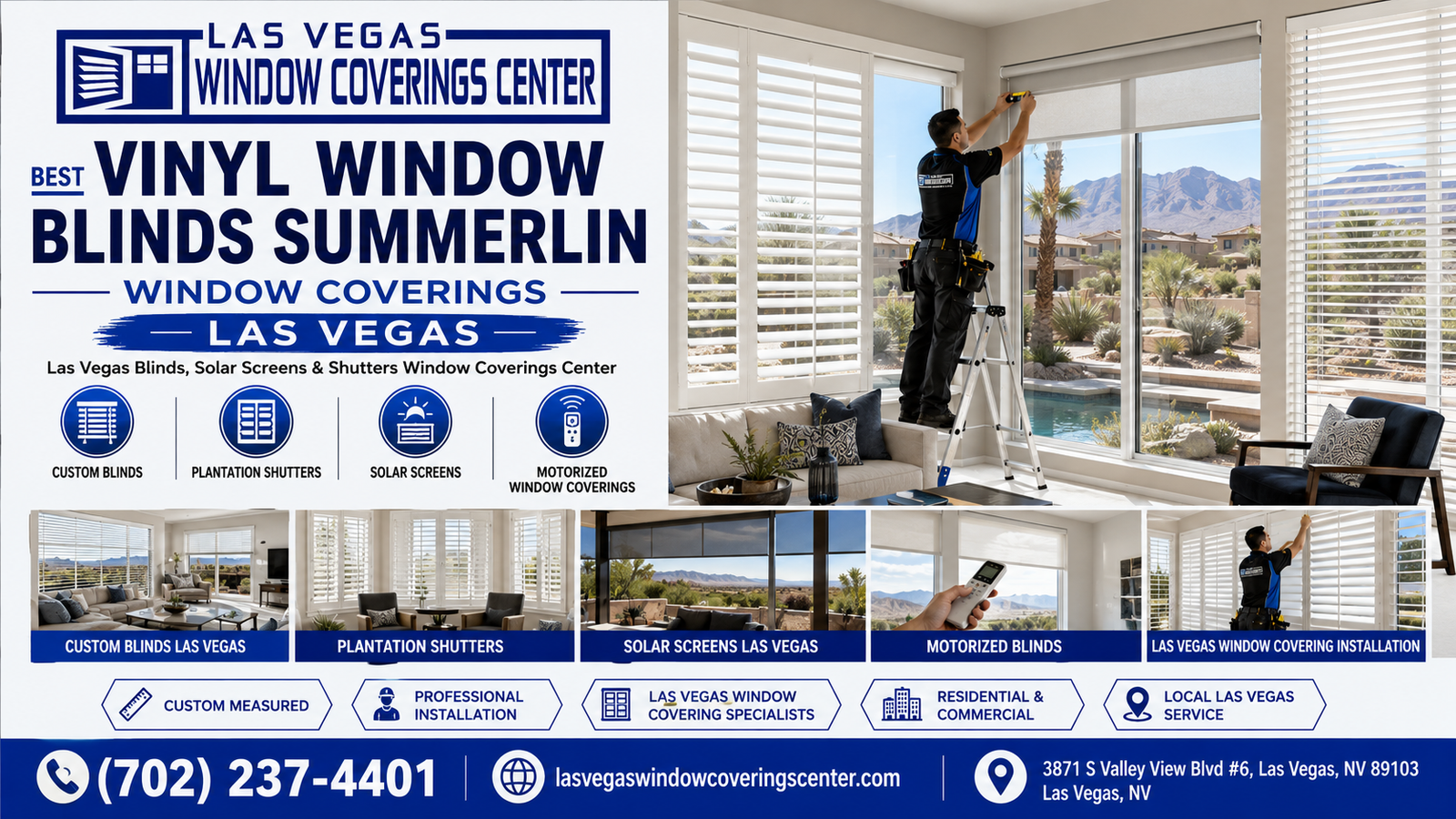
Vinyl Window Blinds Summerlin
Vinyl window blinds Summerlin homeowners consider are often selected for practical reasons: straightforward light control, privacy, wipe-clean maintenance, a broad range of standard applications, and a generally budget-conscious position compared with some heavier or more decorative window-covering categories. The important decision is not simply whether vinyl is inexpensive. It is whether the blind is properly sized, appropriate for the room, compatible with the window depth and trim, easy to operate, and suitable for the amount of sunlight the window receives.
This guide explains what vinyl blinds are, where they may work well in Summerlin homes, how they compare with faux wood and aluminum blinds, what custom sizing changes, how professional measuring reduces fit problems, and what to consider when a west-facing Las Vegas Valley window receives strong afternoon sun.
Prepared by Las Vegas Blinds, Solar Screens & Shutters Window Coverings Center, located at 3871 S Valley View Blvd #6, Las Vegas, NV 89103 and serving Summerlin, Las Vegas, and nearby Las Vegas Valley communities.
Quick Answer: Are Vinyl Window Blinds a Good Choice in Summerlin?
Vinyl window blinds can be a practical choice for many Summerlin rooms when the goal is adjustable privacy, everyday light control, easy cleaning, and a cost-conscious material. They are commonly considered for bedrooms, rentals, secondary rooms, offices, utility spaces, and other windows where function and simple maintenance matter. The right result still depends on the quality of the headrail, slats, lift and tilt system, window dimensions, mounting method, and installation.
Vinyl should not be selected by price alone. Compare how the material looks in the room, how wide the window is, whether the opening receives strong direct sun, whether the blind needs to be custom sized, how much privacy is required, and whether a heavier or more decorative material would better match the interior. For some homeowners, faux wood may offer a more substantial appearance; for others, aluminum may provide a slimmer profile; and for windows with significant sun exposure, a shade or exterior solar screen may deserve comparison.
For a Summerlin property, the most useful approach is to choose the product by window and room rather than using one blind everywhere. Professional measurement is especially useful where an inside mount is desired, the opening is not perfectly square, window depth is limited, or multiple windows need to align visually.
What Are Vinyl Window Blinds?
Vinyl blinds are horizontal or vertical window coverings that use slats made from vinyl or a related synthetic material. In a horizontal blind, the slats are connected to a headrail and operating system that allows the user to raise or lower the blind and tilt the slats. In a vertical blind, the vanes typically hang from a track and rotate to adjust light or slide to one side to open the view.
For many homeowners, the appeal of vinyl is simplicity. The material does not need to imitate natural wood perfectly to be useful. A well-selected vinyl blind can provide privacy, adjustable daylight, a neat appearance, and straightforward maintenance. The key is to evaluate the complete blind rather than only the slat material. Headrail quality, lift mechanism, tilt controls, mounting brackets, slat spacing, finish, and accurate sizing all influence daily performance.
Horizontal Vinyl Blinds
Horizontal vinyl blinds are often used on standard residential windows. Their slats tilt to regulate how much light enters and how much visibility there is through the window. Raising the blind opens the entire window, while lowering it and adjusting the slats allows a homeowner to balance privacy and daylight.
They may be available in different slat widths and finishes. Narrower slats can create a more traditional mini-blind appearance, while broader slats can create a stronger horizontal visual line. The appropriate width depends on the window, the room, the desired style, and the overall scale of the opening.
Vertical Vinyl Blinds
Vertical vinyl blinds are commonly considered for sliding glass doors and other wide openings because the vanes move horizontally with the access pattern of the door. They can rotate for light and privacy and stack toward one side when the opening needs to be clear.
Not every homeowner prefers the appearance of vertical blinds, so they should be compared with other wide-opening treatments. However, their functional relationship to sliding doors can make them worth considering when frequent access, practical cleaning, and straightforward operation are priorities.
Vinyl Is a Material, Not a Guarantee of Quality
Two products described as “vinyl blinds” may differ substantially in slat thickness, finish, headrail construction, operating system, size limits, bracket design, color stability, and overall feel. That is why shoppers should avoid treating the material label as a complete specification.
Ask to see the actual product or a representative sample when possible. Compare how the slats feel, how the controls operate, how the color looks next to your walls and trim, and whether the proposed size is appropriate for the opening.
Are Vinyl Window Blinds a Good Fit for Summerlin Homes?
Vinyl blinds can fit many Summerlin applications, but the right answer depends on the specific room. Summerlin includes compact condos, established single-family homes, active-adult communities, contemporary new construction, and high-end custom properties. Those homes can have very different window sizes, interior finishes, sun exposure, privacy needs, and expectations for the finished appearance.
A straightforward vinyl blind may be a strong practical choice in a secondary bedroom, rental, office, laundry area, or standard-size window where easy maintenance and adjustable privacy matter. In a highly visible formal living room, custom dining area, or large architectural opening, a homeowner may prefer to compare faux wood, real wood, plantation shutters, roller shades, cellular shades, or another treatment that better matches the room's design.
Standard Windows
Standard rectangular windows are often the easiest application for vinyl blinds. The main decisions are width, height, slat style, color, control type, and inside versus outside mount. Even on a standard opening, careful measurement matters because small differences in width can affect fit, slat clearance, and the amount of visible light around the edges.
Large Windows
As a blind becomes wider or taller, weight and operating forces increase. Some very large openings may be better divided into multiple blinds or handled with a different product. The best design depends on the window dimensions, mullions, furniture, view, and how often the treatment will be raised.
A homeowner considering vinyl for a large Summerlin window should ask whether the specific product is engineered for that width and whether a split configuration would improve operation and alignment. “Vinyl” by itself does not answer those questions.
Sliding Glass Doors
A sliding door needs a treatment that allows practical access. Vertical vinyl blinds can be a functional option because their direction of travel follows the door. However, homeowners should also compare stack-back space, furniture placement, traffic patterns, privacy, and appearance.
High Windows
High windows can make manual operation inconvenient. For those openings, a different treatment or motorized shade may make more sense than a basic manually operated vinyl blind. The decision should be based on daily use, not just material cost.

Advantages and Tradeoffs of Vinyl Window Blinds in Summerlin
A useful product comparison should identify both strengths and limitations. Vinyl blinds can work well in many applications, but they are not automatically the best treatment for every room.
Practical Maintenance
Smooth vinyl slats are generally straightforward to dust and wipe. This can be useful in rooms where simple upkeep is important.
Adjustable Light
Tilting the slats allows the homeowner to change the direction and amount of daylight without fully raising the blind.
Privacy Control
Closed slats can provide privacy, while partially open slats allow more light. Nighttime privacy should still be evaluated with interior lights on.
Budget Positioning
Vinyl is often considered when cost control matters, but exact pricing depends on size, quality, customization, controls, and installation.
Design Tradeoffs
Some homeowners prefer the richer appearance of wood, faux wood, woven materials, or shutters in formal or highly visible rooms.
Sun Exposure Matters
Strong direct Las Vegas sunlight can influence product selection. A heavily exposed window may deserve comparison with shades or exterior solar screens.
Why Easy Cleaning Can Matter in the Desert
The Las Vegas Valley is dry and dusty. Any horizontal blind can collect dust on the top surface of the slats, so the ability to wipe the material easily may be useful. A simple microfiber cloth, duster, or manufacturer-approved cleaning method is often more practical than a product requiring specialized care.
The amount of cleaning required depends on the room and how often windows or doors are opened. Kitchens, patio doors, and high-traffic areas may need more frequent attention than guest bedrooms.
Why Appearance Should Be Judged in the Actual Room
Product photos can make different materials look similar on a screen. In person, finish, texture, slat thickness, sheen, and color temperature can change how the blind relates to paint, flooring, cabinetry, trim, and furniture. Summerlin homes with modern Southwest interiors may call for a different finish than a traditional home.
If the room is visually important, compare samples next to the actual surfaces before finalizing the order.
Where Vinyl Blinds May Work Best: A Summerlin Room-by-Room Guide
Bedrooms
Vinyl blinds can work well in bedrooms when adjustable privacy and everyday light control are the main goals. Homeowners who need stronger room darkening should compare whether the blind alone is sufficient or whether a shade, drapery, or layered treatment would better meet the objective.
Pay attention to nighttime privacy. During daylight, tilted slats may allow light while limiting direct views. At night, interior lighting changes visibility conditions. The most private setting is generally with the slats fully closed, but edge gaps and product design still matter.
Home Offices
In a home office, glare can be as important as privacy. A vinyl blind can be adjusted through the day to redirect sunlight away from a screen. However, on a strongly exposed west-facing window, the homeowner may want to compare solar shades or exterior solar screens if glare and solar heat are major concerns.
Kitchens
Kitchens need window coverings that fit around counters, sinks, handles, and potentially higher levels of airborne grease or moisture than some other rooms. Vinyl can be attractive for easy wipe-down, but the exact placement of the window matters. A treatment directly behind a sink, stove, or frequently used counter should be selected with practical cleaning and safe clearance in mind.
Bathrooms
Bathrooms often prioritize privacy and maintenance. A vinyl product may be considered because it is not natural wood, but homeowners should still confirm whether the specific blind and hardware are appropriate for the room's conditions. The headrail, cords, tapes, and metal parts may have different material properties than the slats.
Living Rooms
Living rooms tend to be more design-sensitive. Vinyl blinds can work, especially where simplicity is preferred, but this is also where faux wood, real wood, shutters, woven shades, roller shades, or motorized treatments may be worth comparing.
If the room has a view toward Red Rock or a golf course, the homeowner may prefer a treatment that preserves more open glass when raised. If the room receives strong afternoon sun, glare management may be more important than material cost.
Rental Properties
Landlords and property managers often prioritize cost control, straightforward replacement, neutral appearance, and easy cleaning. Vinyl blinds can fit those priorities, but durability still depends on the specific product and how tenants use it. A low upfront cost may not be economical if a blind is poorly sized, hard to operate, or repeatedly damaged.
Commercial Offices and Small Businesses
Vinyl blinds can be used in some commercial settings where practical light control and privacy are needed. For larger offices, storefronts, conference rooms, or heavily used spaces, compare operation, size limits, cleaning, color consistency, and whether a commercial-grade alternative would better fit the usage pattern.
Vinyl vs. Faux Wood vs. Aluminum Blinds in Summerlin
Summerlin shoppers often compare vinyl with faux wood and aluminum because all three can provide adjustable slat-based light control. The materials differ in appearance, weight, feel, maintenance, and the types of rooms where they are commonly considered.
| Blind Material | Appearance | Maintenance | Weight | Moisture Considerations | Best Rooms | Budget Position |
|---|---|---|---|---|---|---|
| Vinyl | Clean, simple, available in neutral finishes | Generally easy to dust and wipe | Often lighter than many faux-wood products | Slat material is synthetic; confirm complete product suitability for room conditions | Bedrooms, rentals, offices, utility spaces, standard windows | Often considered cost-conscious, depending on size and quality |
| Faux Wood | Wood-look appearance with thicker slats | Typically straightforward to clean | Can be heavier, especially on large blinds | Often considered where natural wood may be less desirable | Bedrooms, living rooms, kitchens, family rooms | Varies by construction, finish, size, and controls |
| Aluminum | Thin, crisp, contemporary or utilitarian look | Dusts and wipes clean; slats can bend if mishandled | Generally lightweight | Confirm hardware and finish suitability for room conditions | Offices, modern interiors, utility spaces, standard windows | Varies widely by quality and configuration |
Vinyl vs. Faux Wood
Faux wood blinds are often chosen when the homeowner wants a more substantial slat and a visual style closer to painted or stained wood. Vinyl can be a better fit when simplicity, lighter visual weight, and practical cost control are more important.
On large openings, weight should be discussed. A very wide faux wood blind can become heavy, while a lighter product may be easier to operate. The exact difference depends on the product, so ask about size limits rather than assuming one material is always lighter enough for every opening.
Vinyl vs. Aluminum
Aluminum blinds often use thinner slats and can create a sharper, more minimal appearance. Vinyl may feel softer visually and can be attractive for residential rooms where a basic neutral covering is desired. Aluminum slats can dent or bend when mishandled; vinyl can also be damaged, so households with pets, children, or frequent contact should consider how the blind will be used.
Vinyl vs. Wood
Real wood offers natural grain and a warmer visual character that vinyl does not try to duplicate perfectly. Wood may be appropriate for formal rooms and design-sensitive interiors, while vinyl may be more practical for budget-focused or maintenance-focused applications.
The right answer depends on the room. A guest bedroom, rental, or office may not need the same material investment as a main living area with custom millwork.
If you are comparing several categories, review the broader guide to best window blinds for Summerlin by use case rather than choosing solely by material name.
Custom Vinyl Blinds vs. Ready-Made Blinds
One of the most important decisions is not just material; it is whether the blind is made to the actual opening or purchased in a standard size. Ready-made blinds can work when window dimensions closely match available products and the homeowner is comfortable with the resulting fit. Custom sizing provides more control when dimensions, clearances, alignment, or appearance matter.
When Ready-Made Vinyl Blinds May Make Sense
Ready-made products may suit a simple budget project where the windows are standard sizes, the homeowner accepts standard colors and operating options, and exact edge coverage is not a major concern. They can also be practical for temporary applications or spaces where design customization is not a priority.
The main risk is assuming that “close enough” dimensions will perform like a measured product. A blind that is too wide may rub or not fit an inside mount. A blind that is too narrow may leave larger light gaps or look visually undersized. A blind that is too short or too long can affect the finished appearance.
When Custom Vinyl Blinds May Be Worth It
Custom sizing may make sense when an inside mount is important, several side-by-side windows need visual alignment, the opening is not a common size, the homeowner wants a particular slat or control option, or the project covers many rooms where consistency matters.
Professional measurement can also identify whether the opening is square, whether window depth is adequate, and whether handles or trim will interfere with the blind.
Custom Does Not Automatically Mean Expensive
Custom simply means the product is configured to the project rather than selected only from a standard size. Pricing depends on material, dimensions, options, controls, number of windows, and installation. A custom vinyl blind can still be a cost-conscious option relative to more elaborate treatments, but homeowners should request an actual quote rather than assuming a fixed category price.
Learn more about custom blinds when precise fit is a priority.
Professional Measuring for Vinyl Window Blinds in Summerlin
Accurate measuring is one of the most important steps in any blind project. Vinyl is a forgiving material in some respects, but it cannot correct a blind that was ordered too wide, too narrow, too long, or with insufficient mounting clearance.
Width
Width determines whether the blind fits between the sides of an inside-mounted opening or covers enough area as an outside mount. Inside-mount windows should be measured at multiple points because an opening may not be perfectly square.
Height
Height affects how much material is needed and where the lower rail rests when the blind is fully lowered. For doors or very tall windows, height can also affect operation.
Window Depth
Depth is crucial for inside mounts. The headrail and mounting brackets need adequate room. A shallow opening may allow only a partial recess or may require an outside mount instead.
Trim, Handles and Cranks
Existing trim, handles, cranks, locks, alarm sensors, and other obstructions can influence the mounting position. These details should be identified before the blind is ordered.
Side-by-Side Windows
Multiple windows in one visual group require planning. The homeowner may want headrails aligned, slat lines to appear consistent, and gaps between blinds to look intentional. Professional measuring can help coordinate those details.
Sliding Doors and Wide Openings
If vertical vinyl blinds are being considered for a sliding door, measure the full width and height while also considering the stack-back position, active door panel, handle clearance, floor level, and nearby furniture.
Inside Mount vs. Outside Mount for Vinyl Blinds
Mounting style affects appearance, fit, light gaps, and how the blind interacts with trim.
Inside Mount
An inside mount places the headrail within the window opening. This can create a clean look and preserve visible trim. It requires enough depth and suitable surfaces for the brackets. Inside mounts also typically leave some side clearance so the blind can move without rubbing.
If room darkening is a major goal, those side gaps should be discussed before ordering. A standard blind is not the same as a blackout system.
Outside Mount
An outside mount places the blind over the opening or trim. This can be useful when depth is limited, the opening is uneven, or broader coverage is desired. It can also visually enlarge the window when the blind is sized beyond the frame.
Outside mounts require careful positioning so the blind is level, centered, and attached to appropriate support.
Which Is Better?
Neither is universally better. Inside mount often looks integrated and clean; outside mount can improve coverage and solve depth limitations. The correct choice depends on the actual opening and design goal.
Privacy and Light Control With Vinyl Blinds
Slatted blinds are useful because the homeowner can adjust light without fully opening the window covering. However, the direction of slat tilt affects both visibility and daylight.
Daytime Privacy
During bright daylight, partially closed slats can reduce direct views while still allowing some light. The exact privacy level depends on viewing angle, floor level, window orientation, and how far the slats are open.
Nighttime Privacy
At night, interior lights can make a room more visible from outside. Homeowners should evaluate privacy with the slats closed and the interior lights on. If greater privacy is required, a different or layered treatment may be appropriate.
Glare Control
Tilting the slats can redirect sunlight, which may help when a television or computer screen is affected by glare. For very intense sun, a blind may be one part of the solution rather than the only product worth considering.
Room Darkening
Standard vinyl blinds usually have gaps between the slats, at the headrail, and around the edges. They should not be described as blackout unless the specific product is designed and documented for that purpose. Bedrooms requiring stronger darkness may benefit from a room-darkening shade, drapery, or layered approach.
Vinyl Blinds, Las Vegas Sun, Heat and Glare
Las Vegas and Summerlin receive intense sunlight for much of the year. West-facing windows can be particularly challenging in the late afternoon, when direct sun may create glare and unwanted heat in the room.
The U.S. Department of Energy notes that interior blinds and shades and exterior sunscreens can help reduce undesirable solar heat gain. That does not mean every vinyl blind provides the same performance or that a blind alone will solve every heat problem. Product type, color, fit, window glass, orientation, and how the treatment is used all matter.
West-Facing Summerlin Windows
For a west-facing bedroom or office, a vinyl blind may provide useful directional light control. If the priority is stronger glare reduction or managing direct sun before it reaches the glass, compare an interior shade or exterior solar screen as well.
South-Facing Windows
South-facing windows can also receive significant sunlight. The right treatment depends on the season, overhangs, exterior obstructions, glass type, and how much daylight the homeowner wants to preserve.
Views and Daylight
Summerlin homes near the western valley may have mountain views. A homeowner who wants to preserve the view may prefer to raise a blind during lower-glare periods and close or tilt it when direct sun becomes uncomfortable. A shade with a different openness level may also deserve comparison.
Avoid Unsupported Energy-Savings Claims
It is reasonable to discuss solar heat and shading, but no responsible window-covering guide should promise a specific utility-bill reduction from vinyl blinds without product-specific and building-specific evidence. Treat energy comfort as one decision factor, not a guaranteed percentage.

Vinyl Blind Installation Considerations
Good installation should leave the blind level, secure, easy to operate, and compatible with the window. The installer should verify that the brackets are attached appropriately, the headrail seats correctly, the blind moves without binding, and the tilt system operates as intended.
Bracket Placement
Brackets need suitable support. Their location depends on the product and mounting method. Homeowners should not assume that every blind uses the same screw pattern or support requirements.
Alignment
Alignment is especially visible when multiple blinds share one wall. Small differences in headrail height or tilt can make a multi-window installation look inconsistent.
Operational Check
After installation, raise and lower the blind, tilt the slats in both directions, and check whether it rubs against trim or handles. If the blind is cordless, confirm that it stays at the desired height and moves smoothly.
High Windows and Ladders
High-window installation can introduce fall risk. Homeowners should not use unstable ladders or improvised platforms. A window that is difficult to reach may also be a signal that a motorized or differently operated product would be more practical.
Child Safety
The U.S. Consumer Product Safety Commission advises that cordless window coverings are the safest option where young children are present. When selecting a vinyl blind for a child's room or a home where children frequently visit, operating-system safety should be part of the product decision.
Cleaning and Maintaining Vinyl Window Blinds
Maintenance is one reason homeowners consider vinyl. The slats can usually be dusted and wiped, but the exact cleaning method should follow the product's instructions.
Routine Dusting
Close the slats in one direction and dust the surface, then reverse the tilt and clean the other side. A microfiber cloth or appropriate duster can help remove the dry dust common in the Las Vegas Valley.
Spot Cleaning
For marks or residue, use only cleaning products compatible with the blind's finish. Avoid harsh chemicals unless the manufacturer specifically allows them. Test any cleaner in a small inconspicuous area first.
Do Not Force the Slats
If a slat is caught or bent, avoid forcing the tilt mechanism. Check whether the blind is obstructed. Repeated forcing can damage the operating system even when the slat material itself appears flexible.
Check the Headrail and Controls
A blind is more than its slats. If the lift or tilt system becomes difficult to operate, stop and inspect the product rather than pulling harder. In some cases an adjustment may be possible; in others replacement may be more practical.
Vertical Blind Maintenance
Vertical vanes should hang freely without catching on furniture or door handles. Track operation should be smooth. If individual vanes are damaged, ask whether they can be replaced separately or whether the system requires a larger repair.
What Affects the Cost of Vinyl Window Blinds in Summerlin?
Vinyl is often associated with budget-friendly blinds, but there is no single accurate price for every Summerlin project. The final cost depends on the dimensions and scope of the order as well as the quality and options selected.
| Cost Factor | How It Affects Price | Lower-Complexity Scenario | Higher-Complexity Scenario | Question to Ask |
|---|---|---|---|---|
| Window size | Larger blinds require more material and may need different construction | Standard bedroom window | Oversized living-room opening | Is this product rated for the full width? |
| Number of windows | Whole-home projects involve more product and labor | One or two windows | Multiple rooms or an entire property | Is the quote itemized by window? |
| Custom sizing | Made-to-measure products require project-specific dimensions | Ready-made standard size | Custom dimensions or special configuration | What is custom about the order? |
| Operating system | Cordless or specialized controls may affect product configuration | Basic standard operation | Upgraded control system | Which control is included? |
| Installation | Access, mounting surface, and quantity influence labor | Accessible standard windows | High, wide, or difficult openings | Is professional installation included? |
| Removal | Existing treatments may need to be taken down | Empty window | Existing blinds, shutters, or hardware | Is removal included in the scope? |
Do Not Compare Quotes by Total Price Alone
A quote for vinyl blinds should identify what is included. Two totals may look different because one includes measuring and installation while another is product-only. One may use a custom size while another uses a cut-down stock product. One may include cordless operation, upgraded headrails, or removal of old blinds.
Ask for a written scope and compare the same elements. If current pricing is important, call (702) 237-4401 for measurement-based information rather than relying on a generic online price.
Should You Adjust, Upgrade or Replace Existing Vinyl Blinds?
Minor Adjustment May Make Sense When
- The blind is basically functional but slightly misaligned.
- The slats need cleaning rather than replacement.
- A bracket needs inspection or tightening.
- The blind rubs lightly because of a small alignment issue.
- The product still fits the window and serves the room's needs.
Upgrade May Make Sense When
- You want cordless operation.
- Privacy needs changed.
- The room now receives stronger glare because furniture or screen placement changed.
- A remodel changed the room's style.
- You want a more substantial faux wood or wood appearance.
- You want a room-darkening shade instead of a slatted blind.
- You are adding a solar screen to a strongly exposed window.
Replacement May Be More Practical When
- Many slats are cracked, bent, or missing.
- The headrail no longer operates correctly.
- The blind repeatedly jams or falls out of alignment.
- The window was replaced and the old blind no longer fits.
- The mounting system is damaged.
- The existing blind no longer provides the privacy or light control you need.
Replacement should solve a functional or design problem. Do not upgrade simply because a more expensive product exists. A well-fitted vinyl blind can still be the right choice when it matches the room and usage.
Safe Homeowner Checks Before Ordering Vinyl Blinds
Homeowners can gather useful information before a consultation without taking unnecessary risks.
What Homeowners Should Not Do
Do not climb unstable ladders, drill into unknown surfaces without understanding what is behind them, force an oversized blind into an opening, guess final custom dimensions when fit matters, modify motorized components without appropriate knowledge, or use unsafe cord configurations around young children.
Questions to Ask Before Buying Vinyl Window Blinds in Summerlin
- Is vinyl appropriate for this room? Ask what advantages and tradeoffs apply to the specific window.
- Will the windows be professionally measured? This matters especially for custom inside mounts.
- Is inside mount or outside mount recommended? Ask why.
- How much window depth is required? Headrail depth can determine whether an inside mount is possible.
- What slat width is available? Slat scale changes the appearance.
- How does vinyl compare with faux wood for this room? Compare weight, appearance, maintenance, and budget.
- How does vinyl compare with aluminum? Compare slat thickness, visual style, and maintenance.
- What privacy should I expect at night? Evaluate with the slats fully closed.
- How will this blind handle strong afternoon sun? Ask whether another treatment should be compared.
- Are cordless options available? This is especially important where young children are present.
- Does the quote include professional installation?
- Does it include mounting hardware?
- Are oversized windows handled differently?
- Is the blind appropriate for a sliding glass door? A vertical product may be more practical.
- What maintenance does the finish require?
- What light gaps should I expect?
- Can I see a material or color sample?
- What exactly is included in the written quote?
Red Flags When Shopping for Vinyl Window Blinds
A low price is not automatically a red flag, and a higher price is not automatically proof of quality. Instead, look for missing information that makes it difficult to understand what you are buying.
- No clear measurement process.
- No explanation of custom versus ready-made sizing.
- No discussion of inside versus outside mount.
- No discussion of window depth.
- The same blind is recommended for every room without evaluating use.
- No explanation of how vinyl differs from faux wood or aluminum.
- Strong Summerlin sun exposure is ignored on west-facing windows.
- Privacy requirements are not discussed.
- Room darkening is promised without explaining normal slat and edge gaps.
- The quote does not identify measuring, product, hardware, or installation scope.
- Unsafe DIY advice is given for high windows or unsupported mounting surfaces.
- Unverified claims of being the cheapest or best.
- Unverified review totals or awards.
- No final fit-and-operation check after installation.
Why Consider Las Vegas Blinds, Solar Screens & Shutters Window Coverings Center?
Las Vegas Blinds, Solar Screens & Shutters Window Coverings Center is a local Las Vegas window covering company serving Summerlin and nearby communities. For homeowners comparing vinyl blinds, the value of a local consultation is the ability to compare the material with other products instead of assuming the least expensive-looking option is automatically right.
The company helps customers compare custom blinds, shades, plantation shutters, solar screens, motorized window coverings, and other residential and commercial treatments. That broader product range can be useful when one room is a good fit for vinyl while another would benefit from a different solution.
Custom Blinds
Compare vinyl with faux wood, wood, and other blind materials based on fit, privacy, sunlight, and room style.
Window Treatments
Compare blinds with shades, shutters, and other treatments when the best product category is not yet clear.
Solar Screens
Compare exterior solar screens where direct sun and glare are major issues.
Venetian Blinds
Review horizontal slat-based window covering options for adjustable privacy and light control.
Professional Measuring
Accurate dimensions help determine fit, mount type, clearance, and whether the product suits the opening.
Local Las Vegas Service
The business serves Summerlin from its Las Vegas location at 3871 S Valley View Blvd #6.
Call (702) 237-4401 to discuss vinyl blinds, custom sizing, professional measuring, installation, or alternative treatments for a Summerlin property.
Vinyl Blind and Window Covering Service Areas
Las Vegas Blinds, Solar Screens & Shutters Window Coverings Center serves customers throughout the Las Vegas Valley from its physical Las Vegas location at 3871 S Valley View Blvd #6, Las Vegas, NV 89103. The communities below are service areas and do not represent separate business locations.
Vinyl blinds, custom blinds, shades, shutters, and window treatment comparison.
Window treatments for privacy, large glass, and modern interiors.
Blinds and shades for newer homes and strong western sun exposure.
Practical easy-operation blinds and window treatment options.
Custom window coverings for contemporary residential interiors.
Professional measuring and custom window covering options.
Privacy and light-control window treatments.
Window covering options for design-sensitive residential spaces.
Residential and commercial blinds, shades, and shutters.
Custom and practical window treatment options for homes and businesses.
Blinds, shades, shutters, solar screens, and motorized treatments.
Residential and commercial window covering services.
Frequently Asked Questions About Vinyl Window Blinds Summerlin
Are vinyl window blinds a good option for Summerlin homes?
Vinyl blinds can be a practical option for Summerlin bedrooms, rentals, offices, utility rooms, and many standard windows where adjustable privacy, everyday light control, easy cleaning, and cost-conscious material selection matter. The final choice should also consider sun exposure, room design, window size, and whether custom sizing is needed.
Are vinyl blinds cheaper than faux wood blinds?
Vinyl is often positioned as a more budget-conscious material, but exact pricing varies by window size, product quality, custom sizing, operating system, installation, and number of windows. Compare written quotes for the same scope rather than assuming every vinyl blind costs less than every faux wood blind.
Are vinyl blinds good for bedrooms?
They can be. Vinyl blinds provide adjustable privacy and light control, but standard slatted blinds are not automatically blackout. If strong room darkening is important, compare room-darkening shades or layered treatments as well.
How do vinyl blinds compare with faux wood blinds?
Vinyl blinds typically offer a simple, lightweight visual style and practical maintenance. Faux wood blinds generally have thicker slats and a more substantial wood-look appearance. The better fit depends on room style, window size, maintenance preferences, budget, and desired visual weight.
Do vinyl blinds work for west-facing Summerlin windows?
Vinyl blinds can provide adjustable light and glare control, but strongly exposed west-facing windows may also deserve comparison with solar shades or exterior solar screens. The best approach depends on the amount of direct sun, desired view, privacy, and room use.
Should vinyl blinds be custom measured?
Custom measuring is especially useful for inside mounts, nonstandard windows, multiple aligned windows, shallow openings, or any project where fit matters. Ready-made blinds can work on standard openings, but exact custom dimensions provide more control over the finished fit.
Are cordless vinyl blinds available?
Cordless operating systems are available in many window-covering categories. Ask what is available for the specific vinyl product being considered. CPSC advises that cordless window coverings are the safest option where young children are present.
How can I request current vinyl blind pricing in Summerlin?
Pricing depends on window dimensions, number of windows, product configuration, custom sizing, operating system, installation, and removal requirements. Call Las Vegas Blinds, Solar Screens & Shutters Window Coverings Center at (702) 237-4401 for current project-specific information.
Las Vegas Window Coverings Center Location
Las Vegas Blinds, Solar Screens & Shutters Window Coverings Center serves Summerlin and surrounding Las Vegas Valley communities from:
3871 S Valley View Blvd #6
Las Vegas, NV 89103
Need Help Choosing Vinyl Window Blinds in Summerlin?
Vinyl blinds can be a strong practical choice when they match the window and the room. Before ordering, consider window dimensions, mounting depth, privacy, direct sun, desired appearance, maintenance, cordless operation, and whether another material or treatment would better solve the problem.
Las Vegas Blinds, Solar Screens & Shutters Window Coverings Center
3871 S Valley View Blvd #6, Las Vegas, NV 89103
Phone: (702) 237-4401