
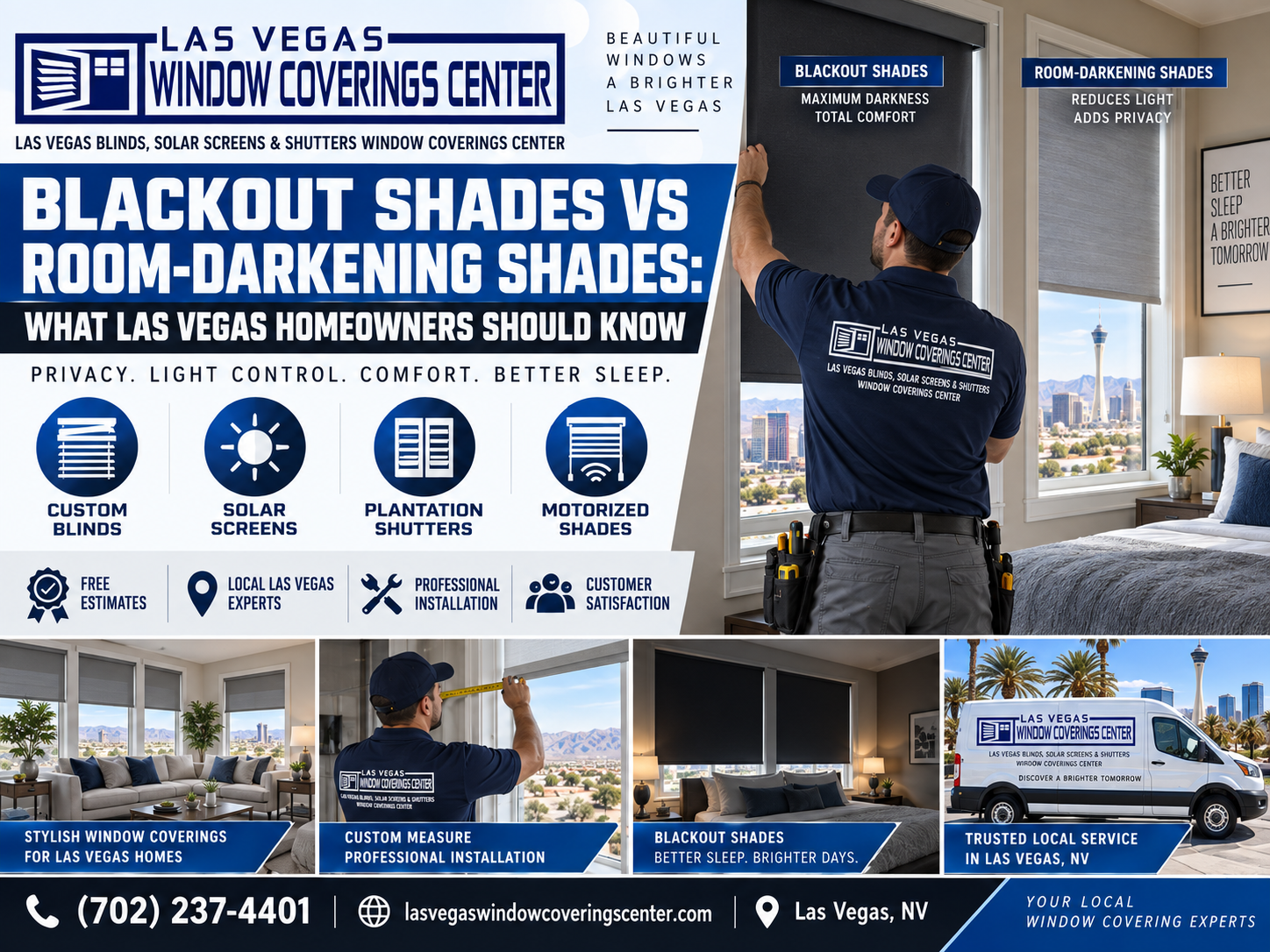
Blackout and room-darkening shades are often treated as if they mean the same thing. They do not. The difference becomes especially important in Las Vegas bedrooms, nurseries, media rooms and homes affected by strong desert sunlight, early-morning exposure, street lighting or bright neighboring properties. This guide explains the fabric, installation, side-gap and mounting differences that determine how dark a room actually becomes.
Short answer: blackout shade fabric is designed to block essentially all direct light through the material itself. Room-darkening fabric blocks a substantial amount of light but intentionally allows more residual light into the room.
The most important detail: blackout fabric does not automatically create a completely black room. Light can still enter around the top, bottom and sides of the shade. Mounting method, window depth, roller width, brackets, side channels and surrounding trim all influence the final result.
For most Las Vegas bedrooms, room-darkening shades may provide enough darkness if a small amount of daylight is acceptable. Blackout shades are the stronger starting point for day sleepers, very light-sensitive sleepers, nurseries where parents specifically want stronger light control, and media rooms where minimizing outside light is important.
If near-total darkness is the goal, evaluate the entire installation, not only the label on the fabric.
Las Vegas creates several real-world situations where homeowners care about stronger light control. A bedroom may face sunrise. A west-facing room may remain intensely bright late in the afternoon. A home near commercial lighting or a brightly illuminated street may receive noticeable exterior light long after sunset.
Day sleepers may need to create nighttime-like conditions while the desert sun is high. Home theaters need controlled light so reflections do not wash out a television or projection surface. Nurseries and guest bedrooms may need more darkness than a living room or home office.
Yet many homeowners start shopping by asking only for a “blackout shade.” That can create disappointment if they assume the word blackout means absolutely no light will be visible anywhere around the window.
Manufacturer guidance from Hunter Douglas on blackout and room-darkening window treatments explains that opaque fabrics can darken a room substantially while perimeter gaps remain an important source of residual light.
Similarly, Graber's blackout vs room-darkening guidance distinguishes room darkening from blackout and discusses the role of light entering along the edges of a shade.
Las Vegas homeowners can compare materials, mounting options and other custom treatments through Las Vegas Blinds, Solar Screens & Shutters Window Coverings Center .
The central difference is the amount of light allowed through the material.
A blackout fabric uses an opaque construction intended to prevent visible daylight from transmitting through the fabric itself. Depending on the shade style, that opacity may come from the fabric construction, a backing layer or a separate blackout liner.
Room-darkening material also blocks a large amount of daylight but permits more residual glow. This can create a dim, comfortable room without making the space feel completely separated from daytime conditions.
Best compared when blocking direct light through the shade material is the priority. Installation details are then used to address light entering around the perimeter.
Best compared when the homeowner wants a substantially darker room but does not require the strongest possible daytime darkness.
A dark-looking fabric is not automatically blackout. A light-colored fabric may have an opaque backing that blocks substantially more light than a visually darker fabric without that backing.
Ask to see the actual opacity classification and hold the sample against a strong light source rather than choosing solely from the front color.
This comparison separates fabric performance from installation performance so homeowners can identify which level of light control actually fits the room.
| Factor | Blackout Shade | Room-Darkening Shade | What Homeowners Should Know |
|---|---|---|---|
| Fabric Opacity | Designed to block essentially all direct visible light through the shade material. | Blocks a substantial amount of light but allows more residual glow through the material. | Blackout is stronger when maximum fabric opacity is required. |
| Complete Room Darkness | Not guaranteed by fabric alone. | Not intended to create near-total darkness. | Perimeter gaps, mounting and channels determine the final room. |
| Edge Light | Can be visually obvious because the center of the shade is very dark. | Edge glow may be less visually dramatic because the fabric already admits some light. | Discuss gaps before ordering. |
| Bedroom Use | Strong choice for light-sensitive sleepers and daytime sleep. | Often adequate for homeowners who simply want a darker bedroom. | Personal light sensitivity matters. |
| Media Room | Stronger starting point when reducing external light is important. | Useful when reducing glare is enough and total darkness is unnecessary. | Screen location and exterior light sources matter. |
| Daytime Privacy | Opaque fabric normally prevents direct view through the material. | Usually provides substantial privacy depending on the exact fabric. | Side gaps can still affect privacy at certain angles. |
| Natural Daylight | Very limited when the shade is fully lowered. | Allows a subdued amount of residual daylight. | Room darkening can feel less enclosed during the day. |
| Inside Mount | Clean appearance but may leave visible side gaps. | Also leaves normal installation clearance. | Window depth and hardware determine feasibility. |
| Outside Mount | Extra overlap may reduce perimeter light. | Can also increase overall coverage. | Wall space, trim and appearance matter. |
| Side Channels | Can significantly improve edge-light control when available for the system. | Usually unnecessary unless much stronger darkness is desired. | Availability depends on the exact shade system. |
| Best General Fit | Day sleepers, media rooms, highly light-sensitive bedrooms. | Bedrooms, guest rooms, living areas and spaces needing strong dimming. | Select by room function rather than marketing label. |
Blackout refers primarily to the light-blocking ability of the shade material itself.
If you hold a properly specified blackout material against the light, the fabric should prevent direct visible daylight from transmitting through its main surface.
Different shade categories can use blackout materials. Depending on manufacturer and collection, homeowners may encounter blackout roller shades, cellular shades, Roman shades, natural shades with a blackout liner and drapery with an opaque lining.
Consider a roller shade mounted inside a window opening. The fabric must usually be narrower than the complete inside width so the roller, brackets and moving shade can operate without rubbing against the window frame.
That clearance produces narrow spaces between the fabric and the sides of the opening. Bright daylight can enter through those spaces even though no light passes through the blackout material itself.
This is why a homeowner can purchase genuine blackout fabric and still see bright vertical lines at the edges of the shade.
Room-darkening shades are designed to make a room substantially darker without necessarily eliminating essentially all light transmission through the material.
Graber's current opacity guidance separates room-darkening from blackout, describing room-darkening treatments as appropriate where much of the light should be blocked while blackout represents the highest opacity category.
This distinction can be helpful for homeowners who do not actually want a cave-like room during the day.
A homeowner who sleeps primarily at night may simply want to reduce early sunrise, exterior lights and morning brightness. A room-darkening shade may provide sufficient control without creating the strongest possible daytime darkness.
The room retains a subtle sense of daytime conditions while remaining substantially darker than it would with a light-filtering shade.
Full blackout can be excessive for spaces where occupants still want some ambient daylight. A room-darkening material can reduce television glare or create a calmer home office without completely disconnecting the room from the outside.
Light gaps are one of the most important concepts in a blackout-shade project.
When the main body of a shade becomes extremely dark, even a narrow strip of bright Las Vegas sunlight around the edge can become visually obvious.
The human eye adapts to the darker interior. Once the main area of the window is covered by an opaque shade, a thin opening around the shade may appear disproportionately bright.
That does not mean the blackout fabric failed. It means the installation needs a different approach if stronger room darkness is the objective.
Mounting method affects both appearance and darkness.
An inside mount positions the treatment within the window opening. Many homeowners prefer the clean architectural look because the shade does not cover surrounding trim.
The tradeoff is clearance. Most operating systems need some space between the fabric and the sides of the opening, especially roller shades where the fabric itself is narrower than the complete headrail assembly.
That can create vertical light gaps on both sides.
An outside mount installs the treatment over or beyond the opening. By extending the fabric past the edges of the window, the shade can create more overlap and reduce direct light entering around the sides.
The amount of overlap should be determined from the actual window, wall space and trim.
An outside mount may not be visually appropriate for every room, and furniture, nearby walls, switches or architectural trim can limit how far the shade can extend.
Not every blackout shade needs side channels. They become especially useful when the homeowner wants to reduce the bright vertical gaps that can remain beside an inside-mounted shade.
Side channels are narrow components installed along the sides of the treatment to cover or capture the shade edges. Some blackout systems also incorporate sill or bottom-channel components.
Manufacturer systems vary. Hunter Douglas discusses specialized side-channel configurations for enhanced room darkening, while Graber offers blackout-channel solutions on certain shade systems.
If the goal is simply to make a bedroom much darker, a well-fitted room-darkening or blackout shade without channels may already provide enough control.
Side channels add hardware and visual detail, so they should solve a specific light-control problem rather than being added automatically.
A blackout or room-darkening shade does not have to work alone. Drapery or another overlapping treatment can cover side gaps and soften the appearance of a highly functional shade.
This is particularly useful when a homeowner wants the clean function of a roller or cellular shade but prefers a more decorative bedroom.

Layered window treatments can add decorative softness while also helping cover light that enters around the perimeter of an interior shade.
The best combination depends on how often the room needs to be fully dark and how much daylight the homeowner wants at other times.
For many bedrooms, room-darkening shades are enough. For bedrooms used during daylight hours for sleep—or for occupants who are especially sensitive to light—blackout shades usually deserve the stronger comparison.
A bedroom facing east can become bright very early in the morning, while west-facing bedrooms may receive intense late-afternoon light. Window orientation therefore matters even when two rooms use the same shade fabric.
A professional consultation should identify when the strongest direct light reaches the glass rather than assuming every bedroom requires the same opacity.
Day sleepers place much greater demands on a window covering because the shade must work against full daytime brightness rather than ordinary nighttime exterior lighting.
In this application, focus on the complete light-control system.
The goal is not merely to buy the darkest fabric sample. It is to control all of the major paths through which unwanted daylight reaches the room.
Light control is only one consideration in a room used by young children. Window-covering controls also matter.
The U.S. Consumer Product Safety Commission's window-covering cord guidance recommends cordless window coverings where young children are present because accessible cords can create a strangulation hazard.
When comparing blackout or room-darkening shades for a nursery, ask which cordless or inaccessible-control configurations are available for the exact shade.
Do not assume a product is appropriate for a nursery merely because it has blackout fabric. Evaluate its control system, mounting security, furniture placement and the manufacturer's installation requirements.
Cribs, beds and climbable furniture should not be positioned where children can reach hazardous window-covering cords.
Media rooms often benefit more from blackout treatments because even relatively small areas of bright daylight can create reflections or reduce perceived image contrast.
However, the exact requirement depends on the television, projection system, screen location and time of day the room is used.
If the room is used primarily at night, room-darkening shades may provide all the glare control needed. If afternoon movie viewing is common and the window receives direct sun, a blackout system with stronger perimeter control may be worthwhile.
A narrow gap on a wall behind the viewer may be relatively harmless. The same gap positioned directly opposite a television can become extremely distracting.
Evaluate the room while the problem is actually occurring instead of judging it only during an evening consultation.
Large windows can make a room bright and glare-prone without creating a need for complete darkness.
A living room, office or multi-purpose space may be more comfortable with room-darkening fabric that reduces intensity while maintaining a softer sense of daytime light.
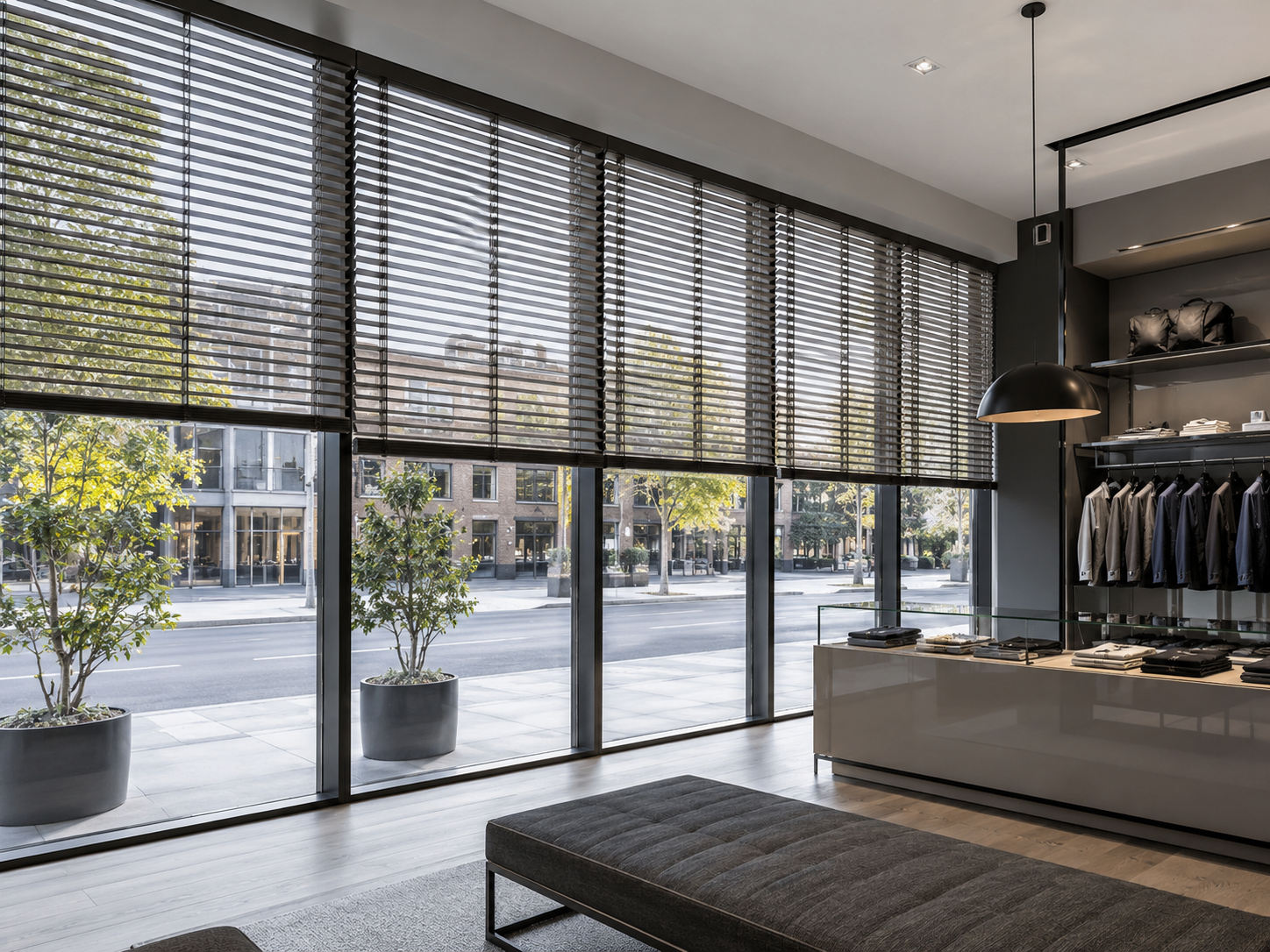
Large areas of glass often need controlled daylight rather than permanent maximum darkness, making room function an important part of shade selection.
Blackout fabric is opaque, so it generally provides a very high level of privacy through the material itself when the shade is fully lowered.
Room-darkening fabrics are also commonly designed to provide substantial privacy, but exact opacity varies by material.
Privacy is still affected by fit. A person standing at an angle outside the window may potentially see through a large side gap even if the fabric itself is completely opaque.
A homeowner can need strong privacy without wanting a completely dark room. In that situation, a room-darkening or opaque treatment may be more comfortable than a full blackout environment.
Conversely, a media room may need maximum darkness even though privacy is not a major concern.
West-facing windows can receive powerful late-afternoon sunlight. Blackout shades can eliminate direct visible light through the fabric, which can dramatically change a bedroom or media room during those hours.
But light control and solar heat control are not exactly the same problem.
An opaque interior shade can reduce sunlight entering the occupied space, but homeowners whose primary problem is severe solar heat at the glass should also compare dedicated solar-control strategies.
The previous guide on plantation shutters vs blinds for Las Vegas homes is useful when adjustable louvers and slats are being considered instead of fabric shades.
A north-facing bedroom with moderate light may only need room-darkening fabric. A west-facing bedroom receiving intense afternoon sun may create a stronger case for blackout fabric or additional solar-control layers.
Blackout describes a light-control characteristic rather than one universal shade style. Different window treatment categories can incorporate blackout materials or liners.
Blackout roller fabrics can create a clean modern appearance. Because the fabric is narrower than the complete mechanism on many systems, side-gap planning is especially important.
Cellular shades can combine opaque fabric with honeycomb construction. Well-fitted cellular shades are also recognized by the U.S. Department of Energy for their insulating properties.
Certain Roman-shade systems can use room-darkening or blackout liners, combining softer fabric styling with stronger light control.
Woven natural materials often contain visible openings, but an opaque liner can significantly increase privacy and darkness.
Drapery with an opaque liner can overlap the wall around a window, helping address side light that is difficult to control with an inside-mounted shade alone.
Some systems combine separate fabrics so one layer can provide softer daytime control while another supplies stronger darkness when needed.
Yes. Both can use highly opaque material, but their physical construction is different.
Roller shades wrap a single flat sheet of material around a tube. Cellular shades use pleated honeycomb-shaped cells that create trapped air pockets.
The U.S. Department of Energy cellular shade fact sheet explains how cellular construction traps air and can improve insulating performance at the window.
The correct product should be chosen by room requirements and installation details rather than assuming one blackout shade type performs identically to another.
Plantation shutters provide excellent adjustable privacy and daylight control, but they should not automatically be described as blackout.
Even when louvers are closed, small amounts of light can enter between louvers, around panel edges and where the shutter frame meets the opening.
Shutters can therefore be a good option when architectural appearance, adjustable privacy and directional daylight matter more than the darkest possible room.

Plantation shutters offer adjustable louvers and strong privacy, but they should not be confused with a dedicated blackout shade installation.
Motorization is not necessary for blackout performance, but it can make daily operation more convenient.
This can be particularly useful for tall windows, hard-to-reach windows, multiple bedroom shades or a day sleeper who wants shades to follow a regular schedule.
Motorized systems vary by manufacturer and product. Battery, rechargeable, plug-in and hardwired options exist in the broader market, but availability should be confirmed for the exact shade being quoted.
A motor simply operates the shade. It does not eliminate side gaps unless the complete shade system includes components specifically designed for stronger perimeter light control.
Hardwired electrical work should be completed according to applicable product installation and electrical requirements.
Large windows create additional design and engineering questions. Shade width affects fabric behavior, roller-tube requirements, control options and the feasibility of covering the opening with one treatment.
A very wide opening may require multiple shades instead of one large shade. When multiple shades are used, narrow gaps can appear between them.
Where possible, multiple shades can be coordinated with window mullions or frame divisions so unavoidable fabric gaps fall over existing structural lines rather than clear glass.
Roller shades collect around a tube at the top, while cellular shades compress into a pleated stack. The amount of visible material when open can influence the view and usable glass area.
Professional measurement should include width, height, mounting depth, structural mounting surfaces, window handles and intended shade divisions.
Blackout fabric by itself does not determine the complete project cost. Several installation and operating details can have a greater effect than the difference between two fabric opacities.
A quote should identify what is included rather than describing the entire project simply as “blackout shades.”
Ask whether measurement, installation, removal of old window coverings, channels, fascia and controls are included in the written scope.
Strong dimming can be sufficient when you mainly sleep at night and do not require daylight-level darkness.
Start with blackout fabric and evaluate edge gaps, outside mounting or side channels for stronger daytime darkness.
Maximum light control is useful when unwanted daylight creates screen reflections or reduces the viewing experience.
A highly dimmed but not completely black room can be a comfortable compromise for different guests.
East-facing bedrooms can become bright early, making stronger fabric opacity and perimeter planning useful.
Most living spaces benefit from glare reduction without eliminating nearly all daytime light.
Be cautious when the sales explanation ignores the difference between opaque fabric and complete window coverage.
Las Vegas homeowners deal with an unusual combination of strong desert sunlight and substantial nighttime exterior lighting. That means a blackout project may need to address both daytime and nighttime sources of unwanted light.
Early sunlight can make an east-facing bedroom bright well before a homeowner wants to wake. Blackout shades may be useful when room-darkening material still allows too much morning light.
Homes in Summerlin, The Ridges, Red Rock Country Club and other west-valley communities may have bedrooms affected by intense late-afternoon exposure. Blackout fabric can eliminate visible light transmission through the material, while mounting and solar-control considerations determine the broader performance of the window.
Streetlights, landscape lighting, neighboring homes and nearby commercial areas can create nighttime brightness even when the sun is no longer a factor.
In these situations, the most noticeable leakage may come from the sides of the treatment rather than through the fabric itself.
Homes in Henderson, Seven Hills, Anthem and MacDonald Highlands may combine broad valley views with significant exterior lighting at night. A room-darkening shade can provide a compromise when daytime view and ambient light remain important, while a blackout treatment is better suited to rooms where darkness is the priority.
Condos near the Strip, Downtown Las Vegas or Paradise can experience artificial exterior light from surrounding buildings and signage. Shade opacity and perimeter coverage may therefore remain important even after sunset.
A Las Vegas house does not need blackout shades on every window. Bedrooms and media rooms may benefit from maximum light control while living areas can feel more natural with room-darkening or light-filtering fabrics.
Matching opacity to room function usually creates a more comfortable result than selecting one fabric for the entire property.
Las Vegas Blinds, Solar Screens & Shutters Window Coverings Center is a local Las Vegas window covering business where homeowners can compare different levels of opacity and different window treatment categories based on the actual room.
A useful blackout-shade consultation should consider the window's direction, room use, time of unwanted light, mounting depth, trim, desired privacy, light sensitivity, side gaps, control preferences and whether an outside mount, layering or specialized channel system is appropriate.
Homeowners can also compare roller shades, cellular shades and other custom window covering options when blackout fabric alone is not the complete answer.
Las Vegas Blinds, Solar Screens & Shutters Window Coverings Center serves customers throughout the Las Vegas Valley. These communities describe service coverage and do not imply a separate showroom or business location in each area.
Visit Las Vegas Blinds, Solar Screens & Shutters Window Coverings Center at 3871 S Valley View Blvd #6, Las Vegas, NV 89103 to compare blackout shades, room-darkening shades and other custom window treatments.
Blackout shade material is designed to block essentially all direct visible light through the fabric itself. Room-darkening material blocks a substantial amount of light but allows more residual glow. Neither term by itself describes how much light enters around the edges of the treatment, so mounting, side gaps and the complete installation also determine how dark the room becomes.
Not automatically. Blackout fabric can prevent light from passing through the material, but daylight may still enter around the sides, top or bottom of the shade. Outside mounting, greater overlap, side channels, bottom channels or layered drapery can reduce these gaps. The window and mounting method should be evaluated when near-total darkness is the goal.
For many homeowners, yes. Room-darkening shades can substantially reduce early-morning or nighttime light and may provide enough darkness for normal nighttime sleep. A day sleeper, highly light-sensitive person or bedroom with intense direct sun may benefit from blackout fabric and stronger perimeter-light control. Window orientation and personal light sensitivity should guide the decision.
Blackout shades are generally the stronger starting point for people who sleep during daylight hours because the fabric provides greater opacity than room-darkening material. Day sleepers should also evaluate side gaps, top and bottom light, mounting method and whether compatible side channels are available. Full daytime darkness depends on the complete installation rather than fabric opacity alone.
An outside mount can often provide stronger perimeter coverage because the shade can overlap the window opening rather than fitting entirely inside it. That additional overlap may reduce side light. However, wall space, trim, window size and appearance determine whether an outside mount is practical. Some inside-mount systems use side channels to address perimeter light instead.
Blackout cellular shades can be useful when a homeowner wants strong fabric opacity plus honeycomb construction at the window. Cellular shades trap air in their cells, which is why the U.S. Department of Energy recognizes well-fitted cellular shades for their insulating properties. Light gaps still need to be considered when strong room darkness is required.
The blackout fabric itself does not determine cord safety. The U.S. Consumer Product Safety Commission recommends cordless window coverings where young children are present because accessible window-covering cords create a strangulation hazard. Parents should compare appropriate cordless or inaccessible-control configurations for the exact blackout or room-darkening shade.
Contact Las Vegas Blinds, Solar Screens & Shutters Window Coverings Center at (702) 237-4401 or visit 3871 S Valley View Blvd #6, Las Vegas, NV 89103 to compare blackout and room-darkening window treatments based on room use, window orientation, opacity, mounting, privacy and desired darkness.
Shade terminology, opacity and enhanced light-control features can vary by manufacturer. The sources below provide supporting information for the distinctions discussed in this guide.
Hunter Douglas explains opacity, room-darkening materials, blackout-style light control, outside mounting, liners and specialized side-channel systems for reducing light around shade edges.
This guide explains different opacity categories and the relationship between light-filtering, room-darkening and blackout fabrics.
Graber explains the difference between room-darkening and blackout light control and discusses edge light, blackout fabrics and channel systems.
Graber's roller-shade documentation identifies multiple opacity levels and describes blackout-channel options designed to reduce light entering around the sides and bottom of compatible shades.
CPSC recommends cordless window coverings where young children are present and provides safety guidance for homes with existing corded window treatments.
DOE explains how cellular shades trap air within honeycomb cells and between the shade and window, providing insulating benefits in addition to daylight, glare and privacy control.
Read the U.S. Department of Energy cellular shade fact sheet →
If you simply want a bedroom to feel significantly darker, room-darkening shades may provide all the light control you need. If you are a day sleeper, highly sensitive to light or creating a media room, blackout shades are usually the stronger starting point.
The final result depends on more than fabric. Window depth, mounting, side gaps, top and bottom gaps, orientation, controls and optional channel systems all affect how dark the room actually becomes.
Call Las Vegas Blinds, Solar Screens & Shutters Window Coverings Center at (702) 237-4401 to compare blackout shades and room-darkening shades in Las Vegas and nearby areas.