

Faux wood and real wood blinds can create a similar classic horizontal-blind appearance, but they behave differently when exposed to intense sunlight, changing temperatures, dry desert conditions, moisture, dust and large windows. This Las Vegas comparison explains the practical differences so homeowners can choose the material that fits the room instead of selecting blinds based on appearance alone.
Short answer: for windows exposed to intense Las Vegas sun and high surface temperatures, a quality faux wood or engineered alternative-wood blind generally has the durability advantage. Many faux-wood products are specifically engineered to resist warping, bowing and fading under heat, sunlight or moisture. That makes faux wood a strong first product to compare for sunny exposures, kitchens, bathrooms and other demanding rooms.
Real wood still has important advantages. Genuine hardwood blinds are typically lighter than faux wood, provide authentic natural grain and can create a premium furniture-like appearance. Real wood can work very well in Las Vegas living rooms, bedrooms and other conditioned interior spaces when the product and finish are appropriate for the window.
The real decision is not simply “heat versus no heat.” Window orientation, hours of direct sun, window size, slat color, material construction, glazing, indoor humidity, room use and blind width should all be considered. On a large window, for example, the heavier weight of faux wood may matter more than its added environmental resistance.
A horizontal blind installed on a shaded north-facing bedroom window does not experience the same conditions as a blind sitting behind west-facing glass during a Las Vegas afternoon. Direct sunlight can create a demanding environment at the window even when the home's air conditioning keeps the room comfortable.
That is why material selection matters. Faux wood and genuine hardwood can look similar from across the room, but they are not the same product. Their weight, moisture response, surface finish, maintenance requirements and environmental resistance can differ.
Official guidance from Hunter Douglas describes faux wood as an alternative for rooms exposed to heat, harsh sunlight and humidity, while its real-wood guidance emphasizes genuine hardwood's lighter weight and natural character.
Similarly, Graber's composite and faux wood product information describes engineered blinds intended to resist warping, fading, cracking and peeling in demanding conditions.
Customers comparing these materials can also review faux wood blinds , real wood blinds , and broader blinds for Las Vegas homes before choosing a product.
Real wood blinds are made from genuine wood. Depending on the manufacturer and collection, that may include hardwood such as basswood. The natural material provides real grain, variation and the warm appearance many homeowners associate with wood furniture and cabinetry.
Faux wood blinds are engineered products designed to create a similar visual appearance without using solid natural wood slats. Construction varies by brand. Some products use PVC-based materials, while others use composites or proprietary alternative-wood formulations.
That distinction is important because “faux wood” is not one universal material. The environmental performance of a premium engineered blind should not automatically be assumed for every inexpensive faux-wood blind on the market.
Often selected for heat, moisture resistance, easy cleaning and consistent finishes. Usually heavier than genuine wood.
Genuine wood offers authentic grain, rich stains and lighter slats, but it generally requires more careful environmental and moisture management.
Use this comparison as a decision framework rather than a guarantee. Exact performance depends on the manufacturer, product construction, slat dimensions, finish, installation and window conditions.
| Factor | Faux Wood Blinds | Real Wood Blinds | Las Vegas Consideration |
|---|---|---|---|
| Heat / Direct Sun | Quality products may be engineered specifically to resist warping, bowing and fading. | Can work well indoors, but natural wood should be matched carefully to severe exposures. | Faux wood generally has the durability edge on demanding sunny windows. |
| Weight | Usually heavier. | Generally lighter. | Real wood may be easier to operate on larger horizontal blinds. |
| Moisture | Many faux/composite products are designed for moisture resistance. | Genuine wood needs more protection from high moisture or steam. | Faux wood is usually easier to specify for kitchens and bathrooms. |
| Appearance | Can imitate natural wood grain and painted finishes. | Authentic grain, stain variation and natural character. | Real wood often wins when natural material is the design priority. |
| Cleaning | Typically easy to dust and clean according to manufacturer guidance. | Requires more delicate care to protect the wood and finish. | Faux wood may be convenient where desert dust builds up quickly. |
| Large Windows | Added weight can become important as blind width increases. | Lighter slats may reduce operating weight. | Very wide windows should be measured and product limits checked. |
| Privacy | Excellent adjustable privacy with properly tilted slats. | Excellent adjustable privacy with properly tilted slats. | Slat fit and closure matter more than material alone. |
| Light Control | Adjustable horizontal slats control incoming light. | Adjustable horizontal slats control incoming light. | Neither should automatically be treated as a blackout product. |
| Design Character | Consistent color and wood-look finishes. | Natural variation and furniture-like character. | Choose according to cabinetry, trim and room design. |
| Best General Fit | Heat-prone, moisture-prone, high-use or easy-maintenance applications. | Living spaces where authentic material, lower weight and appearance matter most. | There is no single material that wins every room. |
High-quality faux wood blinds are often engineered for environmental durability. That is the main reason they are frequently recommended for windows exposed to stronger heat, sunlight or moisture than a conventional interior wood product might encounter.
Hunter Douglas states that its EverWood alternative wood blinds resist fading, yellowing, warping and bowing and describes faux wood as appropriate for rooms prone to heat and harsh sunlight. That statement applies to the manufacturer's specific product rather than every faux-wood blind in existence, but it illustrates the reason engineered materials are often considered for difficult exposures.
Graber similarly describes its composite and faux wood blinds as engineered to resist warping, fading, cracking and peeling, with PVC-based faux wood options designed for moisture resistance.
A west-facing blind may spend hours receiving direct afternoon sunlight. The temperature around the window can be substantially different from the thermostat reading deeper inside the room. The slats closest to the glass are part of that environment.
For a homeowner who wants a traditional horizontal-blind appearance but is concerned first about demanding sun exposure, faux wood can therefore be the more forgiving material category to investigate.
Product quality matters. Different manufacturers use different materials, formulations, finishes, slat dimensions and reinforcement methods. An inexpensive product and a premium custom faux-wood blind should not be assumed to have identical performance.
Before buying, ask for the product's actual specifications, maximum sizes, care instructions and warranty terms rather than relying on the phrase “faux wood” alone.
Yes. Real wood blinds can be an excellent choice in Las Vegas when the room, exposure and product are appropriate. Natural wood should not be dismissed simply because Southern Nevada is hot.
Genuine wood has advantages that engineered materials cannot completely reproduce. Natural grain, stain depth, variation from slat to slat and the relationship to real wood cabinetry or trim can make a room feel richer and more architectural.
Real wood is also generally lighter than faux wood. Hunter Douglas identifies genuine hardwood blinds as lighter in weight than alternative wood blinds, and Graber describes basswood as a lightweight material used in its wood blind construction.
As a horizontal blind becomes wider, the weight of the slats becomes more important. A blind that is easy to raise on a small bedroom window may become much heavier when built for a broad living-room opening.
That means real wood may be a better design and operation choice for some larger windows—provided the window is a suitable environment for genuine wood.
Wood is a natural material. The USDA Forest Products Laboratory Wood Handbook explains that wood changes dimension as its moisture content changes. Drier conditions can cause shrinkage and more humid conditions can cause swelling.
That does not mean a wood blind in Las Vegas will automatically warp. It means genuine wood is environmentally responsive, so installation location, finish, moisture exposure and manufacturer guidance matter.
For large horizontal blinds, weight can become one of the most important differences between faux and real wood.
Faux wood products are commonly heavier than genuine wood products. On a modest window that may not matter much. On a very wide blind, however, total slat weight can affect lifting effort, hardware selection, headrail requirements and whether one blind or multiple blinds are the smarter configuration.
Real wood's lighter weight can become an advantage in these situations. A homeowner may prefer faux wood for heat resistance but discover that the particular window is too wide for the desired product configuration.
A large opening may sometimes work better with multiple blinds under one shared visual treatment rather than one extremely wide blind. This can reduce individual blind weight and make operation more practical.
The right arrangement depends on mullions, window divisions, view, symmetry and how the homeowner wants the blinds to operate.
Not necessarily. Las Vegas has a dry climate, but the room around the blind can still create its own conditions.
Bathrooms can experience steam. Kitchens can experience moisture and cooking residue. Laundry areas may see more humidity than a bedroom. Windows may also be exposed to condensation or cleaning moisture depending on conditions.
Hunter Douglas' care guidance for wood and alternative-wood blinds specifically advises protecting genuine wood from high moisture while allowing different care methods for alternative wood.
This gives faux wood a practical advantage in moisture-prone rooms even in Southern Nevada.
Real wood exchanges moisture with its environment. The USDA Wood Handbook documents dimensional movement in wood as moisture conditions change. A quality finished wood blind is manufactured with this natural behavior in mind, but genuine wood still remains a natural material.
The correct conclusion is therefore not that real wood “cannot handle Las Vegas.” It is that real wood should be selected and maintained as genuine wood, while faux wood may provide a larger margin of environmental tolerance.
Durability and ease of cleaning can make faux wood attractive beyond owner-occupied homes. Property managers, rental owners, offices and other high-use spaces may value a consistent blind that is easy to maintain and less sensitive to occasional moisture.
Real wood can still be appropriate for executive offices, premium interiors or spaces where natural materials are an important part of the design. The decision should reflect how heavily the blinds will be used and who will be responsible for routine care.
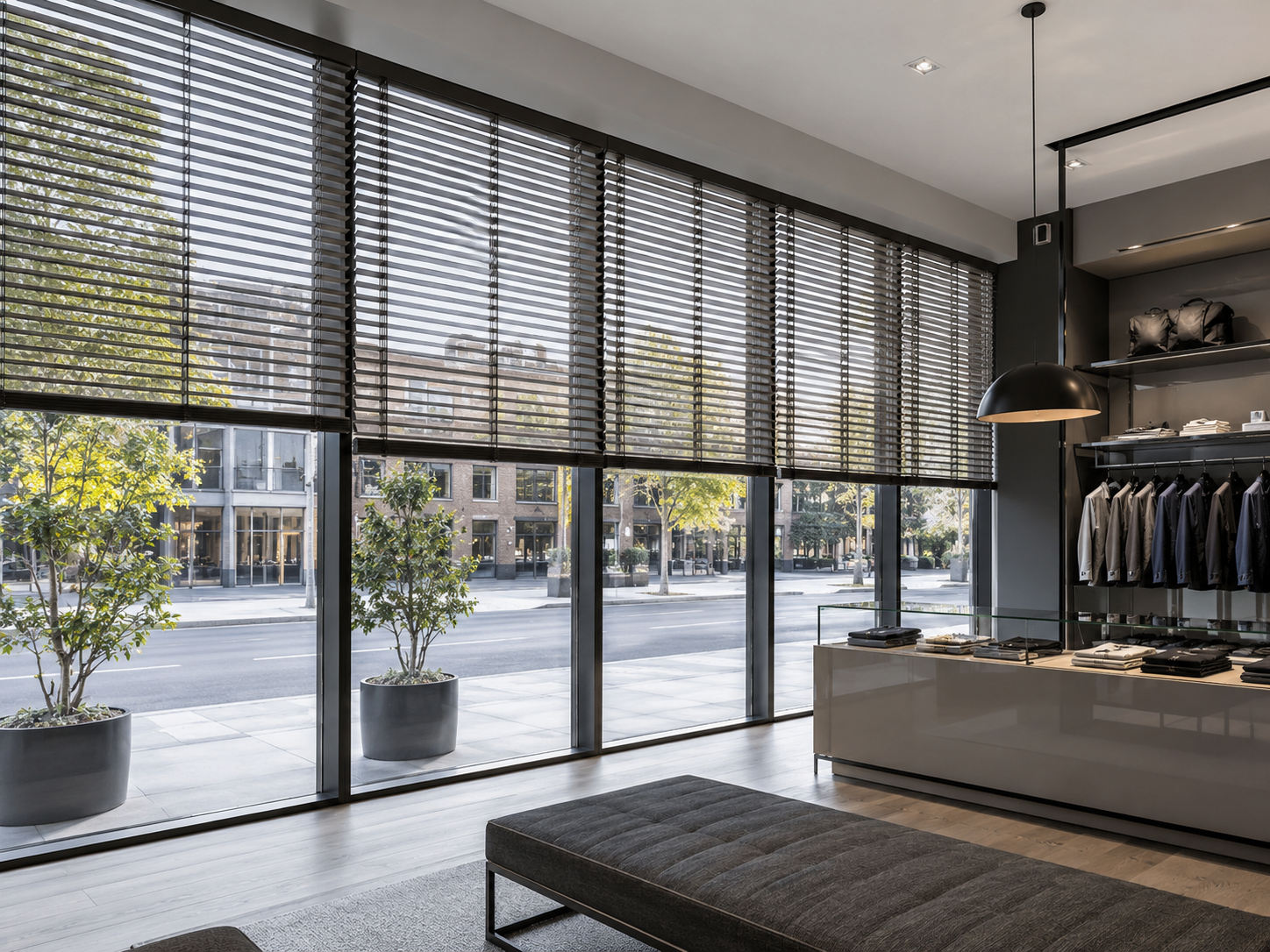
Commercial and high-use spaces often prioritize durability, simple maintenance and repeatable appearance when selecting blinds.
Both materials require routine dusting because horizontal slats naturally collect dust. Las Vegas homeowners may notice this quickly because desert dust can enter homes through normal daily activity, doors, ventilation and open windows.
Faux wood is generally the more forgiving option when easy cleaning is the priority. Manufacturer care instructions commonly allow dusting, vacuuming with a brush attachment and appropriate damp cleaning depending on the product.
Real wood needs more careful treatment. Avoid saturating the slats or spraying cleaning products directly onto natural wood unless the specific manufacturer says the method is appropriate.
Hunter Douglas advises protecting real wood products from steam and high moisture and recommends care similar to fine wood furniture for stained products.
Material alone does not determine privacy. Both faux wood and real wood horizontal blinds use adjustable slats that can be tilted to control view and light.
When closed properly, both can provide strong visual privacy. When tilted open, both can admit daylight and preserve some view.
What matters more is slat size, overlap, blind fit, route-hole design, mounting, window size and how tightly the slats close.
Horizontal blinds can substantially darken a room, but small amounts of light may remain between slats, around edges or through operating openings. A homeowner who needs stronger room darkening should compare an opaque shade or layered treatment instead of assuming wood-style blinds will create complete darkness.
Bedrooms and media rooms may benefit from combining blinds with blackout shades or another room-darkening layer.
Sometimes. Faux wood or real wood blinds can provide excellent adjustable privacy and light control, but another treatment may solve a separate problem.
Drapery can soften the appearance of horizontal blinds and add another decorative layer. A solar shade may provide a different approach to severe glare. A blackout treatment may be appropriate where sleep and darkness are more important than adjustable slat control.
The correct combination depends on what the room needs rather than a rule that every blind should be layered.

Layered treatments can separate adjustable privacy, glare control and decorative goals instead of requiring one blind to solve every problem.
For a west-facing window receiving strong afternoon sun, faux wood is generally the first material I would compare when durability under heat and sunlight is the main concern.
That recommendation is not because genuine wood is automatically unsuitable. It is because quality alternative-wood products may be specifically engineered to tolerate the conditions that make a west-facing opening challenging.
The U.S. Department of Energy notes that interior blinds and shades can help reduce unwanted solar heat gain and that window orientation, climate and glazing matter when addressing solar exposure.
If a west-facing room is overheating or experiencing intense glare, changing from real wood to faux wood does not necessarily address the underlying solar load as effectively as selecting a window treatment designed specifically for solar control.
In that situation, homeowners may also compare solar shades , exterior solar shades or solar screens.
The previous guide on solar shade openness for Las Vegas windows explains how tighter and more open solar fabrics change glare, view and daytime privacy.
Choose real wood for authentic grain and lighter weight. Compare faux wood when direct sun and easy maintenance are higher priorities.
Privacy and light control are strong with both. Consider a secondary blackout treatment when darkness is the main objective.
Moisture resistance makes faux wood the more practical category to compare in a room that experiences steam and humidity.
Easy cleaning and greater moisture tolerance can make faux wood useful near cooking and sink areas.
Either material can provide adjustable slat control. For severe glare, also compare a solar-control treatment rather than material alone.
Real wood's lower weight may become attractive on larger blinds, but product size limits and exact exposure should be checked.
Appearance is subjective, but there is a meaningful material difference. Genuine wood has real grain and natural variation. The finish can relate naturally to hardwood floors, cabinetry, doors and furniture.
Faux wood can imitate that appearance surprisingly well, especially in modern premium products. It may also provide greater consistency across many windows because the finish is engineered rather than naturally varied.
Real wood is often positioned as the more premium material, while faux wood is frequently chosen as a more practical alternative. However, a useful Las Vegas quote should not be based on material name alone.
Final project cost can change according to window width, height, slat size, finish, control system, decorative upgrades, number of windows, installation requirements and whether a large opening needs multiple blinds.
A premium faux-wood blind can also cost more than an entry-level product from another category. For that reason, broad statements such as “faux wood always costs less” are not useful enough for a custom project.
Material choice receives most of the attention, but a poorly sized blind can create more frustration than choosing one material over another.
Professional measurement should account for width, height, mounting depth, window squareness, trim, handles, locks and other obstructions.
Inside-mounted blinds require adequate depth for the headrail and mounting brackets. An outside-mounted blind requires enough surrounding surface for secure installation and appropriate overlap.
Wide blinds also need to be evaluated against the manufacturer's maximum dimensions. The heavier weight of faux wood can become particularly relevant on broad openings.
Homeowners choosing between faux wood and real wood blinds are often trying to create a classic slatted appearance. Plantation shutters can therefore be another useful product category to compare.
Shutters use larger louvers mounted within a more permanent frame. They create a built-in architectural look and offer adjustable privacy and daylight control.
They are not simply “better blinds.” They are a different window treatment with different cost, appearance, mounting and operating characteristics.
Customers interested in that option can review plantation shutters alongside faux wood and genuine wood blinds.

Plantation shutters provide another slatted window-covering option for homeowners who want adjustable light control with a more architectural look.
Be cautious when the recommendation is based on marketing language rather than the actual window, material and manufacturer specifications.
The Las Vegas Valley combines strong sunshine, very hot summers, dry outdoor air and a large variety of residential architecture. Those conditions make it useful to evaluate blinds according to the actual window instead of selecting one material throughout the entire house automatically.
Windows receiving direct afternoon sun deserve additional attention. If durability under harsh solar exposure is the leading concern, faux wood is often the first wood-look material to compare.
Homes in Summerlin, Henderson, Southern Highlands, The Ridges, Anthem, Seven Hills and other parts of the valley may include larger window openings. On those windows, the lighter weight of genuine wood can become an important consideration.
Horizontal slats create broad surfaces where dust can settle. Homeowners who expect frequent cleaning may value the easier maintenance associated with many faux-wood products.
When the primary concern is not the durability of the blind but the amount of solar energy or glare entering through the glass, a solar-specific product may deserve comparison.
A Las Vegas home with substantial natural wood cabinetry, doors or trim may benefit aesthetically from real wood blinds. A modern home that prioritizes consistent painted finishes may favor faux wood.
The correct answer can therefore change from one room to another within the same property.
Las Vegas Blinds, Solar Screens & Shutters Window Coverings Center helps homeowners and businesses compare window covering categories based on the actual window, room, exposure and design goal.
For a faux wood versus real wood decision, a useful consultation can consider window orientation, hours of direct sunlight, blind dimensions, slat weight, mounting depth, moisture exposure, cleaning preferences, color, trim and the overall look of the room.
Customers can also compare custom blinds against solar shades, solar screens, cellular shades, blackout treatments, plantation shutters and motorized window-covering options when a different product solves the problem more effectively.
Las Vegas Blinds, Solar Screens & Shutters Window Coverings Center serves customers throughout the Las Vegas Valley. The areas below describe service coverage and do not imply a separate showroom in each community.
Visit Las Vegas Blinds, Solar Screens & Shutters Window Coverings Center at 3871 S Valley View Blvd #6, Las Vegas, NV 89103 to compare faux wood, real wood and other custom window covering options.
Quality faux wood blinds generally have the durability advantage for windows exposed to intense heat and direct sunlight because many products are engineered to resist warping, bowing and fading. Real wood can still perform well in conditioned living areas, especially when the homeowner values lower weight and authentic natural wood. The exact product and exposure should be evaluated before ordering.
Product performance varies. Premium faux-wood products may be specifically engineered to resist warping under high heat and direct sunlight, but homeowners should not assume every faux-wood product uses the same material or performs identically. Check the actual manufacturer's specifications and warranty for the product being considered.
Yes. Real wood blinds can work well in Las Vegas living rooms, bedrooms and other conditioned interior spaces. Window orientation and exposure matter, however. For severe west-facing direct sun, homeowners should compare the real-wood product with an engineered faux-wood alternative and may also want to evaluate solar-control shades or screens.
Real wood blinds are generally lighter than faux wood blinds. That can be important for wide windows because blind weight affects operation and hardware. For a large opening, have the window professionally measured and confirm the manufacturer size limits rather than choosing solely by appearance.
Faux wood is generally the more practical category to compare in bathrooms, kitchens and other rooms where steam or moisture may occur. Many faux and composite products are engineered for moisture resistance, while genuine wood requires greater protection from high-moisture conditions.
Both materials require regular dusting, but faux wood is generally more forgiving for routine cleaning. Real wood should be cared for more like fine wood furniture and should not be saturated with water or harsh cleaning chemicals. Always follow the care instructions for the exact product and finish.
Real wood's lighter weight can be an advantage for some large horizontal blinds, but window size is only one factor. Direct sunlight, blind width, height, mounting depth, headrail design and manufacturer limits should also be considered. Some wide openings may work better with multiple blinds rather than one very large blind.
Contact Las Vegas Blinds, Solar Screens & Shutters Window Coverings Center at (702) 237-4401 or visit 3871 S Valley View Blvd #6, Las Vegas, NV 89103 to compare faux wood, genuine wood and other custom window covering options for your specific windows and room conditions.
Product construction differs between manufacturers. The following authoritative and manufacturer resources provide useful background for understanding real wood, faux wood, material stability, cleaning and window heat considerations.
Hunter Douglas explains that its alternative-wood blinds are designed for demanding conditions including heat, harsh sunlight and humidity and describes resistance to fading, warping and bowing.
Hunter Douglas' wood-blind buyer guide compares genuine hardwood with alternative wood, including weight, appearance, moisture considerations and room suitability.
Graber describes its composite and faux wood blinds as engineered for durability and resistance to moisture, warping, fading, cracking and peeling.
The USDA Forest Products Laboratory Wood Handbook explains how natural wood changes dimension as moisture content changes, providing useful background for understanding why genuine wood responds to its environment.
The Department of Energy explains that interior blinds and shades can help reduce unwanted solar heat gain and that climate, glazing and window orientation are relevant to solar performance.
For Las Vegas windows, faux wood generally deserves the advantage when durability under intense sun, easy cleaning and moisture resistance are leading concerns. Genuine wood remains a strong choice when natural grain, premium appearance and lighter weight matter more.
The best decision comes from matching the actual blind to the window's orientation, size, room use and environmental conditions.
Call Las Vegas Blinds, Solar Screens & Shutters Window Coverings Center at (702) 237-4401 to compare faux wood and real wood blinds in Las Vegas and nearby areas.