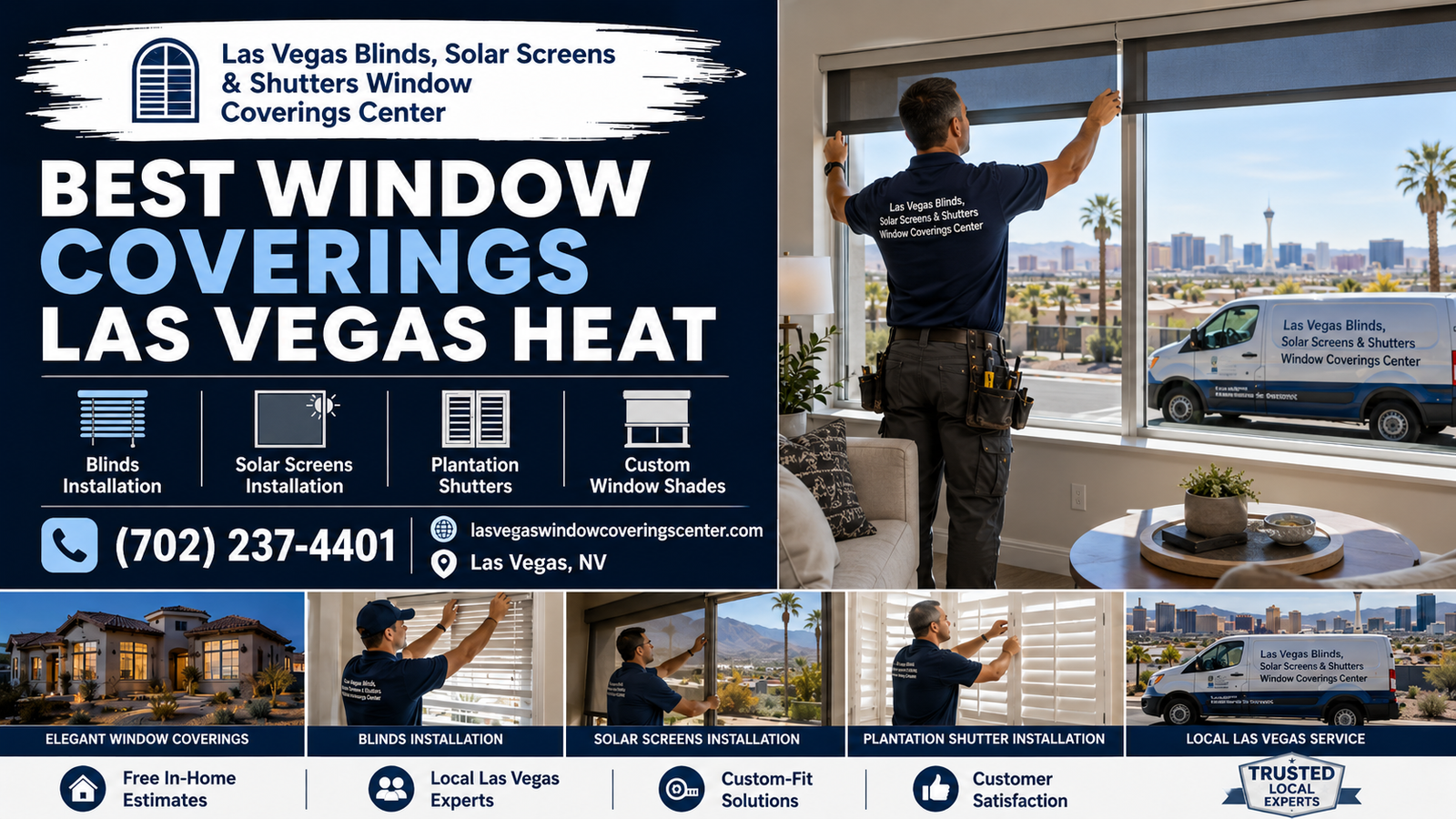
Best Window Coverings for Las Vegas Heat
Compare exterior solar screens, solar shades, cellular shades, shutters, blackout products, and motorized controls for Las Vegas homes and businesses.
What Are the Best Window Coverings for Las Vegas Heat?
The strongest options to compare for Las Vegas heat are exterior solar screens, interior solar roller shades, cellular shades, plantation shutters, blackout or room-darkening shades, and motorized shade systems that close consistently during peak sun. Exterior solar screens are generally best positioned to intercept sunlight before it reaches the glass. Interior cellular and blackout shades provide stronger room-side coverage and privacy, while solar roller shades preserve more view and daylight.
The best choice depends on window orientation, glass type, desired view, privacy, fabric openness, product color, fit, mounting style, and how consistently the treatment is used. West-facing windows often need tighter solar control than north-facing windows. Bedrooms may prioritize privacy and darkness, while living rooms and offices may prioritize glare reduction and outward view.
Window coverings can help manage solar heat, glare, and comfort, but they should not be presented as guaranteed substitutes for efficient windows, insulation, air sealing, or HVAC maintenance. Custom measurement matters because edge gaps, oversized openings, sliding doors, high ceilings, and exterior mounting conditions all affect real performance.
Why Heat-Control Window Coverings Matter in Las Vegas
Las Vegas homes and businesses face long periods of strong direct sunlight, high outdoor temperatures, reflective hardscape, and intense afternoon glare. Rooms near west-facing glass can become uncomfortable even when the air-conditioning system is operating. Furniture, flooring, artwork, retail displays, and upholstery may receive repeated direct exposure.
Homeowners in Summerlin, Henderson, Spring Valley, Enterprise, and North Las Vegas often have large windows, sliding doors, and open floor plans. Modern homes in The Ridges, Red Rock Country Club, MacDonald Highlands, and Southern Highlands may include expansive glass walls that require stronger roller tubes, motorized controls, and carefully planned power. Older homes in Downtown Las Vegas and Winchester may have shallow or uneven openings that make outside mounting more practical.
Landlords and property managers need durable products tenants can operate correctly. Interior designers must balance comfort with color, daylight, and view. Restaurants need to protect west-facing tables without making the dining room feel closed. Offices need monitor-glare control. Medical practices need privacy. Retailers need to protect displays while maintaining storefront visibility.
The phrase “best window coverings for Las Vegas heat” therefore does not point to one universal product. It points to the product or layered system that fits the specific exposure, room use, privacy requirement, maintenance plan, and operating routine.
How Solar Heat Enters Through Windows
Direct solar radiation
Sunlight passes through glass and warms interior surfaces. Dark flooring, furniture, and countertops can absorb that energy and release heat into the room.
Window orientation
West-facing windows often receive severe late-afternoon sun when outdoor temperatures are already high. South-facing windows receive extended exposure, while east-facing windows create morning heat and glare.
Glass performance
Single-pane, double-pane, low-emissivity, tinted, and reflective glass behave differently. A window covering should be selected with the actual glazing in mind.
Edge gaps
Inside-mounted shades need operating clearance. Narrow gaps can allow concentrated light and heat near the sides. Outside mounting, side channels, or layered products can improve coverage.
Interior absorption
Dark fabrics and slats may absorb more heat, while lighter exterior-facing colors can change reflectance. Product-specific performance data is more useful than general color assumptions.
Air leakage
A shade can manage solar exposure but does not repair air leaks around the frame. Weatherstripping, insulation, and window condition remain separate issues.
Best Window Coverings for Las Vegas Heat
Exterior solar screens
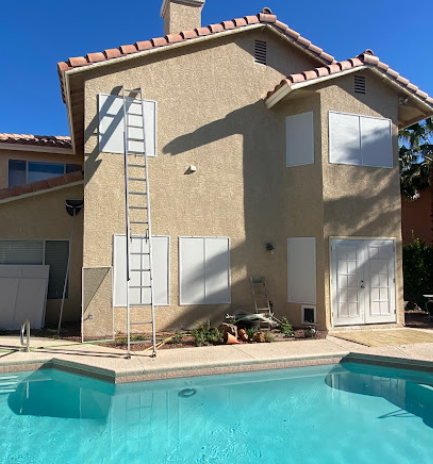
Strong first option for severe west- and south-facing exposure because they shade the glass from outside. Mesh density, frame fit, color, wind, egress, and HOA approval matter.
Interior solar roller shades
Reduce glare and direct exposure while preserving partial outward view. Lower openness generally provides stronger screening but less view.
Cellular or honeycomb shades
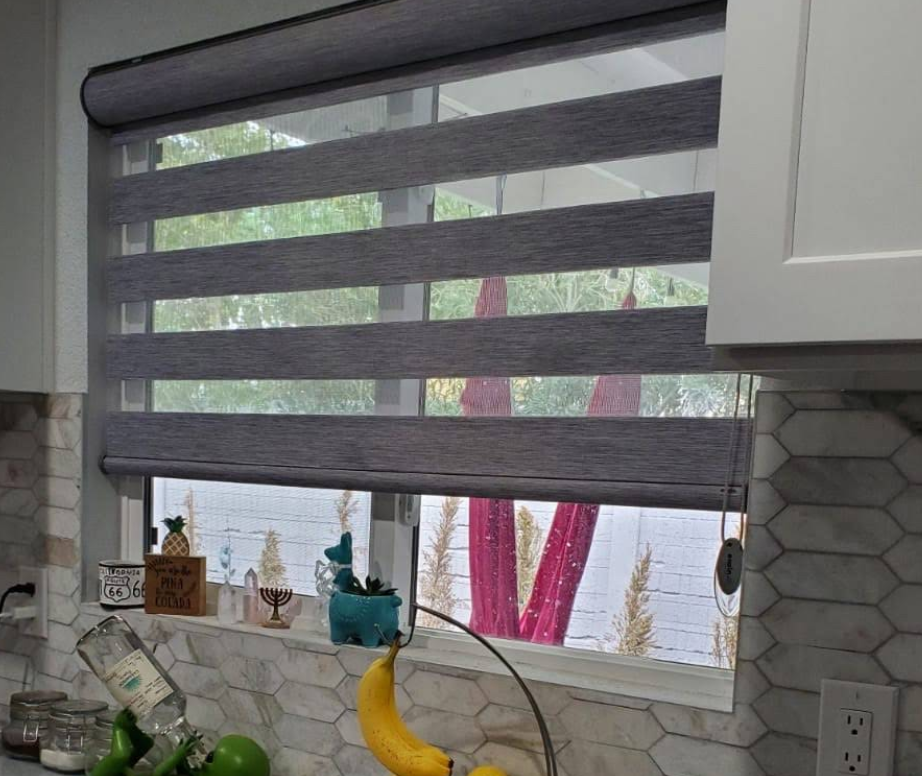
Use enclosed fabric cells that add an insulating air layer. Room-darkening and blackout versions provide stronger coverage and privacy.
Plantation shutters
Closed louvers reduce direct sunlight and allow adjustable light redirection. Composite or suitable materials can be practical in desert conditions.
Blackout roller shades
Provide strong coverage through the fabric for bedrooms, media rooms, and unoccupied spaces. Perimeter gaps remain unless the installation overlaps or uses channels.
Room-darkening shades
Reduce substantial light without creating complete darkness. Useful for bedrooms and living spaces where softer daylight is acceptable.
Dual roller shades
Combine a solar layer with an opaque layer. They offer daytime view and stronger nighttime privacy from one opening.
Faux-wood blinds
Provide adjustable slats and familiar operation. They help with light control but allow more gaps than a continuous shade.
Motorized heat-control shades
Improve consistency by closing before peak sun and reopening later. Motor size, power, controls, and safe service access must be planned.
Heat-Control Window Covering Comparison
| Product | Best For | Heat and Glare | View | Privacy | Cleaning | Smart Compatibility | Installation | Potential Drawback |
|---|---|---|---|---|---|---|---|---|
| Exterior solar screen | Severe west-facing heat | Strong exterior interception | Mesh-filtered | Daytime screening | Outdoor cleaning | Specialty automation varies | Exterior frame, wind, HOA, egress | Changes exterior appearance |
| Solar roller shade | Living rooms, offices, storefronts | Strong glare and solar control | Partial | Mostly daytime | Dusting or approved wiping | Excellent | Inside/outside mount; tube clearance | Limited nighttime privacy |
| Cellular shade | Bedrooms, offices, whole-home comfort | Good insulating coverage | None when closed | Strong | Gentle dusting/vacuuming | Good | Side gaps and depth | Pleats require care |
| Plantation shutter | Traditional homes, adjustable control | Good | Adjustable | Strong | Wipeable louvers | Motorized tilt varies | Frame and panel clearance | Permanent frame |
| Blackout roller shade | Bedrooms and media rooms | Strong when closed | None | Strong | Simple broad-surface care | Excellent | Outside mount or channels may help | Blocks daylight |
| Dual roller shade | Mixed daytime and nighttime needs | Excellent flexibility | Solar or none | Excellent | More hardware to clean | Excellent | Requires more depth | Higher complexity |
| Faux-wood blind | Kitchens, rentals, family rooms | Moderate | Adjustable | Good | Many slats to wipe | Some options | Headrail and slat clearance | More light gaps |
| Roman shade | Decorative rooms | Fabric-dependent | None when closed | Strong with lining | Fabric-specific | Available | Stack and lining | More fabric mass |
| Motorized drapery | Large glass walls and hospitality | Fabric-dependent | None when closed | Strong with lining | Fabric-specific | Excellent | Wall stack and track support | Requires side space |
Exterior Solar Screens vs Interior Shades
Exterior solar screens
Exterior screens sit outside the glass. Their main advantage is position: they reduce direct sunlight before it reaches the window. They are especially relevant to severe west-facing exposures, but the frame, mesh, wind resistance, egress, screen removal, and exterior design must be planned.
Interior solar shades
Interior solar shades are easier to operate from inside and preserve a clean exterior. They reduce glare and direct solar exposure but act after sunlight has reached the glass.
Privacy differences
Both products can provide daytime screening. Neither open mesh product should be assumed to provide dependable nighttime privacy. An opaque interior layer may be needed.
View differences
Dark, more open solar fabrics often preserve a clearer view, while tighter mesh creates stronger screening. Product-specific samples should be tested at the actual window.
HOA and property approval
Exterior screens may be regulated by HOA or landlord rules. Interior shades generally involve fewer exterior design approvals.
Layered systems
Some severe exposures benefit from exterior screening plus an interior privacy or blackout shade. Each layer should have a defined purpose.
Solar Shade Openness, Color, and Fabric Selection
Lower openness
Tighter solar fabric generally admits less visible light and provides stronger glare control. It also reduces outward view and makes the room darker.
Higher openness
More open fabric preserves more view and daylight but allows more light through. It may be suitable on moderate exposures or view-oriented rooms.
Dark fabrics
Dark solar fabrics often provide clearer outward view and reduce internal reflection. They can also appear visually heavier.
Light fabrics
Light fabrics create a brighter interior and may coordinate better with HOA exterior-facing color requirements. Their view characteristics differ by weave.
Blackout and room-darkening fabric
These fabrics prioritize coverage and privacy rather than view. Blackout refers to the material, not the entire installed opening.
Physical samples
View samples at the actual glass during peak sun. Online photographs cannot accurately show transmitted color, glare, privacy, or exterior appearance.
Best Choices for West-Facing Windows
West-facing windows usually create the hardest Las Vegas heat-control problem because low afternoon sun reaches deep into the room. The building and interior may already be warm when the strongest glare begins.
Exterior-first approach
Exterior solar screens or architectural exterior shades are worth comparing when HOA, access, and façade conditions permit.
Tighter solar fabric
Interior solar shades with lower openness may provide better glare control than highly open fabrics. The exact tradeoff is less view and daylight.
Opaque closure when rooms are empty
Blackout or room-darkening shades can close during peak sun when the room is unused. Dual rollers combine this with a solar layer.
Motorized schedules
Schedules can close shades before afternoon sun reaches the glass and reopen them after exposure passes. Seasonal adjustment is important.
Furniture placement
Move sensitive artwork, leather, instruments, and original photographs away from direct exposure where practical. Window coverings reduce risk but do not make interiors fade-proof.
Best Heat-Control Product by Room
Living rooms
Solar roller shades or dual shades preserve daytime view while managing glare. Shutters provide adjustable architectural control.
Bedrooms
Cellular, room-darkening, or blackout shades support privacy, sleep, and stronger coverage.
Home offices
Solar shades reduce monitor glare while maintaining daylight. Motorized groups help manage multiple windows.
Kitchens
Faux-wood blinds, shutters, or cleanable roller fabrics provide adjustable light and practical maintenance.
Sliding doors
Wide roller shades, panel tracks, vertical cellular shades, or motorized drapery may be more practical than standard blinds.
High-ceiling rooms
Hardwired or rechargeable motorized shades reduce dependence on ladders and improve consistent use.
Restaurants
Zoned solar shades protect hot tables while preserving the rest of the dining room.
Retail stores
Solar shades balance merchandise protection with storefront visibility. Opaque shades may be used after hours.
Medical offices
Solar shades suit waiting areas; opaque privacy shades suit consultation and treatment rooms.
Motorized and Smart Heat-Control Shades
Motorized vs smart-connected
A motorized shade moves by remote or switch. A smart-connected shade adds app, schedule, sensor, or voice integration through compatible controls.
Schedules
Schedules are useful because a shade only helps when it is closed during exposure. Set west-facing groups to close before peak sun and reopen later.
Sun and temperature sensors
Some systems can react to sunlight or temperature. Sensor placement and thresholds should be tested to prevent unnecessary movement.
Battery and rechargeable motors
These are practical for many retrofit projects. Charging access should be safe, especially on high windows.
Hardwired power
Hardwired or low-voltage systems can be a good fit for tall windows, new construction, and many-window projects. Electrical work should be properly coordinated.
Smart-home bridge
Some systems require a bridge or hub for app and voice features. Confirm compatibility with the preferred platform before ordering.
Manual backup
Ask what controls remain available during an internet outage. Dedicated remotes and wall switches are useful backups.
Realistic Energy-Efficiency Expectations
Window coverings can help manage solar heat gain and improve comfort near glass, but monthly cooling costs depend on many factors. Outdoor temperature, thermostat settings, HVAC efficiency, duct condition, insulation, air leakage, occupancy, pool equipment, cooking, and utility rates all affect the bill.
Target the most important windows
Treating the hottest west- and south-facing windows may provide more useful comfort improvement than installing the same fabric on every elevation.
Operate the products consistently
Close coverings before direct sun arrives. Open them when daylight is useful and exposure is moderate. Motorized schedules improve consistency.
Maintain the HVAC system
Clean filters, open vents, proper equipment operation, and duct condition remain important. Window coverings do not compensate for a failing cooling system.
Review the building envelope
Air sealing, attic insulation, efficient glazing, and weatherstripping may also deserve attention. A shade complements those measures rather than replacing them.
Avoid unsupported percentages
Do not rely on one general heat-blocking claim for every product. Review product-specific data, fit, orientation, and installation.
Safe Homeowner Checks
Safe checks
- Identify west- and south-facing windows.
- Observe when direct sun reaches the room.
- Check whether shades cover the full glass.
- Look for side and bottom gaps.
- Confirm inside or outside mounting.
- Check for loose brackets.
- Test whether shades roll evenly.
- Check whether cordless shades remain level.
- Replace accessible remote batteries.
- Charge reachable motor batteries.
- Confirm the smart-home hub is online.
- Review HOA rules before exterior screens.
Do not do these things
- Do not stand on unstable furniture.
- Do not remove large shades alone.
- Do not work near electrical wiring without knowledge.
- Do not disassemble motors.
- Do not force a jammed motorized shade.
- Do not pull hard on a stuck cord.
- Do not allow children to play with cords.
- Do not use harsh chemicals without instructions.
- Do not pressure-wash interior shades.
- Do not bend shutter louvers.
- Do not drill into unknown cavities.
- Do not modify exterior screens without approval.
Custom-Fit vs Ready-Made Heat-Control Products
Ready-made products
Ready-made blinds and shades can suit temporary rooms and standard openings. Their limitations include fixed widths, limited fabric options, larger edge gaps, and generic hardware.
Custom-fit products
Custom products are measured for the opening, trim, depth, handles, desired overlap, motor load, and control system. They allow the heat-control strategy to match each orientation.
DIY measurement risk
Measuring only one point or applying a homemade deduction can produce poor fit. Wide shades may also require stronger tubes or multiple units.
Large windows and sliders
Oversized openings need planned tube strength, motor capacity, fabric width, mounting structure, and safe service access.
Commercial properties
Storefront and office projects may require coordinated exterior color, after-hours installation, building approval, electrical coordination, and documented cleaning procedures.
When to Clean, Repair, Upgrade, or Replace
Cleaning
Cleaning may be enough when the product operates normally, dust is the main issue, and the material allows a safe method. Keep moisture away from motors and headrails.
Minor repair
Loose brackets, remote batteries, control chains, programming limits, replaceable slats, shutter magnets, and minor alignment issues may be serviceable.
Upgrade
Upgrade when the homeowner wants stronger glare control, motorization, smart schedules, better privacy, tighter fabric, exterior screening, or blackout performance.
Replacement
Replacement may be practical when fabric is permanently stained, multiple slats are broken, the shade tracks poorly, the headrail fails, parts are unavailable, the motor is obsolete, or the product is badly fitted.
Cost factors
Pricing depends on window measurements, quantity, product category, fabric, openness, color, controls, motorization, mounting, access, custom shapes, electrical requirements, removal, and exterior conditions. Request a product-specific written estimate.
Las Vegas and Clark County Heat Conditions
Local experience matters because Las Vegas properties face strong sun, dry air, fine dust, high cooling demand, and many west-facing glass exposures. Summerlin, Summerlin South, Peccole Ranch, and Queensridge homes may combine HOA requirements with large view windows. Henderson, Green Valley, Anthem, Seven Hills, and Inspirada homes often need a mix of privacy and glare control.
Enterprise, Spring Valley, Paradise, and Winchester include rental homes, multi-unit properties, and commercial spaces where durability and easy operation matter. Downtown Las Vegas businesses may need storefront visibility and office glare control. North Las Vegas, Centennial Hills, Tule Springs, Skye Canyon, and Aliante homes may feature large modern windows and sliding doors.
Luxury communities such as The Ridges, Red Rock Country Club, MacDonald Highlands, Spanish Trail, and Southern Highlands may require coordinated exterior-facing colors, hidden motorization, and early electrical planning. Service in these communities comes from the business’s Las Vegas location and does not imply a separate office in each neighborhood.
Detailed Heat-Control Buying Checklist
Map the sun path
Observe the room in the morning, midday, and late afternoon. Note when direct sun reaches floors, furniture, screens, customer seating, and workstations. The best product may differ by elevation.
Rank view, privacy, and heat priorities
Solar fabric preserves view but provides limited nighttime privacy. Opaque products provide stronger coverage but eliminate the view when closed. Decide which outcome matters most before selecting material.
Review exterior restrictions
Exterior screens can be effective for severe exposure, but HOA, landlord, façade, egress, and wind requirements must be reviewed before ordering.
Test physical samples
Hold samples at the actual glass during peak sun. Compare glare, transmitted color, view, room brightness, and exterior appearance.
Plan daily operation
A manual shade must remain easy to reach. High or frequently forgotten windows are strong motorization candidates. Schedules should follow actual sun exposure.
Confirm maintenance
Ask whether the product allows dusting, vacuuming, damp wiping, or exterior rinsing. Keep motors, charging ports, and electrical components dry.
Document the full system
Keep the fabric name, openness, color, dimensions, mounting style, motor, power, controls, cleaning instructions, and warranty documents.
Set realistic expectations
Window coverings can improve comfort and reduce direct solar exposure, but they do not guarantee a specific temperature change or utility-bill reduction.
Heat-Control Recommendations by Property Type
Single-family homes
Use a room-by-room approach. Solar shades may fit living rooms, cellular shades may fit bedrooms, and exterior screens may target the hottest west-facing windows.
Rental homes
Durable cordless blinds, cellular shades, and simple roller shades provide familiar operation. Document remotes and charging accessories.
Luxury homes
Motorized dual shades, hidden pockets, coordinated power, and exterior-facing colors should be planned early. Large glass may require multiple synchronized shades.
Restaurants
Zoned solar shades allow staff to address hot tables without closing the whole dining room. Nighttime privacy may require an opaque second layer.
Retail stores
Solar shades balance merchandise protection with storefront visibility. Test how the fabric looks from outside before ordering.
Professional offices
Solar roller shades reduce monitor glare and preserve daylight. Grouped motorized controls improve consistency across work areas.
Medical offices
Solar or light-filtering shades suit waiting rooms. Opaque privacy shades suit consultation and treatment rooms.
Hospitality properties
Guest rooms often require blackout products, while lobbies and lounges may use motorized solar shades that preserve views.
Product-by-Product Heat-Control Details
Exterior solar screens
Exterior solar screens are often the first product to compare when direct sunlight is the main problem because they act outside the glass. This position can reduce the amount of direct solar energy reaching the window, but actual results depend on mesh density, color, frame fit, wind exposure, window orientation, and how much of the glass is covered. They should not block required egress, drainage, screen removal, or window service.
For west-facing windows, tighter mesh may provide stronger screening, while more open mesh preserves more view. Darker mesh often improves outward visibility, but exterior appearance and HOA standards may influence the final color. Property owners should review samples from both inside and outside.
Interior solar roller shades
Solar roller shades are practical where view, daylight, and glare control all matter. Their openness factor is one of the most important choices. Lower openness generally creates stronger screening, while higher openness preserves a clearer view. The same openness may not be appropriate on every elevation.
Inside mounting creates a cleaner look but leaves small side gaps. Outside mounting can provide more overlap and stronger edge coverage. Large windows require a roller tube and motor sized for the actual fabric weight and width.
Cellular shades
Cellular shades use folded fabric that creates enclosed air pockets. This design can improve room-side comfort near the window while also providing privacy and light control. Light-filtering fabrics keep the room brighter, while room-darkening and blackout fabrics provide stronger coverage.
Side gaps remain on most inside-mounted cellular shades. Outside mounting can improve overlap but changes the appearance. Top-down bottom-up operation is useful where privacy and daylight are both priorities.
Plantation shutters
Plantation shutters provide adjustable louvers, durable frames, and a permanent architectural appearance. Closed louvers reduce direct sun, while partially open louvers can redirect light upward. Split tilt or divider rails can control upper and lower sections separately.
Material choice, frame depth, panel swing, and window hardware clearance all matter. Shutters are easy to wipe but include more surfaces than a roller shade. They should not be marketed as completely eliminating heat or light.
Blackout and room-darkening shades
Blackout shades are useful where strong coverage, privacy, and sleep control matter. The fabric blocks light through the material, but the installation may still allow edge gaps. Outside mounting, channels, cornices, or layered drapery can improve darkness.
Room-darkening shades reduce substantial light while preserving a softer room environment. They may be more comfortable for living rooms where total darkness is unnecessary.
Faux-wood blinds
Faux-wood blinds provide adjustable slats, familiar controls, and wipeable surfaces. They are useful in kitchens, rentals, and family rooms. However, slat gaps, cord routes, and headrail clearances make them less continuous than a roller or cellular shade.
Cordless lift is preferred where young children are present. Wide blinds can become heavy, so multiple units may be more practical than one oversized blind.
Installation Details That Affect Real Heat Performance
Coverage area
A treatment that leaves large uncovered areas around the glass may not perform as expected. Measure the visible opening, frame, trim, and desired overlap. Outside-mounted products often provide stronger coverage, while inside-mounted products preserve trim and a built-in appearance.
Mounting depth
Roller cassettes, dual shades, cellular headrails, and shutter frames require different depths. A product that projects beyond the frame may still work, but the final appearance and hardware clearance should be explained.
Bracket strength
Wide and motorized shades need secure brackets and suitable mounting surfaces. Weak drywall, damaged trim, or inadequate fasteners can lead to sagging or movement.
Roller-tube deflection
Large roller shades can bow if the tube is undersized. Deflection can create fabric waves, uneven tracking, and inconsistent bottom-rail height. Multiple aligned shades may be more reliable across a large wall of glass.
Motor capacity
Motor torque must match the width, height, fabric weight, tube, and accessories. An undersized motor may stall or stop inconsistently. Controls and upper and lower limits should be tested during handover.
Power planning
Rechargeable motors are convenient for retrofit projects, but charging access must be safe. High windows may benefit from extension charging, removable battery wands, or hardwired power. Electrical services should be clearly identified as included or separate.
Edge gaps
Inside-mounted shades need operating clearance. Small gaps are normal, but they should be disclosed before ordering. Outside mounting, side channels, or layered products can reduce visible light at the edges.
Window and door hardware
Handles, locks, sensors, and sliding-door hardware must remain accessible. A heat-control product should not interfere with normal window operation, egress, or cleaning.
Seasonal and Daily Operating Strategy
Close before peak exposure
Waiting until the room is already hot reduces the benefit of the covering. Close or schedule west-facing shades before the strongest afternoon sun reaches the glass.
Reopen after the sun moves
Once direct exposure passes, reopening shades can restore daylight and view. A permanent closed position may make the home darker than necessary.
Adjust by season
Sun angle and daylight hours change during the year. A schedule that works in July may close too early during cooler months. Review smart routines several times a year.
Use layered products intentionally
A solar shade may remain in use during the day, while an opaque shade closes for privacy at night or during extreme exposure. Dual roller systems make this easier.
Coordinate with room use
Bedrooms may stay darker during daytime sleep. Living rooms may preserve view until direct sun reaches the seating area. Restaurants and offices may operate shades by zone.
Inspect performance
After installation, observe the room through a full sunny day. Confirm that glare, privacy, and direct exposure are improved without creating new problems around doors, vents, furniture, or controls.
Common Heat-Control Mistakes to Avoid
Choosing by color alone
Color affects appearance, but fabric openness, material, fit, and orientation are also important. Use product-specific data and physical samples.
Using the same product everywhere
North-facing windows may need only light control, while west-facing windows may need tighter screening or exterior shading. A room-by-room plan is usually more practical.
Assuming solar fabric provides privacy at night
Open solar fabrics can become transparent after dark when interior lights are on. Add an opaque layer where privacy matters.
Calling every dark fabric blackout
Dark color and blackout construction are not the same. Confirm whether the material is light-filtering, room-darkening, privacy, or blackout.
Ignoring edge gaps
Even blackout fabric can allow light around the sides. Ask how much gap is expected and whether outside mounting or channels are appropriate.
Forgetting daily operation
A high-performance shade that remains open during peak sun will not achieve the intended comfort goal. Motorization or simple staff and household routines may improve use.
Overlooking exterior rules
Exterior solar screens may require HOA or landlord approval. Confirm frame color, mesh appearance, attachment, and removability before ordering.
Expecting one product to fix the whole building
Window coverings support comfort but do not repair poor insulation, failing HVAC equipment, leaking ducts, or damaged windows. Consider the complete property.
Questions to Ask Before Hiring a Window-Covering Company
- Which product is recommended for the hottest windows?
- Is an exterior or interior product more appropriate?
- What openness factor is recommended?
- How much view and daylight will remain?
- Will the product provide privacy at night?
- Is the shade light-filtering, room-darkening, or blackout?
- Is the product custom measured?
- Does the quote include installation?
- Does it include removal of old coverings?
- What side and top gaps should I expect?
- Is the control cordless?
- Can the product be motorized?
- What power source and controls are included?
- Does smart operation require a hub?
- Are electrical services separate?
- How should the material be cleaned?
- Are replacement parts available?
- Does an exterior product require HOA approval?
- Can I view samples during peak sunlight?
- Will I receive a written estimate?
Red Flags When Buying Heat-Control Window Coverings
- Guaranteed energy savings or temperature reductions.
- One product recommended for every elevation.
- No discussion of west-facing exposure.
- No explanation of exterior versus interior control.
- Unsupported heat- or UV-blocking percentages.
- No explanation of openness factor.
- No nighttime privacy discussion.
- Blackout promised without discussing edge gaps.
- No product samples at the actual window.
- No measurement of depth, width, or mounting surface.
- No motor or power plan for high windows.
- No HOA discussion for exterior screens.
- Vague installation charges.
- No clear local business identity or Google Maps presence.
- Pressure to order before the heat problem is observed.
Why Consider Las Vegas Blinds, Solar Screens & Shutters Window Coverings Center?
Las Vegas Blinds, Solar Screens & Shutters Window Coverings Center is a local option for homeowners, landlords, renters, property managers, investors, designers, offices, storefronts, restaurants, and other businesses comparing heat-control window coverings in Southern Nevada.
The team can help compare exterior solar screens, solar roller shades, cellular shades, plantation shutters, faux-wood blinds, blackout shades, dual shades, motorized shades, smart controls, and custom-fit products. A useful consultation should match each product to orientation, window size, privacy, desired view, fabric openness, mounting, cleaning, and daily operation.
Call (702) 237-4401, request help choosing heat-control window coverings, browse the window-covering product catalog, compare cellular shades, review plantation shutters, explore faux-wood blinds, or learn about motorized shades.
For related installation guidance, read the previous article about window treatments for double-hung windows. View the Las Vegas window-covering location on Google Maps.
Areas Served
The business serves customers in these communities from its Las Vegas location. Service in a community does not imply a separate physical office there.
Frequently Asked Questions About Las Vegas Heat-Control Window Coverings
What are the best window coverings for Las Vegas heat?
Exterior solar screens, solar roller shades, cellular shades, shutters, blackout shades, and motorized systems are the main options to compare. The best choice depends on orientation, privacy, view, fabric, and fit.
Are solar screens better than interior shades for heat?
Exterior solar screens are better positioned to intercept sunlight before it reaches the glass. Interior shades are easier to operate and can provide stronger privacy or blackout.
Do cellular shades help with Las Vegas heat?
Cellular shades add an insulating air layer and reduce direct exposure when closed. Actual comfort depends on fabric, fit, glass, orientation, and use.
What is the best option for west-facing windows?
Exterior solar screens, tighter solar shades, cellular shades, or dual rollers are strong options. Motorized schedules improve consistent afternoon use.
Do solar shades provide privacy at night?
Generally not dependable privacy. When interior lighting is brighter than outside, people may see through open solar fabric. Add an opaque layer if nighttime privacy matters.
Can heat-control shades be motorized?
Yes. Solar, blackout, cellular, and dual shades can often be motorized with remote, app, schedule, sensor, or voice-control options.
Should I use inside or outside mounting?
Inside mounting creates a built-in look but leaves operating gaps. Outside mounting increases overlap and can improve coverage on shallow or uneven openings.
How can I request current consultation and installation availability?
Call Las Vegas Blinds, Solar Screens & Shutters Window Coverings Center at (702) 237-4401 to ask about current measurement, consultation, and installation availability.
Find the Las Vegas Location
Las Vegas Blinds, Solar Screens & Shutters Window Coverings Center is located at 3871 S Valley View Blvd #6, Las Vegas, NV 89103. Call before visiting to confirm current availability.
Compare Heat-Control Window Coverings for Your Las Vegas Property
Call Las Vegas Blinds, Solar Screens & Shutters Window Coverings Center at (702) 237-4401 to compare solar screens, cellular shades, solar shades, shutters, blackout shades, and motorized options.
Identify the hottest windows, privacy needs, desired view, mounting conditions, and control preferences before choosing the final product.