Best Smart Blinds in Nevada
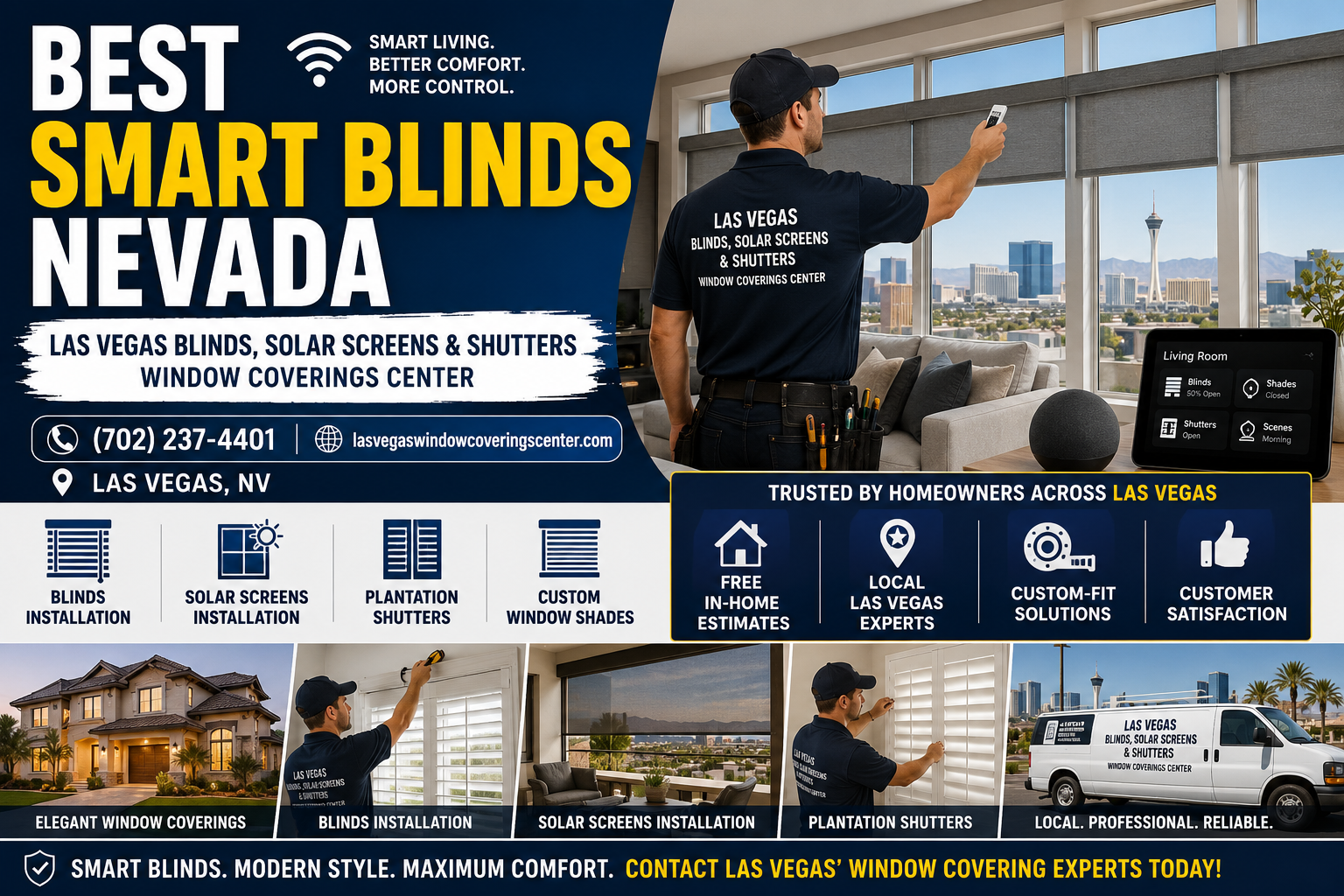
Compare smart roller shades, motorized solar shades, blackout shades, Matter compatibility, power options and custom installation for Las Vegas and Clark County properties.
What Are the Best Smart Blinds for Nevada Homes?
The best smart blinds in Nevada are custom-fit motorized window coverings with a reliable motor, a suitable power source, manual or remote backup, and verified compatibility with the homeowner’s actual smart-home platform. For most Las Vegas homes, motorized roller shades, solar shades, blackout shades and cellular shades are the most practical categories. The right choice depends on whether the priority is heat and glare control, privacy, room darkening, insulation, large-window operation or whole-home automation.
Matter-compatible blinds and shades can be easier to connect across ecosystems such as Apple Home and Google Home, but “Matter compatible” does not guarantee that every advanced feature will appear in every app. Buyers should verify the exact motor, bridge, controller, Thread or Wi-Fi requirement, supported commands, scheduling options and whether the system still works with a handheld remote when the internet or smart-home hub is unavailable.
Battery and rechargeable motors are convenient for existing homes. Hardwired motors are usually the cleanest option for new construction, remodels and many-shade projects. Plug-in systems can work where outlets are accessible. Accurate measurement is essential because motor capacity, shade weight, roller-tube size and mounting conditions must match the window.
Why Smart Blinds Are a Strong Fit for Nevada
Nevada homes often combine intense sunlight, wide glass, tall ceilings and open-plan interiors. These design features create attractive views, but they also make manual window coverings difficult to use consistently. A homeowner may need to close west-facing shades every afternoon, lower blackout shades before sleep, protect a high foyer window from glare or coordinate several windows across one room. Smart blinds and motorized shades make those routines easier.
In Las Vegas, Summerlin, Henderson, North Las Vegas and nearby Clark County communities, smart shades are frequently selected for solar control. A schedule can lower west-facing solar shades before late-afternoon heat and reopen them after the exposure passes. Bedroom blackout shades can close automatically at night and rise in the morning. Living-room shades can respond as a group instead of being adjusted one at a time.
Convenience is only part of the value. Motorized operation removes the need to reach high windows, lean over furniture or operate multiple chains. It can create a cleaner appearance and may support safer cordless designs. In offices, restaurants, retail properties and hospitality spaces, automation can improve consistency because employees do not need to remember a complicated shade routine.
The phrase “best smart blinds Nevada” should not lead to one universal product recommendation. A battery roller shade may be ideal for a completed home with four reachable windows. A hardwired system may be better for a new custom property with twenty tall openings. A Matter-based motor may be useful for a homeowner who wants cross-platform flexibility, while a dedicated professional control system may be more appropriate for a commercial building or whole-home automation project.
Smart Blinds vs Motorized Blinds: What Is the Difference?
Motorized blinds or shades
A motorized window covering uses an electric motor to raise, lower, tilt or traverse the treatment. It may be controlled only by a handheld remote or wall switch. Motorization does not automatically mean internet connectivity, voice control or app access.
Smart blinds or smart shades
A smart window covering adds digital connectivity. It may connect directly through Wi-Fi, Thread or another protocol, or it may use a bridge or hub. Smart functions may include app control, schedules, scenes, sunrise or sunset routines, voice commands, sensor-based automation and coordination with thermostats or lighting.
Why the distinction matters
Some buyers only need reliable remote operation. Adding app accounts, hubs and network dependencies may provide little value. Other buyers want whole-home routines and remote access, making smart connectivity central to the project. The best system is the simplest one that delivers the desired function reliably.
Manual backup
Ask how the shade can be operated if the app, network, bridge or voice assistant is unavailable. Many systems retain a dedicated remote or wall switch. Some also support local button control. Manual hand operation is not available on every motorized design and should not be assumed.
Best Types of Smart Blinds and Shades for Nevada
Smart solar roller shades
Motorized solar shades are one of the strongest choices for Las Vegas because they manage glare and direct sunlight while preserving some outward view. They are especially useful on west-facing living rooms, offices, restaurants and large glass walls. Fabric openness and color determine the balance among view, brightness, daytime privacy and solar control.
Automation can close the shades before afternoon exposure instead of waiting until the room becomes uncomfortable. Solar fabric generally does not provide dependable nighttime privacy, so bedrooms and street-facing rooms may need a second opaque layer.
Smart blackout roller shades
Blackout shades are well suited to bedrooms, media rooms, nurseries, shift-worker sleeping spaces and presentation rooms. The fabric blocks light through the material, but side and top gaps can remain. Outside mounting, side channels or layered curtains may improve coverage.
Smart scheduling allows shades to close automatically before sleep and open at a chosen time. The motor, roller tube and brackets must be sized for the fabric weight and window dimensions.
Smart light-filtering roller shades
Light-filtering fabrics soften daylight while providing a clean, modern appearance. They are useful in kitchens, dining rooms, salons, waiting rooms and spaces where full blackout is unnecessary. Privacy varies by material and nighttime lighting.
Motorized cellular shades
Cellular or honeycomb shades contain enclosed air pockets and can support year-round comfort. Motorization is valuable on high windows and in bedrooms where consistent opening and closing matters. Availability of advanced smart connectivity varies by product line, shade size and operating style.
Smart zebra or dual shades
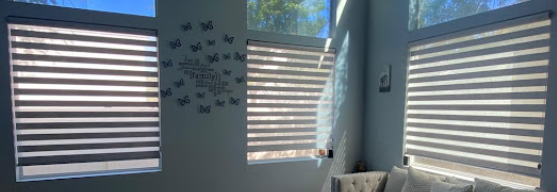
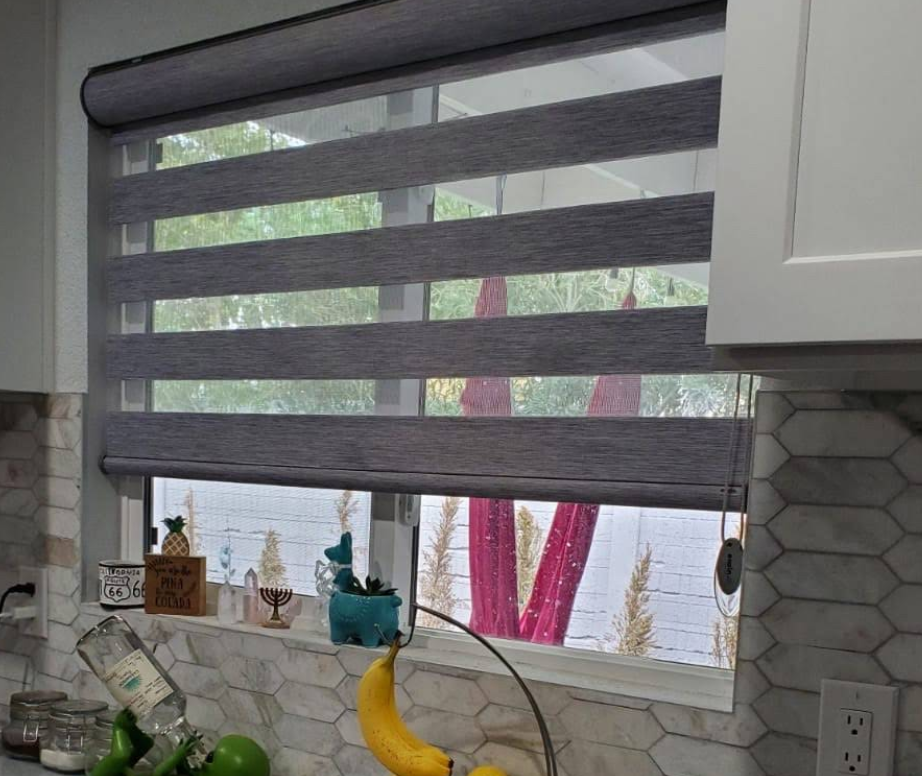
Zebra shades alternate sheer and opaque bands. A motor aligns the bands to change privacy and daylight without fully raising the treatment. They provide a distinctive modern appearance, but they are not the same as blackout shades and may allow view-through or light at certain alignments.
Motorized Roman shades
Roman shades provide a soft, decorative fabric appearance. Motorization avoids visible lift cords and can improve consistency across several windows. Fabric weight, fold style and stack size affect motor selection.
Motorized drapery
Large sliding doors, wide glass walls and hospitality spaces may be better served by automated drapery tracks. Drapery moves horizontally rather than rolling upward. It can provide strong privacy, blackout lining and decorative impact, but requires wall space for the fabric stack.
Smart tilt systems for horizontal blinds
Some systems automate the tilt of horizontal blinds rather than raising the entire blind. This can be practical for existing compatible blinds or rental situations. Buyers should understand whether the device controls tilt only, whether a bridge is required and how visible the retrofit hardware will be.
Smart-Home Compatibility: Matter, Apple Home, Google Home, Alexa and More
Matter
Matter is a smart-home interoperability standard designed to make supported devices work across compatible ecosystems. Blinds and shades are included as a supported device category. A Matter logo can simplify setup and cross-platform control, but buyers still need to verify the exact product, controller requirements and supported functions.
Thread
Thread is a low-power mesh networking technology used by some Matter devices. Matter-over-Thread shades may require a compatible Thread border router in the home. Not every Matter device uses Thread; some use Wi-Fi or connect through a bridge.
Apple Home
Apple Home supports Matter blinds and shades. Buyers should confirm whether the home already has the required home hub or Thread border-router capability for the selected device, and whether all desired automations are supported.
Google Home
Google Home also supports Matter blinds and shades. Setup may involve scanning a Matter code and assigning the shade to a room. Platform support can change, so confirm the current device list and feature set for the exact motor.
Amazon Alexa
Many motorized shade systems integrate with Alexa either directly, through a manufacturer skill, through Matter or through a bridge. The wording of commands and the ability to set exact positions vary.
Samsung SmartThings and professional systems
Some systems connect to SmartThings, Z-Wave networks, Zigbee bridges or professional whole-home platforms. A professionally integrated system may offer deeper scene control and local reliability, but it can require specialized programming and service.
Do not assume brand-name compatibility
A product family may include several motors with different connectivity. One version may use only a remote, another may require a proprietary bridge and another may support Matter. The quote should identify the exact motor and controller, not merely the shade fabric.
Battery, Rechargeable, Plug-In or Hardwired Power?
Replaceable battery
Useful for retrofit projects without wiring. Battery replacement depends on shade size, use frequency and motor design. High windows make access important.
Rechargeable battery
Reduces disposable battery use and can provide a clean installation. The charging port must remain accessible, or a removable battery wand may be needed.
Plug-in power
Provides continuous power where a receptacle is available. Visible cords and transformer placement must be planned.
Hardwired power
Often best for new construction, remodels, large homes and commercial systems. It creates a clean appearance but requires electrical planning and qualified work.
Solar charging accessory
Some battery motors can use a small solar charging panel. Window orientation, glass coatings and panel placement affect usefulness. Compatibility must be verified.
Low-voltage centralized power
Multiple shades may connect to a central low-voltage supply. This can simplify maintenance but requires early wiring coordination.
How power affects the “best” choice
A smart shade is not the best product if charging it requires a dangerous ladder every few months. Tall windows and large shades often justify hardwired or accessible centralized power. Smaller retrofit shades may be ideal candidates for rechargeable motors.
Smart-Blind Control Options
Handheld remote
A dedicated remote is often the most dependable everyday control and remains useful when the internet is unavailable. Remotes should be labeled by room or group.
Wall switch
Wall controls feel familiar and prevent household members from searching for a phone. Wired and wireless versions may be available.
Mobile app
Apps can create rooms, groups, scenes and schedules. Review whether control works locally or requires a cloud account, and who owns the account if the property is sold or rented.
Voice control
Voice commands are useful when hands are occupied or for accessibility. Exact commands vary, and voice should not be the only control method.
Schedules
Schedules can close solar shades before peak heat, lower privacy shades at sunset and open bedroom shades in the morning. Seasonal adjustment is important in Nevada.
Scenes
A “movie” scene may lower blackout shades and adjust lights. An “away” scene can close selected shades. A “morning” scene can open east-facing shades while keeping hot west-facing glass covered.
Sun and temperature sensors
Some systems can respond to sunlight or temperature. Sensor placement and thresholds require commissioning. The homeowner should retain an override.
Smart-Blind System Comparison
| System Type | Best For | Power | Controls | Smart Compatibility | Main Advantage | Main Limitation |
|---|---|---|---|---|---|---|
| Remote-only motorized shade | Simple reliable automation | Battery, plug-in or hardwired | Remote or switch | None unless upgraded | Simple setup | No app or automation platform |
| Wi-Fi smart shade | Small projects and direct app control | Varies | App, voice, remote | Platform-dependent | May not need separate bridge | Relies on Wi-Fi and cloud design |
| Matter-over-Thread shade | Cross-platform smart homes | Usually low-power motor | App, voice, automation, remote | Matter ecosystems | Interoperability and local mesh | Needs compatible controller and border router |
| Proprietary bridge system | Whole-home projects | Varies | Manufacturer app, remote, scenes | Through bridge integrations | Mature shade-specific features | Bridge and ecosystem dependence |
| Professional hardwired system | New builds, luxury homes, commercial spaces | Hardwired or centralized low voltage | Wall controls, app, automation processor | Professional integration | Clean power and deep control | Higher planning and installation complexity |
| Retrofit blind-tilt device | Renters or existing horizontal blinds | Battery or solar accessory | App, remote, hub | Product-dependent | Lower-cost retrofit | Often controls tilt only and adds visible hardware |
Heat, Glare, Privacy and Blackout Considerations
Smart solar shades for heat and glare
Automation is particularly valuable for solar shades because timing matters. Closing the shade before direct sunlight enters can reduce radiant discomfort and glare. Actual cooling savings depend on fabric, glass, fit, orientation and use.
Privacy at night
Open solar fabrics often provide limited nighttime privacy. A smart routine can lower an opaque second shade after sunset, but a single solar layer should not be presented as a complete privacy solution.
Blackout expectations
Blackout fabric blocks light through the material, not necessarily around the perimeter. Side channels, outside mounts and layered drapery can improve darkness. The motorized rail should be programmed to stop consistently at the correct bottom position.
Winter operation
Smart shades can open during useful winter sun and close after sunset. Nevada schedules should change seasonally rather than using a fixed summer routine year-round.
UV and furnishing protection
Window coverings can reduce exposure, but product-specific data should be used for any UV claim. No shade should be described as guaranteeing that furnishings will not fade.
Custom Measurement and Installation Requirements
Motor capacity
Motor torque must match the shade width, drop, fabric weight and roller tube. An undersized motor may move slowly, stop inconsistently or fail prematurely.
Roller-tube strength
Wide shades can cause tube deflection and fabric waves. Large windows may need stronger tubes or multiple shades aligned with mullions.
Inside mount
Inside mounting creates a built-in appearance but requires enough depth for the motor, roller and brackets. Small side gaps remain for operation.
Outside mount
Outside mounting can provide greater coverage and room for hardware. It affects trim, wall space and the visible shade size.
Electrical planning
Hardwired systems should be coordinated before drywall when possible. Electrical services may be separate from the window-covering contract.
Wi-Fi and Thread coverage
Large homes, detached rooms and high-rise units may have weak network coverage. Test connectivity where the shades will be installed. Thread devices rely on a suitable mesh and border-router placement.
Account ownership and handover
For rentals, resale homes and commercial properties, document who owns the app account, bridge, QR codes and administrator access. Store setup codes securely.
Best Smart-Blind Setup by Room
Living rooms
Motorized solar or light-filtering roller shades provide glare control and group operation. Use scenes for television viewing and afternoon sun.
Bedrooms
Blackout roller or cellular shades with schedules are practical. Add side-gap control when strong darkness is required.
Home offices
Solar shades can reduce monitor glare. Position schedules around working hours and video-call lighting.
Kitchens
Choose easy-clean roller materials and controls that do not require reaching across counters.
High foyers
Hardwired or long-life motorized shades are often better than frequently charged battery systems.
Sliding doors
Consider motorized drapery, wide roller systems or specialty vertical products that preserve door access.
Media rooms
Blackout shades, side channels and scene integration with lighting provide the strongest result.
Commercial offices
Group shades by elevation and meeting area. Wall controls and central scheduling simplify staff use.
Restaurants and hospitality
Use zoned solar shades for customer comfort and automated privacy layers for evening operation.
Safe Checks Before Buying Smart Blinds
Safe checks
- Record approximate window dimensions for planning.
- Identify inside- or outside-mount space.
- Check nearby outlets and accessible charging locations.
- List the smart-home platforms already used.
- Confirm whether the home has a compatible hub or Thread border router.
- Test Wi-Fi or network coverage near the windows.
- Note direct sunlight and heat exposure.
- Check whether furniture blocks shade movement.
- Identify nighttime privacy and blackout requirements.
- Review HOA requirements for exterior products.
Avoid these actions
- Do not stand on unstable furniture to charge or reset a motor.
- Do not disassemble a motor or power supply.
- Do not work on hardwired electrical connections without qualification.
- Do not force a jammed motorized shade.
- Do not drill into unknown wiring or plumbing.
- Do not discard Matter codes, setup labels or manuals.
- Do not assume every motor in a product family has the same compatibility.
- Do not depend on voice control as the only operating method.
- Do not install an undersized motor on a heavy shade.
- Do not allow fabric to hit furniture, handles or doors.
What Affects Smart-Blind Cost?
Smart-blind pricing varies by window dimensions, fabric, motor, power source, controller and installation. Fixed online prices may not include the motor strength, custom size, fascia, bridge, electrical work or programming required for the actual window.
Shade type
Roller, cellular, Roman, zebra and drapery systems use different hardware.
Window dimensions
Wide and tall treatments require stronger motors and roller tubes.
Motor and protocol
Remote-only, Wi-Fi, Matter, bridge-based and professional motors differ.
Power source
Battery, rechargeable, plug-in and hardwired systems have different installation requirements.
Controls and hubs
Remotes, wall switches, bridges, gateways and automation processors add components.
Electrical work
Hardwired power may require separate qualified electrical services.
Programming
Grouping, scenes, schedules and third-party integration may require commissioning.
Access
High ceilings, stairs and large commercial glass affect labor and equipment.
Cleaning, Repairing, Upgrading or Replacing Smart Blinds
Cleaning
Follow the fabric instructions and keep moisture away from motors, charging ports and power supplies. Use gentle dusting, low-suction vacuuming or approved wiping methods.
Minor service
Remote batteries, rechargeable battery packs, pairing, limits and schedules may be serviceable without replacing the shade. Motor resets should follow the manufacturer’s procedure.
Connectivity upgrades
A bridge or controller may add app and voice functions to compatible motors. Do not assume an older remote-only motor can be upgraded without replacing components.
Replacement
Replacement may be practical when motors are obsolete, parts are unavailable, fabric is damaged, the shade is poorly fitted or the system no longer works with the owner’s automation goals.
Software and account maintenance
Keep apps and controllers updated, but review release notes before changing a stable professional system. Store administrator credentials securely and remove former owners or employees from shared access.
Nevada and Las Vegas Conditions
Nevada’s intense sun makes automated solar control one of the strongest use cases for smart shades. West-facing windows in Summerlin, Spring Valley, Enterprise and Henderson may benefit from schedules that close before afternoon exposure.
Large custom homes in The Ridges, Red Rock Country Club, MacDonald Highlands, Southern Highlands and Seven Hills often have tall windows where charging access and motor strength are important. Hardwired planning can be valuable during construction or renovation.
High-rise units and dense developments may have network interference or concrete construction that affects wireless signals. Connectivity should be tested at the window location rather than assumed from performance near the router.
Desert dust collects on fabric, fascia and charging ports. Easy-clean materials and accessible service positions matter. Exterior solar products may require HOA approval and are separate from interior smart-blind selection.
Seasonal schedules should account for useful winter sun. A shade routine optimized for July may unnecessarily block warmth in January. Review automations throughout the year.
Detailed Smart-Blind Buying Decision Guide
List the functions you genuinely need
Write down whether you need remote operation, app control, voice commands, scheduled opening, sun response, thermostat coordination or remote access away from home. A long feature list can increase complexity without improving daily use.
Choose the shade before choosing the ecosystem
The fabric and shade type must solve the window problem. A perfectly connected solar shade will not create blackout privacy, while a smart blackout shade may remove a view the homeowner wanted to preserve. Select light, privacy and heat performance first, then choose a compatible motor.
Inventory the existing smart home
Record the phones, speakers, hubs, routers and platforms already in use. Identify whether the home uses Apple Home, Google Home, Alexa, SmartThings or a professional automation system. Confirm whether a Matter controller or Thread border router is already present.
Decide how much cloud dependence is acceptable
Some systems depend heavily on a manufacturer cloud service. Others support local control through Matter, a bridge or a professional processor. Ask which functions remain available if the internet is down or the manufacturer app changes.
Plan for guests and household members
Not every person wants to use an app or voice assistant. Wall switches and dedicated remotes provide simple access for guests, children, older residents, housekeepers and maintenance staff.
Review privacy and account security
Smart-home accounts can reveal device names, routines and occupancy patterns. Use strong passwords, multi-factor authentication when available and limited sharing permissions. Remove former residents or employees promptly.
Protect setup codes
Matter QR codes, bridge labels and administrator credentials should be stored securely with property records. Do not discard the label after setup or leave it exposed where unauthorized people can scan it.
Plan power before ordering
Map every shade and note how it will be powered and serviced. Rechargeable shades need a safe charging method. Hardwired systems need coordinated power. Plug-in transformers need concealed cable routes.
Evaluate noise
Motor sound varies. A bedroom may need quieter operation than a storefront. Ask to hear a comparable system and remember that several shades moving together create more combined sound than one sample.
Consider speed and synchronization
Grouped shades may start and stop at slightly different times depending on the system. High-end projects may require tighter synchronization. Ask what level of alignment is normal.
Test accessibility
Smart shades can improve access for people with limited mobility, but the controls must be usable. Voice, wall buttons, large remote buttons and app design should be evaluated for the actual occupants.
Plan for property resale
A future owner should be able to take control without replacing the system. Keep diagrams, invoices, motor details, bridge information and reset instructions. Avoid tying the entire installation permanently to one person’s private account.
Ask about firmware and service life
Software support matters, but motor mechanics and replacement-part availability are equally important. Ask how a failed motor is replaced and whether the shade fabric can remain in service.
Use a phased approach when uncertain
A homeowner can begin with the most important room and evaluate reliability before automating the entire property. The selected platform should support expansion without creating incompatible islands.
Review every automation after installation
Confirm that sunrise, sunset, temperature and occupancy routines behave as intended. Avoid automations that close shades onto open windows, furniture or decorations. Seasonal review prevents outdated schedules from causing inconvenience.
Questions to Ask Before Hiring a Smart-Blind Company
- Is this motor remote-only, app-connected or fully smart?
- Which protocol does it use: Wi-Fi, Thread, Z-Wave, Zigbee or proprietary radio?
- Is it Matter certified, bridged to Matter or not Matter compatible?
- Which exact Apple Home, Google Home, Alexa or SmartThings features are supported?
- Does the system require a hub, bridge or Thread border router?
- Will it continue working locally if the internet is down?
- Is a dedicated remote or wall switch included?
- What power source is recommended for these windows?
- How will high shades be charged or serviced?
- Is the motor sized for the shade weight?
- What roller-tube size is included?
- Can several shades operate as a synchronized group?
- Are schedules and scenes included in setup?
- Are electrical services included or separate?
- Who owns the app account and setup codes?
- How are the shades transferred to a new homeowner or tenant?
- Are replacement motors and controls available?
- What manufacturer and installation warranty documents apply?
- Does the quote identify the exact motor, controller, fabric and power system?
- Will I receive a written estimate before ordering?
Red Flags When Buying Smart Blinds
- “Works with everything” without naming the exact motor and protocol.
- No explanation of the required hub, bridge or border router.
- No backup remote or wall control.
- No power or charging plan for high windows.
- No motor-capacity calculation for large shades.
- Motorization promised without checking mounting depth.
- No discussion of local control versus cloud dependence.
- No written compatibility list.
- Matter compatibility claimed without a Matter code or certification details.
- No plan for app-account ownership or property transfer.
- No explanation of nighttime privacy or blackout gaps.
- Unsupported energy-savings claims.
- No measurement of the actual windows.
- No clear local business identity or Google Maps presence.
- Pressure to order before controls and power are understood.
Why Consider Las Vegas Blinds, Solar Screens & Shutters Window Coverings Center?
Las Vegas Blinds, Solar Screens & Shutters Window Coverings Center is a local option for Nevada homeowners, property managers, designers and businesses that want custom-fit motorized and smart window coverings rather than one-size-fits-all online products.
The team can help compare smart roller shades, motorized solar shades, blackout shades, cellular shades, zebra shades and other automated systems. A useful consultation should address the window size, fabric goal, heat and glare exposure, power source, motor strength, control method, ecosystem compatibility and long-term service access.
Call (702) 237-4401 to ask about current consultation and measurement availability. You can also ask about smart blinds installation, review motorized shades in Las Vegas, browse the window-covering product catalog, or find the business on Google Maps.
For a related energy guide, read about whether solar shades save energy.
Areas Served
The business serves customers throughout Las Vegas and nearby Clark County communities from its Valley View Boulevard location. Service in a neighborhood does not imply a separate physical office there.
Frequently Asked Questions About Smart Blinds in Nevada
What are the best smart blinds for Nevada homes?
Motorized roller, solar, blackout and cellular shades are among the most practical choices. The best system depends on window size, heat and privacy needs, power access, motor reliability and verified smart-home compatibility.
What is the difference between smart blinds and motorized blinds?
Motorized blinds use an electric motor and may be controlled only by a remote. Smart blinds add app, automation or ecosystem connectivity through Wi-Fi, Matter, Thread, a bridge or another protocol.
Are Matter smart blinds better?
Matter can simplify cross-platform control, but it does not automatically make every product better. Motor quality, power, shade construction, local controls and the features supported by each ecosystem still matter.
Do smart blinds work with Apple Home and Google Home?
Some do, including certain Matter-compatible or bridge-connected systems. Verify the exact motor and controller because compatibility can differ within the same shade collection.
Are battery or hardwired smart shades better?
Rechargeable and battery motors are convenient for retrofit projects. Hardwired shades are often better for high windows, many-shade installations, new construction and projects where regular charging would be inconvenient.
Can smart blinds help with Las Vegas heat?
Automated solar or blackout shades can close before peak sunlight and help manage glare and unwanted solar heat. Actual energy results depend on fabric, glass, fit, orientation and operating habits.
What happens if the internet goes down?
A well-planned system should retain local control through a remote, wall switch or local smart-home controller. Cloud-only features may be unavailable until connectivity returns.
How can I request a smart-blind consultation in Las Vegas?
Call Las Vegas Blinds, Solar Screens & Shutters Window Coverings Center at (702) 237-4401 to ask about current consultation, measurement and installation availability.
Find the Las Vegas Location
Las Vegas Blinds, Solar Screens & Shutters Window Coverings Center is located at 3871 S Valley View Blvd #6, Las Vegas, NV 89103. Call before visiting to confirm current availability.
Final Smart-Blind Selection Checklist
Before approving the order, confirm the exact shade type, fabric, opacity, motor model, communication protocol, power source, remote, wall control, bridge, hub requirements, app, ecosystem compatibility, mounting method, window dimensions, network coverage, charging access, warranty documents and service process. Test the intended voice and app commands on a demonstration system when possible. Verify what happens during an internet outage, a router replacement and a change of homeowner. The best smart blinds in Nevada are the ones that solve the window problem reliably and remain understandable, serviceable and controllable over time.
Smart-Blind Reliability and Network Planning
Wi-Fi congestion
Large homes, apartments and commercial properties may have many wireless devices competing for network attention. A smart shade that works near the router may behave differently in a distant bedroom or behind concrete, metal framing or low-emissivity glass. Test coverage where each shade will be installed and document which devices rely on Wi-Fi, Thread or a proprietary bridge.
Thread mesh design
Thread devices can create a low-power mesh, but the system still needs a compatible border router and a healthy network. A single border router at one end of a large home may not provide ideal coverage. The exact device roles and routing behavior are handled automatically, but placement of compatible hubs and powered Thread devices still matters.
Router replacement
Ask what happens when the homeowner replaces the router, changes the Wi-Fi name or updates a password. Some devices need to be reconfigured, while bridge-based or Thread systems may preserve more local structure. Keep setup codes and reset instructions available before making network changes.
Power outages
Battery shades may continue operating with a remote during an outage, while hardwired systems may stop unless backed by another power source. Cloud automations may be unavailable even when the motor still works locally. Buyers should understand the expected behavior rather than assume every system responds the same way.
Long-term support
Smart-home technology evolves faster than shade fabric. Choose motors and control systems from product lines with documented replacement parts, firmware support and service procedures. A durable shade should not become unusable only because an app or bridge is discontinued.
Commercial network separation
Businesses may place smart devices on a separate network or require coordination with IT policies. Consumer cloud accounts may be unsuitable for multi-user facilities. Commercial projects should identify who administers the shades, who can change schedules and how access is revoked when employees leave.
Compare Smart Blinds for Your Nevada Property
Call Las Vegas Blinds, Solar Screens & Shutters Window Coverings Center at (702) 237-4401 to compare smart roller shades, solar shades, blackout shades, motors, power systems and automation options.