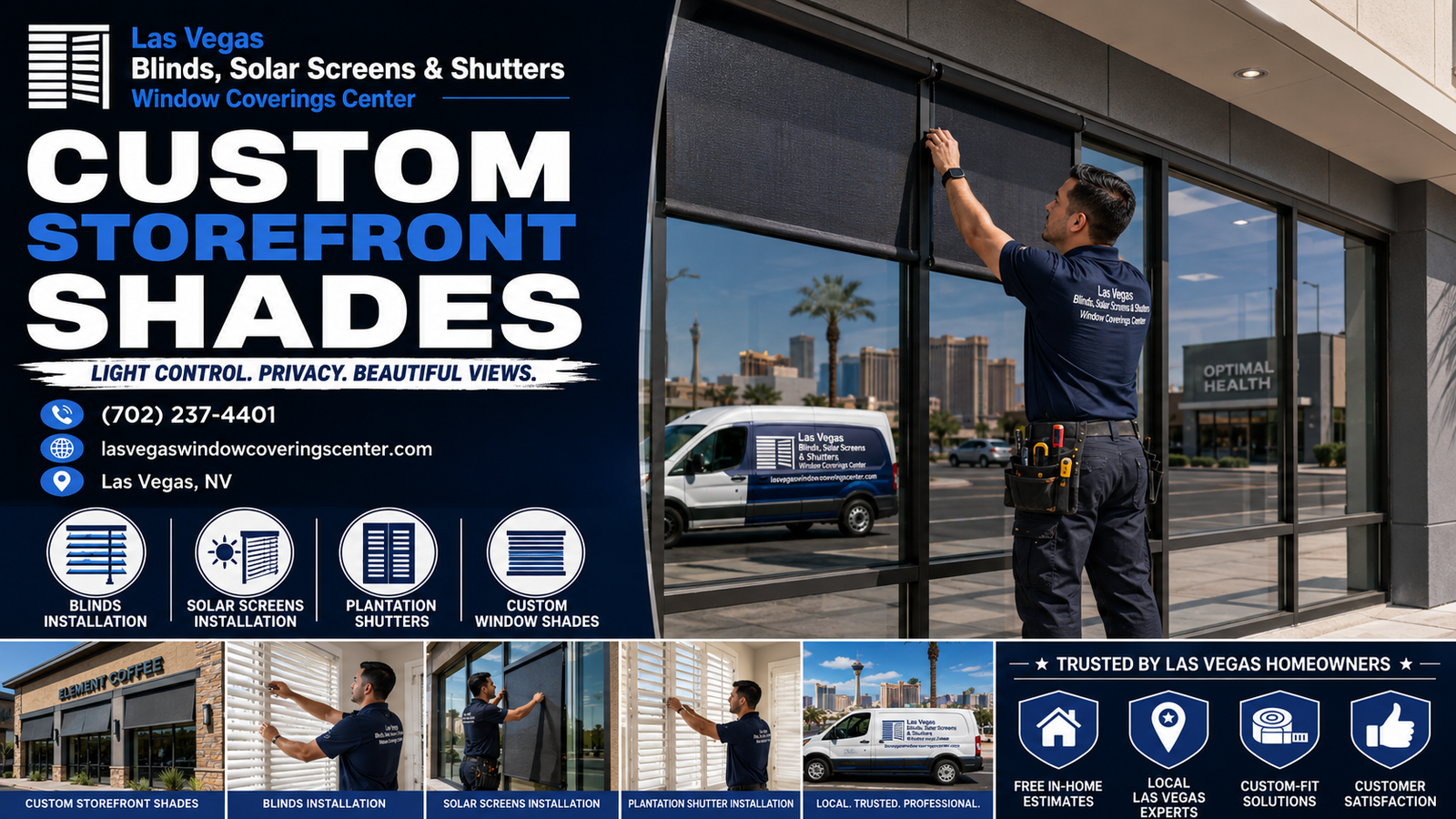
Custom Storefront Shades in Las Vegas
Compare commercial solar, privacy, blackout, roller and motorized shades for Las Vegas retail stores, restaurants, offices, medical spaces and hospitality properties.
What Are Custom Storefront Shades?
Custom storefront shades are made-to-measure commercial window coverings designed for large retail, office, restaurant, medical, hospitality and street-facing glass. They can help manage glare, direct sunlight, visual privacy, customer comfort and the appearance of a business from both inside and outside. Common options include commercial roller shades, solar shades, privacy shades, blackout shades, dual shades and motorized systems.
The right product depends on the glass size, window orientation, operating hours, display needs, privacy requirements, cleaning routine and whether staff need manual, grouped or automated control. Solar fabrics can preserve some outward visibility while reducing glare. Privacy and blackout fabrics offer stronger visual separation but remove more of the exterior view. Motorization may be useful for tall or frequently adjusted shades.
For Las Vegas storefronts, accurate measurement and product selection matter because large glass areas can receive intense sun and heat. A custom consultation should evaluate west- and south-facing exposure, fabric openness, color, mounting surface, shade width, tube strength, controls, electrical access, exterior appearance and how the treatment affects merchandise displays, employees and customers.
Why Storefront Window Coverings Matter for Las Vegas Businesses
Storefront glass helps a business feel open, visible and welcoming, but it also creates practical problems. Direct sunlight can wash out digital screens, produce uncomfortable hot zones, fade merchandise and force employees to reposition throughout the day. Pedestrians may see directly into offices or treatment rooms. Evening lighting can make a business interior highly visible from parking areas and sidewalks. Custom storefront shades give owners a way to respond to these conditions without permanently blocking the glass.
Las Vegas presents an unusually demanding environment for commercial windows. Strong sun, long cooling seasons, reflective pavement, bright skies and low-angle afternoon glare can make large panes difficult to manage. A boutique in Downtown Las Vegas may want to protect product displays while keeping visual connection with foot traffic. A restaurant near Summerlin may need glare control during lunch and privacy after sunset. A medical office in Henderson may require stronger visual separation. A professional office in Spring Valley may need screen-friendly daylight without making the workspace feel closed.
Ready-made residential shades are not always suitable for these applications. Storefront windows are often wider, taller and used more frequently. Commercial systems may require stronger roller tubes, heavier brackets, durable clutches, grouped controls, fascia, side channels or motorization. The mounting surface may be metal framing, concrete, masonry, wood blocking or drywall rather than a conventional residential window frame.
Business owners must also think about appearance from outside. A row of shades at inconsistent heights can look unplanned. Mixed backing colors may conflict with signage or lease standards. Exterior-facing hardware can be visible to customers. A successful project balances interior function with a coordinated storefront presentation.
Start With the Business Goal, Not the Product Name
Glare control
Glare is often the primary complaint in offices, showrooms, restaurants and reception areas. It may come from direct sun, bright sky or reflected light from vehicles and pavement. Solar shades are commonly considered because the open-weave fabric can reduce brightness while preserving some view. The openness factor, color and mounting position affect the result. A tighter weave generally provides more screening and privacy but less outward visibility.
Solar heat management
Interior shades can reduce radiant discomfort and limit direct solar exposure inside the space, but they do not stop all heat at the exterior side of the glass. Performance depends on fabric, color, glass type, air gap, fit and orientation. Exterior solar screens or other building-envelope strategies may be appropriate for severe exposures, subject to landlord, architectural and HOA requirements.
Privacy
Privacy needs vary widely. A retail store may want visibility during business hours and screening after closing. A medical office may need consistent privacy. A restaurant may want to obscure a service area while leaving dining-room views open. Solar fabrics may provide daytime screening but can reverse at night when the interior is brighter. Privacy or blackout materials are more dependable when visual separation is essential.
Merchandise protection
Direct sunlight can contribute to fading and heat buildup around displays. Window coverings can reduce exposure, but no responsible provider should promise complete protection without product-specific data. Display layout, glass coatings, shade schedules and fabric selection should work together.
Customer and employee comfort
Hot seats, bright tables and screen glare affect how long customers stay and how comfortably employees work. A shade should be positioned where it solves the actual problem without creating dark, uneven interiors. Zoned control lets staff adjust only the affected windows.
Brand appearance
Color, fascia, alignment and exterior backing can support a professional storefront. A neutral exterior-facing color may satisfy lease or design standards while the interior-facing fabric complements the brand. Custom measurement helps create consistent headrail heights and hem-bar lines.
Best Types of Custom Storefront Shades
Commercial solar roller shades
Solar roller shades are a common choice for storefronts because they combine a simple profile with glare management and partial view-through. The fabric contains small openings that allow some visibility. Openness percentages vary by manufacturer; a lower openness typically creates a tighter weave, stronger screening and reduced view. A higher openness preserves more view but may provide less glare and privacy control.
Dark solar fabrics often improve outward view and reduce visible glare, while light fabrics can create a brighter appearance and may reflect more visible light. The final decision should be made with physical samples at the actual window. The same fabric can look different on a north-facing office than on a west-facing restaurant.
Light-filtering roller shades
Light-filtering shades diffuse daylight without the open weave of solar fabric. They can soften a storefront, hide distracting exterior views and create more consistent illumination. Privacy varies with fabric density and nighttime lighting. They are useful in salons, waiting rooms, studios and offices that want a softer decorative appearance.
Privacy roller shades
Privacy fabrics prevent clear view-through while still allowing some light. They are a practical choice for consultation rooms, staff areas, ground-floor offices and businesses that handle sensitive information. Because the exterior view is removed, owners should consider whether the shade will remain closed continuously or only during specific periods.
Blackout shades
Blackout fabrics block light through the material itself, but light can still enter around the perimeter. Side channels, sill channels, overlaps or outside mounting may improve control. These systems are useful for presentation rooms, studios, treatment spaces and areas where stronger visual privacy is needed. They may be excessive for a retail display that depends on natural light.
Dual roller shades
Dual systems place two fabrics at one opening, such as a solar shade for daytime glare and a privacy or blackout shade for evening use. They provide flexibility but require more mounting depth, larger fascia and additional hardware. Motorized dual systems may need more electrical planning.
Motorized storefront shades
Motorization is useful for tall glass, multiple windows and shades that need frequent adjustment. Controls may include handheld remotes, wall switches, grouped zones, schedules, sun sensors, building-control interfaces or compatible smart platforms. Exact compatibility varies, and electrical work may be separate from the shade installation.
Exterior solar screens
Exterior products intercept sunlight before it reaches the glass and can be effective for strong exposures. They affect the building exterior and may require landlord, property-management or HOA approval. Wind, access, cleaning, frame color and emergency-egress requirements must be evaluated.
Vertical systems and panel tracks
Very wide glass walls and sliding openings may be better suited to vertical blinds, panel tracks or drapery-style systems. These products move horizontally rather than rolling upward. They can provide access through doors and divide large expanses, though they create a different visual style from roller shades.
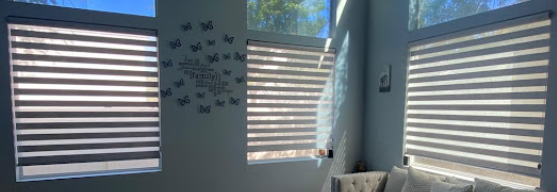
How to Choose Storefront Shade Fabric
Openness factor
For solar fabric, openness describes the proportion of open area in the weave. It influences visibility, glare, privacy and daylight. There is no single best percentage for every storefront. A restaurant may choose a tighter weave on west-facing windows and a more open fabric on north-facing glass. An office may use different fabrics by elevation while keeping the same exterior color.
Color
Fabric color affects appearance and visual performance. Darker fabrics can provide a clearer outward view through the weave and reduce reflected glare. Lighter fabrics can appear brighter and may coordinate with neutral interiors. Exterior-facing color may be restricted by a lease or design standard. Always review full-size samples against the glass.
Privacy at night
Solar fabric does not guarantee nighttime privacy. When the interior is illuminated and the exterior is dark, people outside may see through the fabric. Businesses that require after-hours privacy should use a second privacy layer, close a denser shade or select an opaque material.
Flame, code and commercial documentation
Commercial projects may require documentation concerning flame performance, material composition or other project specifications. Requirements depend on the building, occupancy, authority and contract. The property owner, architect, contractor or code professional should identify applicable requirements before ordering.
Cleaning and maintenance
Restaurants, medical offices, salons and high-traffic stores need realistic care instructions. Some coated fabrics can be gently wiped, while decorative textiles require vacuuming or specialized cleaning. Ask which cleaners are approved, whether the fabric is moisture tolerant and how stains should be handled.
UV and fade claims
Manufacturers may publish solar or optical data for specific fabrics. Use only documentation for the exact material. Avoid assuming that every shade blocks the same amount of ultraviolet light or prevents fading. Merchandise protection also depends on glass, exposure time, product sensitivity and shade-use habits.
Why Custom Measurement Is Critical for Storefront Glass
Large widths require stronger components
A wide shade places greater load on the roller tube. An undersized tube can deflect, causing fabric waves, telescoping or uneven movement. Commercial systems may use larger-diameter tubes, reinforced components or multiple shades divided at mullions. The correct design depends on width, drop, fabric weight and control system.
Window mullions create natural divisions
Dividing a storefront into shades aligned with vertical mullions can reduce size, improve serviceability and create a coordinated rhythm. Gaps between shades should align with framing whenever possible so they are less noticeable. One oversized shade may look continuous but can be heavier and more difficult to service.
Inside, outside and surface mounting
Some storefronts have deep pockets suitable for recessed mounting. Others require installation on metal framing, above the glass or to the ceiling. Every option changes light gaps, fascia position, access and exterior appearance. The substrate must support repeated operating loads.
Doors, handles and egress
Shades must not obstruct doors, panic hardware, exit signage or required paths. Door-mounted shades require products designed for movement. A storefront treatment should never interfere with emergency operation.
Signage and displays
Window graphics, hanging signs, shelves, mannequins and display lighting can conflict with shade travel. Measure the finished condition, not an empty opening before displays are installed. Plan where the hem bar will rest and whether merchandise can touch the fabric.
Electrical access
Motorized shades may use line voltage, low voltage, plug-in transformers, battery power or other systems. Power planning should occur before walls and ceilings are finished when possible. Qualified electrical work may be required and should be coordinated separately when it falls outside the window-covering scope.
Storefront Shade Recommendations by Business Type
Retail stores
Solar shades can reduce glare while preserving daytime visibility. Use zoned control so displays remain visible where direct sun is not a problem. Consider denser evening privacy shades if inventory is visible after closing.
Restaurants and cafés
Prioritize customer comfort, cleanability and quick staff operation. West-facing dining areas may need tighter solar fabric or exterior control. Shades should not contact tables, food-service equipment or exit doors.
Medical and dental offices
Privacy, cleanability and simple controls are important. Opaque roller shades may suit consultation rooms, while solar shades can help waiting areas. Facility-specific requirements should guide material selection.
Professional offices
Glare control and monitor visibility usually lead the design. Use solar fabrics by orientation and group shades into logical zones. Conference rooms may need blackout or dual shades for presentations.
Salons and spas
Light-filtering or privacy roller shades can soften daylight and protect client privacy. Choose materials that tolerate the space’s cleaning routine and humidity.
Fitness studios
Glare, heat and privacy vary by class schedule. Solar shades can preserve daylight, while opaque shades may be needed for street-level evening sessions.
Hotels and hospitality
Lobby and event spaces may need coordinated motorized systems. Appearance, durability, cleaning and control integration should be planned with the broader interior design.
Auto and product showrooms
Large glass and reflective surfaces create severe glare. Commercial solar shades, divided at mullions, can help without hiding the showroom. Oversized dimensions require careful engineering.
Street-level apartments and mixed-use properties
Privacy shades can screen residential or management areas while maintaining a consistent exterior façade. Property-management standards may control backing color and hardware.
Manual, Motorized and Automated Controls
Manual clutch and continuous-loop control
A commercial clutch system uses a chain or loop to rotate the roller. It is simple and familiar, but the control must be secured and positioned safely. Staff must be able to reach it without moving displays or climbing. Frequent use increases wear, so durable hardware is important.
Spring-assisted and cordless options
Some shades use spring-assisted mechanisms or cordless lift. These reduce visible loops but may be less suitable for very large shades. Operation should be tested for control, stopping position and reach.
Individual motorized control
Each shade can have a dedicated motor and remote or switch. This is useful when windows require independent adjustment. It can become cumbersome in a storefront with many openings unless controls are labeled and grouped.
Grouped zones
Grouping shades by elevation or room lets staff operate several at once. A west-facing zone may close during afternoon sun while north-facing shades remain open. Good zoning follows actual solar exposure and business use.
Schedules and sensors
Automated schedules can lower shades before direct sun reaches displays or reopen them after the exposure passes. Sun sensors may provide responsive control, but commissioning and override procedures should be clear. Automation should not block required views, security monitoring or emergency access.
Smart and building-system integration
Some motors connect to apps, voice assistants or building-control systems through bridges or gateways. Compatibility must be confirmed for the exact motor, protocol and control platform. Network changes, software updates and account ownership should be considered before specifying consumer-style smart controls for a business.
Power options
Battery and rechargeable motors can reduce wiring but require maintenance and charging access. Plug-in power needs nearby receptacles and cable management. Hardwired systems can create a cleaner appearance but require electrical planning. Shade width, fabric weight and operating frequency affect motor suitability.
Safe Preliminary Checks for Business Owners
Safe checks
- Record approximate glass width and height for planning.
- Identify mullions, doors, handles, signs and displays.
- Note which windows receive direct sun and at what times.
- Observe glare from customer seats and employee workstations.
- Check nighttime privacy from the parking lot or sidewalk.
- Identify available mounting surfaces and ceiling conditions.
- Locate accessible outlets for preliminary motor planning.
- Review lease, landlord and design requirements.
- Ask staff how often shades need adjustment.
- Document existing damage, stains or failed controls.
Do not do these things
- Do not climb on displays, chairs or unstable ladders.
- Do not remove oversized shades without trained help.
- Do not drill into metal framing, masonry or ceilings without checking conditions.
- Do not work on electrical wiring without qualified authorization.
- Do not force a jammed clutch or motorized shade.
- Do not cut chains, cords or safety devices.
- Do not block doors, exit signs or panic hardware.
- Do not apply harsh cleaners without fabric instructions.
- Do not install exterior screens without required approval.
- Do not rely on daytime testing for nighttime privacy.
Commercial Storefront Shade Comparison
| Product | Best Application | Glare Control | Privacy | View | Maintenance | Motorization | Main Tradeoff |
|---|---|---|---|---|---|---|---|
| Solar roller shade | Retail, offices, restaurants | Strong when correctly specified | Daytime screening; limited at night | Partial outward view | Fabric-specific dusting or wiping | Widely available | Does not provide dependable nighttime privacy |
| Light-filtering roller shade | Salons, waiting rooms, studios | Softens brightness | Moderate, fabric-dependent | Usually obscured | Fabric-specific | Widely available | Less exterior view than solar fabric |
| Privacy roller shade | Medical, offices, street-level rooms | Good | Strong | No clear view | Often straightforward | Widely available | Removes visual connection to outside |
| Blackout shade | Presentation, treatment, studio spaces | Maximum through fabric | Strong when gaps are controlled | None | Fabric-specific | Widely available | Perimeter light gaps require design attention |
| Dual roller shade | Flexible day/night use | Excellent flexibility | Strong with second layer | Available with solar layer | Two fabrics and mechanisms | Available | More depth, hardware and cost |
| Motorized solar shade | Tall or multi-window storefronts | Consistent zoned control | Depends on fabric | Depends on openness | Includes motor and control maintenance | Built in | Power and commissioning required |
| Exterior solar screen | Severe sun exposure | High potential before glass | Varies | Mesh-dependent | Outdoor cleaning | Possible in some systems | Exterior approval, wind and access concerns |
| Vertical blind or panel track | Wide openings and doors | Adjustable | Good | Available when open | Track and vane care | Specialty options | Different appearance and moving parts |
What Affects the Cost of Custom Storefront Shades?
Commercial shade pricing cannot be reduced to one reliable per-window number without measurements and specifications. Storefront glass varies dramatically, and the hardware needed for a small office panel is not the same as the hardware for a wide showroom opening.
Shade width and drop
Larger dimensions require more fabric, stronger tubes, larger brackets and sometimes motorization or multiple shades.
Fabric category
Solar, decorative, privacy, blackout and specialty commercial fabrics differ in construction and documentation.
Manual or motorized control
Motors, power supplies, remotes, gateways, switches and programming add components and coordination.
Number of zones
Grouped control may simplify use but requires planning, labeling and commissioning.
Mounting substrate
Metal framing, masonry, concrete, ceiling pockets and concealed blocking affect labor and fasteners.
Fascia and side channels
Decorative covers and light-control accessories add material and installation steps.
Access
High ceilings, stairs, displays, security barriers and occupied business conditions can affect installation.
Electrical work
Hardwired systems may require separate qualified electrical services and permitting depending on scope.
Removal and disposal
Existing shades, blinds, films or hardware may need removal and surface repair.
Project scheduling
After-hours work, phased installation or coordination with contractors may change labor requirements.
A useful written estimate should identify dimensions, fabric, color, openness or opacity, tube and control system, mounting method, fascia, electrical exclusions, installation, removal, taxes or fees, ordering process and applicable warranty documents.
Cleaning, Repairing, Upgrading or Replacing Storefront Shades
Cleaning may be sufficient
If the shade rolls evenly, the fabric is not damaged and the issue is ordinary dust or fingerprints, cleaning may restore appearance. Follow the exact fabric instructions. Start with gentle dusting or low-suction vacuuming. Some coated fabrics permit light wiping; others can be permanently marked by moisture or aggressive chemicals.
Minor repair may make sense
A loose bracket, worn chain, damaged tension device, lost remote, failed battery or programming issue may be repairable. Commercial roller systems may also need clutch, chain, motor or hem-bar service. Compatible parts and safe access are essential.
Upgrade when business needs change
Manual shades may be upgraded to motorized systems when staff cannot reach them or consistent operation matters. A solar shade may be paired with a privacy layer when business hours change. Stronger tubes or divided shades may be needed if an existing oversized shade sags.
Replacement may be more practical
Replacement may be appropriate when fabric is permanently stained, faded or torn; mechanisms are obsolete; the shade is poorly sized; the tube deflects; controls create safety concerns; parts are unavailable; or the product no longer meets privacy, glare or branding needs. New measurements should be taken rather than copying a failed installation.
Las Vegas Conditions That Affect Storefront Shades
Extreme sun and long cooling seasons
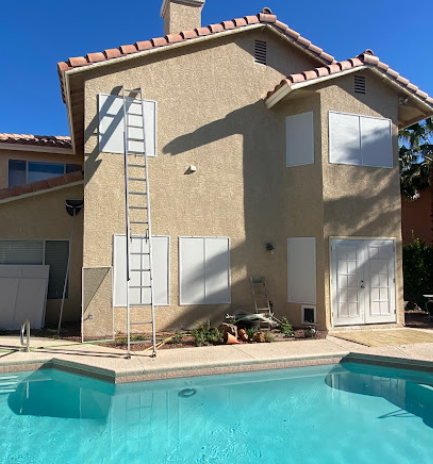
Commercial glass can receive hours of intense sunlight. Interior shades can improve comfort and glare control, but results depend on glass, fabric and use. West-facing storefronts commonly need tighter control in the afternoon than north-facing glass.
Low-angle glare
Late-day sun can pass beneath awnings and deep into a space. Shade zones should match actual exposure rather than closing the entire storefront. Staff may need simple override controls as seasons change.
Desert dust
Fine dust settles on rollers, fascia and hem bars. Dark fabrics may show pale dust, while light fabrics may show fingerprints. Choose materials that match the cleaning ability of the business.
Large panes and modern architecture
New retail and office spaces often use wide glass panels. Tube size, bracket spacing and fabric alignment become critical. Dividing shades at mullions may improve operation and serviceability.
Reflected light
Parking lots, neighboring glass and pale concrete can reflect brightness into a storefront even when direct sun is not striking the window. On-site observation during operating hours is better than selecting fabric from orientation alone.
Tourism and extended business hours
Restaurants, hospitality properties and retail businesses may operate from bright daytime into dark evening conditions. A solar fabric that works at noon may provide little privacy after sunset. Dual systems or planned closing schedules can address the change.
Local commercial areas
Storefront needs differ across Downtown Las Vegas, the Resort Corridor, Summerlin, Spring Valley, Enterprise, Henderson and North Las Vegas. Pedestrian traffic, parking-lot sightlines, lease standards and surrounding architecture should be included in the design. The business serves these markets from its Las Vegas location without implying a separate office in each community.
Detailed Storefront Shade Project-Planning Checklist
Observe the glass at several times of day
Do not select fabric from a morning visit if the problem occurs at 4 p.m. Photograph direct sun, reflected glare and customer seating at different times. Note whether the problem is seasonal. Winter sun can enter at a lower angle than summer sun, changing the useful shade position.
Map customer, employee and display zones
Mark where people sit, stand, work and wait. A solar shade may be needed behind a cashier but not across a product display. A restaurant may need independent zones for booths, bar seating and entry glass. Thoughtful zoning avoids closing every shade because one area is uncomfortable.
Test samples against the actual window
Hold solar and privacy samples at the glass, then view them from inside and outside. Repeat after dark. Evaluate color, reflected glare, transparency, interior brightness and the way the fabric interacts with signage. A small sample book under showroom lighting cannot reproduce every storefront condition.
Coordinate exterior appearance
Stand across the parking area and examine the façade. Decide whether shades should align at the same height, whether the backing color should be uniform and whether fascia will be visible. Landlords and shopping centers may require neutral exterior-facing colors even when the tenant prefers a bold interior fabric.
Plan around security
Shades can affect visibility for security cameras, staff and patrols. A closing schedule should not unintentionally block required views. Conversely, after-hours privacy may reduce visibility of inventory. Coordinate shade use with the business’s security plan rather than assuming fully open or fully closed is always safer.
Plan for window cleaning
Storefront glass is cleaned frequently. The shade should allow access without being soaked, snagged or removed each time. Exterior crews should know whether screens or sensors are present. Interior cleaners should avoid spraying solution onto fabric, motors or controls.
Document controls
Label remotes, wall switches and zones. Provide staff with a simple operating guide. Define who can change schedules, replace batteries or call for service. A sophisticated system becomes frustrating when no one understands how it was programmed.
Coordinate with tenants and property managers
In leased spaces, determine who approves drilling, electrical work, exterior-facing color and attachment to storefront framing. Clarify who owns the shades at the end of the lease and who is responsible for repairs.
Account for future displays
Retail layouts change. Leave clearance for seasonal displays and signage. Avoid placing a shade where mannequins, shelves or hanging graphics will repeatedly contact the fabric. If the business frequently changes merchandising, independent narrow zones may be more flexible than one large shade.
Consider acoustics and visual softness
Roller shades are primarily visual and solar-control products, but fabric can slightly soften a hard interior. Do not treat them as an acoustic solution. Restaurants and offices with echo problems may need separate acoustic finishes.
Decide how failure will be handled
Ask what happens if one motor, clutch or fabric panel fails. Can a single unit be serviced without removing the entire row? Are replacement parts stocked or ordered? Is the fabric likely to remain available? Modular design can reduce disruption.
Schedule installation around operations
Installation may require ladders, lifts, drilling and temporary movement of displays. Decide whether work can occur during business hours. Restaurants, clinics and retailers may prefer phased or after-hours installation, which should be included in planning and pricing.
Protect the finished space
Identify fragile displays, floors, counters and equipment. Clarify who moves merchandise and who restores the area. Installation crews need clear access to every opening. Delays often occur when the glass is blocked by furniture or inventory.
Review the final operation before sign-off
Operate every shade through its full range. Check alignment, noise, stopping positions, chain tension, motor direction, remote labels and schedules. Look from outside for consistent heights. Record product information and keep manuals with facility records.
Questions to Ask Before Hiring a Commercial Window-Covering Company
- Which product is recommended for this exact elevation and why?
- What openness factor or opacity is being specified?
- How will the shade perform during daytime and after dark?
- Will customers still see merchandise through the glass?
- Does the fabric have product-specific solar or optical data?
- Is the system rated for the measured width and drop?
- What roller-tube size and bracket system are included?
- Will shades be divided at window mullions?
- What gaps will remain between adjacent shades?
- Does the exterior-facing color comply with lease requirements?
- Is fascia included?
- Are side channels or sill channels needed?
- Is the control manual, motorized or automated?
- What power source is required?
- Are electrical services included or separate?
- How are zones, remotes and wall switches organized?
- Can staff override schedules or sensors?
- How should the fabric be cleaned?
- Are replacement parts and fabric available?
- Does installation include removal of old treatments?
- Will work occur during or outside business hours?
- How will doors, exits, signs and displays remain unobstructed?
- What warranty documents apply to fabric, controls and installation?
- Will I receive a detailed written estimate before ordering?
Red Flags When Buying Custom Storefront Shades
- No site measurement of the actual finished storefront.
- No observation of sun and glare during business hours.
- The same fabric is recommended for every elevation without explanation.
- Nighttime privacy is promised from an open solar fabric.
- No discussion of roller-tube strength for wide shades.
- No explanation of gaps between adjacent shades.
- Motorization is proposed without a power plan.
- No coordination with doors, exits, signage or displays.
- No written fabric name, color or openness factor.
- Unsupported heat, energy or UV percentages.
- No cleaning instructions for a restaurant, clinic or salon.
- No explanation of control safety or chain tensioning.
- Quote changes without a documented scope change.
- Pressure to order before samples are viewed at the glass.
- No clear local business identity or Google Maps presence.
- No explanation of who measures, installs and services the system.
Why Consider Las Vegas Blinds, Solar Screens & Shutters Window Coverings Center?
Las Vegas Blinds, Solar Screens & Shutters Window Coverings Center is a local option for retail stores, restaurants, offices, medical spaces, hospitality properties and other Clark County businesses that need custom-fit window coverings. The business offers a broader range than one generic shade, including roller shades, solar screens, motorized window coverings, privacy products, blackout options, shutters, cellular shades and custom materials.
A storefront project benefits from local observation. The team can evaluate the direction of the glass, afternoon glare, customer seating, workstations, display placement, after-hours privacy, mounting conditions and daily operating routine. That makes it easier to compare solar, privacy, blackout, dual and motorized options without assuming the most expensive treatment is automatically the best fit.
The business serves customers from 3871 S Valley View Blvd #6, Las Vegas, NV 89103. Call (702) 237-4401 to ask about current commercial consultation and measurement availability. You may also discuss commercial window shades, browse the verified window-covering product catalog, or find the Las Vegas window-covering location on Google Maps.
For a related privacy-focused residential guide, see top-down bottom-up shades in Las Vegas.
Commercial Service Areas
Las Vegas Blinds, Solar Screens & Shutters Window Coverings Center serves businesses and property owners throughout Las Vegas and nearby Clark County communities from its Valley View Boulevard location. Service in a neighborhood does not imply a separate physical office there. Call to discuss current commercial measurement and consultation availability.
Frequently Asked Questions About Custom Storefront Shades
What are the best shades for a Las Vegas storefront?
Commercial solar roller shades are often useful for glare and daytime view, while privacy or blackout roller shades fit spaces that need stronger visual separation. The best choice depends on orientation, business hours, privacy and the desired exterior appearance.
Do solar shades provide privacy at night?
Usually not reliably. When the interior is brighter than outside, people may see through solar fabric. Businesses needing nighttime privacy should add an opaque layer or use a privacy shade.
Can storefront shades reduce heat?
They can help manage direct solar exposure and radiant discomfort, but results depend on fabric, glass, color, fit and orientation. Interior shades do not replace efficient glazing, HVAC maintenance or exterior shading.
Are motorized storefront shades worth considering?
Motorization can be useful for tall windows, many shades or frequent adjustment. It adds power, controls and programming, so the decision should be based on access, staff routine and project size.
How are very wide storefront windows covered?
Large glass may be divided into multiple shades aligned with mullions. This can improve tube strength, serviceability and control. One oversized shade may require stronger hardware or may exceed product limits.
What openness factor should a storefront solar shade use?
There is no universal answer. Tighter fabrics usually provide more glare control and screening, while more open fabrics preserve more view. Samples should be tested at the actual glass.
Can custom storefront shades be branded?
Fabric color, fascia and alignment can support a brand presentation, and some specialty projects may offer printed or custom materials. Availability and durability should be verified for the exact product.
How can I request a commercial shade consultation in Las Vegas?
Call Las Vegas Blinds, Solar Screens & Shutters Window Coverings Center at (702) 237-4401 to ask about current consultation, measurement and installation availability.
Find the Las Vegas Window-Covering Location
Las Vegas Blinds, Solar Screens & Shutters Window Coverings Center is located at 3871 S Valley View Blvd #6, Las Vegas, NV 89103. Call before visiting to confirm current availability.
Plan Custom Storefront Shades for Your Las Vegas Business
Call Las Vegas Blinds, Solar Screens & Shutters Window Coverings Center at (702) 237-4401 to discuss storefront glare, privacy, fabric openness, motorization, large-window measurement and installation planning. Bring lease requirements, operating hours and the actual business use into the decision.