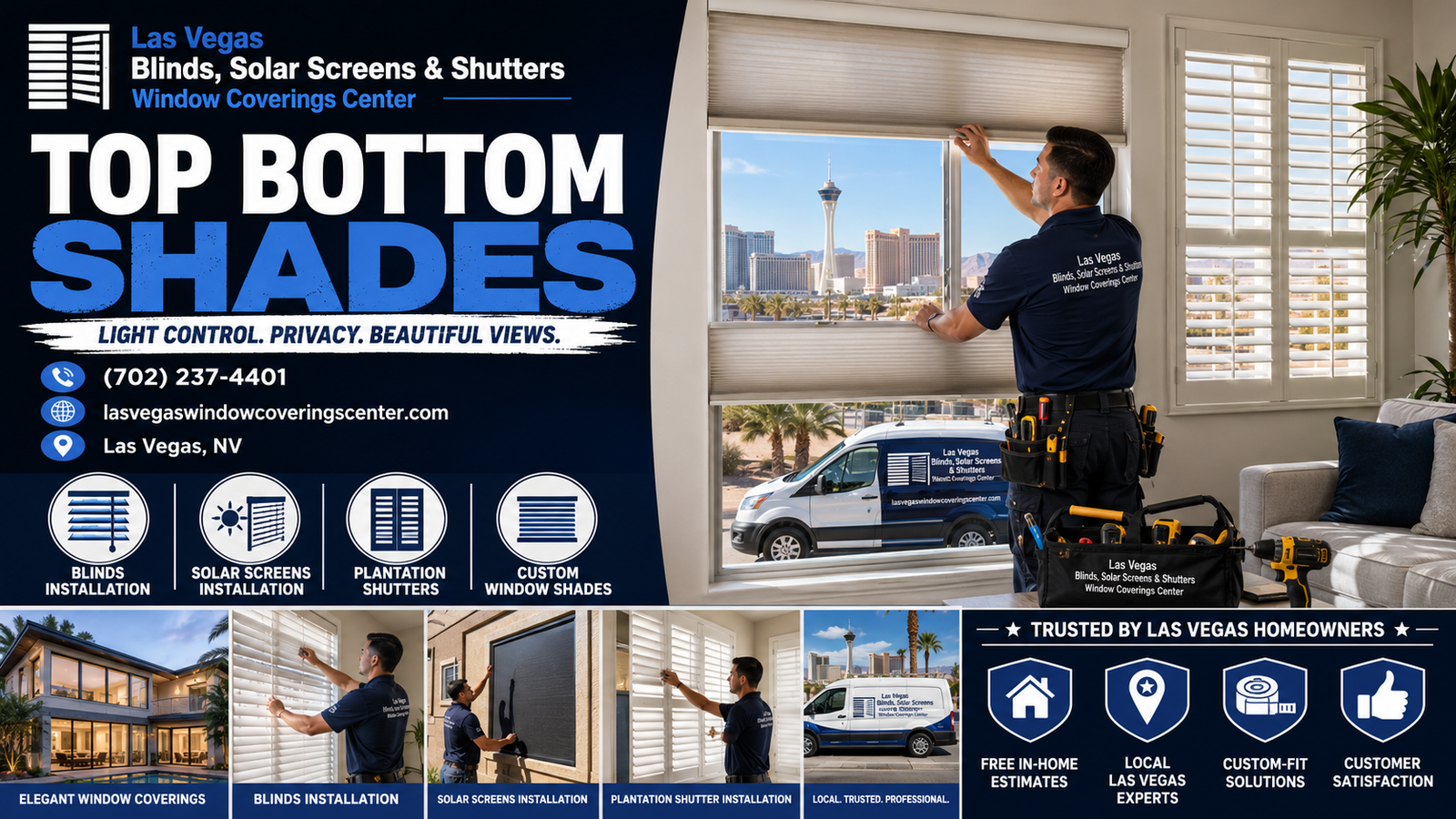
Top-Down Bottom-Up Shades in Las Vegas
Learn how top-bottom shades can cover eye-level views while admitting daylight above, which cellular fabrics and mounts work best, and what Las Vegas homeowners should know before ordering custom shades.
What Are Top-Down Bottom-Up Shades?
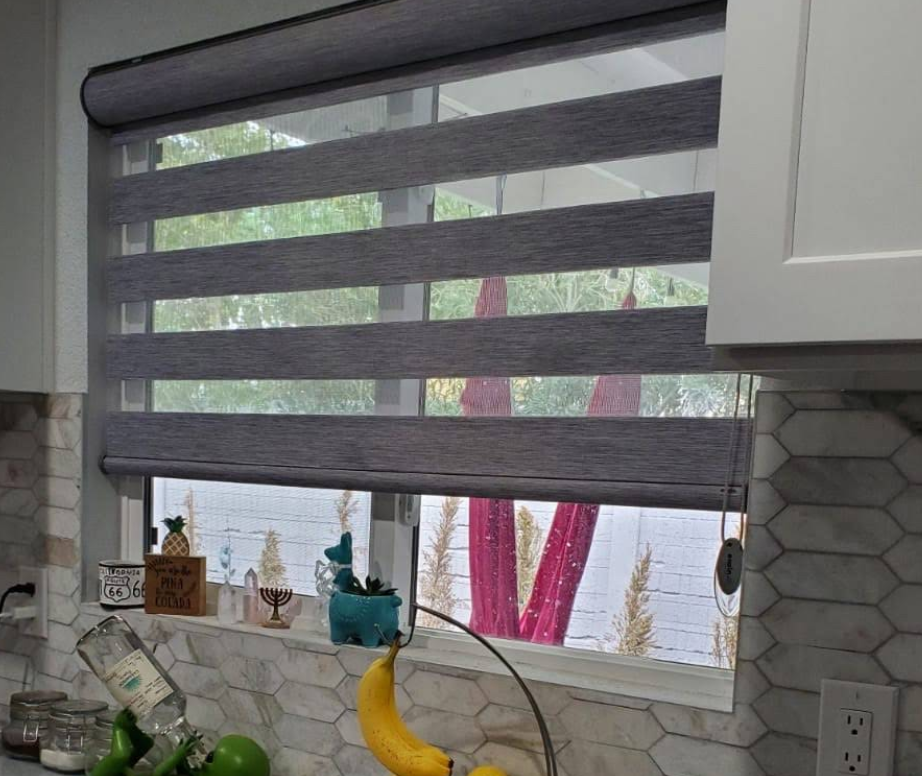
Top-down bottom-up shades are window coverings that can be lowered from the top, raised from the bottom, or positioned between the top and bottom of the window. This flexible movement lets occupants admit daylight above eye level while covering the lower part of the glass for privacy. They are especially useful on street-facing windows, bathrooms, bedrooms, home offices, dining rooms and closely spaced Las Vegas homes where conventional shades create an all-open or all-closed choice.
Most top-down bottom-up products are cellular or honeycomb shades, although some pleated and specialty fabric systems are available. Cellular construction can add a layer of trapped air at the window, while light-filtering, room-darkening and blackout fabrics provide different levels of brightness and privacy. Actual performance depends on the fabric, fit, side gaps, window orientation, mounting method and glass.
The main tradeoff is that the mechanism is more complex than a standard single-direction shade. Accurate measurement, appropriate hardware, balanced operation and realistic expectations about light gaps are important. For Las Vegas homes, a custom consultation can also help coordinate privacy with harsh sun, glare, heat near the glass, child-safe controls and HOA-sensitive exterior appearance.
Why Top-Bottom Shades Matter in Las Vegas
Las Vegas homeowners often want two things that seem to compete: abundant natural light and dependable privacy. A standard roller shade or cellular shade usually moves from the bottom upward. When it is open, the room receives daylight but becomes visible from outside. When it is closed, privacy improves but the view and much of the daylight disappear. Top-down bottom-up shades divide those functions by letting the upper glass remain exposed while the lower glass stays covered.
This difference is particularly useful in dense neighborhoods, gated communities, townhomes, condominiums and houses with windows facing sidewalks, driveways or neighboring properties. In Summerlin, Spring Valley, Enterprise, Henderson and North Las Vegas, many homes have large front-facing windows that bring in attractive daylight but expose living rooms or offices at eye level. Lowering the top of a shade can brighten the room without leaving the lower window uncovered.
Landlords and property managers may find the product useful in rentals where occupants value privacy but still want a bright interior. Interior designers can use the adjustable opening as part of a layered lighting plan. Home-office users can position the exposed area above a computer monitor to reduce direct screen glare while preserving ambient light. Bedrooms and bathrooms may benefit from the ability to cover sightlines while opening the sky-facing part of the window.
The product is not automatically right for every opening. Sliding doors, very wide windows, unusual shapes and windows that receive intense low-angle afternoon sun may require a different solution or a combination of products. This guide explains the mechanism, materials, applications, tradeoffs and selection process so buyers can decide whether top-down bottom-up shades are a good fit.
How Top-Down Bottom-Up Shades Work
Two moving rails create flexible positioning
A conventional shade has a fixed headrail at the top and a movable bottom rail. A top-down bottom-up shade adds a movable intermediate or top rail. The upper rail can descend from the headrail, while the bottom rail can rise from the sill. Depending on the design, the shade can cover the full window, open only at the top, open only at the bottom, or rest as a band of fabric in the middle.
When the top rail is lowered, support cords or internal lift components remain visible across the exposed upper portion of many models. Some buyers barely notice these cords, while others prefer a product with minimized visual lines. The exact appearance should be reviewed on a sample before ordering.
Cordless systems
Cordless top-down bottom-up shades are operated by moving the rails by hand, often with handles attached to the movable components. Cordless operation removes dangling lift cords and can create a cleaner appearance. The shade must be properly sized and balanced so each rail stays level and moves without excessive force.
Large or high windows may make manual cordless operation inconvenient. A rail that is easy to reach when the shade is fully closed may become difficult to reach after it is raised. Furniture, deep counters and bathtubs can also block access. These practical details should be considered during measurement.
Continuous-loop and specialty controls
Some systems use secured continuous-loop controls or other operating mechanisms. These can provide mechanical advantage on larger shades but add visible hardware and contact points. Any chain or loop should be installed with the appropriate tensioning device and used according to current safety guidance and manufacturer instructions.
Motorized possibilities
Motorization is common for standard roller and cellular shades, but true motorized top-down bottom-up operation is less universal and can be more complex because two rails need independent or coordinated movement. Availability depends on product line, size, fabric, power source and control platform. Buyers interested in app, remote, schedule or voice control should confirm that the exact top-down bottom-up configuration—not merely a standard shade from the same collection—supports the desired automation.
Cellular construction
Cellular shades use fabric folded into honeycomb-shaped cells. The cells create air pockets between the room and glass. Single-cell and double-cell constructions vary in thickness, stack size and visual appearance. Cellular fabric is popular for top-down bottom-up operation because it compresses neatly and provides a continuous privacy surface without horizontal slats.
Privacy and Daylight: The Main Reason to Choose Top-Down Bottom-Up Shades
Covering eye-level sightlines
The most distinctive benefit is the ability to cover the lower portion of a window while admitting light above. This can block direct views from a sidewalk, driveway or neighboring window without making the room feel closed. The exact height should be set based on outdoor grade, nearby sightlines, occupant height and whether people outside are standing, seated or on a higher level.
Privacy is not determined only by shade position. Fabric opacity matters. A sheer or open weave may obscure detail in daylight but become transparent at night when interior lights are brighter than the exterior. A light-filtering cellular fabric usually provides stronger visual privacy than an open solar fabric, while a room-darkening or blackout material provides more coverage. Samples should be viewed against light whenever possible.
Using upper daylight
Daylight entering near the ceiling can spread more softly through a room than direct light at eye level. Lowering the top rail may illuminate walls and ceilings while reducing the view into the occupied zone. This is useful in living rooms, breakfast areas and offices where people want a bright atmosphere without exposing furniture layouts or daily activity.
Managing television and monitor glare
Top-down positioning can sometimes keep direct sun off a television or monitor while allowing light through another part of the window. The best rail position changes through the day as the sun moves. On a west-facing Las Vegas window, late-afternoon sunlight can enter at a low angle, so a partially open top may still admit glare. Solar orientation and actual screen placement should guide the fabric and operating choice.
Privacy at night
At night, the exposed upper glass can still reveal ceilings, lighting fixtures and movement. Ground-level viewers may have limited sightlines through a high opening, but elevated neighbors, stairs, hills and multi-story buildings can change the angle. Buyers who need complete nighttime privacy should close the shade fully or pair it with another treatment.
Bathrooms and moisture
Top-down bottom-up shades are attractive for bathrooms because they can cover the lower window and reveal the sky. However, not every cellular fabric or component is ideal for repeated moisture exposure. Ventilation, distance from the shower, condensation and cleaning requirements matter. Faux-wood blinds, shutters, privacy glass or suitable roller materials may be better in high-moisture areas.
Top-Down Bottom-Up Shade Materials and Fabric Choices
Light-filtering cellular shades
Light-filtering cellular shades soften daylight and provide general privacy while keeping a room brighter than room-darkening products. They are often the most versatile option for living rooms, kitchens, dining spaces and home offices. Fabric color influences the way transmitted light appears: white and pale neutrals tend to brighten the room, while darker colors may create stronger visual contrast and absorb more light.
Light-filtering does not mean transparent, but exact privacy varies. Hold a sample against a bright window and look at it from both sides. Ask whether silhouettes are visible at night. A fabric that feels private in a showroom may behave differently when interior lights are on.
Room-darkening cellular shades
Room-darkening fabrics reduce more light than ordinary light-filtering materials. They can be useful in bedrooms, media rooms and nurseries where occupants want flexible daylight during the day and stronger darkness when fully closed. The name does not guarantee total darkness. Light can enter around the rails and side gaps, particularly with an inside mount.
Blackout cellular shades
Blackout materials contain an opaque layer that prevents light from passing through the fabric. They may still allow perimeter light. An outside mount, side channels or layered drapery can reduce gaps, but each solution changes the appearance and operation. A top-down bottom-up opening intentionally exposes part of the glass, so blackout performance applies only when the product is fully closed.
Single-cell versus double-cell
Single-cell shades typically have one row of honeycomb pockets, while double-cell shades have two. Double-cell construction may provide additional air trapping but also creates a thicker fabric package and potentially a larger stack. The best option depends on window depth, size, desired appearance, climate goals and product specifications.
Pleated shades
Pleated shades resemble cellular shades from the front but usually use a single layer of folded fabric without enclosed honeycomb cells. Some are available with top-down bottom-up operation. They can have a lighter profile and lower stack but may show lift cords or holes more clearly. Their privacy and insulation characteristics depend on the material and liner.
Natural and decorative fabrics
Specialty systems may use woven or decorative materials. These can add texture but may not create the same continuous privacy as cellular fabric. Natural woven shades often require a liner for stronger privacy or room darkening. A moving top rail, liner and decorative fabric can create a larger stack and more weight, so availability may be limited by manufacturer.
Color selection for Las Vegas sun
Color affects appearance, transmitted light and how dust shows. Very dark fabrics can create dramatic contrast but may show light-colored desert dust. Very bright white fabrics may show fingerprints or marks. Neutral gray, beige and off-white shades often coordinate with Las Vegas interiors, but the final decision should be made using samples in the room’s actual daylight.
Inside Mount vs Outside Mount
Inside mount
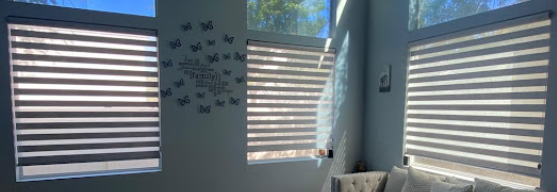
An inside-mounted shade sits within the window opening. It creates a built-in appearance and leaves surrounding trim visible. For top-down bottom-up shades, the headrail, brackets and moving rails must fit within the available depth. The opening should be measured at multiple points because older windows may not be perfectly square.
Inside mounts naturally leave small side clearances so the shade can move. Those gaps can admit light and reveal narrow sightlines. They are usually acceptable for general privacy, but buyers expecting complete blackout should understand the limitation.
Outside mount
An outside-mounted shade attaches to the wall, trim or surface above the opening. It can overlap the sides and improve coverage. Outside mounting may also avoid shallow window depth or obstructions. The tradeoff is that the shade becomes more visually prominent and may cover decorative trim.
Accurate placement is particularly important for top-down operation. If the shade is mounted too high or too wide, users may struggle to reach the movable rail. If it is mounted too close to protruding trim, the fabric may rub or fail to hang freely.
Obstructions and clearance
Window cranks, locks, handles, security sensors, alarm contacts, tile, backsplash, deep sills and furniture can interfere with movement. Top-down bottom-up shades also require space for the rails to remain level. A professional measurement should note every obstruction rather than recording only width and height.
Corner and bay windows
Shades mounted close together in a corner can collide. Bay windows may need spacing so handles remain accessible and fabric edges do not overlap. Privacy gaps at angled joints should be evaluated from the actual viewing direction.
Room-by-Room Guide
Living rooms
Use the top opening to bring daylight above sofas and seating while covering sidewalk-level views. Light-filtering cellular fabrics usually keep the room comfortable and bright. Consider television placement and afternoon glare.
Bedrooms
Room-darkening or blackout fabric can improve privacy when closed. A top opening may provide morning light without exposing the bed area. Remember that nighttime privacy requires evaluating elevated sightlines.
Bathrooms
Top-down positioning is useful for high daylight and lower privacy. Verify moisture suitability, ventilation and cleaning requirements. A material not designed for damp conditions may lose shape or develop stains.
Home offices
Position the opening above monitors to preserve ambient daylight while reducing direct glare. Cordless operation keeps controls simple, while motorized availability should be confirmed for the exact configuration.
Dining rooms
Maintain privacy from nearby homes while using soft upper light for daytime meals. Decorative cellular or pleated fabrics can complement formal interiors without the bulk of drapery.
Kitchens
Consider splashes, cooking residue and access above counters. A fabric shade near a sink or range may be harder to clean. The rail must remain reachable without leaning over hot or wet surfaces.
Nurseries
Cordless designs and secure mounting are priorities. Position cribs and furniture away from windows and controls. Light-filtering or room-darkening fabric can balance daytime use and sleep conditions.
Street-facing rooms
This is the strongest use case. Cover the lower glass at the height needed to block pedestrians and parked-car sightlines while leaving the upper window open to daylight.
Second-story rooms
Top-down privacy may be less necessary from the street but useful against neighboring upper floors. Evaluate the angle from nearby homes rather than assuming elevation provides complete privacy.
Safe Homeowner Checks Before Ordering or Servicing Shades
Safe checks
- Measure visible width and height for preliminary planning.
- Check whether the opening has enough depth for an inside mount.
- Identify locks, cranks, tile, trim and security sensors.
- Observe privacy from the street during day and night.
- Note window orientation and hours of direct sunlight.
- Check whether furniture blocks access to the rails.
- Look for dust, stains, frayed cords or uneven movement.
- Test a shade gently without forcing either rail.
- Review the care label before cleaning.
- Confirm HOA rules before adding exterior products.
Avoid these actions
- Do not stand on unstable furniture to reach a rail.
- Do not force a shade that binds or tilts.
- Do not cut, shorten or retie lift cords yourself.
- Do not remove a large shade without assistance.
- Do not drill near unknown wiring or plumbing.
- Do not soak cellular fabric unless instructions allow it.
- Do not use bleach, solvent or abrasive cleaners without approval.
- Do not let children play with controls or exposed cords.
- Do not assume a motorized standard shade can be converted to top-down operation.
- Do not promise complete blackout without evaluating edge gaps.
Top-Down Bottom-Up Shades Compared With Other Window Coverings
| Option | Privacy Flexibility | Daylight Control | Best Use | Cleaning | Motorization | Main Limitation |
|---|---|---|---|---|---|---|
| Top-down bottom-up cellular shade | Excellent for lower-window privacy | Upper or lower opening | Bedrooms, offices, street-facing rooms | Gentle dusting or vacuuming | Limited by product line | More complex mechanism and visible support cords on some models |
| Standard cellular shade | Open or closed | Bottom-up only | General insulation and privacy | Gentle care | Widely available | Cannot preserve upper daylight while covering lower glass |
| Roller shade | Open or closed | Simple vertical control | Modern rooms, solar glare control | Often straightforward | Widely available | Usually lacks top-down operation |
| Plantation shutters | Adjustable louvers | Sectional tilt if divided rail is used | Architectural style and durable control | Louvers can be wiped | Not typical | Fixed frame and higher visual weight |
| Faux-wood blinds | Good with tilted slats | Adjustable slat angle | Kitchens, rentals, general rooms | Individual slats require dusting | Available in selected systems | Horizontal slats collect dust and do not create the same open-top effect |
| Roman shade | Open or closed | Soft filtered light | Decorative interiors | Fabric-specific | Available | Folds can create a larger stack and usually operate bottom-up |
| Solar shade | Depends on openness and lighting | Strong glare control | West-facing and office windows | Fabric-specific | Widely available | Daytime privacy may disappear at night |
| Privacy film | Continuous if opaque or frosted | Fixed, not adjustable | Bathrooms and narrow sidelights | Glass cleaning | Not applicable | Cannot change position or restore a clear view |
What Affects the Cost of Top-Down Bottom-Up Shades?
Prices vary too widely for a responsible fixed quote without measurements and product details. A small manual light-filtering cellular shade is a different project from an oversized room-darkening shade with specialty controls. Buyers should compare written specifications rather than only a total price.
Window size
Wider and taller shades require more fabric, stronger rails and sometimes different operating systems. Some dimensions are outside the allowable range for top-down bottom-up operation.
Fabric and cell construction
Light-filtering, room-darkening, blackout, single-cell and double-cell materials differ in manufacturing and performance.
Control system
Cordless, continuous-loop and specialty controls have different hardware requirements. Motorized top-down options may be limited and more expensive.
Inside or outside mount
Mounting affects measurements, brackets, coverage and installation time. Outside mounts may require additional surface preparation.
Number of windows
Multiple matching windows can improve visual consistency but increase total material and installation scope.
Access and height
High windows, stairways, deep counters and obstructed openings can require additional equipment and labor.
Custom shapes
Arches, angles, bay windows and unusually narrow openings may not support standard top-down operation.
Removal and disposal
Ask whether removal of old blinds, patching or disposal is included in the written estimate.
Questions to include in a quote
A useful estimate should identify the product line, fabric, color, opacity, cell size, control type, mounting method, window dimensions, installation scope, old-product removal, taxes or additional fees, expected ordering process and warranty documents. A quote that simply says “custom shades” makes comparison difficult.
Cleaning, Repairing, Upgrading or Replacing Existing Shades
Cleaning may be enough
If the shade moves evenly, both rails stay level, the fabric is intact and the only issue is dust, cleaning may restore its appearance. Cellular fabric usually requires gentle methods. A microfiber duster, low-suction upholstery attachment or manufacturer-approved spot method may be appropriate. Avoid crushing the cells or soaking the fabric.
Minor repair may be practical
A loose bracket, worn handle, detached end cap or minor alignment problem may be repairable when compatible parts remain available. Internal lift-cord or rail problems are more specialized. Because the system contains multiple moving components, improvised repairs can leave the shade uneven or unsafe.
Upgrade when needs change
Replacement with a top-down bottom-up system may make sense when an existing standard shade forces occupants to choose between privacy and daylight. Other useful upgrades include cordless operation, room-darkening fabric, an outside mount for improved coverage or a complementary solar screen for intense exterior heat.
Replace when the mechanism or fabric is failing
Replacement may be more practical when the shade will not stay level, the rails bind, the fabric is torn or permanently stained, cords are frayed, parts are obsolete, the opening was measured incorrectly, or the shade no longer meets privacy and light-control goals. A new custom measurement should be performed rather than copying dimensions from a poorly fitting product.
Las Vegas Climate and Design Considerations
Strong direct sun
Southern Nevada windows can receive prolonged direct sunlight. Top-down operation is primarily a privacy tool, not automatically a heat-blocking system. If the upper glass remains exposed during the hottest part of the day, solar heat and glare can still enter. Fabric selection, window orientation and complementary exterior solar control should be considered together.
West-facing windows
West-facing windows receive low-angle afternoon sun that can pass through a top opening and reach deep into a room. A homeowner may enjoy the open-top position in the morning but need to close the shade later. Solar shades, exterior solar screens, shutters or automated standard shades may better address severe afternoon glare in some rooms.
Desert dust
Fine dust can settle on headrails and compressed cellular folds. Pale fabrics may hide some dust but reveal marks; dark fabrics may show light dust more clearly. Regular gentle maintenance helps keep the cells open and the rails moving smoothly.
Large windows and high ceilings
Large Las Vegas homes often feature tall windows. Manual top-down rails can become unreachable when lowered from a high headrail. A design consultation should assess reach, furniture, stair access and whether an alternate product provides better daily usability.
HOA and exterior appearance
Interior top-down bottom-up shades generally do not change the exterior building structure, but fabric color and visible backing can affect street appearance. Some HOA communities prefer consistent neutral backing. Exterior solar screens may require separate approval.
Neighborhood applications
In Summerlin, The Lakes, Desert Shores, Peccole Ranch, Queensridge, Canyon Gate and Southern Highlands, top-down shades can preserve privacy where homes face sidewalks, golf-course paths or nearby residences. In Downtown Las Vegas, Paradise and Winchester, they may help apartments and offices manage pedestrian sightlines. In Henderson, Green Valley, Anthem, Seven Hills and Inspirada, they can work well on street-facing bedrooms and home offices.
Questions to Ask Before Hiring a Window-Covering Company
- Is this a true top-down bottom-up product or a standard bottom-up shade?
- Which fabrics and cell sizes are available in this operating style?
- Will support cords be visible when the top is lowered?
- Is the control cordless, continuous-loop or motorized?
- Can both rails be reached easily from the floor?
- What is the maximum supported width and height?
- Will the shade remain level during normal use?
- Is the fabric light-filtering, room-darkening or blackout?
- How much privacy does the material provide at night?
- What side gaps should I expect with an inside mount?
- Would an outside mount improve coverage?
- Is there enough mounting depth?
- Will handles, locks, sensors, tile or trim interfere?
- Does the quote include professional measurement?
- Does the quote include installation and old-blind removal?
- How should the fabric be cleaned?
- Are replacement parts available?
- What manufacturer and installation warranty documents apply?
- Can I view the fabric in my room’s daylight?
- Will this product solve my actual privacy sightline?
- Would a different product perform better on west-facing glass?
- Will I receive a written estimate before ordering?
Red Flags When Buying Top-Down Bottom-Up Shades
- The seller uses “top-bottom” language but cannot demonstrate both moving rails.
- No one measures the window depth or checks for obstructions.
- The quote does not identify fabric, opacity, control type or mounting method.
- The salesperson promises complete blackout without discussing side gaps.
- Daytime privacy is presented as guaranteed nighttime privacy.
- A motorized option is promised without confirming the exact configuration.
- The installer ignores rail reach on high windows.
- No child-safety discussion is provided.
- No explanation is given for visible support cords.
- The same product is recommended for every room regardless of moisture, glare or access.
- Unsupported energy-savings or UV-blocking percentages are used.
- The company cannot explain who performs measurement and installation.
- There is no written estimate or product specification.
- Quote totals change without explanation.
- The business has no clear local identity or Google Maps presence.
- Pressure is applied before the customer understands the product’s limitations.
Why Consider Las Vegas Blinds, Solar Screens & Shutters Window Coverings Center?
Las Vegas Blinds, Solar Screens & Shutters Window Coverings Center is a local option for homeowners, landlords, property managers, investors, designers and businesses that want custom-fit window treatments for Southern Nevada conditions. The team can help compare cellular shades, roller shades, solar screens, shutters, faux-wood blinds, Roman shades, zebra shades and motorized options rather than treating every window as the same problem.
For top-down bottom-up shades, the most important part of the consultation is matching the product to the sightline and daily use. A street-facing living room may need light-filtering cellular fabric. A bedroom may need room darkening and an outside mount. A bathroom may require a more moisture-tolerant material. A tall office window may be a poor candidate for manual operation if the rail cannot be reached.
The business serves customers from its Las Vegas location at 3871 S Valley View Blvd #6. Call (702) 237-4401 to ask about current measurement and consultation availability. You can also request a window-covering consultation or view Las Vegas Blinds, Solar Screens & Shutters Window Coverings Center on Google Maps.
Readers comparing materials may also review the company’s cellular shades in Las Vegas, browse the window-covering product collection, and learn about antimicrobial and easy-clean window coverings.
Areas Served From the Las Vegas Location
Las Vegas Blinds, Solar Screens & Shutters Window Coverings Center serves customers throughout Las Vegas and nearby Clark County communities from its Valley View Boulevard location. Service in a neighborhood does not imply a separate office there. Call to discuss current consultation, measurement and installation availability.
Detailed Buying Decision Guide
Start with the sightline, not the product catalog
Stand outside the property at the locations where privacy matters: the sidewalk, neighboring driveway, shared courtyard, parking area or adjacent window. Ask someone inside to move through the room while lights are on. Record the height at which the lower window must be covered. This practical exercise often determines whether top-down bottom-up operation will solve the problem better than a standard shade.
Repeat the check from seated positions. A dining chair, sofa, desk and bed create different sightlines. A shade that protects a standing occupant may still expose someone seated near the window. In sloped neighborhoods, a viewer downhill or uphill may see through a different section of glass.
Evaluate the daily operating routine
Imagine opening and closing both rails every day. Can every household member reach them? Does a couch, desk or bathtub block access? Will staff in a rental or office understand which rail to move? A product can be technically suitable yet frustrating if the controls do not fit the routine.
For several matching windows, decide whether rails should be aligned for a consistent exterior appearance. Uneven top openings can look casual, while equal heights create a more deliberate architectural line. Alignment may matter in formal living rooms, storefront-facing offices and HOA-conscious communities.
Choose fabric based on the hardest time of day
A sample that looks perfect in soft morning light may behave differently under late-afternoon sun. Test the sample during the brightest period and after dark with interior lights on. Evaluate glare, silhouettes, transmitted color and how the material looks from the street.
For west-facing glass, consider whether the shade will normally be open at the top when direct sun enters. If so, the privacy benefit may conflict with heat and glare control. A complementary exterior solar screen or a different operating schedule may be needed.
Plan for cleaning and dust
Cellular folds can collect dust, especially near frequently opened doors and HVAC registers. Ask how the fabric should be dusted, whether low-suction vacuuming is allowed and how stains are handled. Avoid selecting a very delicate material for a kitchen, rental or child’s room unless the care requirements are realistic.
Consider the compressed stack
When fully raised, cellular fabric compresses beneath the headrail. Larger windows, thicker cells and double-cell fabrics create a larger stack. Measure how much glass the stack will cover and whether it interferes with a desired view. Decorative valances or fascia can conceal hardware but may increase visual bulk.
Understand rail and cord visibility
When the top rail descends, support cords may remain visible in the opening. These are functional components, not necessarily a defect. Ask to see an operating sample so the appearance is understood before ordering. Fabric color, cord color and background view influence how noticeable they are.
Confirm product-size limits
Manufacturers set minimum and maximum dimensions based on fabric weight, rail strength and control design. Very narrow shades may not have enough room for hardware. Very wide shades may sag or become difficult to keep level. Dividing a large window into multiple shades may improve operation but create vertical gaps.
Decide whether one shade or several shades is better
A wide bank of windows can be covered by one large shade or separate shades. One shade provides a continuous appearance but is heavier and may have stricter size limits. Separate shades provide independent control and easier service but create light gaps between units. The choice should reflect mullions, furniture layout and desired symmetry.
Coordinate with doors and adjacent treatments
A top-down cellular shade on a window may be paired with a roller shade or vertical treatment on a sliding door. Match colors and headrail heights even when the products differ. Exact material matches may not be possible across categories, so coordinate undertones rather than assuming the same color name is identical.
Think about future furniture changes
A rail that is reachable today may be blocked after a desk, sectional or headboard is moved. Consider likely room layouts, especially in rentals and growing families. A product that depends on reaching the center of a wide window may not remain convenient.
Use custom measurement for irregular openings
Window openings can be narrower at the top than the bottom or out of square. Inside-mounted shades are generally made to the narrowest usable width so they do not bind. That can increase side gaps. An outside mount may provide better coverage, but the mounting surface and visual proportions must be considered.
Review installation surfaces
Drywall, wood trim, metal framing, tile, masonry and concrete require different fasteners and techniques. A secure mount is essential because the shade is handled at two rails. Installation should account for the substrate, shade weight and repeated operating force.
Prioritize child and pet safety
Cordless operation is often preferred in homes with children or pets, but “cordless” does not eliminate every hazard. Keep furniture away from windows, secure the shade properly and follow product-specific safety instructions. Exposed support cords should not be pulled or altered.
Compare long-term serviceability
Ask whether handles, brackets, rails, lift components and fabric can be serviced. Save order documents and product codes. A custom shade is easier to maintain when the exact collection, color and size remain documented.
Set realistic expectations
Top-down bottom-up shades solve a specific privacy-and-daylight problem extremely well, but they do not automatically create complete blackout, exterior heat rejection, soundproofing or permanent nighttime privacy. Buyers who understand the limits are more likely to choose the right fabric, mount and complementary treatments.
Frequently Asked Questions About Top-Down Bottom-Up Shades
What is the correct name: top-bottom shades or top-down bottom-up shades?
The standard product name is top-down bottom-up shades. People also search for top-bottom shades, bottom-up shades and privacy shades. The defining feature is that the upper rail can move downward while the lower rail can move upward.
Are top-down bottom-up shades good for privacy?
Yes. They are especially useful for covering eye-level views while leaving the upper glass open to daylight. Privacy still depends on fabric opacity, rail position, outdoor viewing angle and whether interior lights are on at night.
Can top-down bottom-up shades be blackout?
Blackout cellular fabrics may be available, but light can still enter around the sides and rails. The shade must be fully closed for blackout fabric to cover the glass. An outside mount or additional side treatment may improve coverage.
Are top-down bottom-up shades cordless?
Many models are cordless and operated by moving the rails by hand. Availability depends on product line and size. Large or high windows should be evaluated for reach and ease of operation.
Can top-down bottom-up shades be motorized?
Some specialty systems may support motorization, but it is less common than motorization for standard roller or cellular shades. Confirm that the exact two-direction configuration supports the desired remote, app or smart-home controls.
Do top-down bottom-up cellular shades help with Las Vegas heat?
Cellular fabric can add an insulating air layer when the window is covered, but an open top still exposes glass to sunlight. Results depend on fabric, cell construction, fit, glass, orientation and how the shade is used. Exterior solar control may be useful on severe west-facing windows.
Are these shades suitable for bathrooms?
They can provide excellent privacy and upper daylight, but the selected fabric and hardware must be suitable for moisture and cleaning conditions. Highly damp rooms may be better served by composite blinds, shutters or another moisture-tolerant product.
How do I request a consultation in Las Vegas?
Call Las Vegas Blinds, Solar Screens & Shutters Window Coverings Center at (702) 237-4401 to ask about current consultation, measurement and installation availability.
Find the Las Vegas Window-Covering Location
Las Vegas Blinds, Solar Screens & Shutters Window Coverings Center is located at 3871 S Valley View Blvd #6, Las Vegas, NV 89103. Call before visiting to confirm current availability.
Compare Top-Down Bottom-Up Shades for Your Las Vegas Windows
Call Las Vegas Blinds, Solar Screens & Shutters Window Coverings Center at (702) 237-4401 to discuss privacy, daylight, fabric opacity, mounting depth and custom measurement. A useful product choice should fit the actual window, block the sightline that matters and remain easy to operate every day.