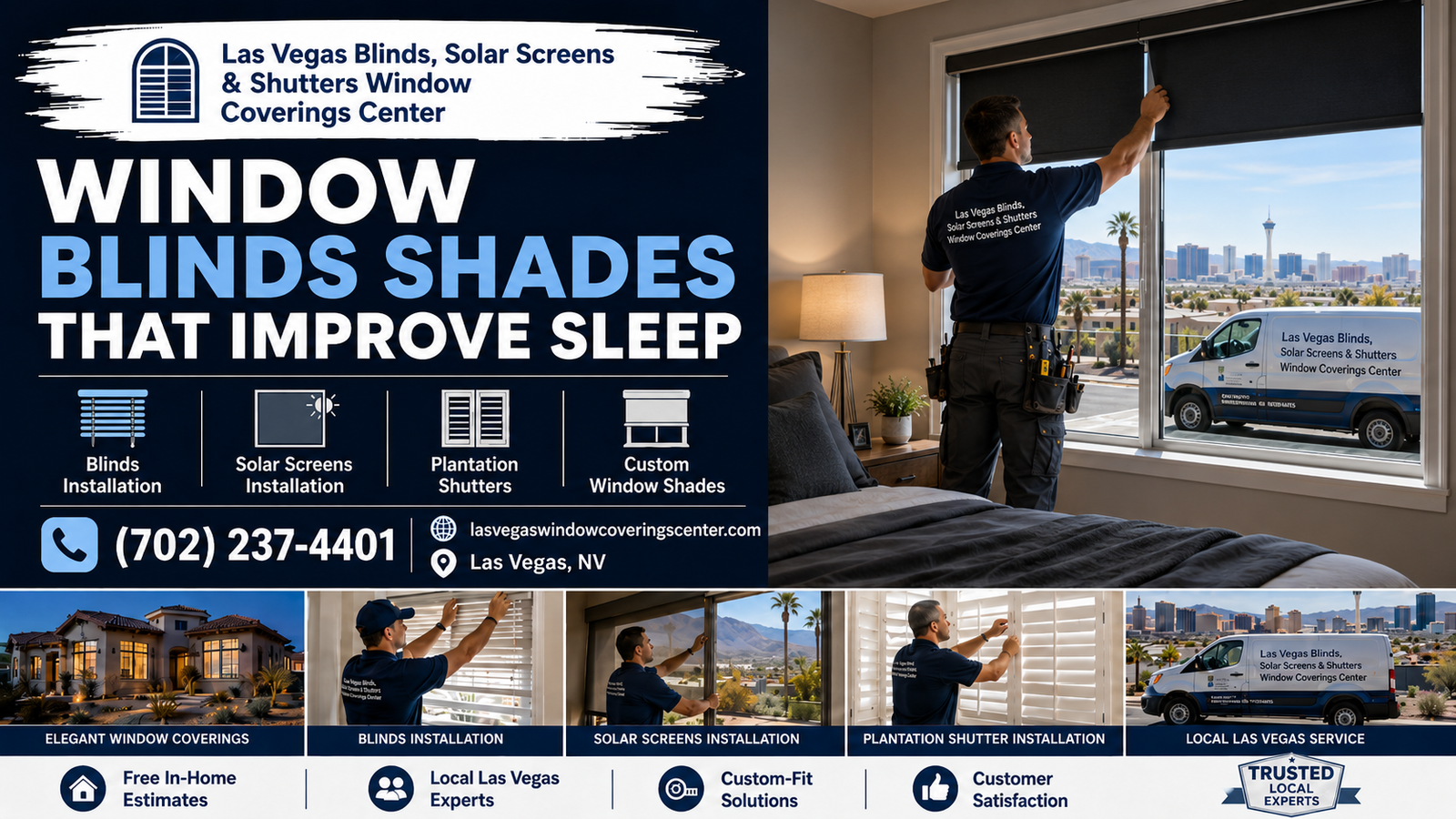
Window Blinds and Shades That Improve Sleep
Compare blackout, room-darkening, cellular, Roman, dual, shutter, and motorized options for darker, more private Las Vegas bedrooms.
Which Window Blinds and Shades Can Help Improve Sleep?
The strongest window coverings for sleep are usually blackout roller shades, blackout or room-darkening cellular shades, lined Roman shades, dual roller shades, and motorized shades programmed to close before bedtime. Plantation shutters and tightly closed blinds can also reduce light, but their louvers and slat gaps usually allow more light than a continuous opaque shade.
The most important distinction is between the fabric and the complete installation. “Blackout” describes material that prevents light from passing through the fabric; it does not guarantee that every edge of the window will be dark. Outside mounting, side channels, overlapping drapery, cornices, and careful custom measurement can reduce light around the top, sides, and bottom.
For Las Vegas bedrooms, heat and glare may also affect comfort before bedtime. Cellular shades, blackout rollers, exterior solar screens, or layered products can help manage direct exposure. Motorized schedules are useful for shift workers, nurseries, high windows, and anyone who wants shades to close consistently without handling cords.
Why Sleep-Friendly Window Coverings Matter in Las Vegas
Las Vegas bedrooms can be affected by intense evening sun, early desert sunrise, streetlights, security lighting, neighboring properties, illuminated commercial areas, and strong reflections from pale walls or hardscape. A room may feel dark at midnight yet brighten much earlier than the sleeper wants. West-facing bedrooms may remain warm after sunset, while east-facing rooms can receive direct morning light.
Homeowners in Summerlin, Henderson, Spring Valley, Enterprise, and North Las Vegas often want better darkness without making the entire home feel closed during the day. Shift workers may need a bedroom dark enough for daytime sleep. Parents may want nursery shades that reduce light while using cordless or inaccessible controls. Renters and landlords may need durable products that are simple to operate and document.
Interior designers must balance sleep performance with color, fabric, stack, trim, and exterior-facing appearance. Property managers and hospitality operators need repeatable darkness, privacy, and easy staff operation. Medical and wellness properties may need rest rooms or treatment spaces with stronger light control.
No blind or shade can guarantee better sleep by itself. Sleep also depends on schedule, noise, temperature, health, light from electronics, and personal sensitivity. A properly selected window covering can reduce unwanted outdoor light and support a more consistent bedroom environment.
How Outdoor Light Can Disrupt a Bedroom
Early sunrise
East-facing windows can brighten quickly in the morning. Small gaps around a shade may create narrow beams that reach the bed even when the fabric is opaque.
Late afternoon and evening sun
West-facing bedrooms can remain bright and warm close to bedtime. Solar control and room-darkening may need to work together.
Streetlights and security lights
A nearby fixture can create a concentrated light source that remains visible through slat gaps, sheer fabric, or the sides of an inside-mounted shade.
Commercial and neighborhood lighting
Homes near busy roads, parking areas, hospitality properties, and mixed-use districts may receive more nighttime light than suburban interiors.
Light reflected from ceilings and walls
Even a small gap near the top can send light across a pale ceiling. Cornices, outside mounting, or a layered curtain can reduce that effect.
Indoor sources
Charging lights, televisions, phones, and hallway lighting also affect bedroom darkness. Window coverings address outdoor light, not every source inside the room.
Best Window Blinds and Shades That Improve Sleep
Blackout roller shades
A strong all-around choice for bedrooms. Opaque fabric blocks light through the material, and outside mounting or side channels can reduce perimeter gaps.
Blackout cellular shades
Combine opaque fabric with insulating honeycomb cells. They provide privacy, room darkening, and a softer bedroom appearance.
Room-darkening cellular shades
Reduce substantial light while allowing a slightly brighter room than blackout material. Useful for children’s rooms and bedrooms where total darkness is unnecessary.
Lined Roman shades
Decorative fabrics can use room-darkening or blackout lining. The folds add softness, but side gaps and the upper stack must be planned.
Dual roller shades
Combine a solar or light-filtering daytime layer with a separate blackout or privacy layer for nighttime and daytime sleep.
Plantation shutters
Closed louvers provide adjustable privacy and substantial light control. Small gaps remain around louvers and panels.
Faux-wood blinds
Familiar and adjustable, but slat edges and cord routes allow more light than a continuous shade. Drapery can improve darkness.
Zebra shades
Provide adjustable bands for daytime light and privacy, but they are usually not the first choice for maximum bedroom darkness.
Motorized blackout shades
Useful for high windows, shift-work schedules, nurseries, and timed bedtime routines. Motor, power, controls, and safe access matter.
Sleep-Friendly Window Covering Comparison
| Product | Best For | Darkness | Privacy | Heat and Glare | Cleaning | Smart Compatibility | Installation | Potential Drawback |
|---|---|---|---|---|---|---|---|---|
| Blackout roller shade | Primary bedrooms, shift workers | Very strong through fabric | Strong | Strong | Simple dusting | Excellent | Outside mount or channels may reduce gaps | View and daylight disappear when closed |
| Blackout cellular shade | Bedrooms needing darkness and insulation | Very strong | Strong | Good | Gentle dusting or vacuuming | Good | Inside or outside mount | Pleats require care |
| Room-darkening cellular | Children’s rooms and moderate darkness | Strong | Strong | Good | Gentle care | Good | Side gaps remain | Not full blackout |
| Lined Roman shade | Decorative bedrooms | Strong with blackout lining | Strong | Fabric-dependent | Fabric-specific | Available | Stack and lining need clearance | More folds and fabric |
| Dual roller shade | Daytime view plus nighttime darkness | Excellent flexibility | Excellent | Strong | More hardware to clean | Excellent | Requires more depth | Higher complexity |
| Plantation shutter | Traditional bedrooms | Strong but not gap-free | Strong | Good | Wipeable | Motorized tilt varies | Frame and panel swing | Louver gaps remain |
| Faux-wood blind | Rentals and adjustable light | Moderate | Good | Moderate | Many slats to wipe | Some options | Headrail and slat clearance | More light leakage |
| Zebra shade | Modern bedrooms with flexible daylight | Moderate | Moderate | Moderate | Gentle dusting | Excellent | Band alignment and roller depth | Not maximum darkness |
| Motorized drapery | Large glass and luxury bedrooms | Strong with lining | Strong | Strong | Fabric-specific | Excellent | Track support and wall stack | Needs side space |
Blackout vs Room-Darkening Shades
Blackout fabric
Blackout fabric is designed to prevent visible light from passing through the material. It is appropriate for shift workers, media rooms, nurseries, and sleepers who are highly sensitive to outdoor light.
Room-darkening fabric
Room-darkening fabric reduces substantial light but may transmit a small amount. It creates a softer daytime environment and may be sufficient for many bedrooms.
Light-filtering fabric
Light-filtering material diffuses daylight and provides daytime comfort, but it is not intended to create a dark sleep environment.
Why the installation matters
Even blackout material can leave light at the sides, top, and bottom. Inside mounting creates a clean appearance but normally requires operating clearance.
Layered darkness
Outside-mounted blackout shades, side channels, cornices, and lined drapery can reduce perimeter light. Each added layer increases hardware, cleaning, and cost.
How to Reduce Light Gaps Around Bedroom Shades
Outside mounting
An outside-mounted shade overlaps the frame and can cover more of the opening. It may conceal decorative trim and project farther into the room.
Side channels
Specialty channels capture the fabric edges and are useful where stronger darkness is needed. They require precise measurement and compatible hardware.
Fascia, cassette, or cornice
A covered roller or cornice can reduce light near the top while creating a finished appearance.
Layered drapery
Blackout curtains can overlap shade edges and provide decorative softness. The rod should extend beyond the opening so the panels cover the sides.
Window sill and bottom rail
A projecting sill may stop a shade before it reaches the wall. The final drop and bottom-rail position should be measured carefully.
Multiple windows
Several individual shades may leave gaps between adjacent units. One larger treatment may reduce gaps but requires stronger hardware and can limit independent operation.
Best Shades for Shift Workers and Daytime Sleep
Shift workers often need stronger control because daytime sunlight is far brighter than typical nighttime street lighting. The bedroom may also be warmer during the sleeping period.
Use opaque fabric
Blackout roller or cellular shades are usually more appropriate than solar or light-filtering fabrics.
Increase overlap
Outside mounting, channels, cornices, or layered curtains can reduce side and top gaps.
Use motorized schedules
Program shades to close before the sleeper arrives home and reopen after the planned sleep period. A remote or wall switch should remain available.
Manage temperature
Cellular shades, exterior solar screens, or daytime solar control may help reduce direct exposure. Window coverings complement, rather than replace, proper cooling and insulation.
Reduce indoor light
Cover device lights, reduce hallway spill, and use consistent indoor lighting routines. The shade cannot address every source of light.
Preserve emergency access
Bedroom coverings should not prevent required window egress or normal lock operation.
Nursery and Child-Safe Bedroom Shades
Choose cordless or inaccessible controls
Cordless cellular shades, cordless roller shades, shutters, and motorized systems avoid many accessible lift cords. Continuous-loop controls require the approved tension device.
Keep furniture away from windows
Cribs, beds, chairs, toy storage, and shelving should not give children access to controls, sills, or windows.
Use room-darkening thoughtfully
Many families prefer a room-darkening shade that supports naps without making every daytime wake period completely dark. Blackout may be more appropriate for specific schedules.
Secure brackets
Window coverings should be mounted with hardware suitable for the wall, trim, or frame. A loose headrail or shutter panel should be addressed promptly.
Control automatic movement
Parents should understand motorized schedules and override controls. Keep the shade travel path clear of furniture and toys.
Bedroom Heat, Glare, and Sleep Comfort
Las Vegas bedroom comfort is affected by more than darkness. A west-facing room may remain warm after sunset, while an east-facing room can heat quickly after sunrise. Window coverings may help reduce direct solar exposure and improve comfort near the glass.
Cellular shades
Honeycomb cells create an air layer and provide broad coverage. Blackout cellular fabric combines darkness and room-side insulation.
Exterior solar screens
Exterior screens can reduce direct exposure before sunlight reaches the glass. HOA, egress, wind, and exterior appearance must be reviewed.
Dual shades
A solar layer can manage daytime glare, while a blackout layer closes for sleep. This provides more flexibility than one fabric.
Motorized timing
Closing shades before the strongest sun reaches the window may be more useful than closing them only at bedtime.
Realistic expectations
Shades can support comfort but do not repair inefficient glass, air leaks, inadequate insulation, or HVAC problems.
Bedroom Privacy During the Day and Night
Solar shades
Solar fabric can provide daytime screening, but it is not dependable nighttime privacy when interior lights are on.
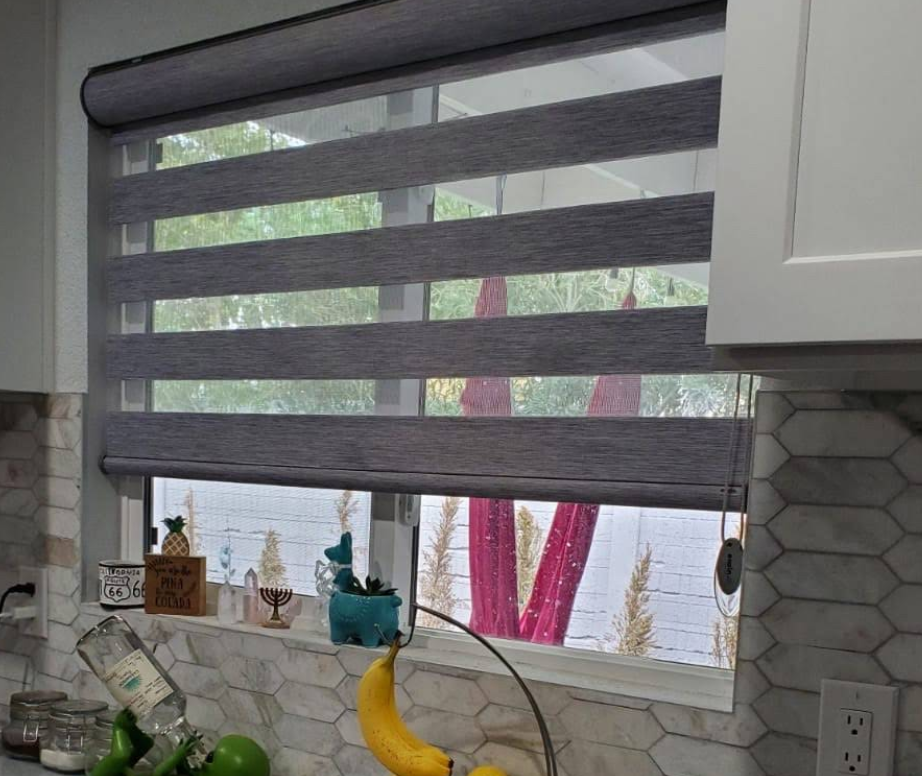
Opaque roller and cellular shades
Privacy and blackout fabrics prevent direct views through the material when fully closed. Small edge gaps may remain.
Blinds and shutters
Closed slats or louvers provide adjustable privacy. Angle matters; partially open products may allow views from above or below.
Top-down bottom-up shades
These allow daylight from above while keeping the lower part of the window covered. They are useful for street-facing bedrooms and bathrooms.
Dual products
Dual rollers or layered curtains allow different privacy settings during daylight, sleep, and nighttime use.
Motorized and Smart Shades for Sleep Routines
Motorized vs smart-connected
A motorized shade moves by remote or switch. A smart-connected shade adds app, schedule, sensor, or voice features through compatible controls.
Bedtime schedules
Shades can close before bedtime to reduce outdoor light and reopen after the desired wake time. Schedules should be easy to override.
Sunrise routines
A gradual or scheduled opening may support a consistent morning routine, though available movement features depend on the exact motor system.
Battery and rechargeable motors
These suit many existing homes. Charging ports should remain safely accessible without standing on furniture.
Hardwired power
Hardwired or low-voltage power is practical for high windows, new construction, and whole-home systems. Electrical work should be coordinated properly.
Smart-home bridge
Some app and voice functions require a hub or bridge. Confirm compatibility with the homeowner’s preferred platform before ordering.
Internet outage
A dedicated remote or wall switch is a useful backup when the app or network is unavailable.
Sleep-Friendly Recommendations by Bedroom Type
Primary bedroom
Blackout cellular or roller shades with outside mounting or layered drapery provide strong darkness and privacy.
Shift-worker bedroom
Opaque fabric, stronger edge coverage, heat control, and motorized schedules deserve priority.
Nursery
Cordless room-darkening cellular shades or motorized blackout rollers support naps and safer controls.
Child’s bedroom
Room-darkening cordless shades balance sleep support, daylight, and simple operation.
Guest bedroom
Room-darkening roller or cellular shades provide privacy and familiar controls without unnecessary complexity.
East-facing bedroom
Blackout shades help reduce early sunrise light. Side gaps should be reviewed from the bed position.
West-facing bedroom
Dual shades, cellular shades, or exterior solar screens can address afternoon exposure before the blackout layer closes.
Luxury suite
Motorized dual shades or lined drapery can coordinate with whole-home scenes and hidden power.
Rental bedroom
Durable cordless cellular or roller shades provide simple operation and easier turnover documentation.
Safe Homeowner Checks
Safe checks
- Observe where light enters after dark.
- Check side, top, and bottom gaps.
- Identify east- and west-facing windows.
- Confirm inside or outside mounting.
- Look for loose brackets.
- Check whether the shade rolls evenly.
- Check whether a cordless rail stays level.
- Look for frayed or accessible cords.
- Replace accessible remote batteries.
- Charge reachable motor batteries.
- Confirm the smart-home hub is online.
- Check whether furniture blocks operation.
Do not do these things
- Do not stand on unstable furniture.
- Do not remove large shades alone.
- Do not work near wiring without proper knowledge.
- Do not disassemble motors.
- Do not force a jammed motorized shade.
- Do not pull hard on a stuck cord.
- Do not allow children to play with cords.
- Do not use harsh chemicals without instructions.
- Do not pressure-wash interior shades.
- Do not bend shutter louvers.
- Do not drill into unknown wall cavities.
- Do not block required bedroom egress.
Inside Mount vs Outside Mount for Bedroom Darkness
Inside mount
Inside mounting creates a clean built-in appearance and preserves trim. It normally leaves narrow side gaps for operation and may be less suitable where maximum darkness is the priority.
Outside mount
Outside mounting overlaps the opening and can reduce light gaps. It covers more wall or trim and needs a strong mounting surface.
Ceiling mount
A ceiling-mounted shade or drapery track can cover a larger area and support floor-to-ceiling design. It requires secure structure and enough wall stack.
Side channels
Channels provide stronger edge control but add visible hardware and precise installation requirements.
Window hardware
Handles, locks, cranks, and tilt-in sashes must remain operable. Custom measurement helps prevent interference.
Custom-Fit vs Ready-Made Bedroom Shades
Ready-made products
Ready-made shades can suit temporary rooms and standard openings, but available widths, fabrics, controls, and overlap are limited.
Custom-fit products
Custom measurement accounts for trim, depth, sill, lock projection, desired overlap, fabric, control, and the sleeper’s sensitivity to edge light.
DIY measurement risk
Measuring only once or applying a homemade deduction can create larger light gaps or a shade that binds.
Large windows
Wide shades need suitable roller tubes, motors, brackets, and fabric width. Several aligned units may be more reliable than one oversized shade.
Bay and specialty windows
Corner gaps, angled walls, arches, and deep trim require product-specific planning. Custom shutters, cellular shades, or outside-mounted rollers may be appropriate.
When to Clean, Repair, Upgrade, or Replace
Cleaning
Cleaning may be enough when the shade operates normally, dust is the main problem, and the fabric allows a safe method. Keep moisture away from motors and headrails.
Minor repair
Loose brackets, remote batteries, control chains, motor programming, replaceable slats, shutter magnets, or minor alignment issues may be serviceable.
Upgrade
Upgrade when the room needs stronger darkness, cordless controls, motorization, smart schedules, better privacy, tighter edge coverage, or improved heat control.
Replacement
Replacement may be more practical when fabric is permanently stained, multiple slats are broken, the headrail fails, the shade no longer raises evenly, parts are unavailable, cords create a safety concern, or the product cannot meet the bedroom’s current darkness needs.
Cost factors
Pricing depends on measurements, number of windows, product category, fabric, lining, control type, motorization, smart integration, mounting, access, custom shapes, electrical work, and removal of old products. Request a product-specific written estimate.
Las Vegas Bedroom Conditions
Las Vegas bedrooms may face intense early or late sun, illuminated streets, neighboring security lights, dry desert dust, and long cooling seasons. East-facing rooms in Henderson, Green Valley, Anthem, and North Las Vegas may brighten early. West-facing bedrooms in Summerlin, Spring Valley, Enterprise, and Southern Highlands may remain bright and warm into the evening.
Older homes in Downtown Las Vegas and Winchester may have shallow, uneven, or wood-trimmed openings where outside mounting provides better coverage. Newer homes in Skye Canyon, Inspirada, Mountains Edge, and Centennial Hills may include tall windows that benefit from motorization.
Luxury properties in The Ridges, Red Rock Country Club, Queensridge, Seven Hills, and MacDonald Highlands may require hidden power, coordinated drapery tracks, dual shades, and whole-home controls. Rental properties and multi-unit homes may prioritize durable cordless products and simple turnover documentation.
The company serves these communities from its Las Vegas location and does not claim a separate physical office in each neighborhood.
Detailed Sleep-Friendly Shade Buying Checklist
Evaluate the room from the bed
Sit or lie where the sleeper normally rests and identify every visible source of exterior light. A small side gap may be unimportant from the doorway but shine directly toward the pillow.
Observe the room at the actual sleep time
Nighttime streetlights, early sunrise, and daytime shift-work conditions create different problems. Evaluate the room when the shade will actually be used.
Choose a darkness target
Some sleepers need total darkness, while others only want reduced glare and privacy. Choose blackout, room-darkening, or light-filtering fabric based on that target.
Review the complete opening
Measure trim, depth, sill, handles, locks, and desired overlap. Identify whether outside mounting, channels, cornices, or curtains are needed.
Choose safe controls
Use cordless or inaccessible controls where children live or visit. Plan safe battery charging and keep automatic shade travel clear.
Test samples
Hold samples against the glass during bright daylight and after dark. Compare transmitted light, color, privacy, and how the material looks from outside.
Plan the wake-up routine
Motorized shades can reopen at a scheduled time, but the homeowner should retain a remote or wall switch for local control.
Document the system
Keep fabric names, measurements, motor details, remotes, charging accessories, care instructions, and warranty documents with household or property records.
Common Bedroom Shade Mistakes
Choosing blackout fabric with a narrow inside mount
The fabric may be opaque while the side gaps remain bright. Review overlap and mounting before ordering.
Using solar fabric for nighttime privacy
Solar shades can appear private in daylight but allow views inward after dark. Add an opaque layer where needed.
Ignoring heat before bedtime
A west-facing room may remain uncomfortable even after the blackout shade closes. Consider earlier closure, cellular construction, or exterior solar control.
Blocking bedroom egress
Window coverings should not prevent required exit access, locks, or normal window operation.
Using unsafe controls in nurseries
Accessible cords and unsecured loops should not be selected for rooms used by young children.
Depending only on an app
Smart shades should retain a practical local control method when the internet, phone, or account is unavailable.
Skipping physical samples
Online images cannot show true darkness, transmitted color, or privacy at the actual bedroom window.
Assuming window coverings solve every sleep issue
Noise, temperature, electronics, schedules, and health also affect sleep. A shade addresses outdoor light and may support comfort, but it is not a medical treatment.
Product Details for Better Bedroom Darkness
Blackout roller shades
Blackout roller shades are often the first product to compare when the goal is a darker bedroom with a clean, modern appearance. The fabric rolls onto a tube at the top of the window and lowers as one broad panel. This continuous surface generally leaks less light through the middle of the treatment than slatted blinds or shutters. The remaining challenge is the perimeter.
An inside-mounted roller shade needs enough side clearance to move freely. That clearance creates visible gaps. An outside-mounted shade overlaps the trim and can reduce those gaps, but it covers more wall area. Side channels can provide stronger edge control, while a cassette or cornice can reduce light near the roller.
Blackout cellular shades
Blackout cellular shades combine opaque material with a honeycomb structure. Their soft pleats suit bedrooms, nurseries, guest rooms, and traditional interiors. The cellular construction may also improve comfort near the glass, which can be useful in bedrooms exposed to Las Vegas afternoon or morning sun.
Inside-mounted cellular shades still leave operating gaps. Outside mounting can increase overlap. Top-down bottom-up cellular shades are helpful when the bedroom needs daytime privacy and upper daylight, but the additional moving rail adds complexity and may not be available with every blackout fabric or motorized system.
Roman shades with blackout lining
Roman shades use decorative fabric that folds as the treatment rises. Adding blackout lining can improve darkness and privacy while preserving a softer, furnished look. The face fabric and lining should be selected together so the folds hang properly and the exterior-facing color remains appropriate.
Roman shades create a visible stack at the top when raised. This stack may cover part of the glass. Their edges can also admit light unless the shade overlaps the frame or is layered with curtains. Cleaning requirements depend on the fabric and lining.
Plantation shutters
Plantation shutters appeal to homeowners who want a permanent architectural product. Closed louvers provide substantial privacy and light control, but narrow gaps remain between louvers, panels, and frames. They are generally better for adjustable darkness than for a true blackout effect.
Shutters can be paired with drapery when stronger darkness is needed. Split tilt or divided rails allow the upper and lower sections to operate independently. Frame depth, panel swing, window locks, and cleaning access should be reviewed before ordering.
Faux-wood blinds
Faux-wood blinds are familiar, durable, and adjustable. They work well in rentals, guest rooms, and bedrooms where the owner wants flexible light rather than maximum darkness. Closing the slats in the correct direction can reduce visible light, but gaps around the slats and ladder cords remain.
A lined curtain can improve darkness behind or in front of the blind. Cordless lift is preferred where children live or visit. Wide blinds can become heavy, so dividing a large opening may improve operation.
Dual roller shades
Dual roller shades combine two separate fabrics on one opening. A solar or light-filtering layer can remain down during the day, while a blackout layer closes for sleep. This is useful in primary bedrooms, luxury suites, guest rooms, and shift-worker bedrooms where daytime view and nighttime darkness are both important.
Dual systems require more mounting depth and hardware than one roller shade. Motorization can simplify operation, but power, controls, roller clearance, and service access should be planned carefully.
Designing a Bedroom Window-Covering System Around a Sleep Schedule
Standard nighttime sleep
For a typical nighttime schedule, the main concerns are streetlights, neighboring security lighting, early sunrise, privacy, and room temperature. Room-darkening cellular shades may be sufficient for many sleepers. Highly light-sensitive sleepers may prefer blackout rollers with outside mounting or layered curtains.
Daytime sleep
Daytime sleepers face much stronger light. Blackout fabric, wider overlap, side channels, cornices, and layered drapery deserve more attention. Motorized shades can close before the sleeper returns home so the room begins cooling and darkening earlier.
Irregular work schedules
Healthcare workers, hospitality employees, transportation workers, security staff, and other Las Vegas professionals may sleep at different times throughout the week. App-based scenes or labeled remote channels can make it easier to adjust the bedroom without rebuilding a schedule every day.
Children’s sleep schedules
Children may nap during daylight and sleep at night. Room-darkening shades often provide enough control while preserving a softer daytime environment. Parents who choose blackout products should keep controls cordless or inaccessible and maintain safe furniture placement.
Guest rooms
Guest rooms benefit from simple, intuitive controls. A cordless room-darkening cellular shade or straightforward roller shade may be more practical than a complex smart-home system. Leave written operating instructions for motorized products.
Hospitality bedrooms
Hotels, short-term rentals, and furnished rental properties need consistent darkness, privacy, durability, and easy maintenance. Blackout rollers or lined drapery should be measured so housekeeping staff can clean the glass and operate the treatment without forcing it.
Morning light preferences
Not every sleeper wants complete darkness until waking. Motorized shades can open on a schedule, while dual shades can preserve a lighter daytime layer. The homeowner should be able to override automatic movement for weekends, illness, travel, or changing work hours.
Installation Details That Affect Bedroom Performance
Overlap
The amount of fabric extending beyond the opening affects edge light. More overlap can improve darkness but may cover decorative trim, switches, outlets, or nearby walls. The final width should be planned rather than guessed.
Roller direction
Some roller shades can roll from the front or back of the tube. One direction may create better clearance around handles, while the other may place the fabric closer to the glass. The choice can affect edge light and appearance.
Fabric width
Very wide windows may exceed the usable width of a selected fabric. Seams, multiple shades, or a different product may be required. Multiple units create center gaps that should be evaluated from the bed.
Bracket placement
Brackets must attach to suitable structure and remain level. A tilted roller can cause fabric tracking, uneven gaps, and noise during operation.
Bottom-rail position
The bottom rail should stop at a consistent point without striking the sill, furniture, or floor. A rail that stops too high leaves light at the bottom.
Fascia and cassette access
Decorative covers create a finished look but should not make motors, brackets, batteries, or wiring impossible to service.
Drapery stack
Layered curtains need enough wall space to clear the window when open. A rod that is too narrow leaves the panels over the glass and reduces daylight.
Window operation
Bedroom shades should not block locks, handles, tilt-in cleaning, or required egress. These details should be tested before final installation approval.
Questions to Ask Before Hiring a Window-Covering Company
- Which product will create the darkness this bedroom needs?
- Is the fabric blackout or room-darkening?
- What edge gaps should I expect?
- Would outside mounting improve darkness?
- Are side channels or drapery recommended?
- Will the product provide privacy at night?
- Is the shade custom measured?
- Does the quote include installation?
- Does it include removal of old coverings?
- Is the control cordless?
- Is the product suitable for a nursery?
- Can the shade be motorized?
- What motor, power, and controls are included?
- Does smart control require a hub?
- Can schedules be overridden locally?
- Are electrical services separate?
- How should the material be cleaned?
- Are replacement parts available?
- Can I view fabric samples after dark or in strong daylight?
- Will I receive a written estimate?
Red Flags When Buying Sleep-Friendly Blinds and Shades
- Every dark fabric is described as blackout.
- No discussion of edge gaps.
- No nighttime privacy explanation.
- No assessment of east- or west-facing exposure.
- No child-safety or cordless discussion.
- No measurement of depth, trim, and hardware.
- No physical fabric samples.
- Guaranteed sleep improvement claims.
- Guaranteed temperature or energy savings.
- No motor or charging plan for high windows.
- No explanation of smart-home compatibility.
- No backup control for app-connected shades.
- Vague installation charges.
- No clear local business identity or Google Maps presence.
- Pressure to order before bedroom light is evaluated.
Why Consider Las Vegas Blinds, Solar Screens & Shutters Window Coverings Center?
Las Vegas Blinds, Solar Screens & Shutters Window Coverings Center is a local option for homeowners, landlords, renters, property managers, investors, designers, hospitality operators, and other property owners comparing bedroom blinds and shades.
The team can help compare blackout roller shades, cellular shades, Roman shades, dual shades, faux-wood blinds, plantation shutters, motorized shades, smart controls, solar screens, and custom-fit privacy products. A helpful consultation should consider sleep schedule, outdoor light, window orientation, edge gaps, heat, privacy, child safety, mounting, and daily operation.
Call (702) 237-4401, request help choosing bedroom shades, browse the window-covering product catalog, compare cellular shades, review Roman shades, explore faux-wood blinds, or learn about motorized shades.
For related comfort guidance, read the previous article about the best window coverings for Las Vegas heat. View the Las Vegas window-covering location on Google Maps.
Areas Served
The business serves customers in these communities from its Las Vegas location. Service in a community does not imply a separate physical office there.
Frequently Asked Questions About Blinds and Shades for Sleep
What window blinds and shades are best for improving sleep?
Blackout roller shades, blackout cellular shades, lined Roman shades, dual shades, and motorized blackout systems are the strongest options to compare. Installation and edge coverage matter.
What is the difference between blackout and room-darkening shades?
Blackout fabric blocks light through the material. Room-darkening fabric reduces substantial light but may allow some transmission. Both can leave perimeter gaps.
Are cellular shades good for bedrooms?
Yes. Blackout and room-darkening cellular shades provide privacy, broad coverage, and an insulating honeycomb structure.
What are the best shades for shift workers?
Opaque blackout shades with stronger edge overlap, side channels, or layered curtains are usually best. Motorized schedules can close them before daytime sleep.
Do solar shades improve sleep?
Solar shades reduce glare but usually do not create a dark bedroom or dependable nighttime privacy. They work better as the daytime layer in a dual system.
Are motorized bedroom shades worth considering?
They are useful for high windows, shift-work routines, nurseries, and scheduled bedtime or wake-up operation. Confirm power, hub, and backup controls.
Should bedroom shades be inside or outside mounted?
Inside mounting looks built in but usually leaves side gaps. Outside mounting overlaps the frame and can improve darkness when enough wall space is available.
How can I request current consultation and installation availability?
Call Las Vegas Blinds, Solar Screens & Shutters Window Coverings Center at (702) 237-4401 to ask about current measurement, consultation, and installation availability.
Find the Las Vegas Location
Las Vegas Blinds, Solar Screens & Shutters Window Coverings Center is located at 3871 S Valley View Blvd #6, Las Vegas, NV 89103. Call before visiting to confirm current availability.
Compare Sleep-Friendly Blinds and Shades for Your Las Vegas Bedroom
Call Las Vegas Blinds, Solar Screens & Shutters Window Coverings Center at (702) 237-4401 to compare blackout shades, cellular shades, Roman shades, dual rollers, shutters, and motorized bedroom window coverings.
Review outdoor light, edge gaps, privacy, bedroom orientation, controls, and heat before selecting the final product.