★ ★ ★ ★ ★
Proudly backed by over 500+ 5-Star Reviews
Trusted by Las Vegas homeowners.
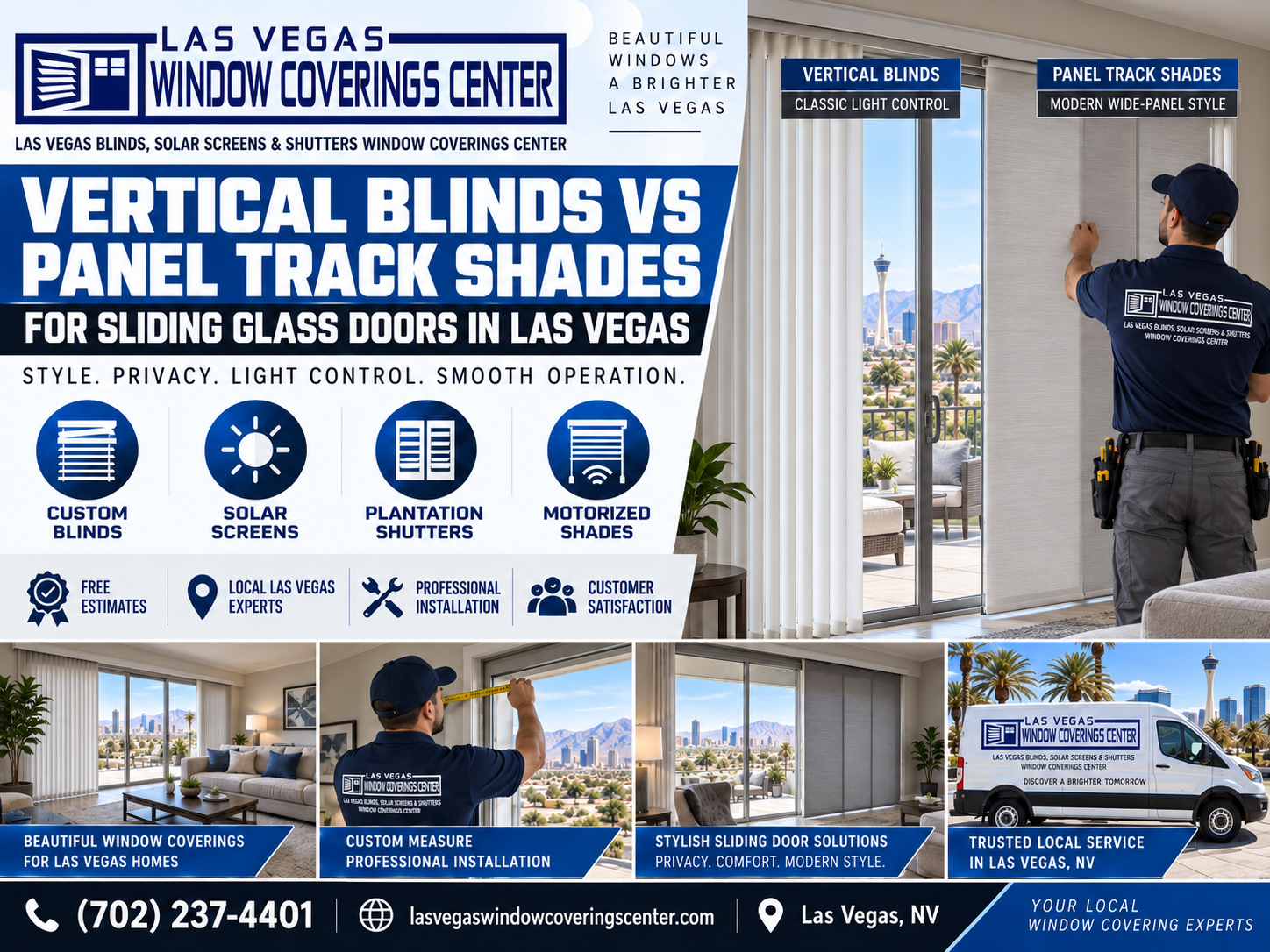
Vertical blinds vs panel track shades on sliding glass doors in a Las Vegas home
Sliding Glass Door Window Treatments • Las Vegas Guide

Vertical Blinds vs Panel Track Shades for Sliding Glass Doors in Las Vegas

Vertical blinds and panel track shades both move horizontally, making them natural candidates for large sliding glass doors. The better choice depends on much more than appearance. Las Vegas homeowners should compare privacy, glare, vane or panel movement, stack direction, usable doorway width, handle clearance, desert dust, traffic flow, fabric or material, direct sun and how much of the view remains open when the treatment is stacked.

Las Vegas Blinds, Solar Screens & Shutters Window Coverings Center 3871 S Valley View Blvd #6, Las Vegas, NV 89103
Vertical Blinds Panel Track Shades Sliding Glass Doors Professional Measurement

Are Vertical Blinds or Panel Track Shades Better for Sliding Glass Doors?

Short answer: vertical blinds are usually the more practical choice when you want adjustable vane tilt, flexible privacy, direct control over incoming sunlight and a familiar treatment that moves in the same horizontal direction as a sliding door. Panel track shades are usually the stronger choice when you want a cleaner contemporary appearance, broad fabric panels and a more visually continuous treatment across a large glass opening.

Choose vertical blinds when: precise light direction matters, you want to rotate the vanes without opening the treatment, compact side stacking is important or easy replacement of individual components is a priority.

Choose panel track shades when: you prefer wide fabric panels, want a modern architectural look, have a large patio door or broad window wall, and are comfortable controlling light mainly by sliding the panels rather than tilting individual vanes.

For Las Vegas sliding glass doors, also consider which direction the door opens, where the treatment will stack, how intense the afternoon sun is, whether the panels or vanes will interfere with the handle, and how much glass you want exposed when the treatment is fully open.

Why Sliding Glass Doors Need a Different Window Treatment Strategy

Sliding glass doors are not simply oversized windows. They are windows, doors and traffic paths at the same time. A window treatment that works beautifully over a stationary living-room window can become frustrating when it blocks the door handle, stacks in front of the active panel or has to be moved every time someone goes to the patio.

That is why vertical blinds and panel track shades are both logical products to compare. Instead of raising vertically like a conventional horizontal blind or roller shade, both can move sideways across the opening.

Graber currently describes its vertical blinds for wide windows and patio doors as a light-control solution available in multiple material styles. Its sliding panel window treatments are likewise designed for wide windows and patio doors.

Hunter Douglas also uses panel-track systems for broad openings, describing its Skyline gliding window panels as a treatment for short, tall and wide windows with panels that stack to the side when opened.

The shared suitability for large glass does not mean the two products behave the same way.

Vertical blinds use many relatively narrow vertical vanes suspended from a headrail. Those vanes can usually rotate for light and privacy control and traverse sideways when the doorway needs to open.

Panel track shades use a smaller number of much wider panels that glide along a multi-channel track. The panels overlap as they move and stack at one side or in another selected configuration.

The key question: do you want a treatment that gives you adjustable vertical vanes, or do you want a treatment that behaves more like broad sliding fabric panels?

For a Las Vegas patio door, that decision should then be tested against privacy, glare, direct desert sun, traffic flow, stack space, cleaning and the actual dimensions of the opening.

Homeowners can compare these options through Las Vegas Blinds, Solar Screens & Shutters Window Coverings Center instead of choosing from appearance alone.

What Is the Main Difference Between Vertical Blinds and Panel Track Shades?

The main difference is how each treatment controls light and moves across the door.

Vertical blinds use individual vanes. Each vane hangs vertically from the headrail. The vanes can rotate together to change privacy and the direction of incoming light. When the door needs to be fully accessible, the blind traverses toward its stack position.

Panel track shades use broad overlapping panels. The panels slide laterally along multiple tracks. Instead of rotating like a vertical-blind vane, a conventional sliding panel opens by moving and stacking the panels over one another.

Vertical Blinds

Individual Vanes

Better suited to homeowners who want the ability to tilt the covering for variable privacy and daylight without necessarily opening the entire treatment.

Panel Track Shades

Wide Sliding Panels

Better suited to homeowners who prefer a broad, clean fabric presentation and straightforward side-to-side opening across a large patio door or window wall.

Why that distinction matters on a sliding door

Imagine wanting daylight while keeping a portion of the patio door private. With vertical blinds, the treatment can remain drawn across the opening while the vanes are rotated to admit more or less light.

With panel track shades, daylight control is more dependent on the selected fabric and how far the panels are opened. A solar-style panel fabric may filter sunlight while remaining across the glass, while a more opaque fabric may require the panels to be opened farther when more daylight or view is desired.

Neither behavior is automatically better. The right choice depends on how the household actually uses the door.

Vertical Blinds vs Panel Track Shades for Las Vegas Sliding Glass Doors

This table focuses on the practical differences that affect everyday use of a patio or sliding glass door.

Decision Factor Vertical Blinds Panel Track Shades Typical Advantage
Light Control Individual vanes rotate to redirect or limit incoming light. Light control comes mainly from fabric selection and how far the panels are opened. Vertical blinds for directional control
Privacy Vanes can be rotated closed while the blind remains across the door. Broad overlapping panels provide coverage according to fabric opacity and panel overlap. Both, depending on material and fit
Appearance Familiar vertical lines with many individual vanes. Broad panels create a cleaner, more contemporary visual field. Panel track for modern styling
Opening Direction Can be configured to traverse toward the preferred side, depending on the system. Panels can be planned to stack according to the track configuration and doorway use. Both require proper planning
Door Traffic Treatment can be moved to the side; individual vanes remain more segmented. Broad panels should be stacked clear of the active doorway before frequent traffic. Depends on household use
Stack Appearance Many narrow vanes gather together at the stack side. A smaller number of wide overlapping panels forms the stack. Depends on available wall and glass space
Wide Window Walls Designed for broad doors and windows. Particularly suited to wide architectural openings. Both
Glare Control Vane angle can change the direction of direct light. Solar or other filtering fabrics can soften glare while panels cover the glass. Depends on desired view and fabric
View When Covered Vanes can be tilted to increase view-through between them. View-through depends heavily on fabric openness and opacity. Vertical blinds for adjustable open-vane view
Cleaning Individual vanes can be cleaned separately; care method depends on material. Broad fabric panels offer fewer individual components but care depends on the selected material. Material-specific
Replacing Components Individual vane issues may sometimes be addressed without replacing the entire visual field, depending on the system. Panel matching and replacement depend on the selected collection. Product-specific
Best General Fit Practical adjustable light control and familiar patio-door operation. Contemporary styling and broad coordinated fabric panels. Depends on homeowner priorities

How Do Vertical Blinds Work on Sliding Glass Doors?

Vertical blinds were developed around the same basic movement pattern that makes sliding doors practical: horizontal travel across a wide opening.

Instead of pulling a large blind upward, the vanes travel along a horizontal headrail. This makes it possible to uncover the active side of a patio door without lifting the entire weight of a broad treatment.

The vanes also rotate. That second movement is what separates vertical blinds most clearly from conventional panel track shades.

Why vane rotation can be useful

Suppose direct afternoon sun is entering through a west-facing patio door. The homeowner may not want to close off the view completely. Rotating the vanes changes the angle at which sunlight enters while allowing some view between them.

The same adjustment can increase privacy. The vanes can remain distributed across the door but rotate toward a more closed position.

Vertical-blind material choices

Current vertical-blind collections can include different material categories. Graber, for example, lists fabric, sheer and vinyl vertical-blind options. Those material differences matter because appearance, cleaning and opacity are not identical.

A vinyl vane can create a more structured, wipeable surface. A fabric vane can soften the visual appearance. Sheer vertical constructions can offer another balance between light diffusion and privacy.

The exact cleaning instructions and room-darkening characteristics should be confirmed for the specific material being quoted rather than generalized from the phrase “vertical blinds.”

When vertical blinds make the most sense

  • You want adjustable vane tilt.
  • You frequently change light direction during the day.
  • The sliding door is opened often.
  • You prefer a familiar patio-door treatment.
  • You want the covering to stack laterally.
  • You want material choices ranging from structured to softer-looking vanes.
  • You need a product designed around broad windows and patio doors.
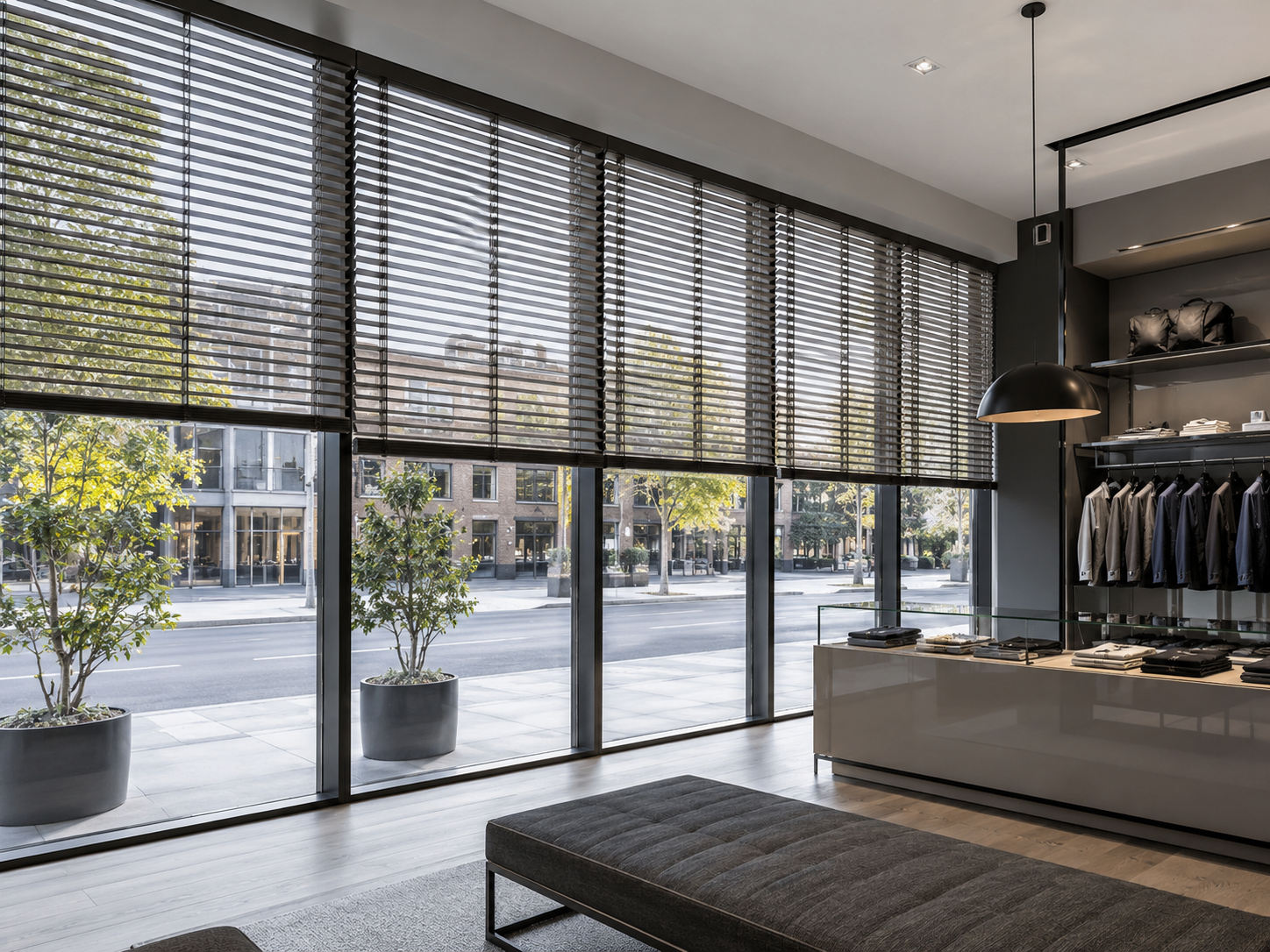
Window coverings on wide glass demonstrating privacy and glare control in Las Vegas

Wide areas of glass require a window treatment that manages glare and privacy without making normal access to the opening inconvenient.

How Do Panel Track Shades Work on Sliding Glass Doors?

Panel track shades—also called sliding panels or panel-track blinds by some manufacturers—replace many narrow vertical vanes with a smaller number of broad panels.

Each panel hangs from a carrier within a horizontal multi-channel track. As the treatment opens, the panels move sideways and overlap into a stack.

The result is visually different from a conventional vertical blind. Instead of seeing repeated narrow vertical lines, the homeowner sees large uninterrupted sections of fabric.

Why panel track shades look more contemporary

Large modern sliding doors often have clean aluminum or minimal frames. Wide fabric panels can complement that architecture because the treatment uses fewer visual divisions.

Hunter Douglas currently describes panel-track treatments as gliding panels for broad windows, while Graber describes sliding panels as a modern option for wide windows and patio doors.

Fabric selection changes the performance

Unlike a rigid vertical vane, a panel track system can be specified with fabric that has different degrees of light transmission, texture and privacy.

Graber notes that its sliding-panel collection can coordinate with fabrics used in several other shade categories. This is useful when a homeowner wants the patio door to coordinate visually with nearby roller or solar shades.

A more open solar-style material can preserve some daytime view and soften glare. A more opaque material can create stronger privacy but reduce view-through when the panels cover the glass.

When panel track shades make the most sense

  • You prefer a contemporary look.
  • The sliding door is very wide.
  • You like broad fabric surfaces rather than narrow vanes.
  • You want to coordinate the door with nearby fabric shades.
  • You are comfortable controlling light primarily through fabric choice and panel position.
  • You have enough planned stack space for the wide panels.

Which Works Better With Everyday Sliding Door Traffic?

The best sliding-door treatment should follow the way the door is actually used.

Before choosing either product, identify which glass panel is fixed and which panel moves. Then identify where people enter and exit, where the handle sits and which side of the opening can accept the treatment stack.

Stack toward the stationary side when practical

In many installations, it is useful to position the stack so the active door panel can open with as little interference as possible.

The correct side depends on the room. Furniture, wall width, a kitchen cabinet, light switch or adjacent window can prevent the most obvious stack location from working.

Think about partial opening

Households do not always fully open the window covering before using a patio door. Someone may want to step outside quickly, let a dog into the yard or carry groceries through the door.

With vertical blinds, a partially opened blind still leaves separate vanes near the traffic path. With panel track shades, a broad panel may remain in front of part of the doorway until it is moved fully clear.

Neither is inherently wrong. The question is which movement feels more natural for the way your household uses the door.

Before ordering: open the sliding door, stand where you naturally reach for the handle, and decide where you want the entire window treatment to go when the doorway is in use.

Why Stack Direction and Stack Space Matter

“How wide is the door?” is only the first measurement. A second question is equally important: where will the covering sit when it is open?

Both vertical blinds and panel track shades occupy lateral space when stacked. If the entire stack remains over the glass, part of the view will stay covered even when the treatment is considered open.

Vertical-blind stack

Vertical blinds gather many narrow vanes together. The actual stack width depends on the size of the opening, vane configuration and hardware.

Because the pieces are narrow, the stack has a different visual profile from panel track shades.

Panel-track stack

Panel tracks collect broad overlapping panels. A system may look very clean when closed, but the stacked panels still need somewhere to go when the door is fully open.

If there is sufficient wall space beside the glass and the selected system can use it, the treatment may expose more of the view. If not, some of the stack may remain in front of the door or fixed glass.

Split stack vs one-way stack

Some product systems and room layouts may allow different draw configurations. A one-way stack can make sense when the door operates from one side. A center-opening or split arrangement may make more sense on another large opening.

Do not choose the draw direction from a catalog illustration. Match it to the actual door.

Which Provides Better Privacy: Vertical Blinds or Panel Track Shades?

Both can provide strong privacy, but they achieve it differently.

Vertical blinds use overlapping vanes. When the vanes rotate toward the closed position, they limit the direct line of sight through the door. Exact privacy depends on vane overlap, headrail alignment, material and fit.

Panel track shades use overlapping fabric panels. A sufficiently opaque fabric can provide substantial coverage across the door, but the overlap between panels and the relationship between the treatment and the wall or jamb still matter.

Vertical blinds allow variable privacy without fully opening

One advantage of rotating vanes is the ability to change the viewing angle while the blind remains distributed across the entire opening. This can be useful on a patio door facing a neighboring property or a street.

Panel-track privacy depends more heavily on fabric

If the panel fabric is opaque, the panels can create a strong visual barrier when closed. If a solar or semi-open fabric is selected, daytime view and privacy can change according to the brightness on each side of the glass.

Daytime privacy through an open solar fabric should not automatically be treated as nighttime privacy. After dark, interior lights can make the room more visible through an open weave.

For rooms where nighttime darkness matters as much as patio-door privacy, the related guide on blackout shades vs room-darkening shades in Las Vegas explains why fabric opacity and perimeter gaps should be evaluated separately.

Which Is Better for Las Vegas Sun and Sliding-Door Glare?

For adjustable directional light control, vertical blinds have a clear functional advantage because the vanes rotate.

That allows a homeowner to experiment with vane angle as the sun moves across the sky. The glass can remain covered while direct light is redirected or reduced.

Panel track shades approach glare differently. They rely more on the selected fabric and how much of the opening remains covered.

A solar-style panel fabric may be useful where glare needs to be reduced while maintaining some connection to the outdoors. A more opaque fabric may provide greater privacy but eliminate more of the view while the panels are closed.

West-facing sliding glass doors

West-facing patio doors can be particularly demanding in the Las Vegas Valley because strong afternoon sunlight can strike a large area of glass for hours.

Interior vertical blinds or panel tracks can help control visible sunlight and glare. The U.S. Department of Energy notes that interior blinds and shades can be used to reduce undesirable solar heat gain and help manage daylight.

However, visible glare and solar heat are not exactly the same problem. If the primary complaint is severe solar heat at the glass, homeowners may also want to compare dedicated solar-control products rather than assuming either interior patio-door treatment alone will solve every aspect of the exposure.

For intense Las Vegas afternoon sun: identify whether the main problem is glare, privacy, heat, fading concerns, or all four. The best fabric or vane material changes with the actual problem.

Which Preserves the Outdoor View Better?

If you want an adjustable view while the treatment remains across the door, vertical blinds usually provide more flexibility.

Rotating the vanes toward the open position creates sight lines between them. The treatment still remains present, but the outdoor view becomes more visible.

A panel track shade behaves differently. Conventional panels do not rotate like individual vanes. When they cover the glass, the view depends on the chosen fabric.

A relatively open solar fabric can maintain daytime view-through. An opaque panel can block the view until the panel is moved away from that part of the glass.

What happens when the treatments are fully open?

At that point, stack space becomes more important than vane or fabric type.

If the stack can move mostly beyond the clear glass area, either treatment may reveal a broad view. If the stack must remain over the fixed glass panel, some of the view will stay covered.

This is why a beautiful sample alone cannot tell you which treatment will preserve your view. The installer needs to evaluate actual stack-back space.

Which Looks More Modern?

Panel track shades generally create the more contemporary appearance. Their broad panels reduce the number of visual lines across the door, which can coordinate well with large modern glass openings, contemporary flooring and open-plan interiors.

Vertical blinds create a more familiar segmented look. That does not make them outdated by definition. Material, color, vane texture, headrail treatment and surrounding décor all affect the final result.

Use the architecture as the guide

A highly modern Las Vegas home with wide minimalist patio doors may visually favor panel track shades. A rental property, practical family room or high-traffic opening may favor the flexibility of vertical blinds.

The best design decision is the one that still works after the patio door has been opened and closed hundreds of times.

Coordinate adjacent windows

If the sliding door sits next to regular windows, consider how the treatments will look together.

Panel tracks can sometimes coordinate with related shade fabrics. Vertical blinds can coordinate through color, texture or a complementary material rather than using exactly the same construction.

Layered drapery and sheer window treatments across large glass doors in a Las Vegas interior

Sliding glass doors can also use softer side-to-side window treatments when drapery, layered privacy or a more decorative appearance is preferred.

Which Is Easier to Clean in the Las Vegas Desert?

Desert dust should be part of the decision because both products cover a large surface area near a frequently used exterior door.

Cleaning vertical blinds

Vertical blinds contain many separate vanes. A smooth vinyl or similar rigid vane may be relatively straightforward to wipe individually, while a fabric vane may require a different cleaning method.

The advantage of separate vanes is that each piece is accessible. The disadvantage is that there are many pieces to clean.

Cleaning panel track shades

Panel tracks use fewer, broader surfaces. This can make the treatment visually simpler, but cleaning requirements depend on the fabric.

Some materials may tolerate light dusting or careful vacuuming while others have manufacturer-specific care instructions.

Do not assume a panel shade can be wiped like vinyl simply because it hangs near a door.

Patio-door traffic adds another maintenance issue

Sliding-door coverings are more likely than many standard window shades to be touched as people pass through. Lower portions can also encounter dust brought in from patios and outdoor spaces.

For a high-traffic household, compare not only appearance but how the exact material should be cleaned.

What Should Homes With Children or Pets Consider?

Sliding doors are naturally high-traffic areas, so controls, loose components and furniture placement deserve attention.

The U.S. Consumer Product Safety Commission recommends cordless window coverings where young children are present because accessible window-covering cords can create a strangulation hazard.

When comparing vertical blinds or panel track shades, ask exactly how the selected product is operated. Wand controls, cordless configurations and other systems vary by manufacturer and product.

Do not assume the product is cordless

A photograph showing a clean window treatment does not tell you what control system will be supplied. Confirm the actual configuration on the written quote.

Consider pet traffic realistically

A dog that regularly goes through the patio door may brush against vanes or panels. A cat may sit directly beside the glass. The best system is one the household can operate fully out of the normal traffic path when the door is being used.

Avoid assuming one product is universally “pet proof.” Material, hardware, animal behavior and household use vary too widely for that claim.

What Should Be Measured Before Ordering a Sliding-Door Window Treatment?

A sliding glass door should not be measured like an ordinary stationary window.

Width and height are only the starting dimensions. The treatment also has to coexist with the door's moving panel, handle, lock, casing, floor, adjacent wall and normal walking path.

Measure the full opening

Record the width and height at multiple points where appropriate. Floors, ceilings and older openings may not be perfectly level or square.

Identify the active and fixed panels

Determine exactly which door panel slides and which remains stationary. This affects the preferred stack side.

Measure the handle projection

Door handles and locks can extend into the room. The treatment needs enough clearance to pass without catching or rubbing.

Evaluate wall space beside the glass

If the goal is to move the stack away from the view or active doorway, measure how much wall space exists beside the opening.

A nearby cabinet, return wall, switch, outlet or adjacent window may limit how far the treatment can extend.

Measure floor clearance

Vertical vanes or panels should be planned in relation to the finished floor. Thick rugs, transitions and changes in flooring should be considered.

Measure for the intended mounting method

An inside-mounted treatment needs sufficient mounting depth and a suitable surface. An outside mount needs enough wall or trim area for the track and brackets.

Calculate the usable doorway when open

This is one of the most overlooked measurements. A treatment can fit the glass perfectly yet still feel inconvenient if its stack consumes too much of the active doorway.

Professional measurement should answer two questions: “Will the treatment cover the glass correctly?” and “Will the sliding door still work conveniently after the treatment is installed?”

Inside Mount vs Outside Mount for Sliding Glass Doors

Many sliding-door treatments are installed outside the immediate glass opening because the track needs room to clear the door frame and hardware. However, the correct mounting method depends on the specific architecture.

Inside mounting

An inside mount can create a contained appearance when the opening has enough depth and a suitable mounting surface. Door handles, locks and trim can make that difficult on some sliding-door systems.

Outside mounting

An outside mount can provide more freedom to position the track above and beyond the door frame. It may also allow additional stack space beside the glass when sufficient wall area exists.

The tradeoff is that the treatment becomes more visually prominent on the surrounding wall.

The mounting method should be selected from the actual measurements rather than from a preference for the words “inside” or “outside.”

What Control Options Should You Compare?

Control options vary significantly by manufacturer and product. Some panel-track systems use a wand to move the panels. Vertical-blind systems can use different wand, cord, chain or other mechanisms depending on the exact collection and current product design.

Because window-covering safety standards and product offerings change, ask which control method is actually included in the current quote rather than relying on an old display or online photograph.

Is motorization available?

Motorization is product-specific. Some broad-opening window treatment categories may have automated options, but not every vertical blind or panel track system is motorized.

If automation is important, verify the exact product, power method, control method, maximum dimensions and any smart-home compatibility directly from current manufacturer documentation.

Hardwired electrical work should follow applicable product installation and electrical requirements.

What If Neither Vertical Blinds nor Panel Track Shades Is the Right Fit?

Sliding glass doors can use several other window treatment categories. The best alternative depends on why vertical blinds or panel tracks were rejected.

Vertical cellular shades

A vertical cellular treatment moves laterally and uses honeycomb-style fabric rather than individual vanes or broad flat panels.

Graber currently identifies vertical cellular shades as an option for patio doors, sliding doors and wide windows.

Drapery

Drapery also travels sideways and can provide a softer appearance. It requires sufficient stack space and should be planned so fabric does not obstruct the active doorway during normal use.

Bypass shutters

Certain shutter systems can use bypass tracks for patio-door applications. This is a much more substantial architectural treatment than vertical blinds or fabric panels, so weight, depth, clearance and cost factors are different.

Custom plantation shutters in a Las Vegas home as an alternative window treatment for large openings

Shutters can provide a more architectural alternative, although sliding-door applications require a system designed specifically for the opening and its traffic pattern.

Which alternative should you choose?

Start with the reason the first two options do not fit. If the problem is appearance, compare drapery or vertical cellular products. If the problem is insulation, compare a cellular option. If the goal is a substantial built-in architectural treatment, investigate a door-specific shutter system.

What Affects the Cost of Vertical Blinds and Panel Track Shades?

It is not useful to state that one category is always cheaper because both can vary by dimensions, material, hardware and optional upgrades.

Vertical-blind cost factors may include:

  • Overall door width and height
  • Vane material
  • Fabric, sheer, vinyl or other current collection options
  • Headrail configuration
  • Draw direction
  • Control system
  • Decorative top-treatment options
  • Custom mounting conditions
  • Number of openings
  • Professional installation

Panel-track cost factors may include:

  • Total opening width and height
  • Fabric collection
  • Panel quantity and dimensions
  • Track configuration
  • Stack direction
  • Light-filtering, solar or more opaque material selection
  • Top treatments where applicable
  • Control options
  • Installation access
  • Number of door openings

Compare complete project scopes

One quote may include professional measurement, installation and removal of an existing blind while another quote may not.

Ask for enough detail that you can compare the same scope rather than comparing only the final number.

The written estimate should identify the treatment type, selected material, approximate configuration, controls, mounting method and installation scope.

Quick Decision Guide: Vertical Blinds or Panel Track Shades?

Adjustable Sun Angle

Choose Vertical Blinds

Rotating vanes provide greater directional control without requiring the treatment to be fully opened.

Modern Design

Choose Panel Track

Broad sliding panels create fewer visual divisions across large contemporary glass doors.

Frequent Patio Traffic

Compare the Stack First

The better product is the one that clears the active doorway with the least disruption to everyday use.

Strong Privacy

Either Can Work

Vertical vane overlap and panel-track fabric opacity can both provide privacy when properly fitted.

Preserve View While Covered

Vertical Blinds

Vanes can be tilted open while remaining spread across the glass, creating adjustable sight lines.

Coordinated Fabric Design

Panel Track

Sliding panels can work well when broad fabric surfaces are part of the room's overall shade design.

Questions to Ask Before Buying a Sliding Glass Door Window Treatment

Which side of my sliding glass door actually opens?
Where should the blind or panel stack when the door is fully open?
How much of the clear glass will the stack cover?
How much usable doorway width remains when the treatment is stacked?
Will the vanes or panels clear the door handle and lock?
Should this treatment draw in one direction or split?
Do I want adjustable vane tilt or broad sliding fabric panels?
How much daytime privacy will the selected material provide?
What privacy should I expect after dark with interior lights on?
How will this material handle direct west-facing sunlight?
Is glare reduction more important than maintaining the outdoor view?
How should the exact vane or panel material be cleaned?
Is this an inside-mount or outside-mount installation?
Is there enough wall or jamb space for the proposed track?
Will nearby furniture interfere with opening the treatment?
What control system is included?
Is there a cordless configuration appropriate for a home with children?
If motorization is important, is it available for this exact product?
Does the quote include professional measurement?
Does the quote include installation and removal of the existing treatment?
What manufacturer care and warranty documents apply?
Should I also compare vertical cellular shades, drapery or a door-specific shutter system?

Red Flags When Buying Window Treatments for a Sliding Glass Door

A good recommendation should address the door itself—not only the window covering sample.

  • The product is recommended without measuring the full opening.
  • No one asks which door panel moves.
  • Stack direction is never discussed.
  • The salesperson cannot explain how much doorway width remains when the treatment is open.
  • Door-handle clearance is ignored.
  • Nearby walls, cabinets or furniture are not considered.
  • A solar-style fabric is described as providing guaranteed nighttime privacy.
  • Unsupported heat-reduction or energy-savings percentages are promised.
  • One material is recommended for every door regardless of exposure.
  • Cleaning instructions for the selected fabric or vane material are unclear.
  • The control system is not identified before purchase.
  • Motorization or smart-home compatibility is promised without identifying the exact system.
  • Cord safety is not discussed in a home where young children are present.
  • The quote does not identify installation scope.
  • The written estimate does not clearly distinguish vertical blinds from panel track shades.
  • No alternative is discussed even though the proposed treatment interferes with normal door traffic.

Why Las Vegas Conditions Matter for Sliding Glass Door Window Treatments

Sliding glass doors are common wherever homeowners want a strong connection between indoor living space and a patio, balcony, pool area or backyard. In the Las Vegas Valley, those broad glass surfaces also create specific light-control and maintenance questions.

Intense afternoon sun

West- and southwest-facing patio doors can receive strong afternoon exposure. In Summerlin, Spring Valley, Enterprise, Southern Highlands, Henderson and other parts of the valley, the intensity of the light can make glare control just as important as privacy.

Vertical blinds provide the ability to adjust vane angle as exposure changes. Panel-track shades can instead use selected fabrics to create a more consistent filtering effect across the glass.

Large modern glass openings

Newer and remodeled homes may use broad sliding or multi-panel glass doors to connect the interior to outdoor living areas.

The wider the opening becomes, the more important stack space and track configuration become. An attractive treatment that consumes too much of the usable doorway may become frustrating in daily life.

Summerlin and west-valley views

Properties in Summerlin, The Ridges, Red Rock Country Club, Queensridge and surrounding west-valley communities may combine afternoon sun with mountain, landscape or city views.

In these rooms, the homeowner may care as much about preserving the view as reducing glare. A vertical blind allows adjustable sight lines between open vanes. A panel track shade may preserve view through a more open fabric or by stacking the panels clear of the principal viewing area.

Henderson and hillside properties

Homes in Henderson, Seven Hills, Anthem and MacDonald Highlands can also have broad views through large doors and windows.

Measure the amount of usable wall beside the door before choosing the panel or vane stack. A view-focused project benefits when more of the treatment can move away from the glass.

Desert dust

Patio-door treatments sit close to one of the most frequently opened exterior access points in the home. Las Vegas dust can enter when the door is open and accumulate on vanes, tracks, panels and nearby floors.

Material should therefore be chosen partly on realistic maintenance preferences. A homeowner who wants a wipeable surface may prioritize a different material from someone who prefers soft woven fabric.

Bright hardscape and pool areas

Sunlight can reflect from light-colored patios, pool decks and exterior surfaces, creating glare even when the sun is not directly in front of the door.

Evaluate the room during the hours when the problem is strongest. A morning appointment may not reveal the glare that occurs at 4:00 p.m.

Condos and high-rise properties

Las Vegas and Paradise condos may have broad glass doors leading to balconies. In these properties, wall space for stack-back can be limited, so the amount of glass covered by the open treatment becomes particularly important.

Property rules may also govern drilling or other modifications. Owners should confirm current building or association requirements when relevant to the proposed installation.

Rentals and investment properties

For a rental property, ease of use, cleaning and replaceable components may carry more weight than achieving a highly customized decorative treatment.

For an owner-occupied home, coordinated fabrics and architectural appearance may deserve more attention.

Local conditions do not make one product universally superior. They make correct diagnosis of the door, exposure and household use more important.

Compare Vertical Blinds and Panel Track Shades in Las Vegas

Las Vegas Blinds, Solar Screens & Shutters Window Coverings Center is a local Las Vegas window covering business where homeowners can compare different ways to cover sliding glass doors and wide windows.

A useful sliding-door consultation should consider more than color. The opening can be evaluated for width, height, active-door direction, handle clearance, stack space, sun exposure, privacy, desired view, cleaning preferences and everyday traffic.

Customers can compare vertical blinds, panel-style treatments and other relevant alternatives instead of assuming that every large door needs the same product.

Professional measurement is especially valuable on sliding doors because the treatment has to fit the architecture without interfering with the way people actually enter and exit the space.

Las Vegas Blinds, Solar Screens & Shutters Window Coverings Center
3871 S Valley View Blvd #6
Las Vegas, NV 89103

Phone: (702) 237-4401
Website: lasvegaswindowcoveringscenter.com
Google: Las Vegas Blinds, Solar Screens & Shutters Window Coverings Center on Google Maps

Sliding Glass Door Window Treatment Service Areas

Las Vegas Blinds, Solar Screens & Shutters Window Coverings Center serves customers throughout the Las Vegas Valley. These communities describe service coverage and do not imply a separate showroom or physical business location in each area.

Las Vegas
Summerlin
Henderson
North Las Vegas
Spring Valley
Enterprise
Southern Highlands
Mountain's Edge
Green Valley
Anthem
Seven Hills
Paradise
Centennial Hills
Skye Canyon
Spanish Trail
Green Valley Ranch
Inspirada
The Ridges
Red Rock Country Club
MacDonald Highlands

Visit Our Las Vegas Window Covering Showroom

Visit Las Vegas Blinds, Solar Screens & Shutters Window Coverings Center at 3871 S Valley View Blvd #6, Las Vegas, NV 89103 to discuss vertical blinds, panel track shades and other window treatments for sliding glass doors and large openings.

Vertical Blinds vs Panel Track Shades FAQs

Are vertical blinds or panel track shades better for sliding glass doors in Las Vegas?

Vertical blinds are often better when adjustable vane tilt, flexible daylight control and familiar patio-door operation are priorities. Panel track shades are often better when the homeowner wants a modern look with broad fabric panels. For Las Vegas doors, also compare afternoon sun, privacy, stack direction, usable doorway width, handle clearance, material and cleaning requirements before choosing.

Do panel track shades work well on large patio doors?

Yes. Panel track shades are specifically designed around wide openings such as large windows and patio doors. Broad panels slide horizontally and overlap as they move. The important design question is where the panels will stack when open. Professional measurement should determine how much glass and doorway width remain uncovered after the panels reach their stack position.

Do vertical blinds provide better light control than panel track shades?

Vertical blinds generally provide more adjustable directional light control because the individual vanes rotate. The blind can stay across the door while the vane angle changes. Panel track shades rely more on fabric selection and how far the panels are opened. A solar-style panel fabric may filter glare while maintaining some view, while a more opaque panel provides greater privacy.

Which is better for privacy at night?

Both can provide good nighttime privacy when the selected material is sufficiently opaque and the treatment fits the opening well. Closed vertical vanes limit direct lines of sight, while opaque overlapping panel-track fabric can cover the glass. Open-weave solar fabrics should not be assumed to provide the same nighttime privacy they may appear to provide during bright daytime conditions.

Which window treatment is easier to clean around a Las Vegas patio door?

It depends on material. Smooth vertical-blind vanes can often be cleaned individually, but there are many separate vanes. Panel tracks use fewer, wider surfaces, although fabric may require manufacturer-specific dusting or cleaning methods. Because patio doors frequently expose coverings to desert dust and traffic, compare care instructions for the exact vane or panel material before ordering.

Can panel track shades preserve my view through a sliding glass door?

Yes, but the result depends on fabric and stack space. A more open fabric can preserve some view while covering the glass. When fully opened, the panels stack laterally. If there is enough space to move much of that stack away from the clear glass, the view can open substantially. If the stack must remain over the door, part of the view remains covered.

Are vertical blinds safe for homes with young children?

Safety depends on the control system. The U.S. Consumer Product Safety Commission recommends cordless window coverings where young children are present because accessible cords can create a strangulation hazard. When choosing vertical blinds or panel track shades, confirm the exact control configuration and select an appropriate current cordless or inaccessible-control option when applicable.

Where can I compare vertical blinds vs panel track shades in Las Vegas?

Contact Las Vegas Blinds, Solar Screens & Shutters Window Coverings Center at (702) 237-4401 or visit 3871 S Valley View Blvd #6, Las Vegas, NV 89103 to compare vertical blinds, panel track shades and other sliding-door window treatments based on privacy, glare, stack space, door operation, material and design.

Technical & Authority References

Sliding Door, Vertical Blind & Panel Track Authority Sources

Product configurations, controls and materials vary by manufacturer. These current manufacturer and government sources support the major product and safety distinctions discussed in this guide.

Graber — Vertical Blinds for Wide Windows and Patio Doors

Graber identifies vertical blinds as a solution for wide windows and patio doors and documents fabric, sheer and vinyl vertical-blind options for different light-control, privacy and design needs.

Review Graber vertical blind information →

Graber — Sliding Panel Window Treatments

Graber describes sliding panels as a modern treatment for wide windows and patio doors and explains their side-to-side panel operation and fabric coordination options.

Review Graber sliding panel information →

Hunter Douglas — Skyline Panel-Track Blinds

Hunter Douglas documents gliding panel-track treatments intended for broad openings and explains their lateral panel movement and stacking behavior.

Review Hunter Douglas Skyline panel-track information →

U.S. Department of Energy — Windows, Blinds, Shades & Solar Heat Gain

Department of Energy guidance explains that interior blinds and shades can help reduce unwanted solar heat gain and that window decisions should consider daylight, glare, climate, maintenance and other building factors.

Read Department of Energy window guidance →

U.S. Consumer Product Safety Commission — Cordless Window Coverings

CPSC recommends cordless window coverings where young children are present because accessible window-covering cords can create a strangulation hazard.

Read CPSC cordless window-covering safety guidance →

Graber — Vertical Cellular Shades for Patio and Sliding Doors

Graber identifies vertical cellular shades as another window treatment category designed for patio doors, sliding doors and wide windows when homeowners want an alternative to vertical blinds or flat sliding panels.

Review Graber cellular shade options →

Important: product dimensions, materials, draw configurations, control systems, cleaning instructions, motorization, smart-home compatibility and warranty terms should be verified for the exact product being quoted. Do not assume the characteristics of one manufacturer's sliding-door treatment apply to every vertical blind or panel track shade.

Related Las Vegas Sliding Door Window Treatment Topics

Compare Sliding-Door Window Treatments Before You Order

Vertical blinds and panel track shades are both logical choices for large sliding glass doors, but they solve the opening differently. Vertical blinds provide adjustable vane tilt and familiar everyday operation. Panel track shades provide broad fabric panels and a cleaner contemporary appearance.

The best treatment is the one that fits the door's actual traffic pattern, stack space, handle clearance, privacy requirements, Las Vegas sun exposure and the amount of view you want to preserve.

Call Las Vegas Blinds, Solar Screens & Shutters Window Coverings Center at (702) 237-4401 to compare vertical blinds, panel track shades and other sliding-door window coverings in Las Vegas and nearby areas.