
★ ★ ★ ★ ★
Proudly backed by over 500+ 5-Star Reviews
Trusted by Las Vegas homeowners.
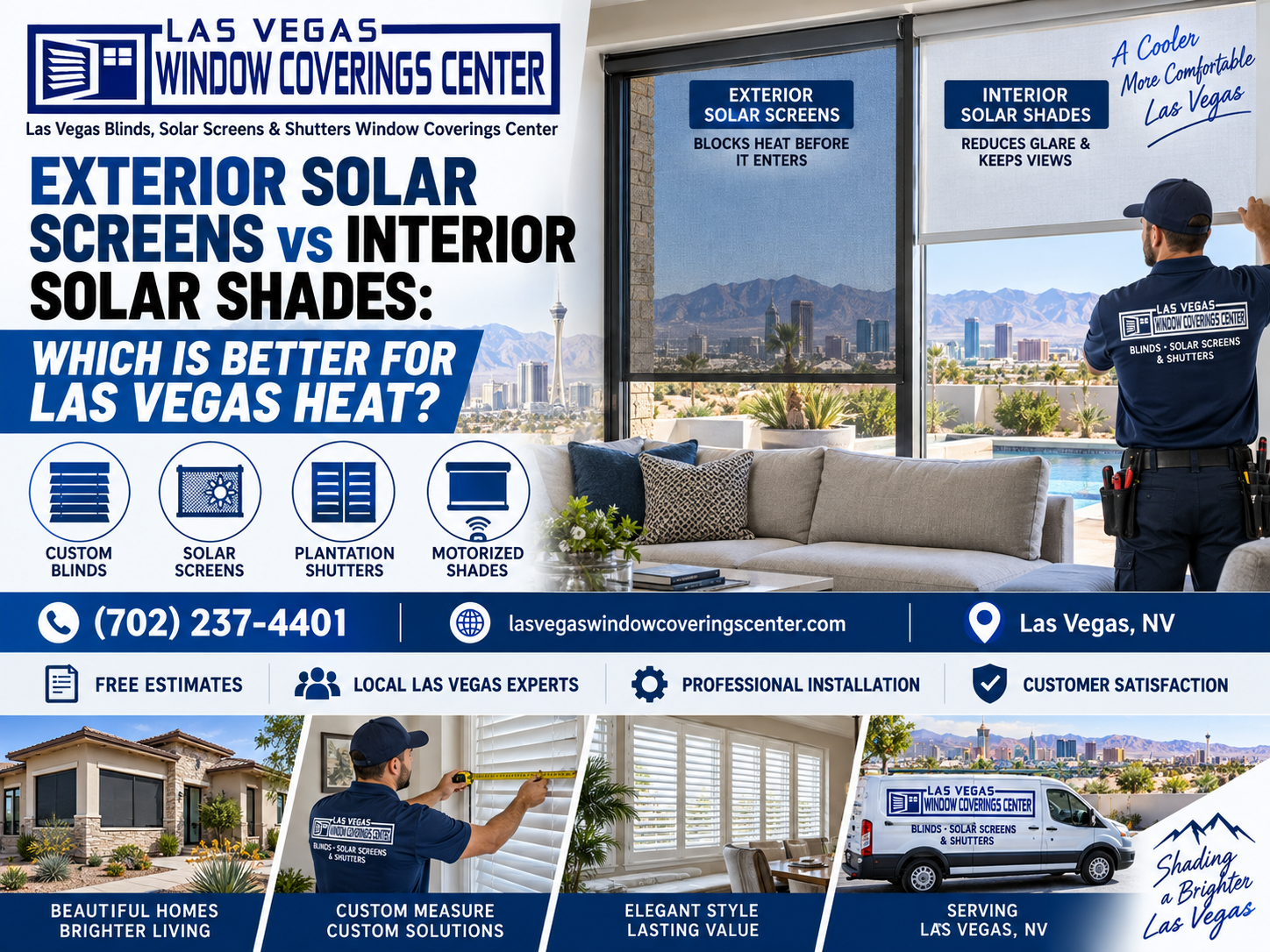
Exterior solar screens vs interior solar shades comparison for reducing Las Vegas window heat
Solar Heat Control • Las Vegas Window Guide

Exterior Solar Screens vs Interior Solar Shades: Which Is Better for Las Vegas Heat?

Exterior solar screens and interior solar shades both reduce the impact of intense sunlight, but they work on opposite sides of the glass. This Las Vegas guide compares heat control, glare, view, privacy, maintenance, exterior appearance, west-facing windows and everyday operation so homeowners can choose the right solar-control strategy for the actual window.

Las Vegas Blinds, Solar Screens & Shutters Window Coverings Center 3871 S Valley View Blvd #6, Las Vegas, NV 89103
Exterior Solar Screens Interior Solar Shades Professional Measurement Las Vegas Valley Service

Are Exterior Solar Screens or Interior Solar Shades Better for Las Vegas Heat?

Short answer: when the main goal is stopping intense Las Vegas sunlight before it reaches the window glass, exterior solar screens generally have the physical advantage because the shading layer is outside the glazing. U.S. Department of Energy guidance for cooling-dominated climates identifies exterior shading as the preferred location for blocking unwanted sun before it strikes a window.

Interior solar shades have different advantages. They are operated from inside, offer flexible control over glare and daylight, preserve varying degrees of outdoor view and do not change the exterior of the home in the same way a screen mounted outside the glass may.

For a severe west-facing Las Vegas window where reducing solar heat is the first priority, start by comparing exterior solar screens. For a living room, home office or large view window where glare control, appearance and easy daily adjustment matter more, interior solar shades may be the better fit.

The final choice depends on the exact screen or shade fabric, glass, window orientation, view, privacy needs, maintenance preferences, exterior appearance and any applicable community requirements.

Why Exterior vs Interior Solar Control Matters in Las Vegas

Window heat in Southern Nevada is not only about the outdoor air temperature. A large pane of glass exposed to direct desert sun can receive intense solar radiation for hours, especially on west- and southwest-facing elevations.

That creates an important design question: should the sunlight be intercepted before it reaches the glass, or should it be filtered after it passes through the glass?

Exterior solar screens and interior solar shades represent those two approaches.

The U.S. Department of Energy's energy-efficient window performance guidance explains that in cooling-dominated regions the best location for shading is outside the window, before the sun strikes the glazing. It specifically lists solar screens among effective exterior shading methods.

DOE also notes that both exterior sunscreens and interior blinds or shades can reduce undesirable solar heat gain. That distinction is useful: interior treatments still matter, but exterior and interior products should not be expected to behave identically.

The key decision: exterior solar screens prioritize stopping more of the solar load on the outside of the window system, while interior solar shades prioritize flexible indoor control of glare, daylight and view-through.

Homeowners who are also considering other interior products can review the previous comparison of cellular shades vs solar shades for Las Vegas homes to understand how insulation, privacy and view-through change between interior shade categories.

What Is the Main Difference Between Exterior Solar Screens and Interior Solar Shades?

The main difference is where the solar-control material sits relative to the window glass.

An exterior solar screen is positioned on the outside of the window. Depending on the system, it may be installed in a screen frame or another exterior configuration. The screen material intercepts part of the sun before that solar energy reaches the glazing.

An interior solar shade is mounted inside the room. Sunlight first reaches and passes through the window glass, then meets the woven solar fabric. The shade reduces glare and visible brightness while allowing varying amounts of view-through according to fabric openness and color.

Exterior Solar Screen

Outside-the-Glass Solar Control

Best compared when reducing direct solar exposure at the window is the leading objective and an exterior-mounted treatment is acceptable.

Interior Solar Shade

Inside-the-Room Glare Control

Best compared when easy operation, interior appearance, adjustable glare control and maintaining an outdoor view are leading priorities.
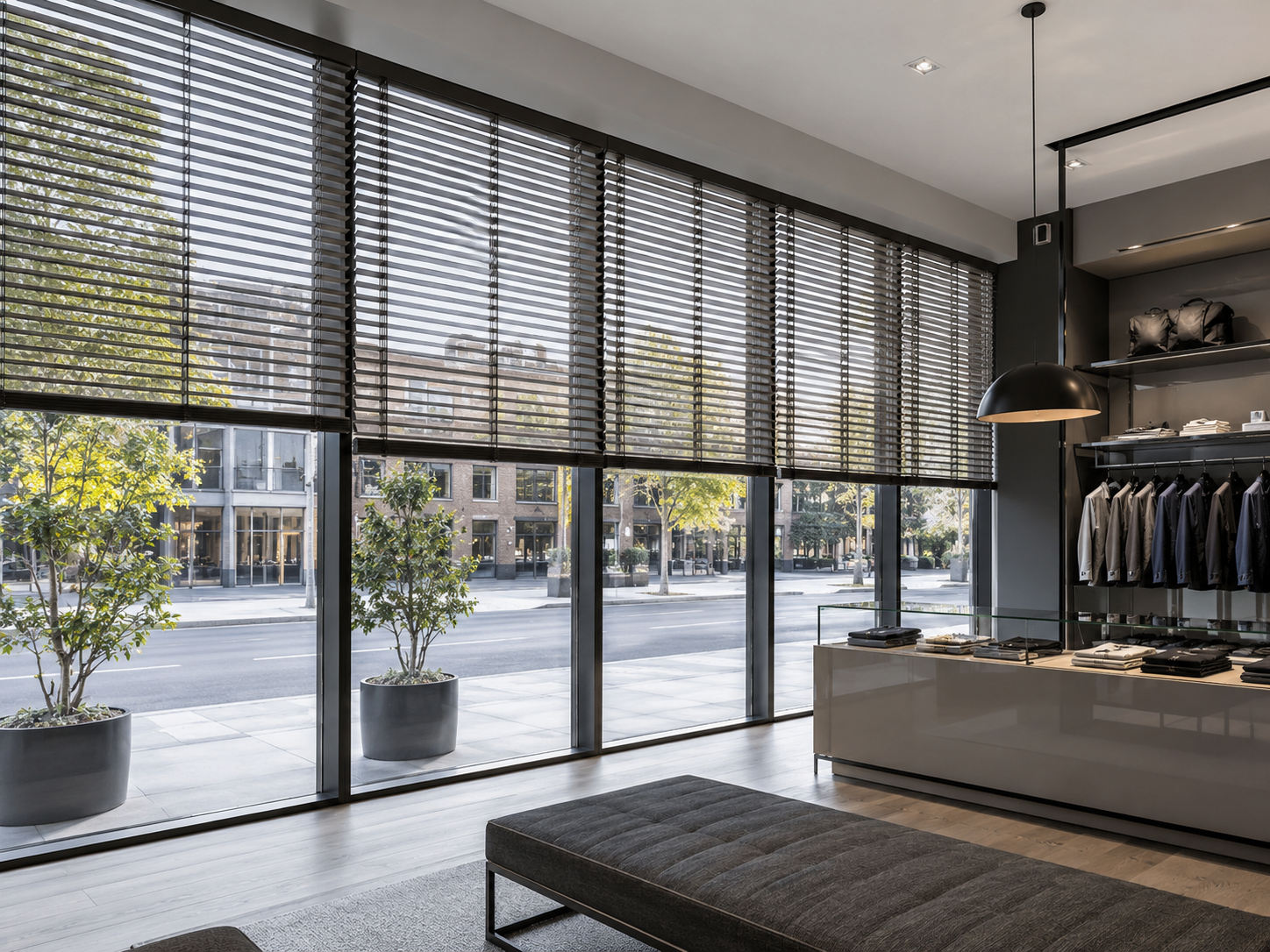
Exterior Solar Screens vs Interior Solar Shades for Las Vegas

This table compares the practical decision factors rather than assuming one product is universally better. Exact results depend on the actual fabric, glazing, installation and exposure.

Decision Factor Exterior Solar Screens Interior Solar Shades Typical Advantage
Solar Heat Control Intercepts sunlight outside the glazing before it reaches the window. Filters sunlight after it has passed through the window glass. Exterior screen for pure solar interception
Glare Control Can substantially reduce exterior brightness before light reaches the room. Designed to give occupants adjustable control over glare from inside. Both; interior shade offers easier adjustment
Outdoor View Depends on screen weave, density and color; screen remains in the exterior sight line. Openness factor can be selected to balance glare and view-through. Depends on desired fabric and operation
Daytime Privacy Some exterior solar screens can increase daytime privacy, depending on material and lighting. Daytime privacy varies by openness, color and interior/exterior lighting. Product-specific
Nighttime Privacy Should not be assumed from daytime performance. Open solar fabric may become easier to see through when interior lights are on. Neither should be assumed to provide complete night privacy
Exterior Appearance Changes the look of the window from outside. Installed indoors and generally has less effect on exterior appearance. Interior solar shade
HOA / Community Considerations Exterior-facing changes may be subject to community requirements. Usually less visible from outside, although fabric color may still be seen through glass. Interior shade for fewer exterior-change concerns
Maintenance Exposed to exterior dust, weather and outdoor debris. Protected indoors but still requires routine fabric dusting. Interior shade for easier access
Window Cleaning Access Screen configuration can affect access to exterior glass. Does not cover the exterior surface of the glass. Interior shade
Insect Screening Certain solar-screen products are also designed as insect screening. Interior solar shades are not insect screens. Exterior solar screen when product is designed for both
Motorization Depends on whether the exterior system is fixed or operable. Many interior roller-style solar shade systems can be motorized. Interior shade for typical indoor automation
Best General Use Severe exterior solar exposure and heat-control-first applications. Glare, daylight, view control and convenient indoor operation. Depends on the problem

Which Controls Solar Heat Better in Las Vegas?

For solar interception alone, exterior shading has the stronger physical position because it acts before sunlight reaches the glass. This is why exterior solar screens are often worth comparing first for very hot, sun-exposed windows.

DOE guidance for cooling-dominated climates states that the preferred place to shade a window is on the outside before sunlight strikes it. The same guidance identifies solar screens as one of the exterior strategies that can be used.

Manufacturer documentation also illustrates the mechanism. Phifer describes its SunScreen solar-screen fabric as an exterior product designed to absorb and dissipate solar heat and glare before that energy reaches the window.

That does not mean every exterior screen provides the same performance. Solar screen materials vary substantially in weave, openness, color, composition and intended application.

What happens with an interior solar shade?

An interior solar shade can still reduce unwanted solar impact in the room, particularly glare and visible brightness. But sunlight has already encountered the window glass before it reaches the shade.

Interior shades remain highly useful because homeowners can adjust them easily, select different openness factors, raise them when solar exposure is low and choose an appearance that coordinates with the room.

For a Las Vegas heat-control-first project: compare exterior solar screens before assuming an interior shade alone is the strongest solar-interception strategy. For a glare-and-view-first project, interior solar shades may be the more practical everyday solution.

How Do Exterior Solar Screens Work?

Exterior solar screens use woven mesh positioned on the outdoor side of the glazing. The material filters a portion of incoming solar radiation before it reaches the window surface.

Because the product sits outside, its design must account for conditions that an interior shade does not normally face: exterior heat, wind, dust, outdoor debris, rain exposure and repeated weathering.

The exact screen material matters. Some products are intended as sun-control screening, some combine solar control with insect-screening functions, and others are engineered for exterior roller-shade applications.

For example, Phifer SunScreen exterior solar-screen documentation describes a woven vinyl-coated fiberglass screen designed to reduce solar heat and glare before it reaches the window while also serving as insect screening.

Solar screen fabric should be matched to the actual application

A screen designed for a standard window-frame application should not automatically be assumed to have the same characteristics as an exterior roller-shade fabric or another specialty sun-control product.

Ask which exact material is being quoted and review the manufacturer's technical information rather than buying based only on a density number or a generic phrase such as “solar screen.”

How Do Interior Solar Shades Work?

Interior solar shades are roller-style shades made from woven solar fabric. Unlike opaque roller shades, the weave contains small open spaces that allow varying amounts of daylight and outward visibility.

The openness factor describes how open or closed that weave is. A lower openness generally means a tighter fabric with stronger filtering and less view-through. A higher openness generally provides more view and daylight but less filtering.

Hunter Douglas' solar shade openness guide explains this relationship and also notes that fabric color changes the way a solar shade handles glare, reflected light and outward view.

Why homeowners like interior solar shades

The product is located where it is easy to reach and operate. Homeowners can lower it during the hours when direct sunlight hits the window and raise it when the exposure changes.

Interior solar shades also integrate visually with indoor furnishings, trim and wall colors. They can be specified with different roller details, cassettes and control methods depending on the product system.

The main tradeoff is that the solar-control layer is behind the glass rather than in front of it.

Interior solar shades on large Las Vegas windows for glare control and filtered daylight

Interior solar shades are particularly useful where occupants want to manage glare and daylight without completely removing the visual connection to the outdoors.

Which Is Better for West-Facing Las Vegas Windows?

West-facing windows are one of the strongest use cases for carefully comparing exterior and interior solar control.

The afternoon sun arrives at a relatively low angle, making west-facing glass difficult to protect with a simple roof overhang. DOE building guidance specifically identifies east- and west-facing glass as challenging from a solar-heat-gain standpoint.

Choose an exterior solar screen first when:

  • The window receives intense afternoon sun for several hours.
  • Reducing solar exposure at the glass is the leading objective.
  • An exterior screen is acceptable from an architectural standpoint.
  • The homeowner is willing to maintain an exterior-mounted product.
  • Current HOA or community requirements permit the planned exterior appearance.

Choose an interior solar shade first when:

  • Glare control is the main complaint.
  • Preserving an outdoor view is highly important.
  • The homeowner wants to raise and lower the shade throughout the day.
  • Interior appearance is a major design consideration.
  • Changing the exterior appearance is undesirable.

What if the room has severe heat and severe glare?

The answer does not have to be one product only. An exterior solar screen can address exterior solar exposure while an interior treatment manages privacy, décor or additional light control.

Whether using multiple treatments makes sense depends on the window, budget, glass, desired appearance and how much flexibility the room needs.

Which Is Better for Glare and Daylight Control?

Both products can reduce harsh sunlight, but interior solar shades often provide the more flexible glare-control experience because the occupant can adjust the shade directly from inside the room.

This is especially important in home offices, living rooms, media areas and commercial spaces where glare changes as the sun moves.

A home-office user may want the solar shade down between 2:00 and 5:00 p.m. but fully open in the morning. An interior roller shade makes that type of operation simple.

A fixed exterior solar screen provides more continuous solar filtering. That can be useful for a window that is consistently problematic but offers less day-to-day variability unless the exterior product itself is operable.

Daylight is not the same as heat gain

A homeowner may want plenty of useful daylight without the visual discomfort of direct sun. Interior solar shades allow the fabric openness to become part of that balance.

This is one reason solar shades are commonly used on windows where people still want the room to feel bright while reducing direct glare.

Which Preserves the Outdoor View Better?

Both exterior screens and interior solar shades can preserve outward visibility, but the viewing experience is different.

With an exterior screen, the mesh remains between the viewer and the outdoors whenever that screen is installed in front of the glass. The amount of visible texture depends on the screen material, color and weave.

With an interior roller-style solar shade, the homeowner may have the option to raise the shade completely when no solar control is needed. When lowered, the openness factor determines how much of the exterior scene remains visible.

Darker solar fabrics and view-through

Manufacturer guidance commonly notes that darker interior solar-shade fabrics can provide clearer outward visual contrast than lighter fabrics, while lighter materials can reflect more solar energy.

That creates another tradeoff: shade color should be selected as part of the solar-control strategy rather than only as an interior-decor decision.

For a Las Vegas view window: compare actual screen and shade samples while looking through the real window. Small swatches can appear very different once stretched across several feet of glass.

Which Provides Better Privacy?

Neither exterior solar screens nor open-weave interior solar shades should automatically be treated as complete privacy products.

During daylight hours, solar-control mesh can improve privacy because the outdoor side of the window may be brighter than the interior. Some exterior solar-screen manufacturers specifically describe increased daytime privacy as a product characteristic.

Interior solar shades can behave similarly. During a bright day, occupants may see outside while the interior is less visible from the exterior.

Night changes the equation

Once it is dark outside and lights are turned on indoors, the lighting relationship reverses. Open solar fabric can become significantly easier to see through from the exterior.

Hunter Douglas' solar-shade guidance explicitly warns that daytime privacy does not automatically continue at night when indoor lights are brighter than the exterior.

Bedrooms, bathrooms and other privacy-sensitive rooms may therefore require a second opaque treatment rather than relying on solar mesh alone.

What Solar Screen Density Is Best for Las Vegas?

There is no universal density or fabric specification that is best for every Las Vegas window.

Exterior solar-screen products vary in how much solar radiation, visible light and air they allow through. The exact weave also changes outward visibility and how dark the window appears from the exterior.

Phifer, for example, offers multiple exterior sun-control fabrics with different published characteristics rather than treating all solar screening as one material.

Its exterior sun-control product information lists different screening families for varying degrees of solar control, outward visibility and exterior applications.

Do not choose from the marketing number alone

A denser screen may provide stronger solar filtering but can also darken the view, alter exterior appearance and reduce the amount of natural light entering the room.

Compare screen samples at the actual window and review the manufacturer's specifications for the exact product being proposed.

What Interior Solar Shade Openness Is Best for Las Vegas?

Interior solar-shade openness is the percentage relationship between the woven material and the small open spaces within the fabric.

Lower openness means a tighter weave. Higher openness means a more open weave.

Tighter Fabric

More Filtering

Useful when glare control and daytime privacy are higher priorities than maximum outward visibility.

Midrange Fabric

Balanced View

Useful when the room needs meaningful solar filtering while still maintaining a noticeable connection to the outside.

More Open Fabric

Stronger View-Through

Useful when preserving daylight and the outdoor view matters more than maximum filtering.

Openness should not be interpreted as a universal heat-blocking percentage. The exact fabric, color, glass and window orientation also influence how the shade performs.

Which Is Easier to Maintain in Las Vegas: Solar Screens or Solar Shades?

Interior solar shades usually have an access advantage because they remain protected inside the conditioned space.

They still collect household dust, but cleaning can generally be performed from inside without removing an exterior screen or accessing the outside of the building.

Exterior solar screens live in a more demanding environment. They may accumulate desert dust, windblown debris and outdoor dirt. Their frames, attachment points and mesh should be checked and cleaned according to the exact product and installation.

Desert dust matters

A dark exterior solar screen may make dust more noticeable over time. If outward visibility is important, accumulated dirt can also affect the visual experience through the mesh.

Ask how the screen can be removed or accessed for cleaning before installation, particularly on windows that are difficult to reach from outside.

Do not use one cleaning method for every material

Exterior solar-screen mesh and interior solar-shade fabric may have different coatings and material constructions. Follow manufacturer care guidance rather than assuming the same detergent, pressure or cleaning technique is appropriate for both.

Exterior Appearance and HOA Considerations

Exterior solar screens change the appearance of the window from outside. That can be a meaningful issue in Las Vegas master-planned communities, condominium associations and neighborhoods with architectural standards.

Screen color, frame color, consistency between windows and visibility from the street may all matter.

Homeowners should confirm current community requirements before ordering exterior-facing changes. Rules can vary by association and may change over time.

No exterior solar-screen product should be described as universally “HOA approved.”

Interior solar shades are less exterior-dependent

An interior solar shade does not add a screen frame to the exterior of the window. However, the shade's backing or fabric color can still be visible through the glass from outside.

For properties where exterior uniformity matters, that difference may make an interior solar shade easier to integrate.

How Do Solar Screens Affect Window Access and Operation?

This question is easy to overlook when a homeowner focuses only on heat. An exterior screen becomes part of the physical window assembly, so the way it is installed can affect cleaning access and use of the opening.

Before ordering, determine whether the window opens, how the screen frame is removed, whether exterior glass can still be cleaned conveniently, and whether handles, locks or other operating components remain accessible.

A fixed window and an operable casement, sliding or double-hung window may require different approaches.

Interior solar shades create their own clearance questions. The roller, fabric path and bottom rail need space around window cranks, handles, trim and sill projections.

Professional measurement should include more than glass size. Measure the actual opening, mounting surface, frame depth, hardware, trim and operating path before choosing the product.

Can Exterior Solar Screens and Interior Window Treatments Be Used Together?

Yes. Exterior solar control and interior privacy or décor can solve different parts of the window problem.

An exterior screen may be selected primarily to reduce direct solar exposure at the glazing. An interior shade, blind, shutter or drapery may then handle nighttime privacy, room darkening or interior design.

This can be useful in bedrooms or street-facing rooms where solar mesh alone does not provide the desired evening privacy.

Layering should still have a clear purpose. Adding multiple treatments increases cost and visual complexity, so the combination should solve a real performance or privacy requirement.

Layered interior window treatments for privacy and sunlight control in a Las Vegas home

Interior layers can add nighttime privacy or room-darkening control when an exterior solar screen is primarily being used for daytime sun management.

Which Product Is Better for Motorization?

Motorization is most commonly relevant when comparing an operable interior solar shade with a fixed exterior screen.

Many interior roller-style shade systems can be paired with motorized controls, allowing homeowners to raise or lower the fabric without manually operating each window.

This can be useful on tall windows, large openings and windows that receive predictable afternoon sun.

Exterior solar control can also be operable in certain systems, but a conventional framed solar screen is different from a motorized exterior roller shade. Do not assume these products use the same hardware or installation method.

Verify the actual control system

Motorized products vary by manufacturer. Battery, rechargeable, plug-in or hardwired configurations may exist depending on the system. App or smart-home compatibility should be verified for the exact motor rather than assumed.

Any hardwired electrical work should follow the manufacturer's requirements and applicable electrical standards.

Which Product Fits Different Las Vegas Window Problems?

West-Facing Bedroom

Exterior Screen + Privacy Layer

Consider exterior solar control for strong afternoon exposure, then use an opaque interior treatment when nighttime privacy or room darkening is required.

Living Room View

Interior Solar Shade

A solar shade can be a strong first comparison when glare must be reduced without permanently changing the view or exterior window.

Home Office

Interior Solar Shade

Easy adjustment and selectable openness make interior solar shades useful for controlling computer-screen glare during specific hours.

Severe Sun Exposure

Exterior Solar Screen

When intercepting strong solar radiation before it reaches the window is the first priority, exterior shading deserves comparison.

HOA-Sensitive Exterior

Interior Solar Shade

An interior shade may be simpler when the homeowner prefers not to alter the visible exterior window treatment.

Insect + Sun Control

Product-Specific Solar Screen

Certain exterior solar-screen materials combine solar control and insect-screening functions. Confirm that the exact screen is designed for both.

Exterior Solar Screen vs Interior Solar Shade Cost Factors

A useful comparison should not assume one product category is always less expensive than the other.

Final pricing depends on the actual window dimensions, materials, hardware, number of openings, installation conditions and optional controls.

Exterior solar-screen pricing can be influenced by:

  • Screen fabric or mesh type
  • Frame material and finish
  • Window width and height
  • Number of screens
  • Removal or access requirements
  • Second-story or difficult exterior access
  • Custom frame conditions
  • Exterior operability when applicable

Interior solar-shade pricing can be influenced by:

  • Fabric collection and openness
  • Shade width and height
  • Roller and headrail configuration
  • Decorative cassette or fascia options
  • Manual versus motorized control
  • Number of windows
  • Large-window hardware requirements
  • Installation access

Ask for a written estimate that identifies the actual product and scope rather than relying on a broad price-per-window statement.

Quick Decision Guide: Solar Screen or Solar Shade?

Heat First

Start With Exterior Solar Screens

Best first comparison when direct solar exposure at the glass is the primary problem.

Glare First

Start With Interior Solar Shades

Best first comparison when the homeowner wants adjustable glare control from inside the room.

View First

Compare Solar Shade Openness

A retractable interior shade can be raised fully and can provide selectable view-through when lowered.

Exterior Appearance

Start With Interior Solar Shades

Useful when the homeowner wants solar control without installing a visible exterior screen.

Strong West Sun

Compare Both

Exterior screens may address solar exposure while an interior shade gives additional daylight and glare control.

Night Privacy

Add an Opaque Treatment

Neither open solar mesh nor an open-weave solar shade should be assumed to provide complete nighttime privacy.

When Solar Screens or Solar Shades May Not Be the Best Choice

Not every window problem is primarily a solar-screen problem. Homeowners who care more about adjustable privacy, directional light control or a built-in architectural appearance may prefer another window treatment.

Plantation shutters, for example, use adjustable louvers rather than open solar fabric. They do not preserve the same through-the-fabric view as solar shades, and they are not exterior solar screens, but they can be useful when privacy and controlled daylight are the main objectives.

Bedrooms may also require blackout or room-darkening treatments. Cellular shades may be more appropriate when insulation is more important than daytime view-through.

Plantation shutters as an alternative interior window treatment for Las Vegas privacy and light control

Plantation shutters solve privacy and directional light-control problems differently from solar screens and solar shades.

Questions to Ask Before Buying Exterior Solar Screens or Interior Solar Shades

Is my main problem solar heat at the window, glare inside the room, privacy, or a combination?
Which direction does the window face?
How many hours of direct sun reach this window?
Do I want the solar-control layer outside the glass or inside the room?
What exact exterior solar-screen material is being quoted?
What published manufacturer specifications are available for that screen?
If choosing an interior solar shade, what is the fabric openness factor?
How does the shade color affect glare, reflection and outward view?
How much outdoor view should I expect with the product installed?
What daytime privacy should I expect?
What happens to privacy after dark?
Can the exterior screen be removed for glass cleaning or window service?
Will the product interfere with window handles, locks or operation?
Does my HOA or community have current rules affecting exterior screens?
What exterior screen-frame colors or finishes are available?
Is the interior solar shade manually operated or motorized?
What are the product's maximum width and height limits?
Does the written estimate include professional measurement and installation?
Does the quote identify removal, access or second-story work if applicable?
Are there alternate window coverings I should compare before ordering?

Red Flags When Comparing Solar Screens and Solar Shades

Be cautious when a recommendation is made without evaluating the actual glass, exposure and desired result.

  • One product is claimed to be automatically best for every Las Vegas window.
  • Exact energy-savings percentages are promised without documentation for the specific product and building conditions.
  • Unsupported heat-blocking or UV-blocking percentages are used.
  • The seller does not identify the actual solar-screen fabric.
  • The seller does not identify the interior solar-shade openness factor.
  • A solar shade is described as a blackout shade simply because it has a tight weave.
  • Daytime privacy is presented as guaranteed nighttime privacy.
  • An exterior solar screen is called universally HOA approved.
  • Window orientation is never discussed.
  • The recommendation is made without measuring the window.
  • Exterior glass-cleaning access is not discussed.
  • The screen is installed without considering window operation or hardware.
  • Large-window product limits are not reviewed.
  • Smart-home compatibility is promised without identifying the exact motor system.
  • The quote does not clearly state what product, hardware and installation are included.

Why Las Vegas Conditions Make Exterior vs Interior Solar Control Important

Las Vegas sits in a cooling-dominated desert environment where strong sun and large areas of glass can create demanding window conditions. The difference between exterior and interior shading becomes particularly relevant on windows with prolonged afternoon exposure.

Summerlin and the west Las Vegas Valley

Homes in Summerlin, The Ridges, Red Rock Country Club, Queensridge and nearby west-valley communities can have windows facing intense afternoon sun. Exterior solar screens may be especially worth comparing where reducing direct solar exposure at the window is the first priority.

Henderson and hillside properties

Homes in Henderson, Seven Hills, Anthem and MacDonald Highlands may combine substantial sun exposure with valuable valley or Strip views. Interior solar shades can be attractive when the owner wants glare control while preserving those views.

Large contemporary glass

Modern homes, condos and high-rise residences may use broad panes of glass as an architectural feature. In these spaces, automatically covering every window with dense exterior mesh may not provide the desired visual result.

The homeowner may instead choose different solutions by orientation: stronger exterior solar control on severe exposures and adjustable interior shades where preserving the view is more important.

Desert dust and exterior maintenance

Southern Nevada dust is another practical factor. Exterior screens require a cleaning strategy, especially on upper-story windows or difficult elevations.

HOA-sensitive communities

Master-planned communities may have standards governing exterior-facing changes. Homeowners in Summerlin, Southern Highlands, Mountain's Edge, Green Valley, Anthem or other governed communities should check current requirements before ordering exterior solar screens.

Interior solar shades may avoid many exterior-appearance concerns, although any fabric visible through the glass should still coordinate appropriately with the home.

Compare Exterior Solar Screens and Interior Solar Shades in Las Vegas

Las Vegas Blinds, Solar Screens & Shutters Window Coverings Center is a local Las Vegas window covering business where homeowners can compare exterior and interior solar-control approaches based on the actual window rather than choosing from a generic online description.

A useful consultation can evaluate window orientation, direct-sun timing, glass size, desired view, daytime and nighttime privacy, exterior appearance, screen access, interior shade openness and whether an adjustable or motorized interior treatment would be useful.

The goal is to identify the actual window problem first. A homeowner with severe west-facing solar exposure may need a different solution from a homeowner whose main concern is afternoon computer glare.

Las Vegas Blinds, Solar Screens & Shutters Window Coverings Center
3871 S Valley View Blvd #6
Las Vegas, NV 89103

Phone: (702) 237-4401
Website: lasvegaswindowcoveringscenter.com
Google: Las Vegas Blinds, Solar Screens & Shutters Window Coverings Center on Google Maps

Solar Screen & Solar Shade Service Areas

Las Vegas Blinds, Solar Screens & Shutters Window Coverings Center serves customers throughout the Las Vegas Valley. The communities below describe service coverage and do not imply a separate showroom or business location in each area.

Las Vegas
Summerlin
Henderson
North Las Vegas
Spring Valley
Enterprise
Southern Highlands
Mountain's Edge
Green Valley
Anthem
Seven Hills
Paradise
Centennial Hills
Skye Canyon
Spanish Trail
The Ridges
Red Rock Country Club
MacDonald Highlands
Sun City Summerlin
Queensridge

Visit Our Las Vegas Window Covering Showroom

Visit Las Vegas Blinds, Solar Screens & Shutters Window Coverings Center at 3871 S Valley View Blvd #6, Las Vegas, NV 89103 to discuss solar screens, interior solar shades and other window-covering options for Las Vegas heat and glare.

Exterior Solar Screens vs Interior Solar Shades FAQs

Are exterior solar screens better than interior solar shades for Las Vegas heat?

Exterior solar screens generally have the stronger position for intercepting direct solar radiation because they shade the window before sunlight reaches the glass. Interior solar shades can still reduce glare and unwanted solar effects indoors, but they operate after sunlight has reached the glazing. The best choice depends on the exact screen or shade, glass, orientation, view and desired exterior appearance.

Are solar screens good for west-facing Las Vegas windows?

West-facing windows are a strong application to evaluate for exterior solar screens because they can receive intense low-angle afternoon sun. Exterior shading can reduce direct solar exposure before it reaches the glass. Homeowners should still compare screen density, outward view, exterior appearance, window access and any applicable HOA or community rules before ordering.

Do interior solar shades reduce heat?

Interior solar shades can reduce unwanted solar effects and are useful for controlling glare and visible brightness. However, the solar-control material sits behind the window glass. If stopping solar radiation before it reaches the glazing is the main objective, exterior shading is generally the stronger strategy. Exact results vary by glass, fabric, color, openness and installation.

Can you see through exterior solar screens?

Many exterior solar-screen materials preserve some outward visibility, but the amount depends on weave, screen density, material and color. A stronger solar-control screen may also make the view darker or more textured. Homeowners should compare actual samples at the window instead of relying only on product photos or a generic percentage.

Can people see through solar shades at night?

They may be able to. Interior solar shades use open woven fabric, so privacy changes with lighting conditions. During daylight, the brighter exterior can make the interior less visible. At night, interior lighting can reverse that effect. Bedrooms and other privacy-sensitive rooms may need an opaque secondary window treatment.

Do exterior solar screens need HOA approval in Las Vegas?

Requirements vary by community and association. Because solar screens change the exterior appearance of a window, homeowners should review current HOA or architectural rules before ordering. No solar-screen product should be assumed to be universally approved across Summerlin, Henderson or other Las Vegas Valley communities.

Are interior solar shades easier to maintain than exterior solar screens?

Interior solar shades generally have easier access because they remain inside the home. Exterior solar screens are exposed to desert dust and outdoor conditions and may need periodic cleaning or removal for window access. Maintenance requirements depend on the exact screen fabric, frame, shade fabric and installation.

Where can I compare solar screens vs solar shades in Las Vegas?

Contact Las Vegas Blinds, Solar Screens & Shutters Window Coverings Center at (702) 237-4401 or visit 3871 S Valley View Blvd #6, Las Vegas, NV 89103 to compare exterior solar screens and interior solar shades based on heat, glare, privacy, view, window orientation and exterior appearance.

Technical & Authority References

Solar Screen, Solar Shade & Window Heat Authority Sources

Exterior and interior sun-control performance varies according to product construction, glazing, orientation and installation. These sources provide technical context for the concepts discussed in this guide.

U.S. Department of Energy — Exterior Shading in Cooling-Dominated Climates

DOE window-design guidance explains that in cooling-dominated conditions the preferred location for shading is outside, before sunlight strikes the window, and identifies solar screens as an exterior shading strategy.

Read DOE guidance on energy-efficient window performance and shading →

U.S. Department of Energy — Solar Heat Gain & Window Coverings

DOE's federal window purchasing guidance discusses solar heat gain and notes that exterior sunscreens and interior blinds or shades can both be used to reduce undesirable solar heat gain.

Review DOE window and solar-heat-gain guidance →

Phifer — Exterior Sun Control Fabrics

Phifer publishes technical and application information for multiple exterior solar-screen and sun-control fabrics, demonstrating why solar screens should be evaluated by exact product rather than a generic screen category.

Review Phifer exterior sun-control products →

Phifer — SunScreen Solar Screen Fabric

Phifer describes SunScreen as an exterior woven solar-screen material designed to reduce solar heat and glare before it reaches the window. Performance figures on that page apply to that specific product and should not be generalized to every solar screen.

Review Phifer SunScreen technical information →

Hunter Douglas — Interior Solar Shade Openness

Hunter Douglas explains how solar-shade openness and fabric color affect sunlight filtering, glare, view-through and privacy.

Read the Hunter Douglas solar shade guide →

Important: Published performance figures should only be applied to the exact product for which they were tested or documented. Do not assume all exterior solar screens or all interior solar shades provide identical heat, glare, UV, privacy or energy performance.

Related Las Vegas Solar-Control Topics

Compare Exterior and Interior Solar Control Before You Order

Exterior solar screens and interior solar shades can both improve a difficult sunny window, but they solve the problem from different sides of the glass.

If stopping intense sunlight before it reaches the glazing is the first priority, exterior solar screens deserve comparison. If easy adjustment, indoor appearance, glare control and preserving the view are more important, interior solar shades may be the better starting point.

Call Las Vegas Blinds, Solar Screens & Shutters Window Coverings Center at (702) 237-4401 to compare exterior solar screens and interior solar shades in Las Vegas and nearby areas.