
How Do I Choose the Right Window Treatments for Each Room in My Home?
Choose each window treatment by matching the room’s privacy, light, heat, glare, safety, maintenance, and style needs—not by using one product everywhere. Las Vegas Blinds, Solar Screens & Shutters Window Coverings Center helps local homeowners and property professionals compare blinds, shades, shutters, solar screens, blackout options, motorized treatments, and outdoor screens for different rooms and window conditions.
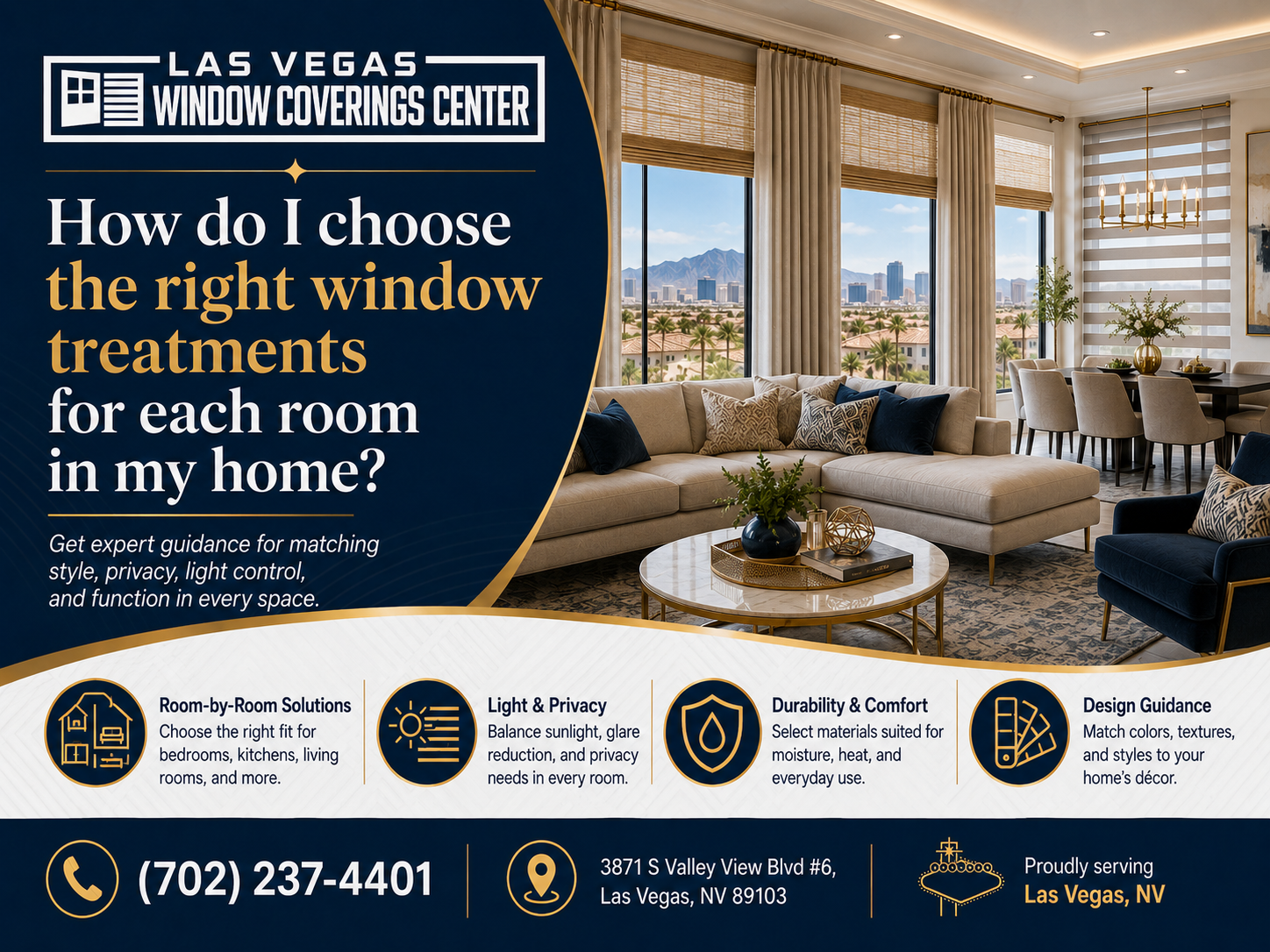
How do you choose the right window treatments for each room?
Start with how the room is used. Bedrooms usually need stronger privacy and room darkening; living rooms often need flexible daylight and glare control; kitchens and bathrooms benefit from practical, easy-to-clean materials; offices need screen-glare management; and patios may need exterior shade or outdoor screen systems.
Next, evaluate window direction, daytime and nighttime privacy, heat exposure, desired view, maintenance, child or pet safety, operating method, and style. Then compare blinds, roller shades, zebra shades, solar shades, blackout shades, cellular shades, plantation shutters, solar screens, motorized shades, or patio screens based on those needs.
For Las Vegas homes, pay special attention to west-facing windows, intense sunlight, desert heat, glare, UV exposure, nearby streets or neighbors, and HOA-facing appearance. A local showroom visit lets you compare materials, colors, opacity, openness factors, louvers, hardware, and control systems before ordering.
Why one window treatment rarely works perfectly in every room
A whole home can look coordinated without using the exact same product everywhere. Each room has a different job, and every window has its own sun direction, size, height, view, privacy exposure, trim depth, furniture placement, and opening method.
A bedroom facing a street has different needs from a bright family room overlooking a backyard. A kitchen window near a sink requires different maintenance than a formal dining room window. A home office needs comfortable computer visibility, while a media room may need aggressive light control. A patio opening must handle exterior sun, wind, dust, and hardware exposure.
This room-by-room approach is useful for Las Vegas homeowners, contractors, remodelers, landlords, investors, property managers, and business owners. It helps prevent common problems such as choosing a sheer fabric for a room that needs nighttime privacy, ordering dark treatments that make a small room feel closed, or selecting an interior shade when the main concern is intense exterior sun.
How to choose window treatments for each room
- Define the room’s main function. Ask whether the room is used for sleeping, working, cooking, bathing, entertaining, relaxing, watching television, caring for children, or accessing a patio. The main activity determines whether privacy, darkness, glare control, durability, convenience, or view preservation comes first.
- Study the light and heat pattern. Note whether the windows face east, west, north, or south. West-facing rooms often experience stronger afternoon heat and glare in Las Vegas, while east-facing bedrooms may receive early morning light. Observe the room at different times before choosing.
- Separate daytime privacy from nighttime privacy. Solar and sheer materials can provide useful daytime screening while still becoming more transparent after dark when indoor lights are on. Bedrooms, bathrooms, and street-facing rooms may need opaque, blackout, adjustable, or layered treatments.
- Choose the operating method. Compare cordless, wand-operated, continuous-loop, remote-controlled, battery-powered, hardwired, or smart motorized options. Tall, wide, grouped, and hard-to-reach windows may benefit from motorization.
- Confirm the fit, material, and installation scope. Final measurements, mounting depth, trim, handles, door movement, furniture clearance, hardware, removal of old treatments, electrical needs, delivery, and installation should be clearly documented.
Best window treatment choices for each room in a Las Vegas home
Living room
Priorities: flexible daylight, glare control, view, style, and guest privacy.
Roller shades, zebra shades, solar shades, plantation shutters, custom blinds, or motorized shades can all work. Solar shades are useful when preserving a daytime view matters, while zebra shades provide adjustable sheer and solid bands. Shutters or blinds offer adjustable slats or louvers. Consider motorization for grouped or hard-to-reach windows.
Primary bedroom
Priorities: privacy, darkness, sleep comfort, and quiet operation.
Blackout roller shades, cellular shades, plantation shutters, Roman shades with privacy lining, or layered treatments are worth comparing. Ask about edge-light gaps, outside mounting, side channels, and whether the fabric is room-darkening or true blackout. A privacy layer can be paired with decorative drapery or another treatment when needed.
Children’s room or nursery
Priorities: cordless safety, darkness, simple operation, and durability.
Cordless blackout shades, cellular shades, shutters, or suitable motorized shades can help. Avoid unnecessary accessible cords and discuss safe control placement. Choose materials that are easy to maintain and controls that adults can use without complicated steps.
Kitchen
Priorities: cleaning, moisture awareness, light control, and clearance.
Faux wood blinds, roller shades, solar shades, shutters, or other wipeable materials may suit many kitchens. Consider the distance from sinks, cooktops, steam, splashes, and food preparation areas. Confirm that the treatment will not interfere with faucets, cabinet doors, or window handles.
Bathroom
Priorities: strong privacy, moisture-aware material, and easy cleaning.
Faux wood blinds, selected shutters, privacy roller shades, or suitable cellular products may work, depending on ventilation and direct moisture exposure. Do not assume light filtering equals nighttime privacy. Ask how the exact material behaves when bathroom lights are on.
Dining room
Priorities: appearance, evening privacy, controlled daylight, and ambiance.
Roman shades, roller shades, shutters, zebra shades, wood blinds, or layered treatments can suit a dining room. Choose a style that coordinates with nearby living spaces while providing enough coverage for evening meals and entertaining.
Home office
Priorities: computer glare, daylight, camera background, privacy, and comfort.
Solar shades, adjustable blinds, zebra shades, cellular shades, or motorized roller shades can help manage changing light. Position the treatment around monitor direction and video-call needs. Solar fabric may preserve daytime visibility, but additional nighttime privacy may be necessary.
Media room
Priorities: strong darkness, reflection control, and easy full-room operation.
Blackout shades, lined Roman shades, cellular blackout shades, or layered systems are practical options. Side channels or outside mounting can reduce edge light. Motorization may help coordinate several windows before watching television or using a projector.
Laundry or utility room
Priorities: privacy, simplicity, cleaning, and compact hardware.
Faux wood blinds, simple roller shades, or other practical treatments can provide coverage without taking visual attention from the room. Check clearance around shelves, machines, doors, and ventilation.
Sliding glass doors
Priorities: access, stack direction, durability, width, and traffic flow.
Vertical blinds, panel-style systems, wide roller shades, split shades, or coordinated motorized treatments may fit. Confirm how the treatment stacks, whether it clears the handle, and how often people or pets use the door.
Entry and street-facing windows
Priorities: privacy, curb-facing appearance, and adjustable visibility.
Shutters, blinds, privacy roller shades, cellular shades, or layered products can provide flexible coverage. Consider exterior-facing color requirements and whether the window is visible from an HOA street, sidewalk, shared courtyard, or neighboring property.
Patio and outdoor living area
Priorities: sun, glare, privacy, wind, dust, airflow, and outdoor durability.
Patio screens, Templar screens, exterior solar screens, or motorized outdoor screens may make a covered area more usable. Discuss opening size, mounting structure, wind exposure, track care, cleaning, and community restrictions before choosing.
Window treatment comparison by room, benefit, and tradeoff
Use this table as a starting point, then compare samples and operating systems in person. The exact fit depends on the window, fabric, material, color, mounting method, and room conditions.
| Window treatment | Rooms it often fits | Main benefits | Possible drawbacks | Choose it when |
|---|---|---|---|---|
| Roller shades | Living rooms, bedrooms, offices, kitchens, media rooms | Clean profile, many fabrics, light-filtering to blackout options, motorization availability | Privacy and darkness depend heavily on fabric and edge gaps | You want a minimal look with a broad range of performance fabrics |
| Zebra roller shades | Living rooms, dining rooms, offices, modern bedrooms | Alternating sheer and solid bands, adjustable daylight, contemporary appearance | Not the same as full blackout; nighttime privacy changes with alignment | You want flexible filtered light with modern styling |
| Solar shades | Living rooms, offices, bright dining areas, view windows | Glare and UV management with some daytime view preservation | Usually limited nighttime privacy when interior lights are on | Daytime view and glare reduction matter more than full darkness |
| Blackout shades | Bedrooms, nurseries, media rooms, shift-worker rooms | Strong room darkening and privacy | Side gaps may remain unless mounting or channels address them | Sleep, media viewing, or darkness is the main priority |
| Cellular or honeycomb shades | Bedrooms, offices, nurseries, sun-exposed rooms | Soft appearance, compact stack, privacy and blackout fabric choices, insulating air pockets | Fabric cells can collect dust and may require careful cleaning | You want a softer treatment with privacy and comfort options |
| Plantation shutters | Living rooms, bedrooms, bathrooms, dining rooms, street-facing windows | Adjustable louvers, durable structure, strong privacy, finished architectural look | Larger visual presence and less completely open glass than some shades | You want structured style and long-term adjustable light control |
| Faux wood blinds | Kitchens, bathrooms, rentals, utility rooms, bedrooms | Practical cleaning, familiar operation, adjustable slats, wood-like appearance | Can stack visibly and may require multiple blinds on very wide windows | You prioritize everyday privacy, durability, and straightforward maintenance |
| Roman shades | Dining rooms, bedrooms, formal living rooms | Soft tailored appearance, fabric variety, lining options | Fabric folds require care; performance depends on lining and construction | You want a decorative fabric treatment with a finished interior look |
| Motorized shades | Large rooms, tall windows, bedrooms, media rooms, offices | Convenient operation, grouping, scheduling, hard-to-reach access | Power, controls, setup, maintenance, and compatibility must be planned | Convenience, accessibility, or coordinated operation matters |
| Exterior solar screens | Sun-heavy exterior windows, especially west- and south-facing elevations | Reduces solar exposure before it reaches the glass; helps with glare and daytime screening | Exterior look, openness, view, access, and HOA rules require review | The main problem is strong exterior sun reaching the glass |
| Patio or Templar screens | Covered patios, outdoor rooms, large exterior openings | Outdoor shade, glare control, privacy, and improved space usability | Wind, dust, mounting, maintenance, hardware, and community rules matter | You want to improve outdoor living comfort and coverage |
Product performance varies. Ask for realistic expectations based on the exact window direction, glass, material, openness, opacity, color, mounting style, and installation.
How to make different room treatments look coordinated
Using different products does not mean the home has to look mismatched. A coordinated plan can repeat colors, headrail styles, valances, hardware finishes, exterior-facing colors, or fabric families while allowing each room to use the treatment that works best.
Keep exterior-facing colors consistent
This can create a more uniform street appearance and may help with community expectations. Confirm current HOA or property guidelines before ordering.
Use one neutral color family
Choose related whites, warm neutrals, grays, wood tones, or frame finishes across rooms while changing product type and opacity.
Repeat visible hardware details
Similar cassettes, valances, rails, control colors, or trim details can visually connect different treatments throughout the home.
Match open-plan spaces more closely
Living, dining, and kitchen areas that share sightlines usually benefit from a tighter visual relationship than rooms separated by doors.
Use layered treatments selectively
Bedrooms, media rooms, and formal spaces may justify a second layer for darkness, privacy, softness, or decoration.
Plan controls as a system
For motorized treatments, ask whether multiple rooms can use compatible remotes, hubs, apps, schedules, or smart-home controls.
Bring a simple floor plan, room photos, approximate measurements, paint colors, flooring samples, and inspiration images to the showroom. This makes it easier to compare products as a whole-home system rather than making isolated decisions one window at a time.
How Las Vegas heat, sunlight, and privacy affect room-by-room choices
West-facing rooms often need stronger sun control
West-facing bedrooms, living rooms, offices, and kitchens can receive difficult afternoon sun. Solar screens, solar shades, cellular shades, shutters, blackout shades, or layered combinations may help, but each option balances view, darkness, exterior appearance, and privacy differently.
Bright desert light changes color perception
White, beige, gray, and wood tones can look different under intense daylight. Compare physical samples near natural light and against the room’s walls, flooring, cabinets, furniture, and trim. A color that appears warm online may look cooler or brighter inside the actual room.
Street and neighbor proximity changes privacy needs
Rooms near sidewalks, shared courtyards, neighboring patios, or close property lines may need stronger nighttime privacy. Evaluate the treatment from both inside and outside with interior lights on whenever possible.
Condos, townhomes, and HOA communities may have appearance rules
Communities in Summerlin, Henderson, Southern Highlands, Anthem, Inspirada, The Lakes, Mountains Edge, Green Valley, and Lake Las Vegas may have exterior-facing color or installation expectations. Review current governing documents or obtain approval before ordering exterior screens or treatments visible from the street.
Rental properties need practical operation and replacement planning
Landlords and property managers may prioritize durable materials, easy cleaning, simple controls, consistent replacement options, and clear tenant instructions. A premium treatment may fit a furnished or higher-end rental, while straightforward blinds or roller shades may fit a turnover-focused property.
Patios require outdoor-specific planning
Exterior and patio screens must account for sun, wind, dust, mounting structure, drainage, track care, cleaning, storage position, and operating limits. Do not treat an indoor shade as interchangeable with an outdoor screen system.
What to compare at a Las Vegas window coverings showroom
Photos are helpful for inspiration, but selecting the right treatment for each room is easier when you can handle materials and see how they filter light. Explore window treatment options for Las Vegas rooms, review the window covering product collection, and compare specific products such as zebra roller shades, cellular shades, and solar screens.
Opacity and openness
Ask to see sheer, light-filtering, privacy, room-darkening, and blackout materials. For solar shades and solar screens, compare openness factors and understand how they affect view, glare, heat exposure, and privacy.
Daytime and nighttime visibility
A material can look private in bright daylight but reveal silhouettes or interiors after dark. Ask for a clear explanation of how each sample behaves under changing light.
Color, texture, and exterior appearance
Compare samples in light similar to your home. Confirm what color is visible from outside, especially for street-facing windows, condos, and HOA communities.
Controls and hardware
Review cordless controls, chains, wands, remotes, motors, power sources, cassettes, valances, rails, frames, side channels, and mounting hardware. Ask how controls will be positioned around furniture, doors, counters, and child-access areas.
Project examples
Browse the window treatment gallery for ideas involving blinds, shades, shutters, solar screens, modern interiors, large windows, bedrooms, living areas, and outdoor spaces.
Questions to ask before choosing window treatments for each room
- What is the main function of this room, and which treatment supports it?
- Do I need blinds, shades, shutters, solar screens, or patio screens?
- How much daytime and nighttime privacy does this room need?
- How does this material handle west-facing or direct Las Vegas sun?
- How much glare and UV reduction should I realistically expect?
- Will this option preserve the view or block it?
- Is the fabric light-filtering, room-darkening, or blackout?
- Can I compare fabric, screen, color, louver, slat, and hardware samples?
- Are cordless, remote-controlled, or smart motorized options available?
- Is the material appropriate near moisture, food, children, pets, or high traffic?
- Can you help with final measurements and installation?
- What should I bring to the showroom for a room-by-room consultation?
- How long does ordering and installation usually take for this product?
- What is included in the written quote?
- Are there current showroom promotions, and what conditions apply?
- What happens if the selected fabric, color, component, or size is unavailable?
- Could my HOA, landlord, or community restrict the exterior-facing appearance?
- How do I clean and maintain the product in a dusty desert environment?
Red flags when planning room-by-room window treatments
A strong window covering proposal should explain why each product fits each room. Slow down when you see any of these warning signs:
- The same product is recommended for every room without discussing room use.
- The quote is vague and does not list window counts, measurements, products, colors, controls, or installation.
- There is no written estimate or no explanation of changes, deposits, cancellation, or warranty terms.
- Materials, opacity, openness factor, hardware, or mounting differences are not explained.
- No physical samples are available to compare.
- Light filtering is presented as the same thing as blackout or nighttime privacy.
- Window direction, west-facing sun, glare, heat, or room temperature are ignored.
- Child-safe or cordless options are not discussed for nurseries or children’s rooms.
- Moisture and cleaning needs are ignored in kitchens and bathrooms.
- Sliding-door access, handles, furniture, or traffic flow are not considered.
- Installation responsibility, removal, electrical preparation, access, or cleanup is unclear.
- Lead times are vague or verbal promises are not written into the scope.
- Upsells are pushed without explaining the practical room-specific benefit.
- The company cannot explain choices for homes, rentals, remodels, offices, patios, or multi-unit projects.
Why consider Las Vegas Blinds, Solar Screens & Shutters Window Coverings Center?
Las Vegas Blinds, Solar Screens & Shutters Window Coverings Center is a strong local option for shoppers who want to compare multiple room-specific products in one place. The Valley View showroom is worth considering for blinds, solar screens, plantation shutters, roller shades, zebra roller shades, blackout shades, cellular shades, motorized shades, patio screens, and other indoor or outdoor window covering options.
The showroom can be a good fit for homeowners, contractors, investors, remodelers, landlords, property managers, and business owners who want to discuss privacy, heat, glare, style, color, measurement, installation, motorization, rental durability, and whole-home coordination. Customers can bring room photos, measurements, floor plans, inspiration, material samples, or project details to help narrow the choices.
Call (702) 237-4401 before visiting to confirm current showroom availability, consultation details, ordering timelines, product availability, and current promotions. Offers and availability may change, so request current details directly.
Room-by-room window treatment guidance across the Las Vegas Valley
The showroom serves window covering shoppers throughout Las Vegas and nearby communities. Local considerations may include strong desert sunlight, west-facing rooms, street privacy, rental upgrades, condo windows, outdoor patios, HOA appearance, and matching samples under bright Nevada light.
Compare room-specific window treatments in person
Visit Las Vegas Blinds, Solar Screens & Shutters Window Coverings Center at 3871 S Valley View Blvd #6, Las Vegas, NV 89103, United States. Call (702) 237-4401 to confirm current showroom details before visiting.
Frequently asked questions about choosing window treatments for each room
How do I choose the right window treatments for each room in my home?
Match the treatment to the room’s function, privacy, daylight, heat, glare, maintenance, safety, view, and operating needs. Bedrooms often need blackout and privacy, living rooms need flexible light control, kitchens need practical materials, and offices need glare reduction.
What window treatments are best for bedrooms?
Blackout roller shades, cellular shades, shutters, lined Roman shades, or layered treatments are common bedroom choices. Compare edge-light gaps, nighttime privacy, operating noise, cordless safety, and how much morning light you want to block.
What window treatments work well in a living room?
Roller shades, zebra shades, solar shades, plantation shutters, blinds, and motorized shades can work well. Choose based on view preservation, television glare, daytime and nighttime privacy, furniture layout, and the room’s design.
What should I use for kitchen and bathroom windows?
Consider practical, moisture-aware, and easy-to-clean materials such as faux wood blinds, selected shutters, or suitable roller shades. Confirm clearance from sinks, cooking areas, faucets, handles, showers, and ventilation.
What window coverings are good for a Las Vegas home office?
Solar shades, adjustable blinds, zebra shades, cellular shades, and motorized roller shades can help manage computer glare and daylight. Also check nighttime privacy and how the treatment appears behind you during video calls.
Should every room use the same window treatment?
Not necessarily. Different rooms can use different products while staying coordinated through related colors, exterior-facing finishes, headrails, valances, hardware, or fabric families. Function should guide the product choice.
Are motorized shades worth using in several rooms?
Motorized shades can be useful for tall, wide, grouped, or hard-to-reach windows and for rooms where scheduled privacy or glare control is convenient. Ask about power, remote controls, smart-home compatibility, battery access, warranty, and grouping.
What should I bring to a window covering showroom?
Bring approximate measurements, room photos, window-direction notes, floor plans, paint or flooring samples, inspiration images, privacy concerns, and project timing. Final custom measurements should follow the process confirmed by the window covering company.
Plan the right window treatment for every room
Call Las Vegas Blinds, Solar Screens & Shutters Window Coverings Center at (702) 237-4401 for window covering options in Las Vegas and nearby areas.