
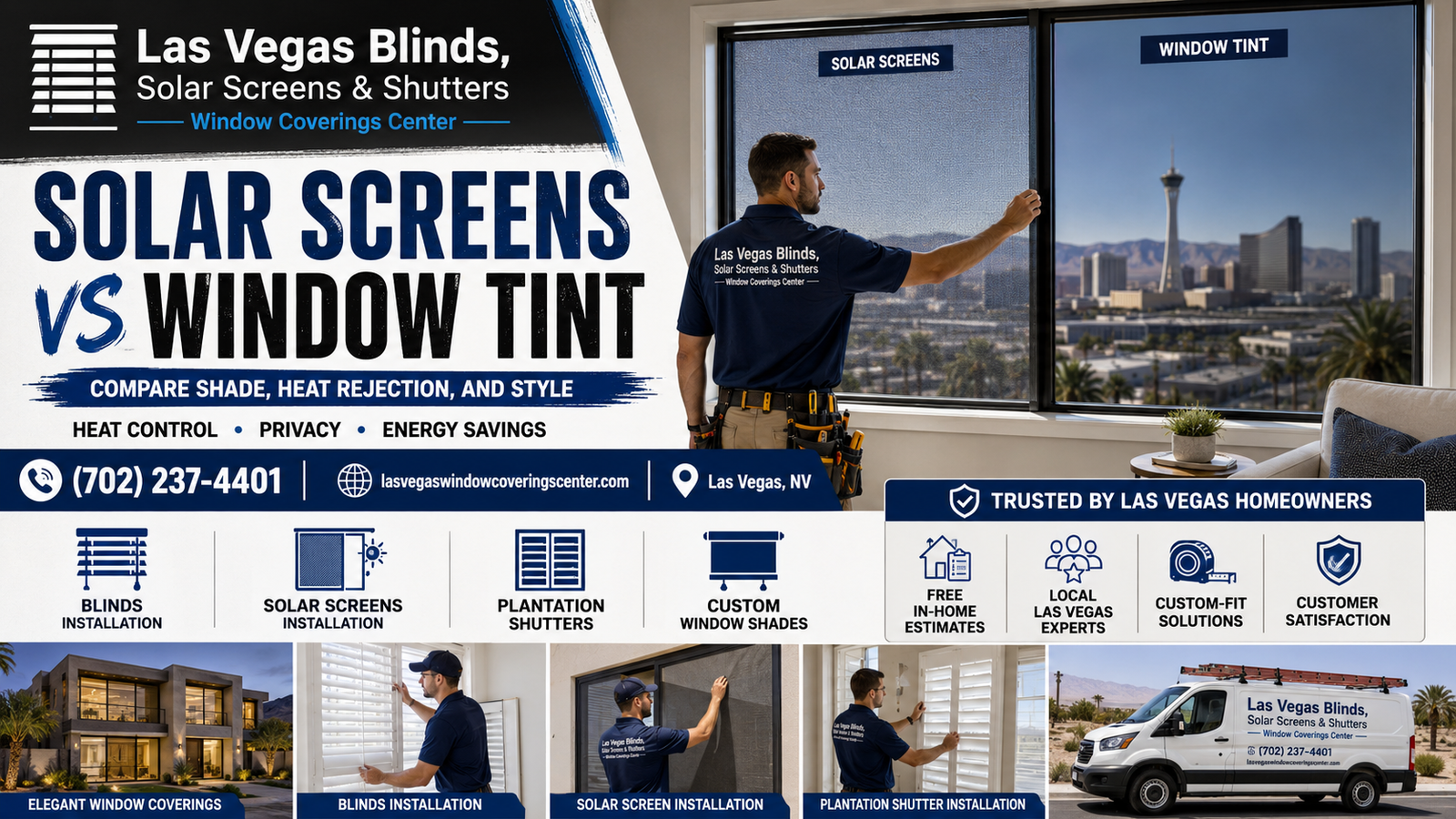
Solar Screens vs Window Tint
Compare exterior solar screens and glass-applied film for Las Vegas heat, glare, view, privacy, maintenance and property rules.
Solar Screens vs Window Tint: Which Is Better?
Exterior solar screens are usually the stronger choice when the main goal is stopping intense Las Vegas sunlight before it reaches the glass, while window tint is usually the cleaner, lower-profile choice when the owner wants a permanent glass treatment without exterior frames. Solar screens can be removed, replaced or targeted to the hottest windows. Tint remains attached to the glass and preserves window operation without adding an exterior screen frame.
The most important tradeoff is that solar screens change the exterior appearance and can reduce view and daylight, while tint changes the glass continuously and may have compatibility, warranty or thermal-stress considerations depending on the glazing. Neither option provides guaranteed nighttime privacy, and neither should be sold using unsupported heat- or UV-blocking percentages.
For west-facing Las Vegas windows, exterior solar control is often worth considering because it intercepts sunlight before it enters the glazing. For high-rise units, storefronts, difficult-access windows or properties with strict exterior-design rules, appropriate window film may be easier to maintain visually. A product-specific consultation should review glass type, orientation, HOA or landlord requirements, desired view, cleaning and whether the owner wants a removable or permanent solution.
Why This Comparison Matters in Las Vegas
Las Vegas homes and commercial buildings receive intense direct sun, bright reflected light and long periods of cooling demand. Large windows can make a room attractive, but they also expose flooring, furniture, merchandise and occupants to heat and glare. Two common solutions are exterior solar screens and solar-control window tint.
At first glance, both products appear to solve the same problem. They do not work in the same location. Solar screens sit outside the glass and shade the window before sunlight reaches it. Window film is applied directly to a glass surface and changes how the glazing transmits, reflects or absorbs solar energy.
That location difference affects heat performance, appearance, view, cleaning, removability and risk. A homeowner in Summerlin may prefer removable exterior screens on west-facing bedrooms. A high-rise owner near Downtown Las Vegas may have no exterior access and may consider approved film. A restaurant may want solar control without hiding the storefront. A medical office may need glare reduction plus a separate privacy treatment.
The better solution depends on the property, not on a universal claim. This guide compares both options in practical Las Vegas terms.
How Exterior Solar Screens Work
They shade the glass from outside
Solar-screen mesh is mounted in a frame outside the window. The mesh reflects, absorbs and disperses part of the sunlight before it reaches the glazing. Heat absorbed by the screen is exposed to outdoor air rather than trapped entirely inside the room.
Mesh density affects performance
Tighter mesh generally provides stronger screening, privacy and glare reduction but limits view and daylight. More open mesh preserves more view while allowing more sunlight through. Product-specific performance data should guide the choice.
Frame and fit matter
A screen that leaves large gaps exposes portions of glass. Custom measurement helps the frame fit the opening, remain secure and coordinate with window operation. Exterior hardware must account for wind, dust and access.
Solar screens are removable
Many framed screens can be removed for cleaning, seasonal use, emergency access or replacement. Removal method varies, and oversized screens should not be handled without suitable assistance.
They alter exterior appearance
Frame color and mesh are visible from outside. HOA, landlord or architectural approval may be required. Uniform color and alignment matter on street-facing elevations.
How Solar-Control Window Tint Works
Film changes the glazing
Window tint or film is bonded to a glass surface. Depending on the product, it can reduce visible light, reflect part of the solar spectrum, absorb energy or provide a combination of effects. The exact performance belongs to the exact film-and-glass system.
It does not add an exterior frame
Film preserves a cleaner architectural profile and does not block window screens, handles or exterior sightlines with a separate frame. The glass will still look darker, more reflective or differently colored depending on the film.
Glass compatibility matters
Film selection must account for pane type, coatings, tempering, laminated construction, edge condition and manufacturer restrictions. An unsuitable film can increase thermal stress. The film installer should identify the glazing and provide product-specific compatibility guidance.
Film is continuous
Once installed, solar control remains in place until the film is removed or replaced. It cannot be opened like a shade or seasonally lifted. This is useful for consistent control but limits flexibility.
Installation quality affects appearance
Glass preparation, edge finishing, dust control and curing influence the result. Bubbles, contamination, peeling or uneven edges are warning signs. Some visual moisture or haze may be temporary during curing, depending on the product and installation instructions.
The Core Difference: Exterior Shading vs Glass-Applied Film
The most important distinction is where solar energy is managed. Exterior solar screens shade the glass before sunlight enters the glazing system. Window film modifies what happens at or within the glass after sunlight reaches the window.
Exterior shading is generally positioned more favorably for reducing solar heat gain in hot climates. The Efficient Windows Collaborative notes that solar screens mounted outside windows lower solar heat gain and allow absorbed heat to be convected away outside. Window film can also reduce solar heat gain and glare, but its interaction with the glass must be evaluated.
This does not mean every solar screen will outperform every film. Mesh openness, color, frame coverage, glazing type, orientation and installation determine real results. A high-performance film on a suitable window may be more practical than a loosely fitted screen, while a properly fitted exterior screen can be highly effective on severe west-facing exposure.
Solar Screens vs Window Tint Comparison Table
| Factor | Exterior Solar Screens | Window Tint or Film | Better Fit When |
|---|---|---|---|
| Heat-control position | Outside, before sunlight reaches glass | Applied to glass; reflects or absorbs depending on film | Screens for severe exterior exposure; film where exterior changes are impractical |
| View | Mesh reduces clarity depending on density | View remains continuous but may darken or change color | Depends on desired daytime appearance |
| Daylight | Reduced by mesh density | Reduced according to visible-light transmission | Compare samples and product data |
| Daytime privacy | Can improve screening | Reflective films may improve daytime screening | Neither guarantees nighttime privacy |
| Nighttime privacy | Limited when interior is brighter | Limited when interior is brighter | Add an opaque interior treatment |
| Removability | Often removable and replaceable | Requires film removal and glass cleaning | Screens for seasonal flexibility |
| Exterior appearance | Visible frame and mesh | Changes glass reflectivity or color | Review HOA, lease and façade requirements |
| Glass compatibility | Usually does not bond to glass | Must be compatible with exact glazing | Film requires more glass-specific review |
| Cleaning | Outdoor dust and debris; screen can often be removed | Clean with film-approved methods | Consider access and maintenance staff |
| Window operation | Frame may affect access or emergency removal | Does not add a separate screen frame | Film for difficult exterior access |
| HOA concerns | Common because exterior look changes | Reflective appearance may also be restricted | Confirm current rules before either option |
| Flexibility | Can target individual elevations and remove seasonally | Continuous fixed treatment | Screens for adjustable strategy; film for set-and-maintain use |
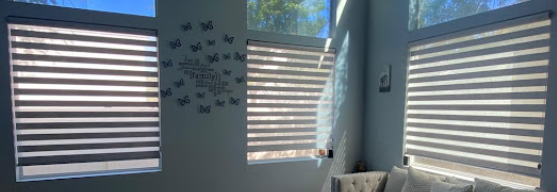
Which Option Is Better for Las Vegas Heat?
West-facing windows
West-facing glass receives low-angle afternoon sun after the building has already warmed. Exterior solar screens are often a strong option because they intercept this sunlight before it reaches the glass. Film may still help when exterior screens are prohibited or impractical.
South-facing windows
South-facing glass receives extended exposure. Screens, architectural shading and film can all contribute. Seasonal sun angles and existing overhangs should be considered.
Large sliding doors
Exterior screens may be difficult if they interfere with door operation. Film or interior solar shades may be more practical, though each changes view and privacy differently.
High-rise and inaccessible windows
Exterior screen installation may be impossible or controlled by the building. Approved film can be a more realistic solution, subject to glass and management requirements.
Whole-home consistency
Not every elevation needs the same treatment. Screens can target severe exposures while leaving view-oriented windows unchanged. Film provides a more uniform appearance when applied across multiple panes.
Glare, View and Natural Light
Solar screens
Mesh reduces glare by screening direct sunlight. Dark mesh often provides a clearer outward view than light mesh, but all screens alter the view. Tighter mesh creates stronger glare control and greater visual screening.
Window tint
Film reduces visible-light transmission and can reduce glare without a visible mesh pattern. Reflective or dark products may change the color and brightness of the view. Very dark film can make interiors feel dim.
Televisions and monitors
Both products can reduce screen glare. The correct choice depends on sun angle, room use and whether the occupant wants to preserve an unobstructed view. Interior shades may still be needed for complete control.
Daylighting tradeoff
Reducing sunlight can reduce electric-lighting demand in one part of the day but may increase the need for artificial light elsewhere. The goal is comfortable daylight, not simply the darkest product.
Privacy Differences
Neither exterior solar screens nor reflective window film should be treated as guaranteed nighttime privacy. During the day, the brighter exterior can make it harder to see into a screened or reflective window. At night, interior lighting reverses that condition and can make the room visible.
Bedrooms, bathrooms, medical offices, ground-floor apartments and after-hours businesses usually need an opaque interior treatment such as a privacy roller shade, blackout shade, shutter or curtain. Solar screens and film can be combined with those products.
Highly reflective film may create a mirror-like daytime appearance, which can be restricted by HOAs or commercial design rules. Screens provide a softer mesh appearance but still change the façade.
UV Exposure and Fading
Both solar screens and window films may reduce portions of solar exposure, but fading is caused by a combination of ultraviolet radiation, visible light, heat, material sensitivity and time. No product should be described as guaranteeing that floors, art, fabrics or merchandise will not fade.
Window-film manufacturers often publish product-specific solar and UV data. Solar-screen suppliers may publish mesh performance information. Compare documentation for the exact product rather than relying on a category-wide claim.
For valuable art, flooring or retail merchandise, use multiple strategies: reduce direct exposure, rotate objects, use interior shades when the room is unoccupied and consult appropriate conservation or product professionals.
Window Tint, Glass Compatibility and Warranty Questions
Identify the glass
Single-pane, double-pane, laminated, tempered, low-emissivity and factory-tinted glazing can react differently to film. Window labels, building documents or professional inspection may be needed.
Thermal stress
Some films absorb solar energy, increasing glass temperature. Edge damage, shading patterns, pane construction and frame conditions can influence thermal-stress risk.
Seal and manufacturer warranties
Ask whether applying film affects any existing glass or window warranty. Obtain written information rather than relying on verbal assumptions.
Film warranty
Film warranties vary by product and application. Do not assume coverage for glass breakage, seal failure, fading or labor unless the written terms say so.
Solar-screen independence
Because exterior screens do not bond to the glass, they generally avoid film-adhesive compatibility issues. They still need correct mounting so frames do not damage window components or block egress.
HOA, Landlord and Exterior-Design Considerations
Exterior solar screens are visible, so frame color, mesh color and uniformity may require HOA approval. Communities in Summerlin, The Ridges, Red Rock Country Club, Anthem, Seven Hills, Inspirada and MacDonald Highlands may have current architectural standards.
Reflective or dark film can also alter the building exterior. Condominium associations, high-rise management and commercial landlords may restrict reflectivity, visible color or film installation.
Renters should obtain written permission before installing either product. Removable framed screens may be easier to reverse, but attachment points and storage still matter. Film removal can require professional labor and adhesive cleanup.
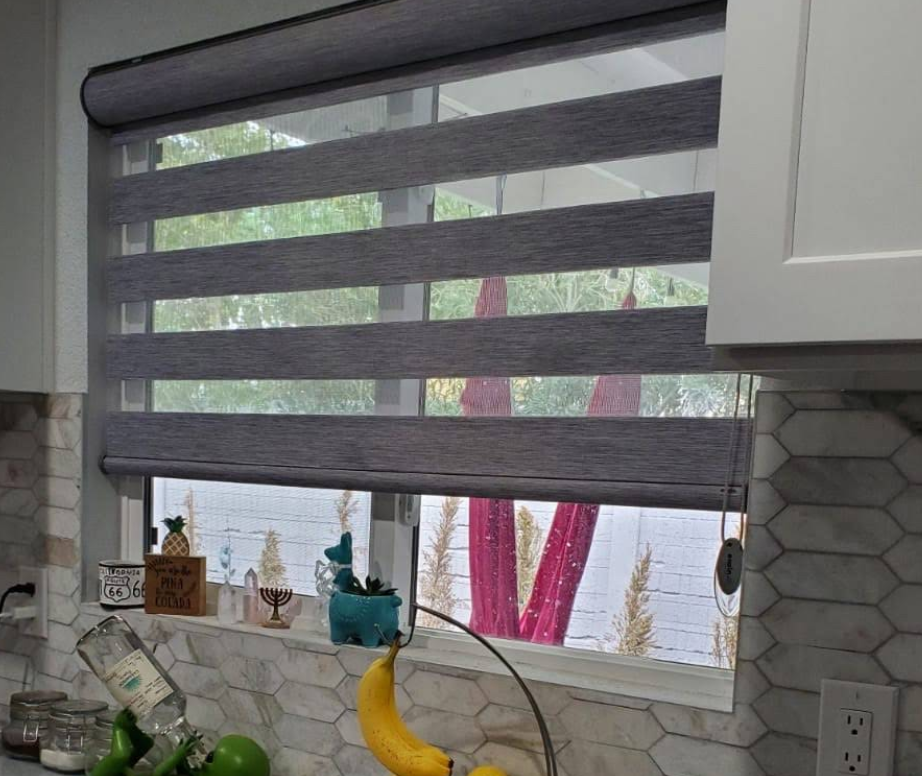
Cleaning, Maintenance and Lifespan Considerations
Solar-screen maintenance
Exterior screens collect desert dust, pollen and debris. They may require gentle rinsing, soft brushing or removal according to manufacturer instructions. Frames, clips and spline should be inspected for damage.
Film maintenance
Film should be cleaned with approved nonabrasive tools and solutions. Harsh chemicals, blades and rough pads can scratch or lift the film. Follow curing and cleaning instructions.
Repair
Screen mesh, spline, clips or frames may be repairable. Damaged film usually requires replacement of the affected pane’s film rather than a small patch.
Replacement
Replace screens when mesh is torn, frames are bent or fit is poor. Replace film when it peels, bubbles, discolors, scratches badly or no longer meets performance and appearance needs.
Cost Factors Without Misleading Fixed Prices
Solar-screen size and quantity
Larger and more numerous frames require more mesh, frame material and installation.
Mesh and frame
Mesh density, color, frame finish and specialty shapes affect cost.
Window-film type
Solar-control, spectrally selective, reflective, ceramic and decorative films differ.
Glass access
High, obstructed or commercial glass can require additional equipment.
Glass preparation
Film installation requires thoroughly prepared glass; damaged or contaminated surfaces complicate work.
Removal
Old screens, old film or adhesive may add labor.
HOA and design requirements
Custom colors or approval documentation can affect scope.
Combination systems
Adding interior shades for privacy or blackout increases the complete project.
Safe Homeowner Checks
Safe checks
- Identify west- and south-facing windows.
- Observe glare and heat during the difficult time of day.
- Check whether existing screens are removable.
- Look for glass labels or window documentation.
- Review HOA, lease or building rules.
- Check exterior access and ladder requirements.
- Inspect screens for torn mesh or bent frames.
- Look for existing film bubbles, scratches or peeling.
- Compare daytime and nighttime privacy.
- Photograph the exterior appearance for approval requests.
Avoid these actions
- Do not work from unstable ladders or roofs.
- Do not remove oversized screens alone.
- Do not apply film without identifying the glass.
- Do not scrape film with unapproved blades.
- Do not use pressure washers on interior film.
- Do not block emergency egress.
- Do not alter exterior appearance without required approval.
- Do not assume reflective film provides nighttime privacy.
- Do not use unsupported heat-blocking claims.
- Do not force clips or frames against window components.
Residential and Commercial Applications
Residential homes
Exterior screens are useful on targeted hot elevations. Film can suit difficult-access glass, minimal exterior profiles and rooms where a permanent reduction is acceptable.
Rental properties
Landlord approval is essential. Removable screens may be easier to reverse, while film may provide lower day-to-day maintenance but more involved removal.
Retail storefronts
Film preserves a clean storefront plane but changes transparency. Exterior screens may hide merchandise or conflict with signs. Interior solar shades offer adjustable control.
Restaurants
Heat and glare near seating can be addressed with film, exterior screens or interior motorized shades. Nighttime appearance and customer view matter.
Medical and professional offices
Film can reduce glare, while opaque interior shades handle privacy. Exterior screens may be appropriate where façade rules allow them.
Hospitality properties
Uniform exterior appearance, maintenance access and replacement planning often favor standardized solutions selected with the property team.
Las Vegas Local Conditions
Las Vegas has intense solar exposure, dry air, wind and fine dust. Exterior screens work in the harshest location and need durable frames, secure attachment and realistic cleaning. Film is protected from outdoor wind but must tolerate the glass conditions and cleaning routine.
West-facing homes in Summerlin, Spring Valley, Enterprise, Henderson and North Las Vegas often experience severe late-afternoon sun. Exterior screens are worth comparing on these elevations. High-rise properties in Downtown Las Vegas and Paradise may have no practical exterior-screen option.
Modern homes with expansive glass may require several coordinated screens or large film panels. Older homes may have uneven openings that benefit from custom measurement. Stucco and recessed windows affect screen attachment.
HOA and gated communities may prioritize consistent exterior colors. Always review current requirements rather than assuming previous neighborhood installations establish approval.
Which Option Should You Choose?
Choose exterior solar screens when
- Your main problem is intense exterior solar heat.
- The hottest windows are accessible.
- You want a removable or replaceable solution.
- Exterior appearance is acceptable and approved.
- You can maintain outdoor mesh and frames.
Choose window tint when
- Exterior screens are prohibited or impractical.
- You want a cleaner window profile.
- The glass is confirmed compatible.
- You accept a continuous, nonadjustable treatment.
- The film’s appearance and reflectivity meet property rules.
Choose a combination when
Severe heat, privacy, blackout and glare goals cannot be met by one product. Exterior screens or film can manage solar exposure while interior shades provide adjustable privacy and darkness.
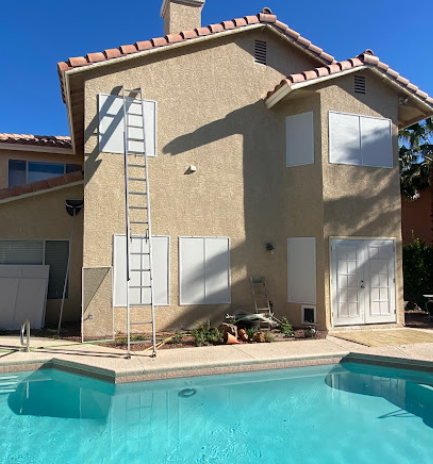
Detailed Property-Evaluation Checklist
Record the exact problem
Write down whether the concern is heat, glare, fading, privacy, view or exterior appearance. One product may solve the first concern while making another worse.
Observe more than one time of day
Morning and afternoon conditions can be completely different. Check the room during the strongest exposure and after dark.
Inspect surrounding shade
Overhangs, patios, trees, neighboring buildings and recessed windows may already shade part of the glass. Treat only the exposure that remains.
Check ventilation and emergency access
Exterior screens should not obstruct required openings, window locks or emergency egress. Film should not interfere mechanically, but building and fire requirements still apply.
Compare samples outdoors and indoors
View screen mesh from the street and from inside. View film samples against the actual glass. Small samples under indoor lights can be misleading.
Review cleaning access
Second-story screens may be difficult to remove. Film on high interior glass may also require professional cleaning access. Consider the complete maintenance routine.
Consider future window replacement
Film may be lost when a glass unit is replaced. Custom screens may or may not fit replacement windows. Document measurements and product details.
Evaluate combinations carefully
Using screen mesh, tinted glass and interior shades together can make the room too dark. Layer only when each product has a defined job.
Use written specifications
Keep mesh type, frame color, film name, visible-light data, solar data, glass-compatibility documentation and care instructions with property records.
Room-by-Room and Property-Type Recommendations
West-facing living rooms
Living rooms with large west-facing windows often experience the strongest late-afternoon heat and glare. Exterior solar screens are frequently the first option to compare because they intercept sunlight before it reaches the glass. If the homeowner wants a completely unobstructed exterior view or cannot alter the façade, compatible window film may be more acceptable. A motorized interior solar shade can add adjustable control when television glare changes throughout the day.
Bedrooms
Heat control is only one bedroom requirement. Nighttime privacy and darkness are also important. Solar screens or film may reduce daytime heat and brightness, but they usually do not replace blackout shades or curtains. A practical bedroom system may combine exterior screening or compatible film with an interior blackout or cellular shade.
Bathrooms
Bathrooms require privacy, moisture tolerance and easy cleaning. Reflective film and solar screens may provide some daytime screening, but privacy can disappear at night. Frosted privacy film is a different category from solar-control film and changes the view continuously. Composite shutters or opaque roller shades may be better for reliable privacy.
Kitchens and dining rooms
Solar screens can reduce heat near breakfast areas and dining tables without adding an interior fabric near cooking residue. Film is easy to keep visually minimal but must be cleaned with compatible methods. Consider whether the glass is near a cooktop, sink or door and whether the window needs to open frequently.
Home offices
Monitor glare is often more important than total heat reduction. Film provides continuous glare reduction, while solar screens provide exterior shading. An interior solar roller shade offers the most adjustable option because it can be raised when glare is absent. For video calls, test how each product changes facial lighting and background brightness.
Sliding glass doors
Framed exterior solar screens can interfere with sliding-door operation unless designed specifically for the opening. Film remains attached to the glass and does not add another moving panel. Interior roller shades, vertical cellular shades or motorized drapery may provide additional privacy and light control.
Rental homes
Renters and landlords should decide who owns the improvement and who restores the property. Removable solar screens may be easier to reverse, but storage and mounting hardware matter. Film removal can leave adhesive and may require professional work. Written permission is recommended for either option.
Retail storefronts
Storefront businesses depend on visibility. Dense solar screens can hide merchandise and change the exterior more than film. Reflective film can also reduce nighttime transparency and create a mirror-like daytime façade. Interior solar shades provide adjustable visibility, while compatible film may suit businesses that want continuous glare reduction.
Restaurants
Customer comfort changes throughout the day. Exterior screens can reduce severe sun at booths, but permanent screening may reduce evening view. Film provides consistent control, while motorized interior shades allow staff to respond to changing sun. A layered approach may be best for west-facing dining rooms.
Medical and professional offices
Film or exterior screens can reduce glare in waiting areas and workspaces, but consultation rooms need a separate privacy product. Building-management approval, glass compatibility and cleaning procedures should be documented.
High-rise condominiums
Owners may not control the exterior façade, making solar screens unavailable. Window film may also be restricted because uniform exterior reflectivity is important. Approved interior solar or cellular shades may be the most practical option. Review the building’s current alteration rules before ordering any product.
Luxury homes and gated communities
Exterior appearance, frame color and consistent elevation design are important in communities such as The Ridges, Red Rock Country Club, Southern Highlands and MacDonald Highlands. Custom screen frames can be coordinated with the property, but architectural approval may still be required. Film must also be reviewed for visible reflectivity and color.
Installation Quality: What Separates a Good Result From a Poor One
Solar-screen measurement
Each opening should be measured individually. Windows that appear identical may have small variations. The installer should check frame depth, clips, handles, weep paths and whether the screen can be removed without damaging stucco or trim.
Frame construction
Frame strength matters on larger screens. Corners should be square, mesh tension should be even and spline should be seated correctly. A bowed frame can leave gaps, rattle in wind or rub against the window.
Secure attachment
Attachment should resist normal wind without creating a difficult emergency-removal problem. Fasteners must match the substrate. Improvised clips can loosen or damage the window frame.
Film glass preparation
Film installation begins with extremely clean glass. Dust, hair, paint overspray, silicone residue and damaged surfaces can become visible under the film. The installer should protect surrounding finishes and use tools appropriate for the glass.
Film edge quality
Edges should be consistent and appropriate for the product and frame. Excessive gaps can look unfinished, while contact with incompatible sealants or frame materials may create problems. Product instructions govern edge treatment.
Curing expectations
Some film installations show temporary haze or moisture during curing. The installer should explain what is normal, how long the product should remain untouched and when cleaning can begin. Persistent bubbles, contamination or peeling should be evaluated.
Final exterior review
After solar screens are installed, view the property from the street and nearby angles. Check frame alignment, color consistency and whether every screen is fully seated. After film installation, compare panes for consistent color and reflectivity.
Documentation
Keep the exact screen mesh or film product, color, installation date, care instructions, compatibility documentation and warranty paperwork. This information is important if a pane, screen or section is later replaced.
Energy-Efficiency Expectations and Whole-Building Context
Solar screens and window film can reduce unwanted solar heat gain, but utility bills depend on more than windows. Outdoor temperature, thermostat settings, HVAC efficiency, duct condition, insulation, air leakage, occupancy, cooking, pool equipment and electricity rates all influence monthly costs.
Exterior shading is generally one of the strongest ways to manage solar heat because it acts before sunlight reaches the glass. Film can also improve performance when selected for the glazing and climate. Neither product repairs failed insulated-glass seals, air leaks around frames or inadequate attic insulation.
Use the products where they matter most
Targeting the hottest west- and south-facing windows may provide more useful comfort improvement than treating every window identically. North-facing glass may need glare control but not the same solar strategy.
Operate interior products with the system
If the property also has blinds or shades, close them during severe sun and open them when daylight is useful. Motorized schedules can improve consistency. Avoid making the room permanently darker than necessary.
Monitor comfort rather than chasing one percentage
Product claims are often presented as one heat-blocking or UV percentage, but real room performance is more complex. Compare surface temperatures, glare, comfort and HVAC behavior before and after installation while recognizing weather differences.
Maintain the HVAC system
Clean filters, unobstructed vents and properly operating equipment remain essential. A window product cannot compensate for a poorly functioning cooling system.
Review winter needs
Las Vegas also has cool winter periods. Removable screens can allow more beneficial winter sun when taken down, while film remains in place year-round. Whether this matters depends on orientation, film type and homeowner preference.
Questions to Ask Before Hiring
- What is the exact solar-screen mesh or window-film product?
- What product-specific data is available?
- Is the film compatible with my exact glass?
- Could film affect a window warranty?
- What visible-light change should I expect?
- How will the product look from outside?
- Will it provide privacy at night?
- Does the screen block window operation or egress?
- Is HOA or landlord approval needed?
- Can I see installed samples or mockups?
- How should the product be cleaned?
- Can the screen be removed?
- How is film removed later?
- Does the quote include measurement and installation?
- Does it include old-film or old-screen removal?
- Are high-access charges included?
- What warranty documents apply?
- Will I receive a written estimate?
Red Flags
- Guaranteed heat or energy savings without product data.
- No glass identification before film recommendation.
- Reflective film sold as nighttime privacy.
- No HOA or exterior-appearance discussion.
- No samples viewed at the actual window.
- No explanation of mesh openness or film visible-light transmission.
- No egress or window-operation check.
- Film applied over damaged or contaminated glass.
- Solar screens measured without checking frame conditions.
- No cleaning instructions.
- No written product name or specification.
- Pressure to approve before compatibility is understood.
- No clear local business identity or Google Maps presence.
Why Consider Las Vegas Blinds, Solar Screens & Shutters Window Coverings Center?
Las Vegas Blinds, Solar Screens & Shutters Window Coverings Center is a local option for property owners comparing exterior solar screens with interior shades and other custom solar-control window treatments.
The team can help evaluate orientation, screen mesh, exterior appearance, custom measurement, HOA concerns and whether interior roller, solar, blackout or motorized shades should be used with another solar-control product.
Call (702) 237-4401, request a solar-control consultation, browse the window-covering product catalog, or find the business on Google Maps.
For a related technology topic, review the previous guide to smart-blind cost factors in Las Vegas.
Areas Served
The business serves customers in these communities from its Las Vegas location. Service in a neighborhood does not imply a separate office there.
Frequently Asked Questions About Solar Screens vs Window Tint
Are solar screens better than window tint for Las Vegas heat?
Exterior solar screens are often better positioned for heat control because they shade the glass from outside. Film may be more practical where exterior screens are prohibited or inaccessible.
Do solar screens or window tint provide privacy at night?
Neither reliably provides nighttime privacy when interior lights are brighter than outside. Add an opaque interior shade, shutter or curtain.
Can window tint damage double-pane windows?
An unsuitable film can create compatibility or thermal-stress concerns. The installer should identify the exact glazing and verify that the film is appropriate.
Do solar screens block the view more than tint?
Solar-screen mesh creates a visible pattern and reduces clarity according to its density. Tint preserves a continuous view but may darken or change its color.
Do solar screens require HOA approval?
They often do because they alter the exterior appearance. Reflective or dark film may also be restricted. Review current community or building rules.
Which option is easier to remove?
Framed solar screens are often easier to remove and reinstall. Window film requires removal from the glass and adhesive cleanup.
Can solar screens and window tint be used together?
They can, but the combined result may be darker than desired. Glass compatibility, view and daylight should be evaluated before layering products.
How can I request a Las Vegas solar-screen consultation?
Call Las Vegas Blinds, Solar Screens & Shutters Window Coverings Center at (702) 237-4401 to ask about current consultation, measurement and installation availability.
Find the Las Vegas Location
Las Vegas Blinds, Solar Screens & Shutters Window Coverings Center is located at 3871 S Valley View Blvd #6, Las Vegas, NV 89103. Call before visiting.
Final Selection Reminder
The better Las Vegas solar-control solution is the one that matches the actual glass, sun angle, view, privacy requirement, exterior rules and maintenance ability. Exterior solar screens deserve serious consideration for severe west-facing heat because they shade the glass from outside. Window film may be the more practical option where exterior access, architectural rules or appearance prevent screens. Neither option replaces proper windows, insulation, HVAC maintenance or an opaque nighttime privacy treatment. Request a written, product-specific recommendation before approving either installation.
Compare Solar-Control Options for Your Las Vegas Property
Call Las Vegas Blinds, Solar Screens & Shutters Window Coverings Center at (702) 237-4401 to compare exterior solar screens, interior solar shades and other custom-fit heat- and glare-control options.